



This twelve-minute beginner hands-on lab rehearses the documentation, risk checks and account reconciliation that a fictional trading assessment might require. Despite the title, the exercise uses only a simulated $100 practice account. It does not provide, promise, define or qualify anyone for actual funding, a funded trading account, a profit share or a financial reward. Any real program's funding and assessment terms are determined exclusively by its published rules. The learner works with one invented Sample Practice Contract and a fictional Rules Sheet version 1. The contract has a $1 price-move value per unit, a minimum size and size step of 0.1 unit, and a commission of $0.10 per unit per side. Rules require planned loss including round-trip fees of no more than $1 per trade, a $3 realized daily loss cap, no more than 1.0 unit open simultaneously, and trading only the specified fictional product. Five simulated trades include four closed positions and one remaining open, while a sixth proposed action is correctly rejected because the minimum size would exceed the risk budget. The four closed positions produce $0.31 gross P&L, $0.50 closed-trade fees and -$0.19 net closed P&L. The open trade has a $0.02 charged entry fee and $0.08 unrealized gain. Total fees paid are $0.52, realized trading P&L is -$0.21, and an unrelated $1 demo credit must be treated as an external cash flow rather than profit. The statement reconciles to $100.79 closing balance and $100.87 equity, with total trading P&L including unrealized gains of -$0.13. Recorded adverse slippage totals $0.10 and is already reflected in actual fills, so it must not be charged again. Learners correct five deliberate trainee errors, perform eight reconciliation checks, write a dated reconciliation note and self-review, and optionally rehearse a small isolated mock order. The lesson builds on trading journal and execution risk and the Week 6 final submission walkthrough, preparing learners for the simulated Week 6 mission: a model portfolio, three adverse scenarios and a trading journal.
Understand the Rehearsal and Record Fictional Rules Sheet v1
The title Funded Stage Rehearsal describes preparation for a possible assessment process, not a funded account or offer of capital. This is an entirely fictional exercise with $100 of simulated starting money. Nothing in the lab promises, grants, defines or determines actual funding, assessment eligibility, a salary, an allocation of capital or a profit share. Any real program's terms would be governed only by its published rules, which are not supplied or invented here. The learner is practicing the evidence needed to explain trading decisions and reconcile a mock statement. That evidence includes intended orders, actual fills, explicit charges, open positions, rejected trade ideas and compliance with a written risk policy.

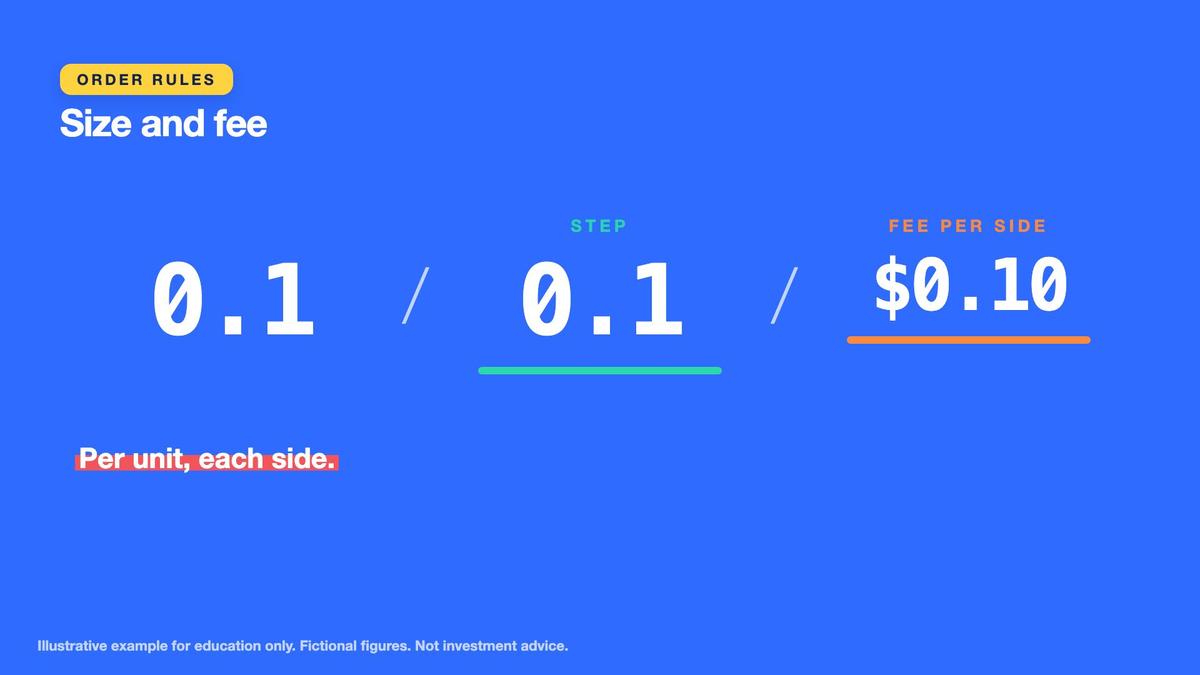
The fictional Rules Sheet version 1 permits only Sample Practice Contract. One unit of the contract gains or loses $1 for a $1 movement in its quoted price. The minimum quantity is 0.1 unit, with changes in 0.1-unit increments. Commission is $0.10 per unit per executed side, meaning an opening and closing transaction together cost $0.20 per unit. The simulated account starts at $100. The maximum planned loss per trade is $1, including the estimated round-trip commission. A realized daily loss reaching $3 triggers an immediate stop to new simulated trading and a written lock note. Maximum simultaneous open size is 1.0 unit.

Key points
- This is a rehearsal with a simulated $100 practice account. It grants, promises and defines no funding or profit share.
- Product (fictional): 1 unit gains or loses $1.00 per $1.00 move; minimum and step 0.1; fee $0.10 per unit per side.
- Rules sheet v1: planned risk at most $1.00 per trade, daily realized loss cap $3.00, at most 1.0 unit open. A $1.00 demo credit is a cash flow, not profit.
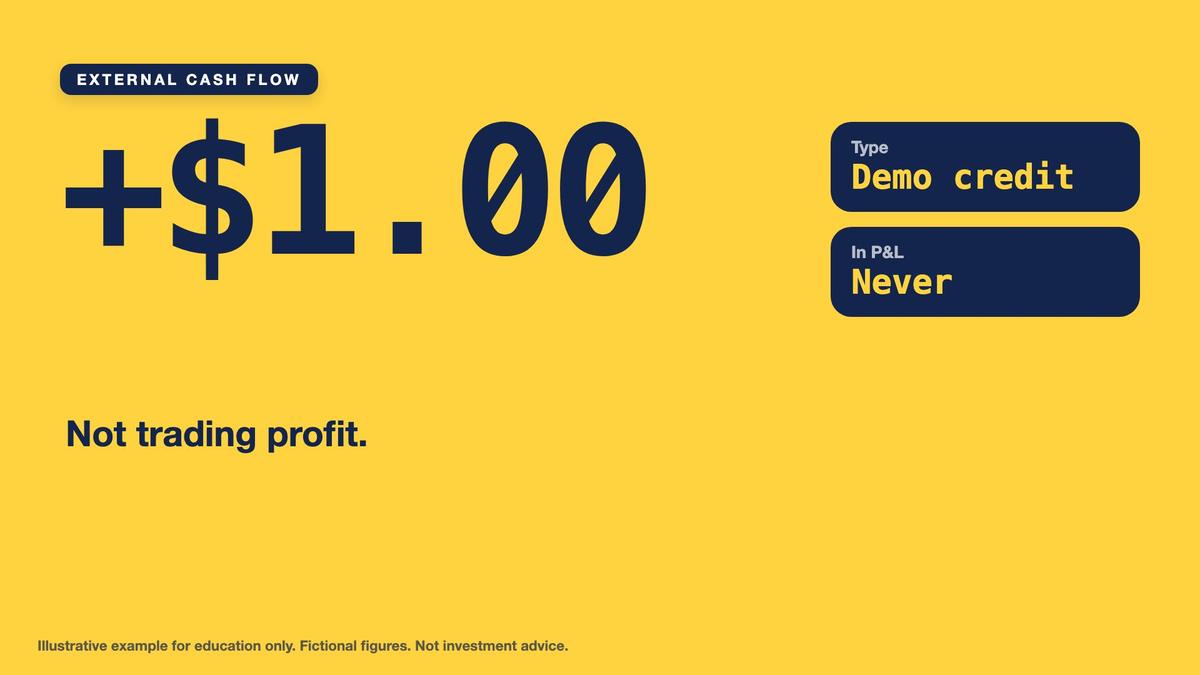
The platform also posts a $1 demo credit. That credit is an external account cash flow, not a trading gain. The journal must preserve the opening $100 balance, the $1 credit and all subsequent charges separately. A complete rehearsal begins by collecting the rules sheet, its version, the platform statement, order history and fill details. If the source materials had explicit timestamps, their dates and times would be recorded; the fictional example does not invent missing timestamps. The learner should keep a distinction between submitted trade records and decisions that never became orders. Five entered trades are documented, while a sixth proposed idea is rejected under the written risk rule.

Build the Fill Ledger and Reconcile Trades T1 and T2
A fill ledger compares the plan with actual execution. Every row should identify trade number, direction, size, intended entry, actual entry, intended exit or stop, actual exit if closed, commission, gross profit or loss, net result, planned risk and execution status. For a long position, gross P&L is exit price minus filled entry price, multiplied by contract size. For a short position, reverse the price subtraction. This case uses a contract with $1 P&L per $1 price change per unit, so no additional contract multiplier is needed. Commissions are charged on each executed side. Slippage is analyzed separately but is already incorporated into the actual fill prices.
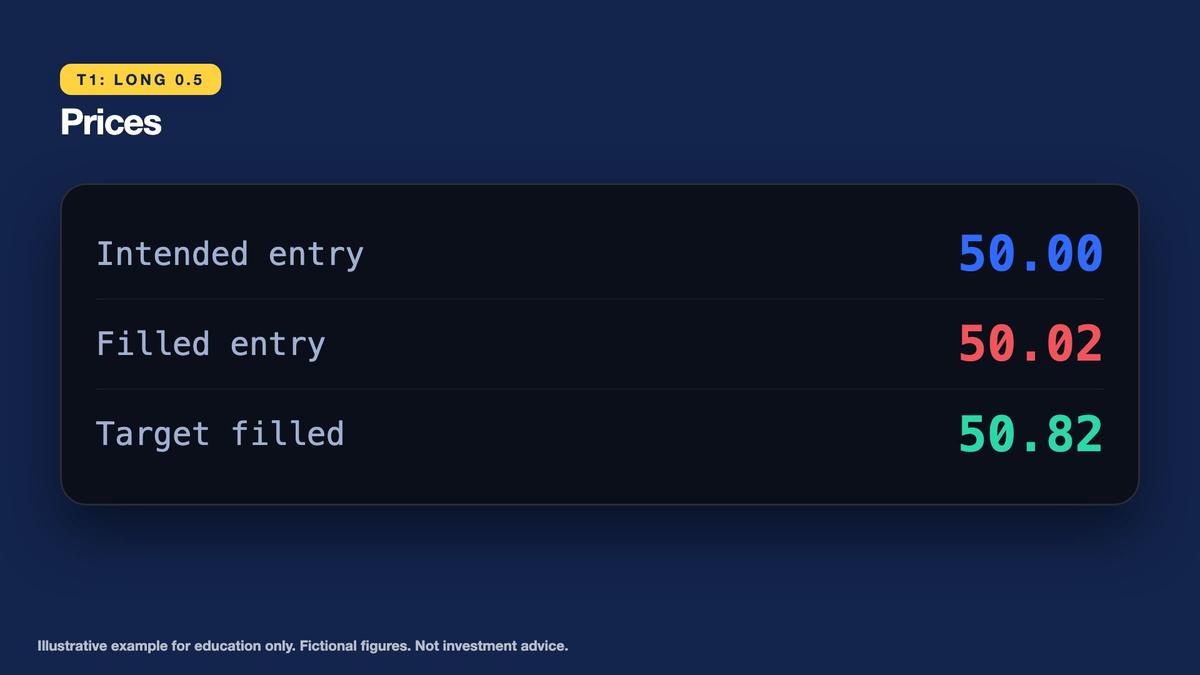
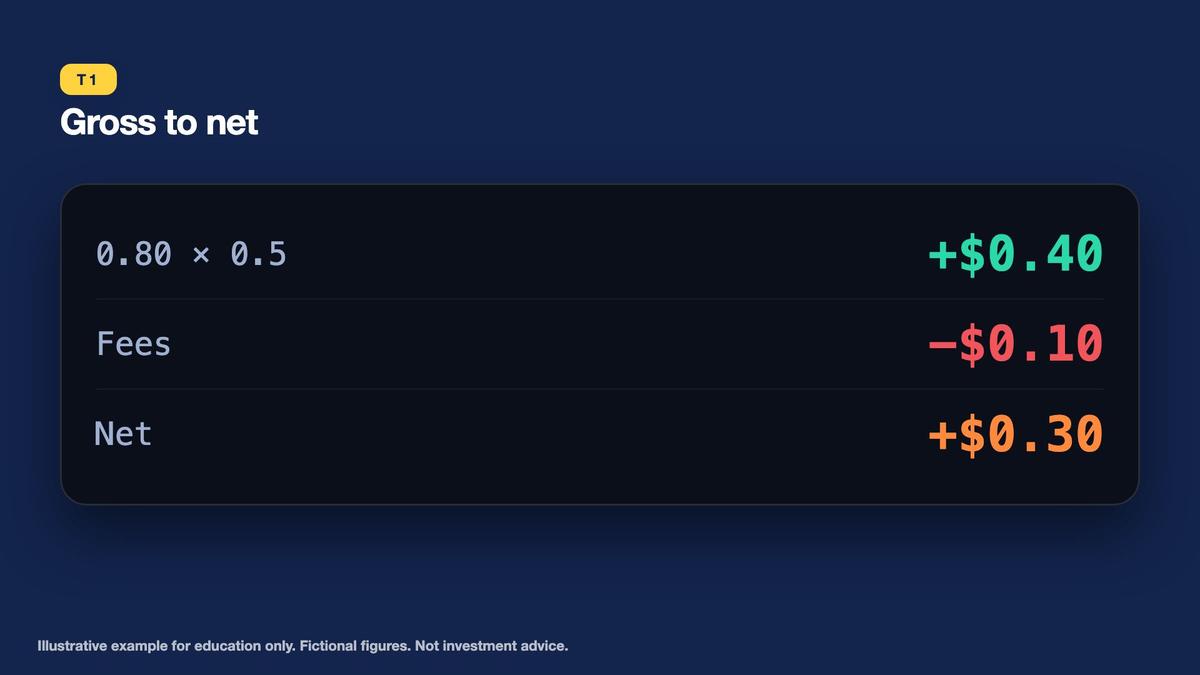
Trade T1 buys 0.5 unit. Its intended entry is 50.00, actual entry 50.02, intended target exit 50.82 and actual exit 50.82. Gross P&L equals (50.82 minus 50.02) multiplied by 0.5, producing +$0.40. The commission is 0.5 multiplied by $0.10 on each of two sides, totaling $0.10. Net profit equals $0.30. The intended stop was 49.00. Planned price risk is (50.00 minus 49.00) multiplied by 0.5, or $0.50. Adding $0.10 expected round-trip commission gives planned risk of $0.60, within the $1 maximum. Entry slippage is $0.02 in price multiplied by 0.5, or $0.01 of adverse execution cost.
Key points
- Collect the rules sheet, order history, fills, fees, open mark and closing statement before calculating.
- Long gross = (exit - entry) x size; short gross = (entry - exit) x size.
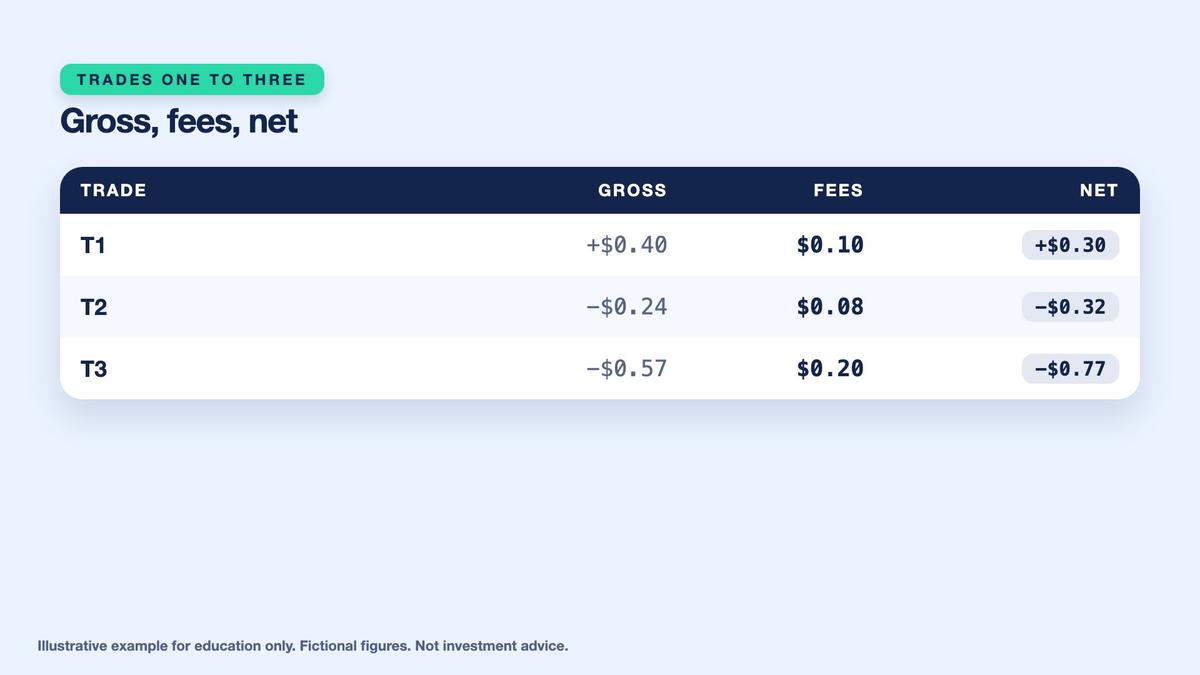
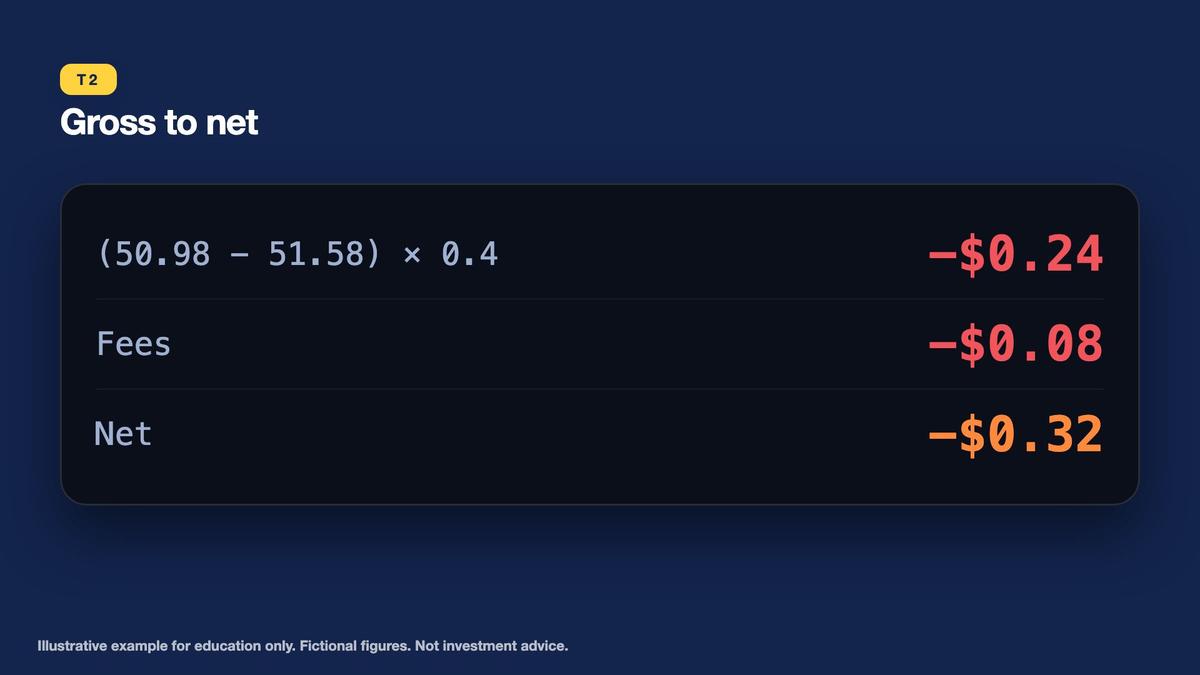
- T1: buy 0.5 filled 50.02, sold 50.82: +$0.40 gross, $0.10 fees, +$0.30 net. T2: short 0.4 from 50.98 covered at 51.58: -$0.24, $0.08, -$0.32.
Trade T2 sells short 0.4 unit. The intended entry is 51.00 but the actual sell fills at 50.98. Its intended stop exit is 51.55, but the actual buy-to-close fills at 51.58. Planned price risk is (51.55 minus 51.00) multiplied by 0.4, or $0.22. Expected commission is $0.08, creating $0.30 planned total risk. Actual gross P&L is (50.98 minus 51.58) multiplied by 0.4, or -$0.24. Subtract $0.08 paid commission to obtain -$0.32 net. Entry slippage costs $0.008, exit slippage $0.012, and combined slippage is exactly $0.02. Actual loss exceeds planned risk by $0.02 because the fills were worse than intended.
Reconcile Trades T3, T4 and the Open Position T5
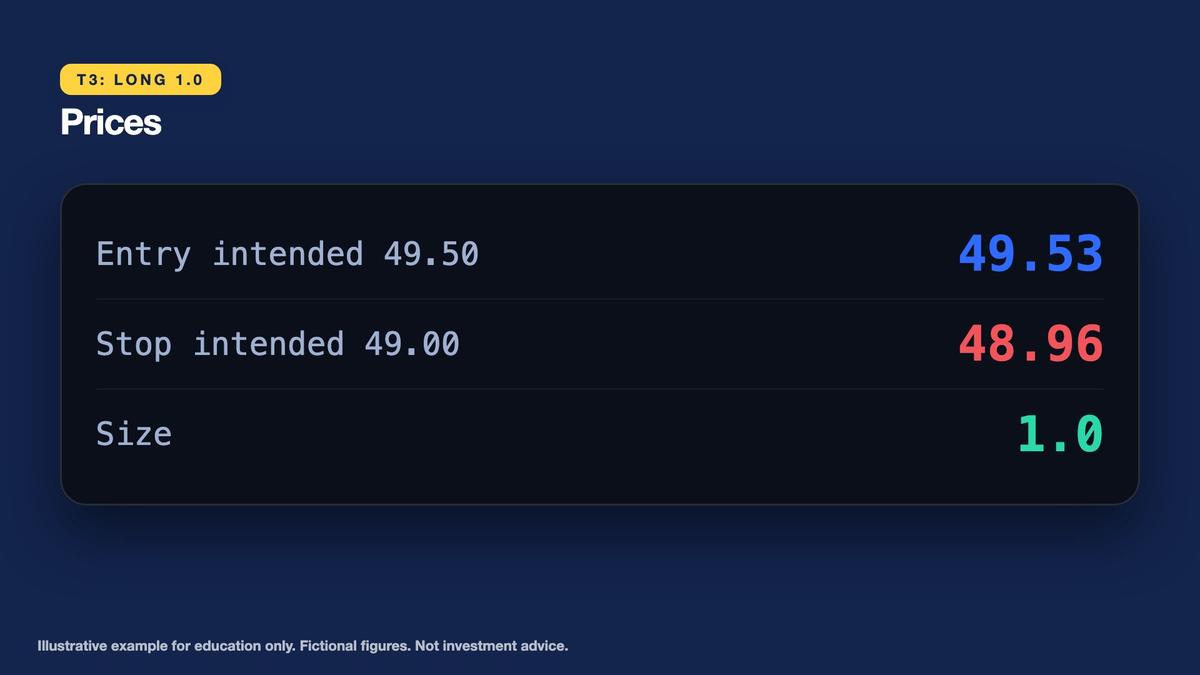
Trade T3 is a long position of 1.0 unit, the maximum permitted simultaneous position size. Its intended entry is 49.50 and its actual entry is 49.53. The intended stop is 49.00, but the closing fill occurs at 48.96. Planned price risk is (49.50 minus 49.00) multiplied by 1.0, or $0.50, plus $0.20 round-trip commission, giving planned risk of $0.70. Actual gross result is (48.96 minus 49.53) multiplied by 1.0, equal to -$0.57. After $0.20 commission, net loss is $0.77. Entry slippage is $0.03 and exit slippage is $0.04, combining into $0.07. The actual loss exceeds planned risk by $0.07 but remains below $1.
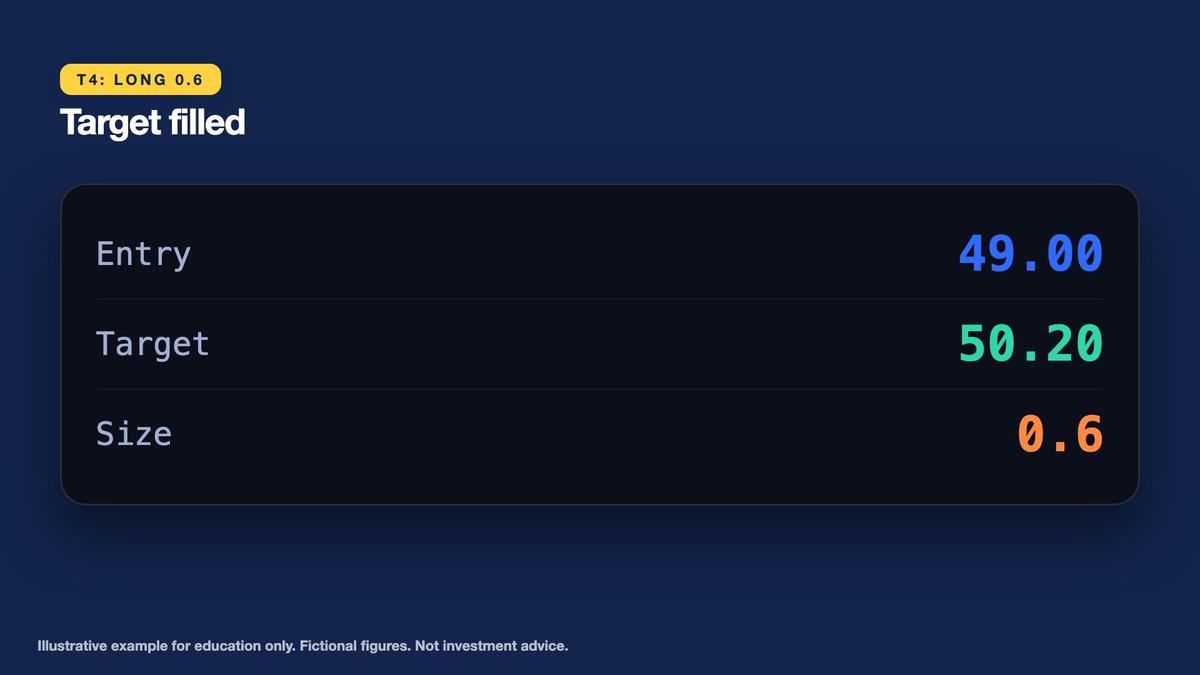
Trade T4 buys 0.6 unit at its intended entry of 49.00 and closes at the intended target of 50.20. There is no price slippage. The price gain of $1.20 multiplied by 0.6 yields $0.72 gross profit. Round-trip commission is 0.6 multiplied by $0.20, or $0.12. Net profit is therefore $0.60. The planned stop was 48.50, so planned price risk is $0.50 multiplied by 0.6, or $0.30, plus $0.12 commission, giving $0.42. The quantity obeys the 0.1 size step, and the planned risk is below the $1 maximum. These four first trades are all closed by the account statement's reporting point.
Key points
- T3: buy 1.0 at 49.53, stop filled 48.96: -$0.57 gross, $0.20 fees, -$0.77 net (planned $0.70, still under $1.00).
- T4: buy 0.6 at 49.00, target 50.20: +$0.72 gross, $0.12 fees, +$0.60 net.
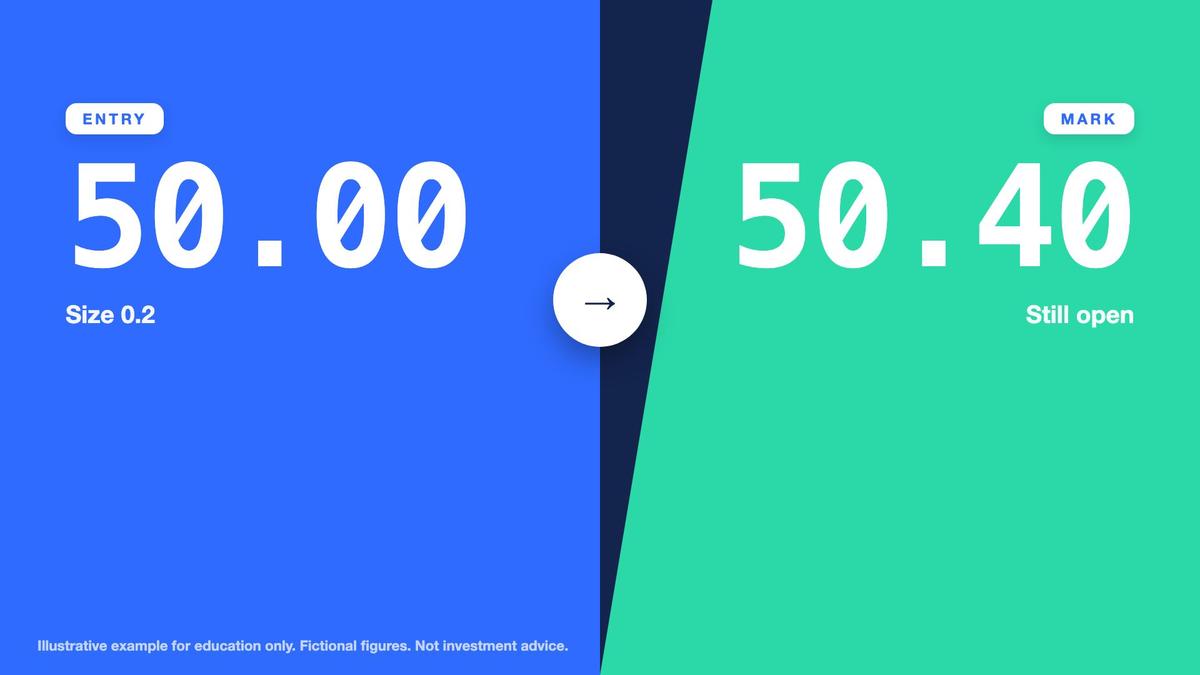
- T5: buy 0.2 at 50.00, open at mark 50.40: +$0.08 unrealized; only the $0.02 entry fee is charged.
Trade T5 buys 0.2 unit at 50.00 and remains open at the statement close. The mark price is 50.40, producing unrealized P&L of (50.40 minus 50.00) multiplied by 0.2, or +$0.08. The planned stop is 49.00. Planned loss including both anticipated sides of commission is $0.20 in price risk plus $0.04 fees, or $0.24. However, only the entry commission of 0.2 multiplied by $0.10, equal to $0.02, has actually been charged. The anticipated second $0.02 commission must not be entered as an already paid exit fee. Under the case assumption, T1–T4 did not overlap and T5 is the only position still open at the close.
Log the Rejected D6 Idea and Separate Slippage From Fees
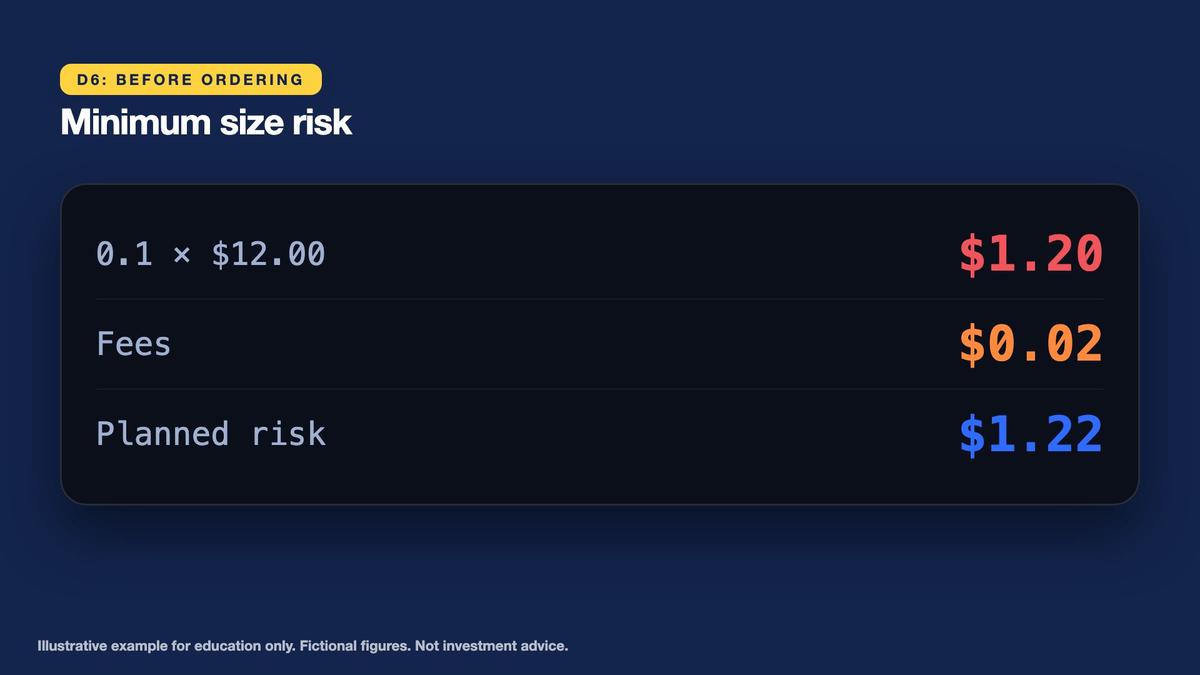
A trading journal should record decisions to stand aside, not just completed transactions. In the fictional sixth idea, the proposed stop is $12.00 away from the intended entry. The minimum order size is 0.1 unit. At that size, the price risk would be 0.1 multiplied by $12.00, or $1.20. Adding planned entry and exit commissions of $0.02 produces $1.22 of total planned risk. This exceeds the $1 maximum by $0.22. Since a smaller executable quantity is unavailable under the rules, the correct classroom response is not to submit the order. Record D6 as a rejected idea with the calculated reason, rather than treating it as a sixth filled trade.
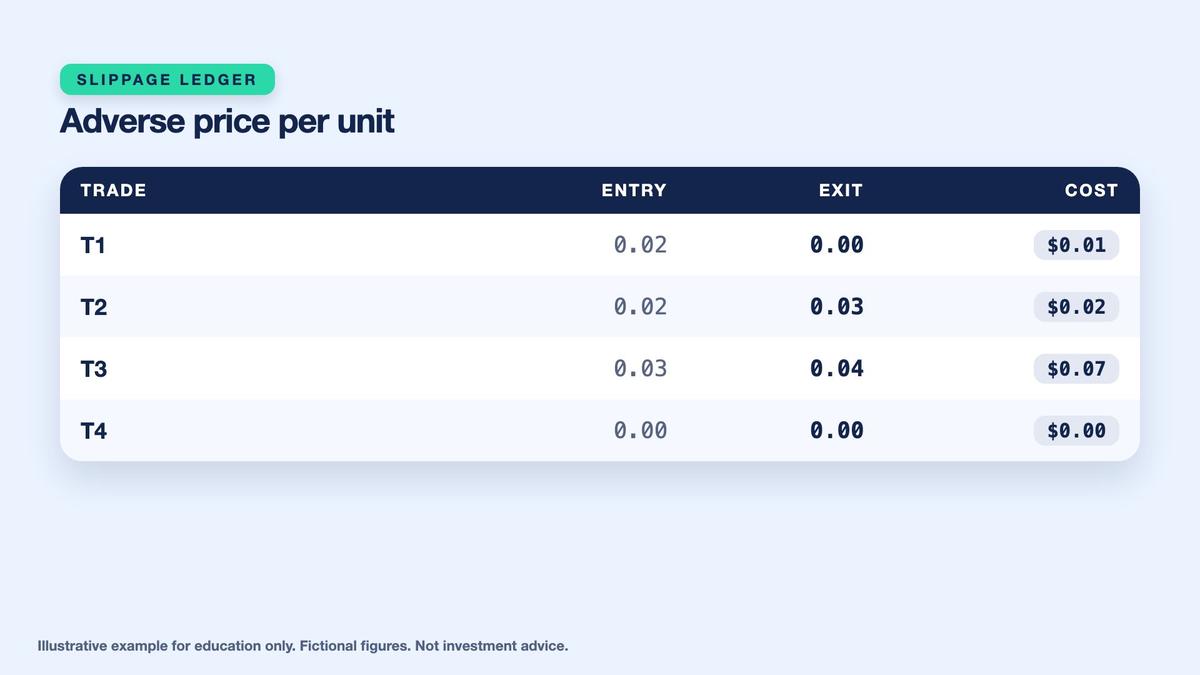
Slippage describes the unfavorable difference between intended and actual execution, but it should not automatically be deducted as a separate fee from P&L calculated using actual fill prices. T1 incurs $0.01 adverse slippage. T2 incurs $0.008 on entry and $0.012 on exit, totaling $0.02. T3 incurs $0.03 on entry and $0.04 on exit, totaling $0.07. T4 has zero slippage, and T5 has zero recorded entry slippage with no exit yet. Adding the slippage amounts gives exactly $0.10. Keeping the intermediate T2 figures at three decimal places preserves their exact sum, even though the statement reports total dollar amounts to cents.
Key points
- D6: a 12.00 stop at the minimum 0.1 unit risks 0.1 x 12.00 + $0.02 = $1.22, above $1.00: stand aside and log it.
- Slippage: T1 $0.01, T2 $0.02, T3 $0.07: total $0.10.
- Slippage is already inside the fill prices, so never subtract it again.
Slippage and commission explain different aspects of execution. Commission is a separately charged explicit fee calculated from position size and the number of executed sides. Slippage is the change in the achieved price relative to the intended price. When actual filled entry and exit prices are used to calculate gross P&L, the execution impact of slippage is already included in that gross result. Subtracting the $0.10 diagnostic slippage a second time would overstate the loss. The learner should retain a slippage column to monitor execution quality, while calculating financial P&L from real mock fills and charged commissions. This distinction is central to the earlier trading journal and execution-risk lessons.
Reconcile Gross, Net, Realized, Unrealized, Balance and Equity
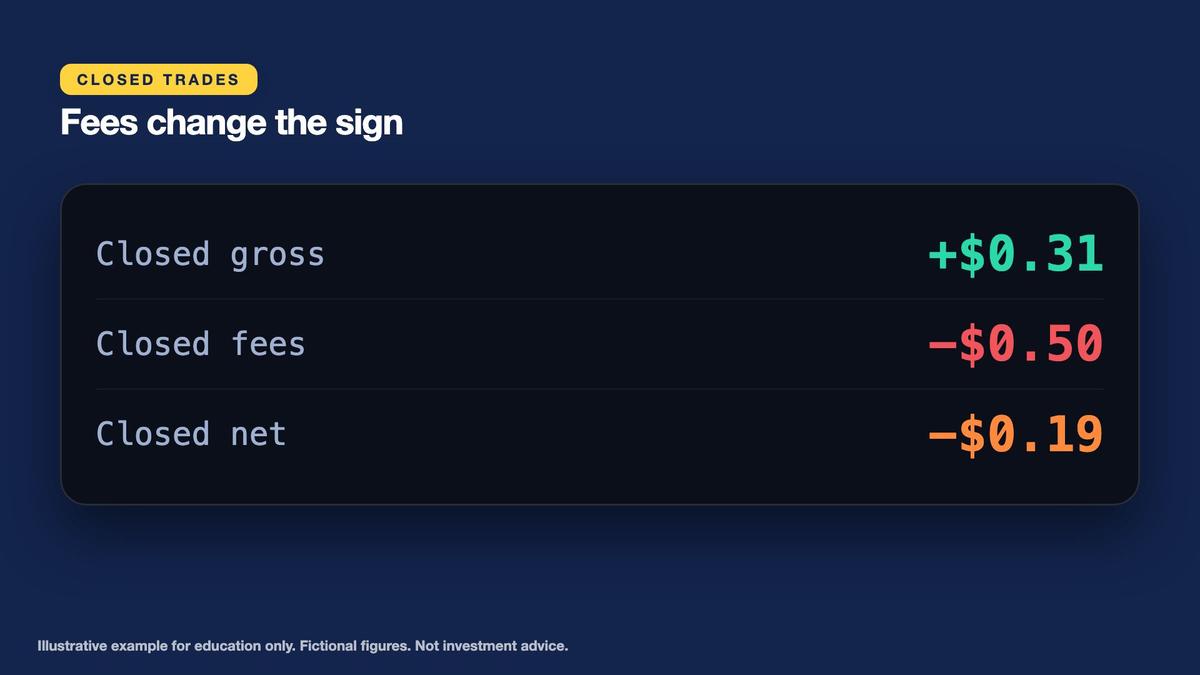
Add the closed trades' gross results first: T1 earns $0.40, T2 loses $0.24, T3 loses $0.57 and T4 earns $0.72. The total is positive $0.31. Their commissions are $0.10, $0.08, $0.20 and $0.12, summing to $0.50. Net P&L from the four closed trades is therefore +$0.31 minus $0.50, or -$0.19. The fact that gross P&L is positive while net P&L is negative illustrates why cost accounting matters even in a tiny fictional account. The open T5 position contributes no closed gross result but has already incurred a $0.02 entry commission. Total charged commissions are thus $0.52, and realized trading result including that charged entry fee is -$0.21.
Now reconcile the account balance. The opening balance is $100.00. Add the separate $1.00 platform demo credit. Add the $0.31 closed gross result, then subtract $0.52 in all charged commissions. Closing balance is $100.79. Its increase relative to the opening balance is $0.79, but that increase includes the $1.00 external demo credit. Therefore the realized trading component is +$0.79 minus $1.00, or -$0.21. The platform credit must not be labeled trading profit, and the open trade's hypothetical future exit commission must not be deducted before it is charged. These conventions are necessary for the ledger and statement to describe the same simulated events.
Key points
- Closed gross +$0.31, closed fees $0.50: closed net -$0.19. Fees turn a gross gain into a net loss.
- All fees $0.52; realized trading result -$0.21.
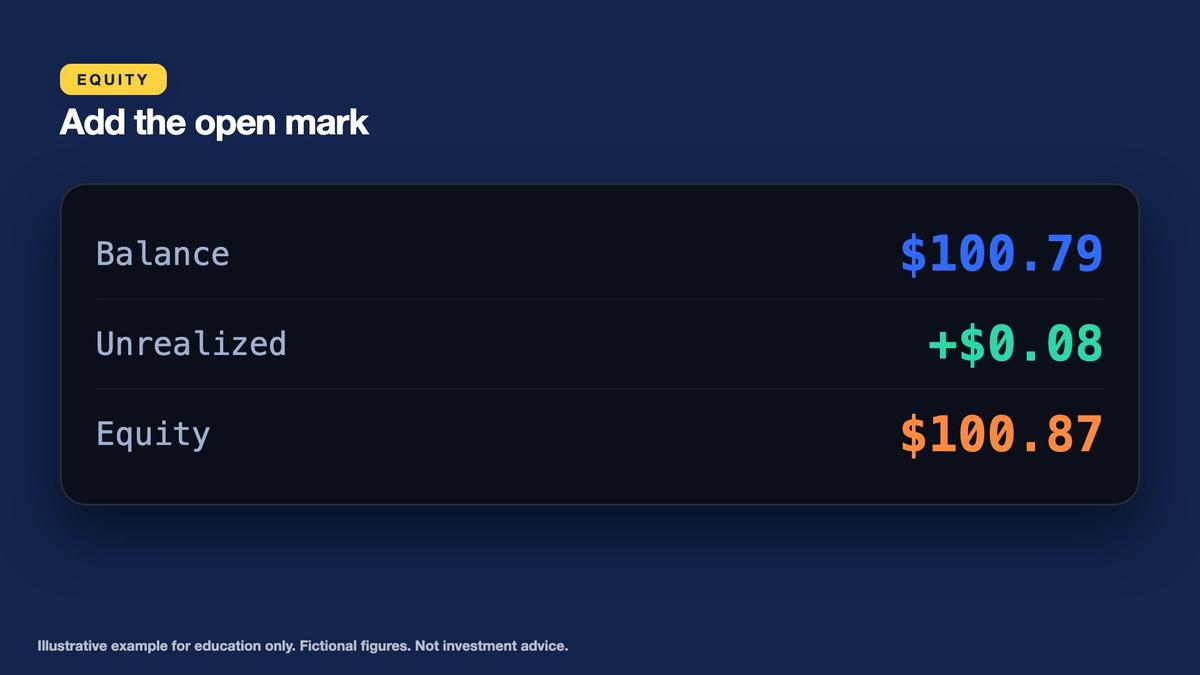
- Balance = 100.00 + 1.00 credit + 0.31 - 0.52 = $100.79; equity = 100.79 + 0.08 = $100.87; trading result including unrealized = -$0.13.
Equity includes unrealized mark-to-market value. Trade T5 has +$0.08 unrealized P&L, so account equity equals $100.79 balance plus $0.08, or $100.87. The total trading result including the open position can be verified in two ways. First, realized trading -$0.21 plus unrealized +$0.08 equals -$0.13. Second, closing equity $100.87 minus opening balance $100.00 minus the unrelated $1.00 credit also equals -$0.13. Agreement between the two methods provides a strong reconciliation check. The result is a small simulated trading loss, despite an increase in the account's displayed balance and equity caused by the separate credit.
Find and Correct Five Errors in the Trainee's Draft
The trainee's draft deliberately contains five errors. E1 reports +$0.39 as total trading P&L by adding the +$0.31 closed gross to the +$0.08 unrealized gain and ignoring commissions. Correct total trading P&L including unrealized is -$0.13. The discrepancy is exactly $0.52, matching the total charged fees. E2 calls the +$0.79 change in closing balance a trading profit. This incorrectly includes the $1.00 external demo credit. The actual realized trading result is -$0.21, a difference of exactly $1.00. Both errors arise from mixing financial categories that must remain separate: gross versus net and trading performance versus external account cash flows.
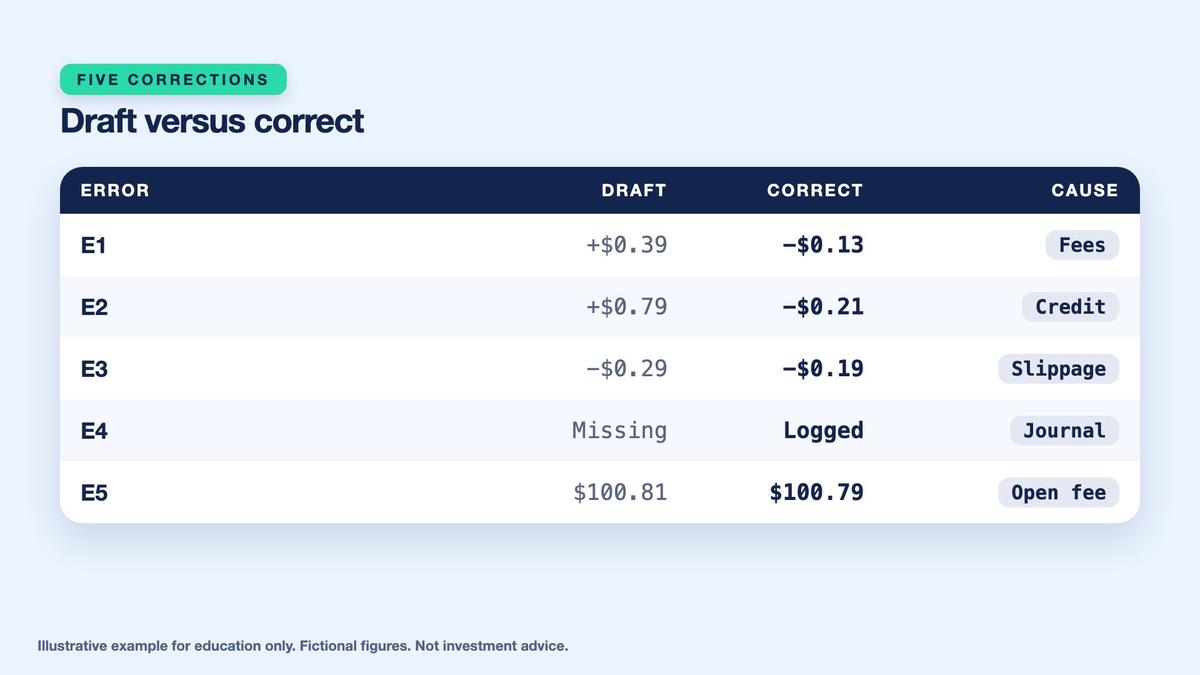
E3 subtracts the $0.10 execution slippage again after calculating P&L from the actual fill prices. The erroneous closed net is -$0.29, while the correct closed net is -$0.19. The execution price disadvantage is already reflected in the filled transactions, so it is a diagnostic rather than another accounting deduction. E4 leaves out the D6 stand-aside decision. That omission prevents the reviewer from seeing that the proposed $12 stop at the minimum 0.1 unit would risk $1.22 including fees and should be rejected under the $1 rule. A rejected trade can be positive evidence of discipline even though it contributes nothing to order count or P&L.
Key points
- E1 reported +$0.39 (fees ignored): correct -$0.13. E2 called +$0.79 profit (credit counted): realized is -$0.21.
- E3 deducted slippage again (-$0.29): closed net is -$0.19. E4 omitted the D6 no-trade.
- E5 missed the $0.02 open fee and showed $100.81: balance is $100.79.
E5 ignores the $0.02 entry commission already charged to the still-open T5 position. As a result, the draft reports $100.81 closing balance instead of the correct $100.79. Correcting the fee restores agreement with the statement. The reviewer should not merely replace five numbers without explanation. For each error, record the incorrect claim, correct calculation, cause, dollar discrepancy if applicable, and one checkable preventive action. Examples include separating external cash flows from P&L, comparing the fee ledger against executed sides, using actual fills for gross P&L, maintaining a no-trade register and verifying open-position entry fees. Repeat the calculations after corrections to ensure that repairing one field does not leave other parts inconsistent.
Run Eight Reconciliation Checks and Review Risk Discipline
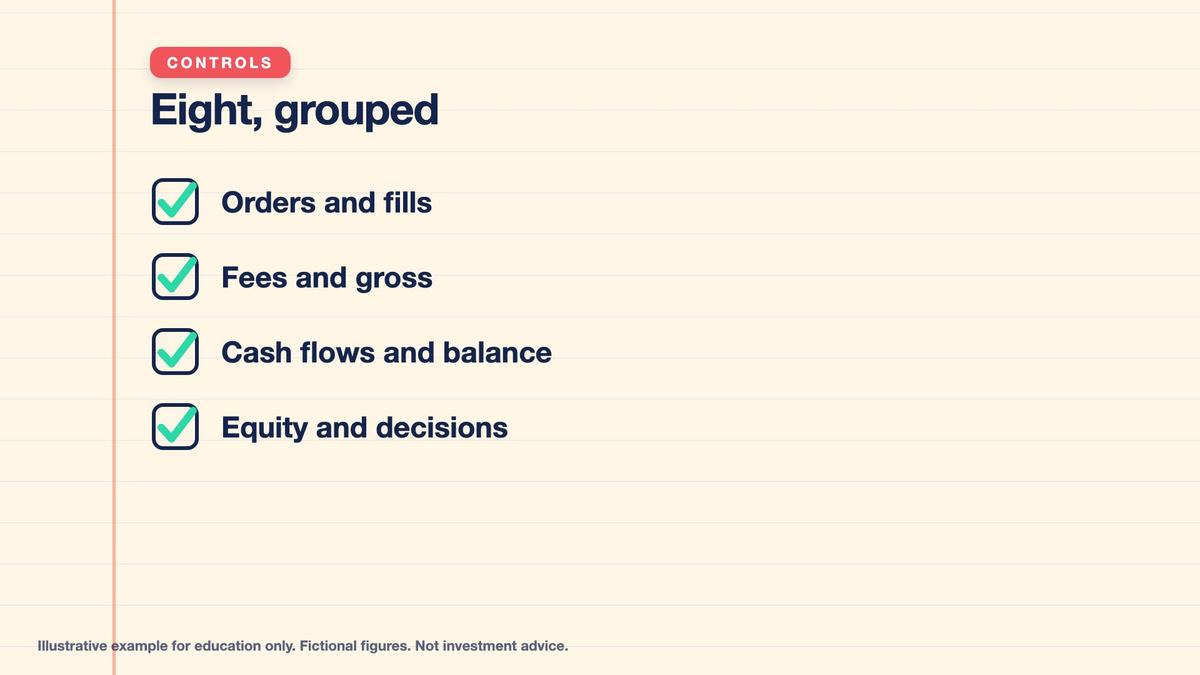
Perform eight explicit checks. R1 verifies five entered trade records, four closed and one open, while keeping D6 separate as a rejected proposal. R2 matches every actual fill, direction and quantity to the fictional platform statement. R3 confirms total charged commissions of $0.52. R4 confirms closed gross P&L of +$0.31. R5 verifies that the $1.00 demo credit appears as an external cash flow rather than trading profit. R6 ties closing balance to $100.79. R7 adds +$0.08 unrealized P&L to obtain $100.87 equity. R8 confirms that every executed trade and stand-aside decision is documented and that planned risks are within the $1 limit for the five executed trades.
Check the planned risks individually: T1 $0.60, T2 $0.30, T3 $0.70, T4 $0.42 and T5 $0.24. Each is at or below $1, while D6's proposed $1.22 minimum-size risk explains why no order is submitted. Review maximum simultaneous exposure: the largest individual position is T3 at 1.0 unit, and the case assumes trades do not overlap beyond the permitted size; T5 at 0.2 unit is the only position open at the statement close. For the daily realized loss rule, the reconciled realized trading result is -$0.21, comfortably inside the $3 cap. Therefore no daily lock is triggered under the fictional assumptions.
Key points
- Eight checks: orders, fills, fees $0.52, closed gross $0.31, cash flows, balance $100.79, equity $100.87, and every decision with risk at or below $1.00.
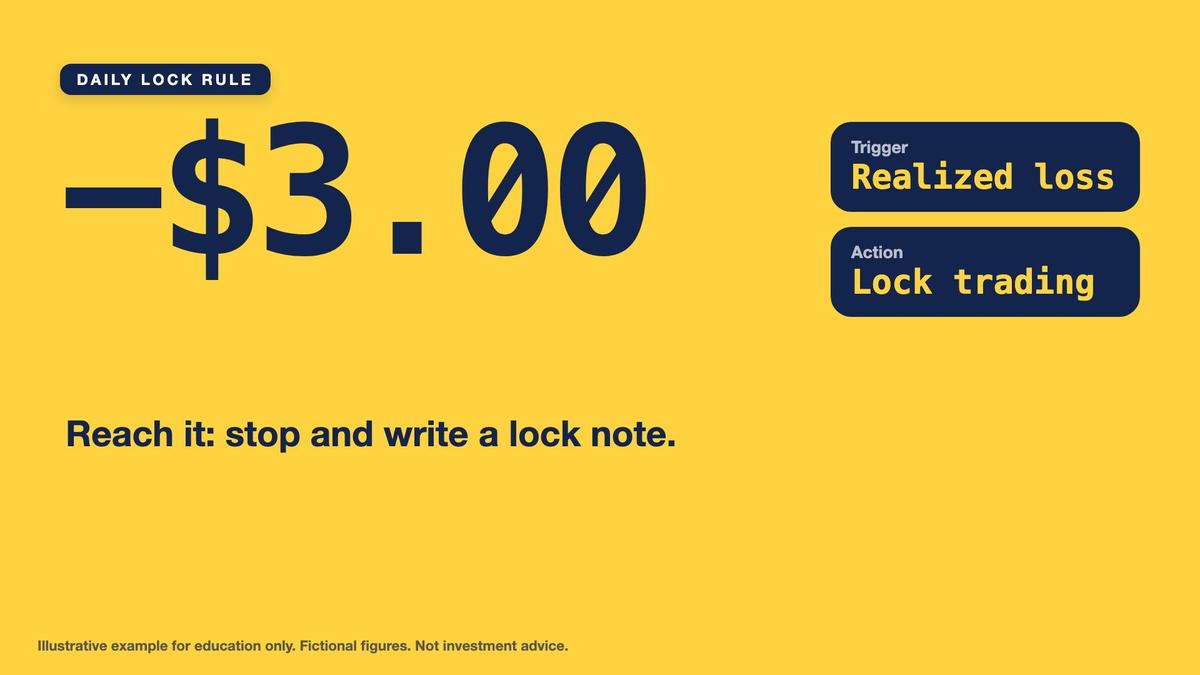
- Daily cap: stop and write a lock note if realized loss reaches $3.00; today -$0.21 does not trigger it.
- Open size never exceeds 1.0 unit under the stated non-overlap assumption.
The rule should still specify what happens if realized daily losses reach $3: stop entering new simulated trades and write a dated lock note explaining the threshold, observed result and action. Do not invent a lock event when the threshold has not been met. The self-review should identify errors and one checkable process improvement for each. Assessment evidence can be organized under planning and stop conditions, sizing and risk, trading discipline, reconciliation and explicit costs, and self-review. Do not invent scores, funded-account qualification criteria, profit splits or assessment thresholds. Demo profitability is discussed as an accounting outcome, but the educational focus is whether plans, fills, fees, risk controls and explanations are accurate.
Write the Reconciliation Note and Rehearse One Safe Mock Order
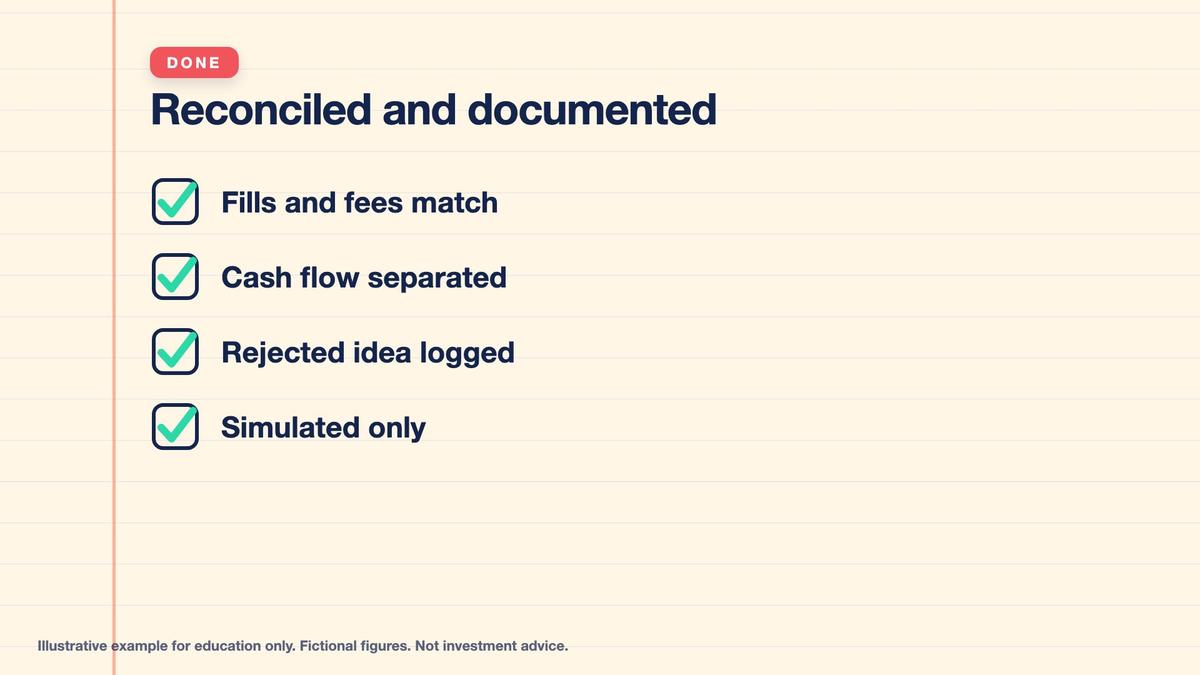
Complete a one-page reconciliation note containing the fictional product and Rules Sheet version, starting balance, external demo credit, order counts, all closed-trade gross and net results, open entry fee, unrealized P&L, adverse slippage diagnostic, closing balance, account equity and the trading result excluding the credit. The key figures should appear together: closed gross +$0.31, closed commissions $0.50, closed net -$0.19, open entry commission $0.02, all charged fees $0.52, realized trading -$0.21, unrealized +$0.08, balance $100.79, equity $100.87 and trading P&L including unrealized -$0.13. Include D6's rejected $1.22 proposed risk, the absence of a daily lock trigger, and the open-position sizing check.
Hands-On Demo Reconciliation: Five Trades, One Open Position and One Stand-Aside
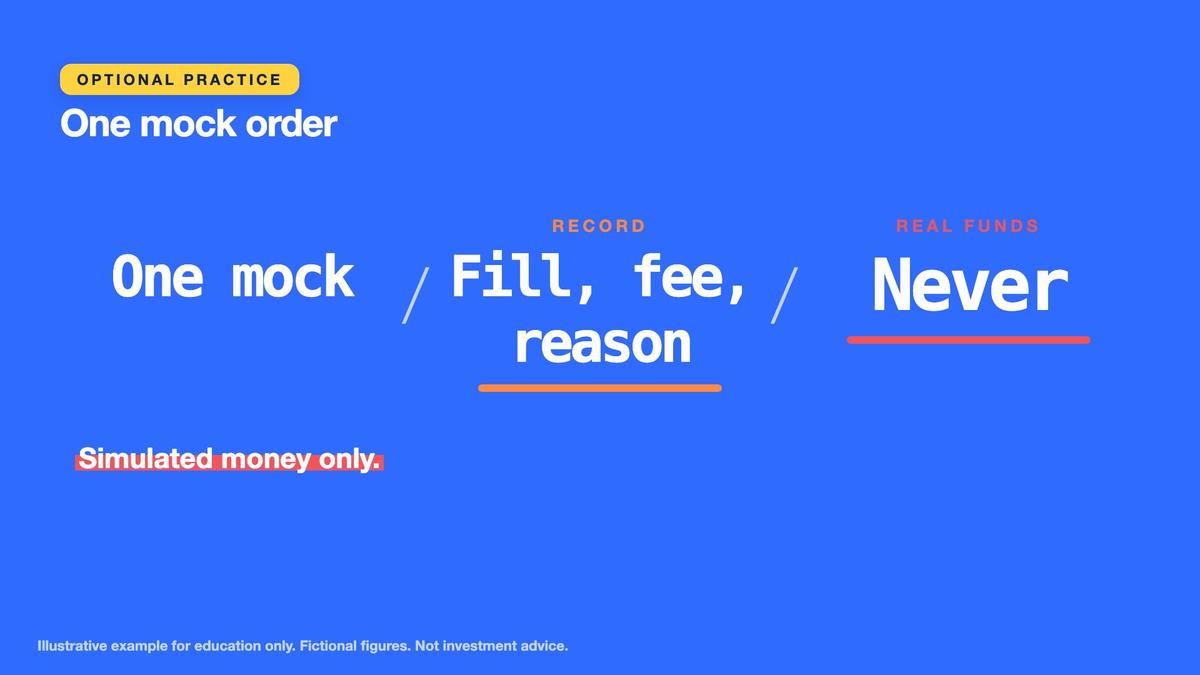
Use the fictional $100 Sample Practice Contract account and Rules Sheet version 1. Record the product's $1 P&L per $1 move per 1.0 unit, 0.1 minimum size and step, $0.10 commission per unit per side, $1 maximum planned risk including round-trip fees, $3 realized daily loss cap and 1.0-unit maximum simultaneous exposure. Enter trades T1–T5 in a fill ledger, including intended and actual prices, direction, quantity, stop, planned risk, gross P&L, charged commissions, net result, slippage diagnostic and status. Treat T5 as open, charging only its $0.02 entry fee and marking +$0.08 unrealized P&L. Log rejected idea D6 separately because its minimum planned risk is $1.22, above the $1 cap. Sum closed gross results to +$0.31, closed fees to $0.50, closed net to -$0.19, all charged fees to $0.52, and realized trading to -$0.21. Record total adverse slippage of $0.10 as already included in actual filled prices, not as a second P&L deduction. Isolate the $1 platform demo credit from trading results and reconcile $100.79 balance, $100.87 equity and -$0.13 total trading P&L including unrealized. Identify errors E1–E5, perform checks R1–R8, document the no-lock verdict and write a self-review linking each correction to a repeatable control. Optionally use https://research-paper-trade-webapp.pages.dev/paper/ for one small isolated mock order, recording its intended price, fill, fee and P&L, without any real accounts, wallets, keys, funds or orders.
- Decision 1: The fictional account begins at $100, receives a $1 external demo credit, and contains five entered trades with four closed and one open. Its Rules Sheet limits planned loss including fees to $1 per trade. — What evidence should be collected before calculating performance, and how should the demo credit be classified?
- Decision 2: Four closed fictional trades have gross P&L of +$0.40, -$0.24, -$0.57 and +$0.72. Their round-trip commissions are $0.10, $0.08, $0.20 and $0.12. — Calculate total closed gross, closed fees, closed net, and explain why the net result differs from the gross result.
- Decision 3: T5 remains open at the close, has an entry fee of $0.02 and unrealized gain of $0.08. A separate $1 demo credit is posted, and the four closed trades have $0.31 gross P&L and $0.50 fees. — Reconcile total fees, realized trading P&L, closing balance, equity and total trading result including unrealized.
- Decision 4: The trainee's draft reports +$0.39 total P&L, calls the +$0.79 balance change profit, subtracts $0.10 slippage again, omits rejected idea D6, and shows $100.81 balance. — Identify all five errors and state the corrected figures or required journal entry.
- Decision 5: The corrected rehearsal has five executed trade records, planned risks of $0.60, $0.30, $0.70, $0.42 and $0.24, realized trading -$0.21, and a rejected D6 proposal at $1.22 minimum risk. — What are the risk compliance conclusions and final evidence required for self-review?
Answer key
Write a short self-review naming at least one corrected mistake and an observable fix. For example, identify the draft's omission of the open entry commission and commit to matching every executed side with its charged fee before calculating balance. Another improvement is maintaining a separate cash-flow register so promotional credits cannot be mistaken for trading profit. A third is recording rejected ideas and their planned risk alongside accepted trades. The journal should state whether each check passed and provide its supporting calculation. This turns the rehearsal into evidence of process discipline rather than a narrative that selectively emphasizes favorable trade outcomes.
Key points
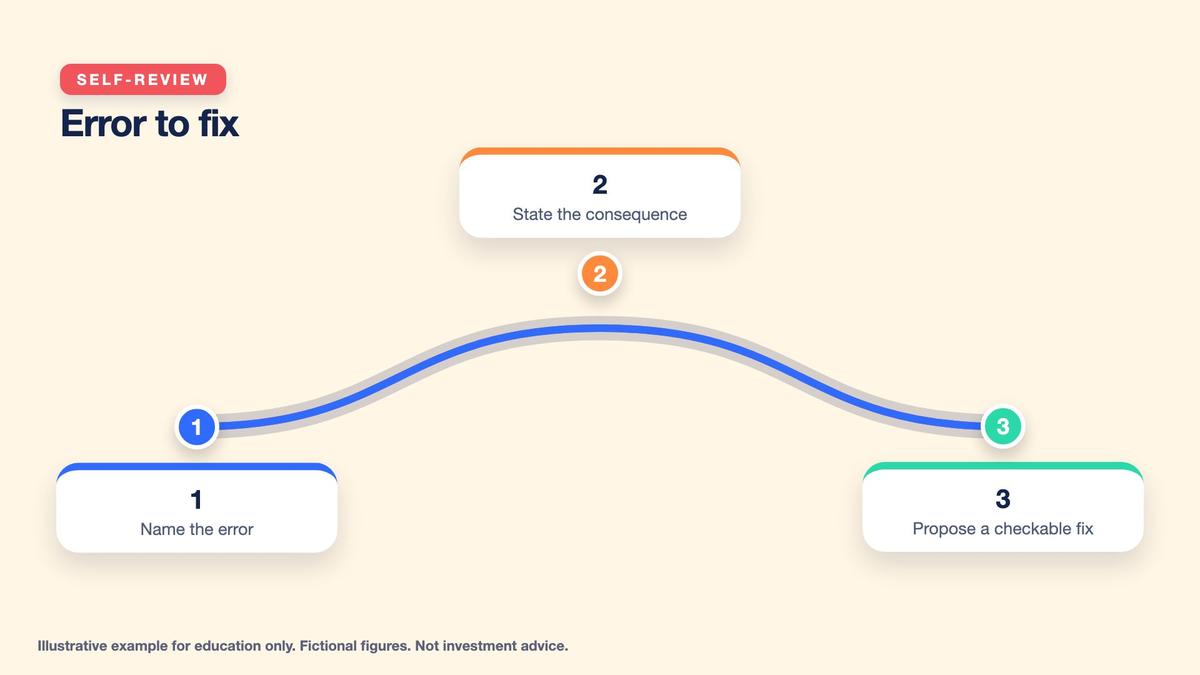
- Self-review: name the error, state its consequence, propose one checkable fix.
- Assessment evidence: plan and stop conditions, sizing and risk, discipline, cost reconciliation and self-review; demo profit alone is not the goal.
- Practice with simulated money only; never connect a wallet or exchange, paste keys or place real orders. Next: the Week 6 mission.
For optional practice, open the user-provided Paper Trading section at https://research-paper-trade-webapp.pages.dev/paper/ only if it provides a safely isolated simulation. Rehearse one small fictional order and record the intended price, actual simulated fill, size, applicable fee, and realized or unrealized P&L. Reconcile the resulting demonstration statement without connecting a real wallet, exchange, funded account or payment method, and never enter private keys or recovery phrases or place live orders. If the site requires real financial credentials or cannot safely simulate the exercise, complete the order entirely offline instead. The next Week 6 mission combines the model portfolio, three adverse scenarios and trading journal, following the final submission walkthrough and earlier trading journal and execution-risk lessons.
Worked example at a glance
Key terms
- Rehearsal: a practice run with simulated money.
- Rules sheet: the versioned list of limits for the day.
- Fill ledger: intended and filled prices for each order.
- Gross P&L: price result before fees.
- Net P&L: result after fees.
- Slippage: the difference between intended and filled price.
- Realized: from closed trades and charged fees.
- Unrealized: the mark-to-market of an open position.
- Cash flow: money added or removed that is not trading result.
- Balance: cash after realized results, fees and cash flows.
- Equity: balance plus unrealized result.
- Stand-aside: a logged decision not to trade.
Multi Asset Trading Lab is strictly an educational program and this Funded Stage Rehearsal is an entirely fictional, simulated-money accounting and risk-control exercise. The word funded in the title does not indicate, promise, create, award, imply eligibility for, or define access to real trading capital, a funded account, financial employment, a salary, a return-sharing agreement, or any profit distribution. Any real financial program's funding arrangements, profit-sharing terms, evaluation requirements, eligibility standards, restrictions and other conditions are governed solely by its current published rules and applicable agreements; no such real terms are provided or inferred in this lesson. The exercise does not involve actual money or live market exposure. No real exchange, broker, account provider, trading platform, security, futures contract, derivative, currency instrument, ticker or actual market price is represented by the fictional Sample Practice Contract. All prices, fills, stop levels, account balances, commission amounts, slippage, trades, risk limits and statement entries are invented for practice. The simulated account starts at $100.00 and follows a fictional Rules Sheet version 1. The sample contract is defined solely by a classroom sensitivity of $1 of profit or loss for each $1 price change per 1.0 contract unit. The minimum order size is 0.1 unit, and valid increments are 0.1 unit. Fictional commission is $0.10 per unit per executed side. The expected fee for opening and closing a position is therefore $0.20 per unit, subject to the assumption that both sides execute. The fictional planned-risk rule limits each proposed trade to a maximum of $1.00 in intended stop-distance risk plus estimated round-trip commission. The realized daily trading loss cap is $3.00, and reaching that cap would require stopping new simulated trades and recording a lock note. The maximum simultaneously open position is 1.0 unit, and the only permitted classroom product is Sample Practice Contract. These invented constraints are not actual rules for any real firm or account, and the case provides no basis for claiming that they satisfy any external evaluation or trading program. The platform posts a separate $1.00 demo credit to the fictional account. This credit is an external cash inflow and is never trading profit. It changes the account balance but must be removed when analyzing trading performance. The exercise includes five entered trade records T1 through T5 and a separately logged rejected proposal D6. Four positions close, while T5 remains open at the statement's reporting point. The case explicitly assumes that earlier closed trades do not overlap such that total simultaneous open exposure would exceed the 1.0-unit maximum; T5 is the only open position at the close. The lesson does not invent or claim execution timestamps beyond these assumptions. Trade T1 buys 0.5 unit. Intended entry is 50.00, actual entry is 50.02, intended and actual exit are 50.82, and planned stop is 49.00. Planned price risk is (50.00 - 49.00) multiplied by 0.5, or $0.50. Adding estimated round-trip commission of 0.5 multiplied by $0.20 yields $0.60 planned total risk. Actual gross P&L is (50.82 - 50.02) multiplied by 0.5, equal to +$0.40. The two charged sides each cost $0.05, yielding $0.10 round-trip fees and +$0.30 net result. Adverse entry slippage is (50.02 - 50.00) multiplied by 0.5, or $0.01, with no exit slippage. Trade T2 sells short 0.4 unit. The intended entry is 51.00, actual entry is 50.98, intended closing stop is 51.55, and actual buy-to-close price is 51.58. Intended price risk is (51.55 - 51.00) multiplied by 0.4, or $0.22, plus $0.08 in expected round-trip commission, creating $0.30 planned risk. Actual gross P&L is (50.98 - 51.58) multiplied by 0.4, equal to -$0.24. After subtracting $0.08 charged commission, net P&L is -$0.32. The adverse entry fill differs from the intended price by $0.02, creating $0.008 execution disadvantage on 0.4 unit. The adverse exit differs by $0.03, creating $0.012 execution disadvantage. Their sum is exactly $0.020, reported as $0.02 of slippage. These intermediate three-decimal dollar amounts should be retained in the educational working calculation, even though the aggregated amount is shown in cents. Actual T2 net loss exceeds its intended planned risk by $0.02, reflecting the unfavorable entry and exit executions. Trade T3 buys 1.0 unit, with intended entry 49.50, actual entry 49.53, intended stop 49.00 and actual closing fill 48.96. Intended price risk is $0.50, and planned round-trip commission is $0.20, giving planned total risk of $0.70. Actual gross P&L is (48.96 - 49.53) multiplied by 1.0, or -$0.57. Subtracting $0.20 paid commission yields -$0.77 net P&L. Entry slippage costs $0.03 and exit slippage costs $0.04, totaling $0.07. The actual $0.77 loss is $0.07 greater than the planned $0.70 risk but remains below the fictional $1.00 planned-risk ceiling. A planned-risk rule does not guarantee that a stop executes at its intended level or that the actual loss will never exceed the initial estimate. Stops can fill less favorably in real markets, and market gaps or liquidity disruptions may create much larger differences than those shown in this made-up example. Trade T4 buys 0.6 unit at the intended and actual entry of 49.00 and exits at the intended and actual target price of 50.20. Gross P&L is (50.20 - 49.00) multiplied by 0.6, or +$0.72. Charged round-trip commission is $0.12, giving net profit of +$0.60. The planned stop is 48.50, producing planned price risk of $0.30, plus expected $0.12 fees, giving total planned risk of $0.42. There is no simulated execution slippage on T4. Trade T5 buys 0.2 unit at its intended and actual entry of 50.00 and remains open at the close, when the fictional mark is 50.40. The open mark creates unrealized P&L of (50.40 - 50.00) multiplied by 0.2, or +$0.08. The intended stop is 49.00, so planned price risk is $0.20 plus $0.04 estimated round-trip fees, or $0.24 planned total risk. Only the $0.02 entry commission has been charged by the reporting time. A separate anticipated $0.02 exit commission could arise if the position were closed under the same fictional commission rate, but it has not yet been executed or charged and must not be included in the account's already paid fees. The +$0.08 unrealized price result is separate from the $0.02 charged entry commission, which is already reflected in realized cash accounting. The fifth trade must not be counted as closed or assigned a fictitious exit fill. The sixth proposal, D6, is a stand-aside decision, not a submitted or filled order. The proposed stop is $12.00 from intended entry. Minimum size is 0.1 unit, creating $12.00 multiplied by 0.1, or $1.20 of planned price risk. Expected round-trip commission at that size is $0.02, so total planned risk is $1.22, exceeding the written $1.00 cap by $0.22. A smaller permitted order is unavailable under the invented minimum size and increment. Therefore the correct classroom decision is to reject the idea and document the calculation rather than submit an order. A decision not to trade can be evidence of rule-following and should appear in the journal even though it produces no realized or unrealized P&L and adds nothing to the actual order count. The four completed trades produce gross results of +$0.40, -$0.24, -$0.57 and +$0.72. Their sum is +$0.31. The corresponding charged round-trip commissions are $0.10, $0.08, $0.20 and $0.12, totaling $0.50. Therefore closed net P&L is +$0.31 minus $0.50, or -$0.19. Gross trading P&L is positive while net P&L is negative because commissions exceed the gross gains. The open T5 position has already incurred $0.02 entry commission, so total charged fees across the five entered trades are $0.52. Realized trading result, under the classroom convention that charged open-entry commission is recognized immediately, is +$0.31 gross closed trading P&L minus $0.52 charged fees, or -$0.21. The open position contributes +$0.08 unrealized P&L, yielding total trading P&L including unrealized of -$0.13. The five trades' adverse execution slippage amounts are $0.01, $0.02, $0.07, $0.00 and $0.00, totaling $0.10. These slippage amounts measure unfavorable differences between intended and actual fills. Because actual fill prices are already used in the gross P&L calculations, the unfavorable execution effects are already included in gross results. The $0.10 is a separate execution-quality diagnostic and must not be subtracted again from closed net, realized trading P&L, balance or equity. The closing simulated balance reconciles as opening $100.00 plus $1.00 external demo credit plus $0.31 closed gross trading P&L minus $0.52 charged fees, equaling exactly $100.79. The balance increase relative to the starting balance is $0.79, but that includes the unrelated $1.00 demo credit. Removing the credit reveals -$0.21 realized trading performance. Adding the +$0.08 unrealized mark of the still-open T5 position produces closing account equity of $100.87. An independent calculation of total trading P&L including unrealized takes closing equity $100.87, subtracts original balance $100.00 and subtracts the unrelated $1.00 credit, producing -$0.13. This matches realized trading -$0.21 plus unrealized +$0.08. Balance, equity, realized P&L, unrealized P&L, gross and net must be labeled consistently. The practice statement's account increase should never be described as proof of profitable trading or expected future performance. The deliberately incorrect draft contains five specific errors. E1 adds the $0.31 closed gross and $0.08 unrealized amount to claim +$0.39 trading profit without subtracting fees. Correct trading P&L including unrealized is -$0.13, a difference of exactly $0.52, equal to total charged commissions. E2 claims that the +$0.79 balance increase is trading profit, incorrectly including the $1.00 external demo credit. Correct realized trading performance is -$0.21, creating a difference of exactly $1.00. E3 subtracts the $0.10 slippage diagnostic again, producing an erroneous -$0.29 closed net instead of the correct -$0.19. E4 omits rejected proposal D6, concealing evidence that the minimum executable size would produce $1.22 planned risk against the $1 maximum. E5 omits the $0.02 entry commission charged for the open T5 position, incorrectly reporting $100.81 balance instead of $100.79. Correcting these errors requires tracing every discrepancy to its source rather than merely replacing output figures without documentation. The required reconciliation checklist contains eight checks. R1 confirms five entered trade records, four closed positions and one open position, with rejected proposal D6 logged separately. R2 matches the directions, sizes and actual fills to the source statement. R3 checks that all charged commissions total $0.52. R4 checks closed gross P&L of +$0.31. R5 verifies that the $1.00 demo credit is recorded separately from trading profit. R6 reconciles closing balance to $100.79. R7 confirms that balance plus +$0.08 unrealized result gives $100.87 equity. R8 confirms that all entered trade decisions and the rejected idea are documented and that all five executed trades have planned losses, including expected fees, at or below $1.00. Their planned amounts are $0.60, $0.30, $0.70, $0.42 and $0.24, respectively. The D6 proposal exceeds the cap but is never entered, so its rejection is the compliant action. The fictional account's realized trading result at the close is -$0.21, which is well inside the written $3.00 daily realized loss cap. The cap is therefore not triggered in this example. Nevertheless, the journal must describe the action required if the cap were reached: halt new simulated trading and record a dated lock note. The lesson should not invent a lock event that did not occur. The case also assumes trades do not overlap such that total simultaneous exposure exceeds 1.0 unit. The largest individual position is 1.0 unit in T3, and T5 is the only open position at the end of the day. The maximum-size rule is satisfied under this stated assumption. These artificial controls do not replicate the rules or risk mechanisms of a real brokerage, exchange, trading firm or funded-account program. Even a trade with planned risk below a written threshold may incur a larger realized loss when execution is unfavorable. The case does not address liquidation, leverage, collateral, settlement rules, market impact, execution failure, market gaps beyond the stated fills, taxes, liquidity shortages, operational interruptions or other material real-world trading risks. Assessment evidence is discussed only in qualitative categories: documented plan and stop conditions, appropriate position sizing and risk, trading discipline including standing aside, reconciliation of fills and costs, and honest self-review. No numerical grades, passing scores, funding thresholds, return targets or profit-sharing arrangements are invented or implied. A profitable mock trade or day does not establish trading competence, eligibility for funding or predictable future profitability. The required self-review must identify an actual draft error, its consequence and a repeatable preventive check. Examples include reconciling every charged execution side before totaling fees, excluding external credits from performance, recording rejected ideas, and calculating gross P&L only from actual fills before deducting commissions once. The lesson builds on the earlier trading journal and execution-risk material and the final submission walkthrough. The subsequent Week 6 mission remains an educational package consisting of a simulated model portfolio, three adverse scenarios and a trading journal, with a combined stress and decision documentation also available from prior work. Optional practice may use the user-provided webpage https://research-paper-trade-webapp.pages.dev/paper/ only if it visibly supports a safe, isolated mock-trading environment without requiring real financial connections. The webpage is not independently verified in this lesson as a broker, exchange, assessment provider or source of official funding terms. Learners must not connect a real wallet, exchange, funded account or payment method, must never enter private keys, recovery phrases or confidential financial credentials, and must never transfer actual assets or place real-money orders. If any interface asks for real funding or sensitive financial information, the learner should stop and use an offline worksheet or calculator instead. No actual financial actions are necessary for this exercise. Nothing in this material constitutes investment advice, a recommendation to buy or sell any financial instrument, a guarantee of profits, a market forecast or a promise of future funding. All examples remain fictional, fully simulated and strictly educational.
Lesson Checkpoint
Review what you learned and get feedback on your work.