



This fifteen-minute beginner hands-on lesson completes the Week 6 Portfolio Lab by assembling, reconciling, verifying and submitting three educational artifacts: a seven-tab portfolio workbook, a one-page decision memo and a set of verification notes. The package continues the entirely fictional $100,000 model portfolio created in Lesson 28, stress-tested in Lesson 29 and conditionally rebalanced in Lesson 30. The classroom-selected Option C holds $30,000 in Sample Wide Stock ETF, $25,000 in Sample Bond Fund, $10,000 in Sample Gold Fund, $9,000 in Sample Foreign Stock ETF, $5,000 in Sample Coin and $21,000 in cash, totaling $100,000 on the specified pre-cost reference basis. A separate $16 modeled selling cost produces a post-cost account value of $99,984 if deducted from cash. Learners create Policy, Holdings, Scenarios, Options, Decision, Journal and Checks tabs, then reproduce four hypothetical stress results: equity -$11,700, crypto -$4,950, currency -$1,600 and combined -$14,710. All four pass the $15,000 fictional loss tolerance on the reference basis, although the combined case leaves only $290 of headroom. Adding the modeled $16 transaction cost as a separate sensitivity increases the combined loss to $14,726, leaving $274. The lesson teaches careful identification of numerical bases, precision, date and version conventions, including the distinction between a displayed 5.0% rounded crypto weight and its slightly higher exact post-cost percentage. The submission includes eight verification checks, three dated journal entries, a five-part 100-point assessment rubric and a sample self-check score of 84. The learner also corrects a deliberate stale memo figure that incorrectly uses Option A's $20,350 combined loss instead of Option C's $14,710. An optional isolated paper-trading exercise records one simulated fill, fee and trade rationale. All instruments, prices, currencies, trades and market shocks are invented, with no investment advice or predictions.
Understand the Three-Part Final Submission and Build the Workbook
The Week 6 Portfolio Lab finishes with three related artifacts: a workbook, a one-page decision memo and a set of verification notes. Together, they must demonstrate a simulated portfolio, three independent adverse scenarios, a combined stress review and a trading journal. A reader should be able to reproduce the key calculations without watching the lesson or trusting an unsupported conclusion. The reference portfolio is entirely fictional and dated June 1, 2026. It begins with $100,000 and follows the classroom Option C decision developed in Lesson 30. Use separate metadata for the historical simulation reference date, the date each journal entry was written, the last verification date and the submission version. These dates serve different purposes and must not be silently substituted for one another.

Create seven workbook tabs named exactly Policy, Holdings, Scenarios, Options, Decision, Journal and Checks. Policy contains the ten-year growth objective, moderate-risk description, $15,000 bad-scenario loss tolerance, 40% maximum individual holding, 5% maximum crypto allocation and 5% minimum cash requirement. Holdings contains six final positions, quantities or currency units where supplied, values, weights, portfolio roles and principal risk sources. Scenarios contains all holding-level assumptions and results. Options preserves the hold and rebalancing alternatives. Decision documents the four-question comparison and classroom conclusion. Journal preserves the chronological explanation of construction, stress testing and the selected option. Checks contains the eight verification results, supporting formulas, review dates and unresolved qualifications.

Key points
- The final submission has three parts: a seven-tab workbook, a one-page decision memo and verification notes. The trading journal lives inside the workbook.
- Tabs: Policy, Holdings, Scenarios, Options, Decision, Journal, Checks.
- Everything continues the fictional $100,000 portfolio of Lessons 28 to 30; the reference date is 1 June 2026, and your own review date is recorded separately.
The workbook should distinguish calculated fields from inputs and retain the source of every material assumption. The model holdings, market shocks, exchange rates and fees are invented; therefore their source can be labeled as the fictional Lesson 28–30 case rather than any real exchange or financial provider. The lesson does not require downloadable financial statements or actual investment accounts. Use formulas rather than typing only final outputs wherever possible, and avoid replacing formulas with rounded values that make later reconciliation impossible. Document units, including dollars, percentages and fictional SCU, in adjacent labels. A clearly structured workbook is more useful than a visually complex one if every calculation remains traceable, reproducible and consistent with the stated policy.

Reconcile the Final Holdings and Explain the Two Accounting Bases
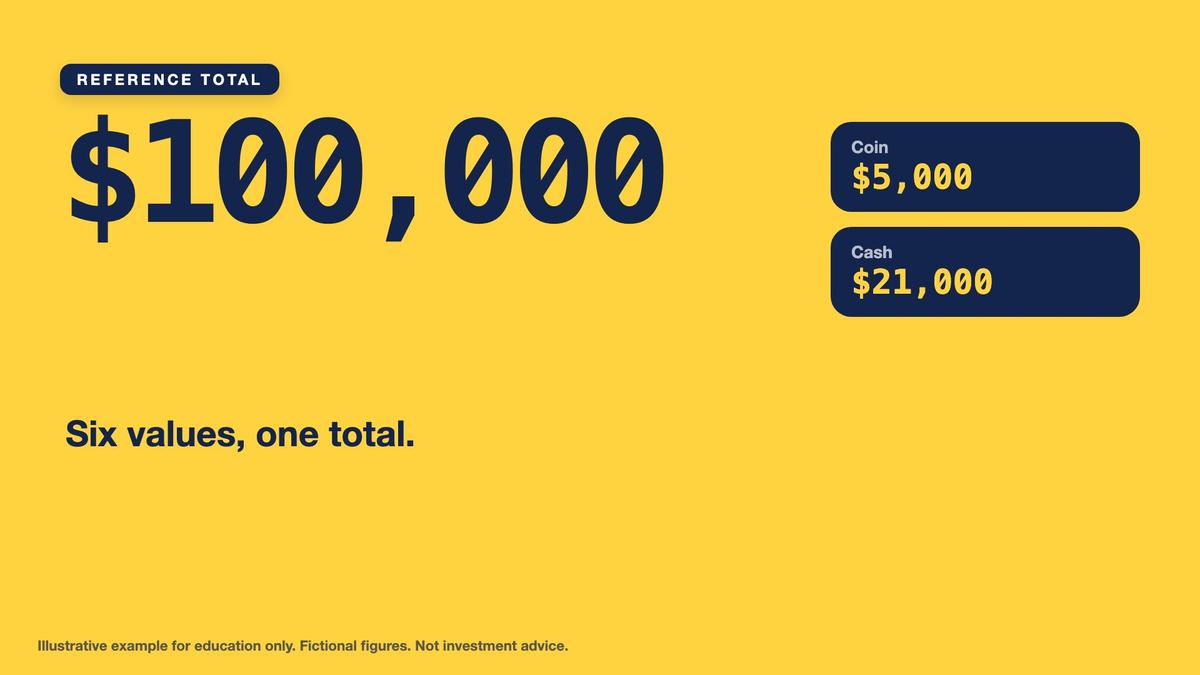
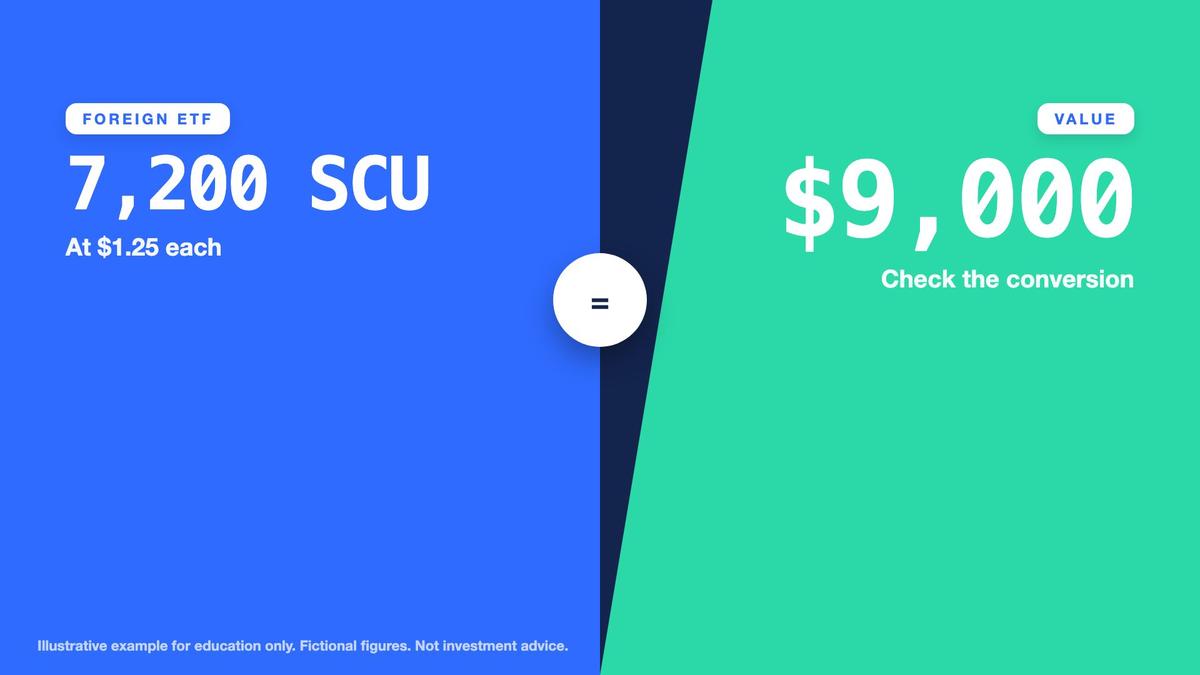
The final fictional Option C holdings on the reference basis are Sample Wide Stock ETF $30,000, Sample Bond Fund $25,000, Sample Gold Fund $10,000, Sample Foreign Stock ETF $9,000, Sample Coin $5,000 and cash $21,000. Adding them gives exactly $100,000. The corresponding reference-basis weights are 30%, 25%, 10%, 9%, 5% and 21%, summing to 100%. The foreign stock holding is denominated in the invented currency SCU and contains 7,200 SCU at the assumed conversion rate of $1.25 per SCU, producing $9,000. Stocks total 39% across the wide and foreign stock funds, while bonds comprise 25%, gold 10%, crypto 5% and cash 21%. These are the final simulated holdings, not the original holdings from Lesson 28.
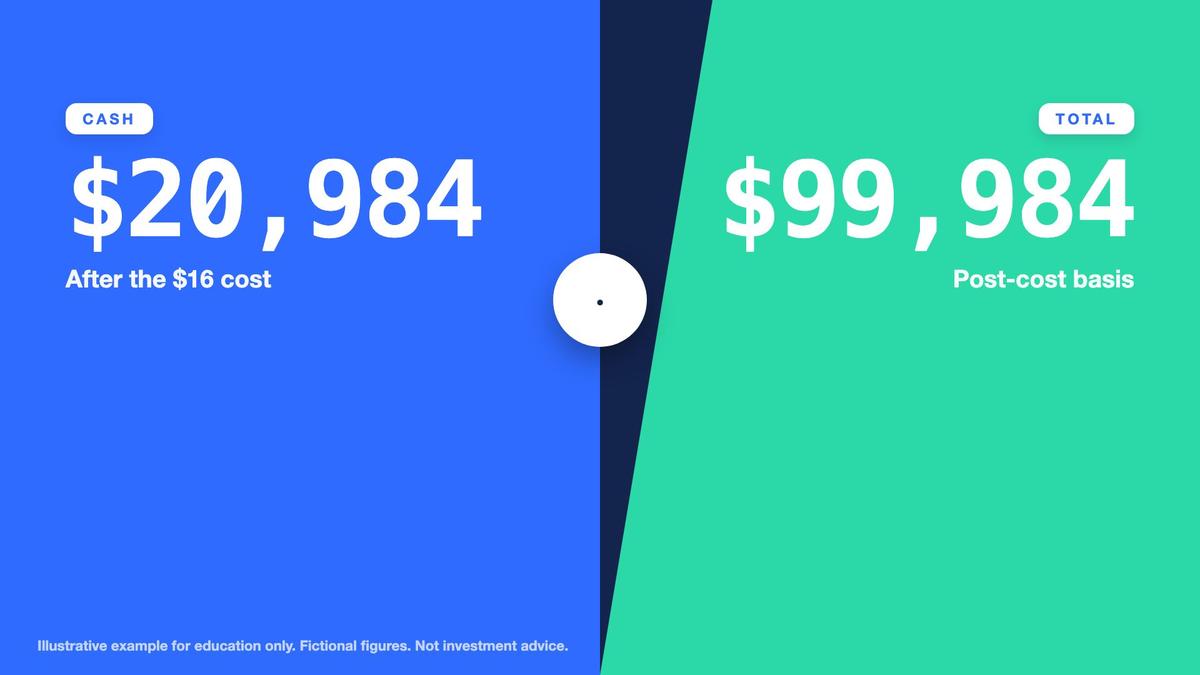
Option C was created by selling $10,000 of Sample Wide Stock ETF and $6,000 of Sample Foreign Stock ETF and retaining the nominal proceeds as cash. The fictional wide selling spread is 0.04% of $10,000, or $4. The foreign selling spread is 0.20% of $6,000, or $12. Combined modeled cost is $16. The main workbook treats the Option C holdings as a $100,000 pre-cost reference portfolio and records trading cost separately, allowing a consistent comparison with the earlier options and stress results. If the cost is instead paid from the cash position, cash becomes $20,984 and total portfolio value becomes $99,984. Both totals can be correct within their explicitly stated conventions; combining their numerators and denominators without labels creates an accounting error.
Key points
- Final Option C holdings: wide $30,000, bonds $25,000, gold $10,000, foreign $9,000 (7,200 SCU x $1.25), coin $5,000, cash $21,000 = $100,000. Weights 30, 25, 10, 9, 5 and 21 percent sum to 100%.
- Reference basis: $100,000 before costs. Modeled selling cost: $4 + $12 = $16.
- Post-cost basis: cash $20,984, total $99,984. Label both bases and never mix them.
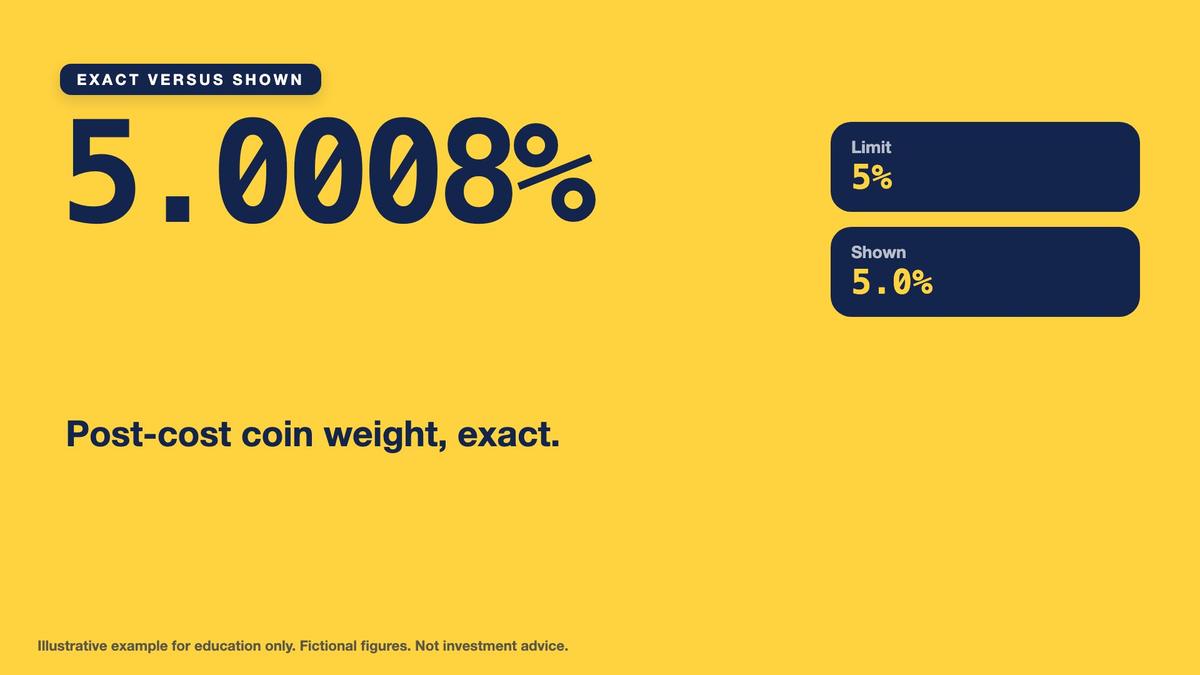
The distinction becomes important for allocation limits. On the $100,000 reference basis, Sample Coin's $5,000 value is exactly 5%, and the classroom allocation rule passes. On the $99,984 post-cost basis, however, $5,000 divided by $99,984 equals approximately 5.000800128%, which is slightly above an exact 5% maximum. Displaying the weight to one decimal place produces 5.0%, creating a rounded classroom boundary pass, but rounding does not eliminate the exact mathematical excess. Verification notes must disclose this difference instead of claiming strict post-cost compliance. The exact excess is approximately 0.000800 percentage points, or about $0.80 of coin value relative to a strict 5% cap on $99,984. A strictly enforced unrounded post-cost cap would require a separately specified adjustment or a different policy convention; this lesson does not silently execute one.
Complete the Scenarios Tab With Holding-Level Evidence
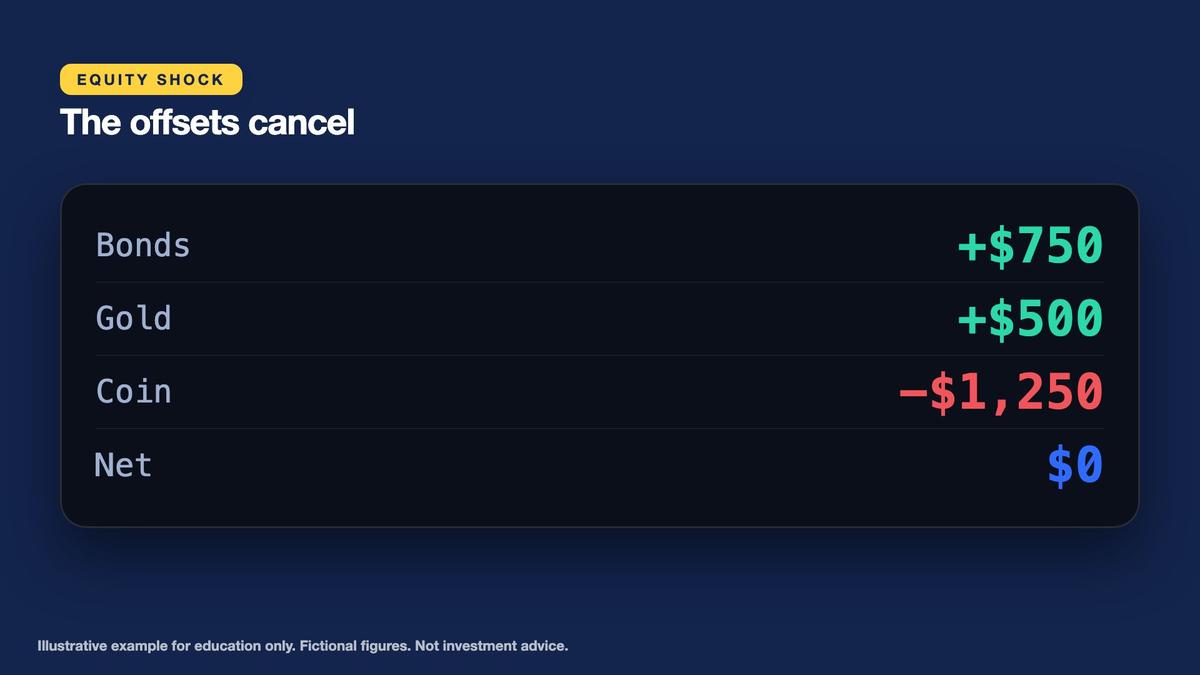
The Scenarios tab should reproduce the three independent adverse scenarios from Lesson 29 using the reduced Option C holdings from Lesson 30. For the equity shock, wide stocks decline 30%, creating a $9,000 loss, and foreign stocks decline 30% in SCU terms with the exchange rate unchanged, creating a $2,700 loss. Bonds gain 3%, or $750, gold gains 5%, or $500, and Sample Coin declines 25%, losing $1,250. Cash does not change. The bond and gold gains exactly offset the coin loss, leaving a net equity-scenario loss of $11,700. Against the $15,000 tolerance, this consumes 78.0%, passes, and leaves $3,300 of remaining headroom.
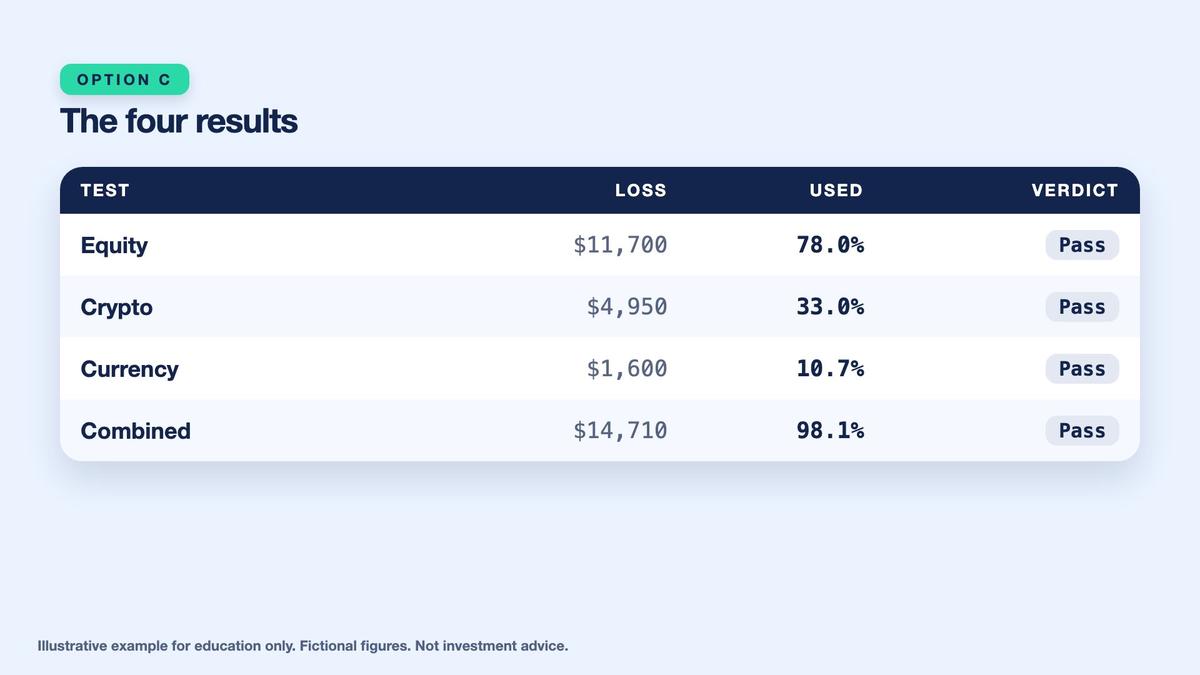
For the crypto scenario, Sample Coin declines 60%, losing $3,000. Wide stocks decline 5%, losing $1,500, and foreign stocks decline 5% in SCU terms with the exchange rate unchanged, losing $450. Bonds, gold and cash are unchanged. Net loss is $4,950, or 33.0% of the $15,000 tolerance, so the scenario passes. The currency scenario assumes SCU depreciates 20% from $1.25 to $1.00 while the foreign share price remains unchanged in SCU. The foreign holding's 7,200 SCU becomes worth $7,200 instead of $9,000, losing $1,800. Gold gains 2%, or $200, while the other positions stay constant. Net currency loss is $1,600, using approximately 10.7% of tolerance, and passes.
Key points
- Equity: wide -$9,000, foreign -$2,700, bonds +$750, gold +$500, coin -$1,250: -$11,700, 78.0%, headroom $3,300. Crypto: -$3,000, -$1,500, -$450: -$4,950, 33.0%.
- Currency: SCU falls from $1.25 to $1.00; foreign -$1,800, gold +$200: -$1,600, 10.7%.
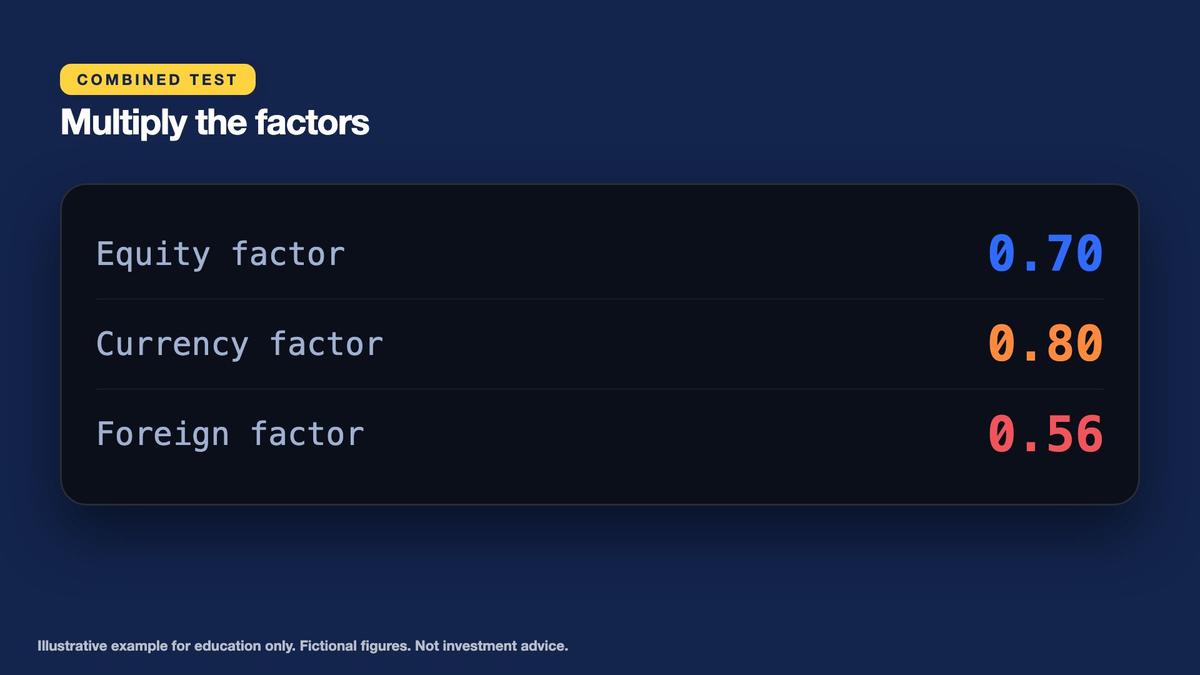
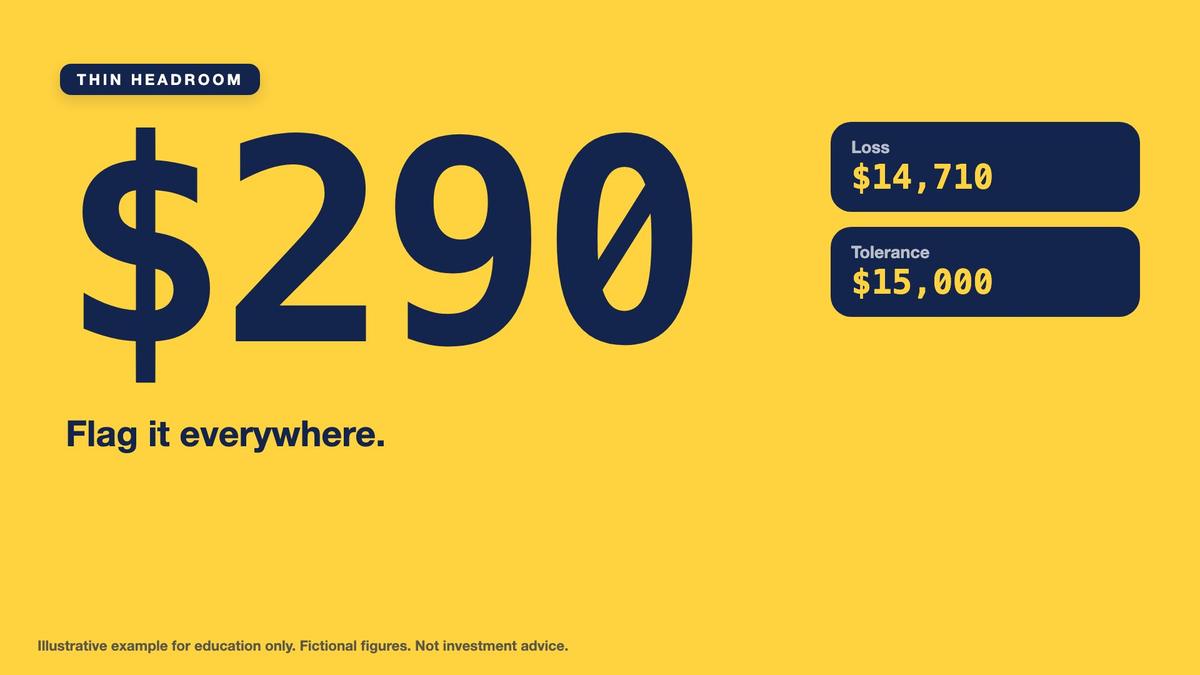
- Combined: foreign factor 0.70 x 0.80 = 0.56, so $9,000 becomes $5,040 (-$3,960); total -$14,710, 98.1%, headroom $290. With the $16 cost the loss is $14,726 and headroom $274.
Include a separate combined scenario row because simultaneous price and currency changes cannot be reconstructed by simply adding the totals of the independent scenarios. Wide stocks lose $9,000, bonds gain $750, gold gains $500, and Sample Coin loses $3,000. Foreign stock prices decline 30% in SCU while SCU depreciates 20%, so their remaining factors multiply: 0.70 times 0.80 equals 0.56. Applying this factor to the $9,000 foreign holding gives $5,040, a $3,960 loss. Net portfolio change is negative $14,710. This consumes approximately 98.1% of the $15,000 tolerance and passes with only $290 headroom. Clearly label the result as pre-cost; adding the modeled $16 cost separately produces a $14,726 sensitivity with $274 headroom.
Preserve the Options Comparison and Write a One-Page Decision Memo
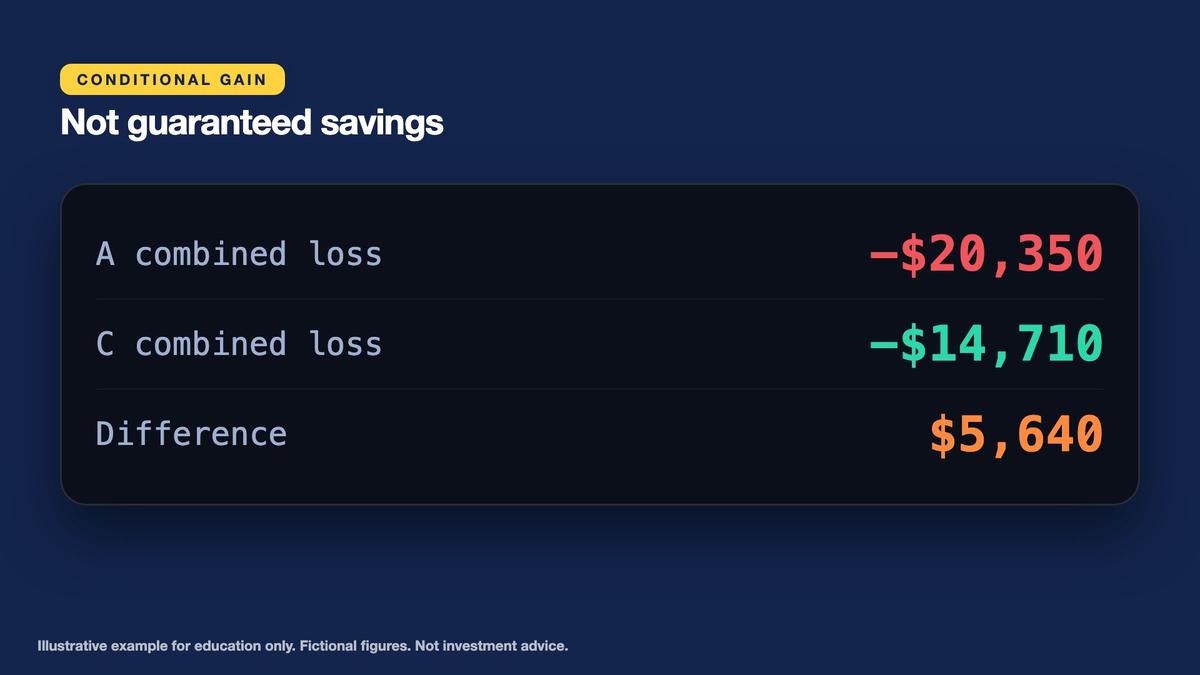
The Options tab preserves why the final holding allocation was selected. Option A holds the original portfolio and has a worst tested loss of $20,350 under the combined scenario, breaching the $15,000 tolerance. Option B moves $5,000 of wide stocks into cash, incurs a modeled $2 selling spread, and reduces the worst combined loss to $18,850, which still breaches the policy. Option C moves $10,000 of wide stocks and $6,000 of foreign stocks into cash, has a modeled $16 selling cost, and reduces the combined loss to $14,710 on the main reference basis. The difference between Option A and Option C's combined tested losses is $5,640. This is a comparison between hypothetical outcomes, not realized savings or forecast profit.
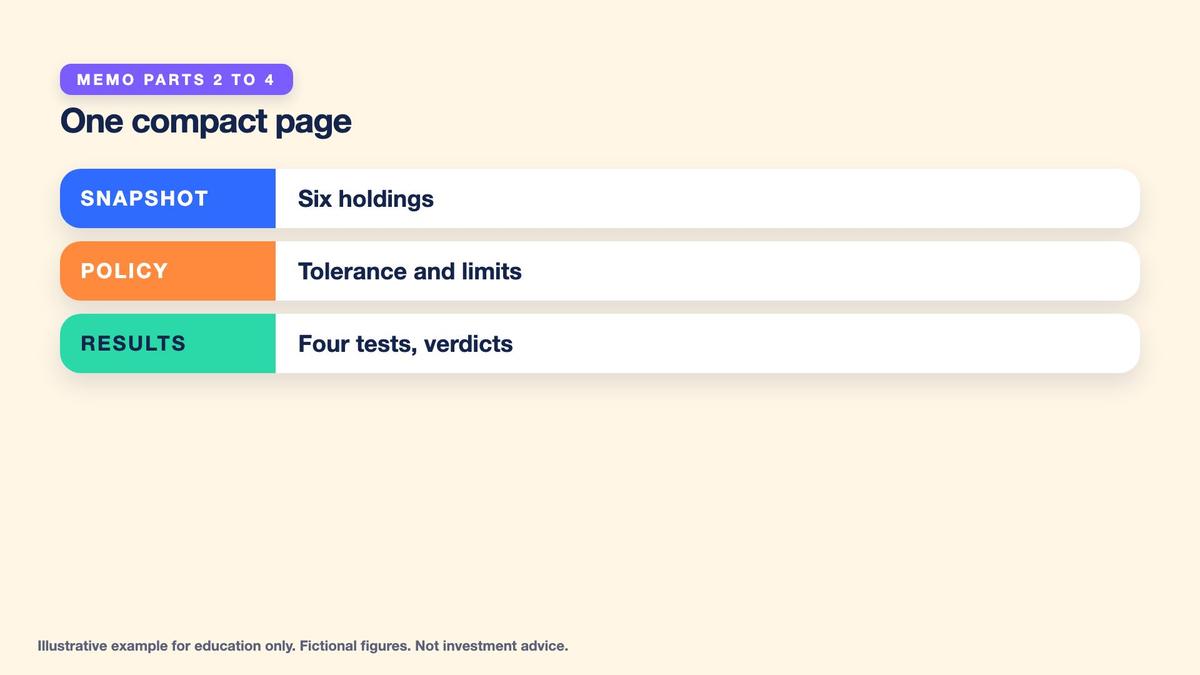
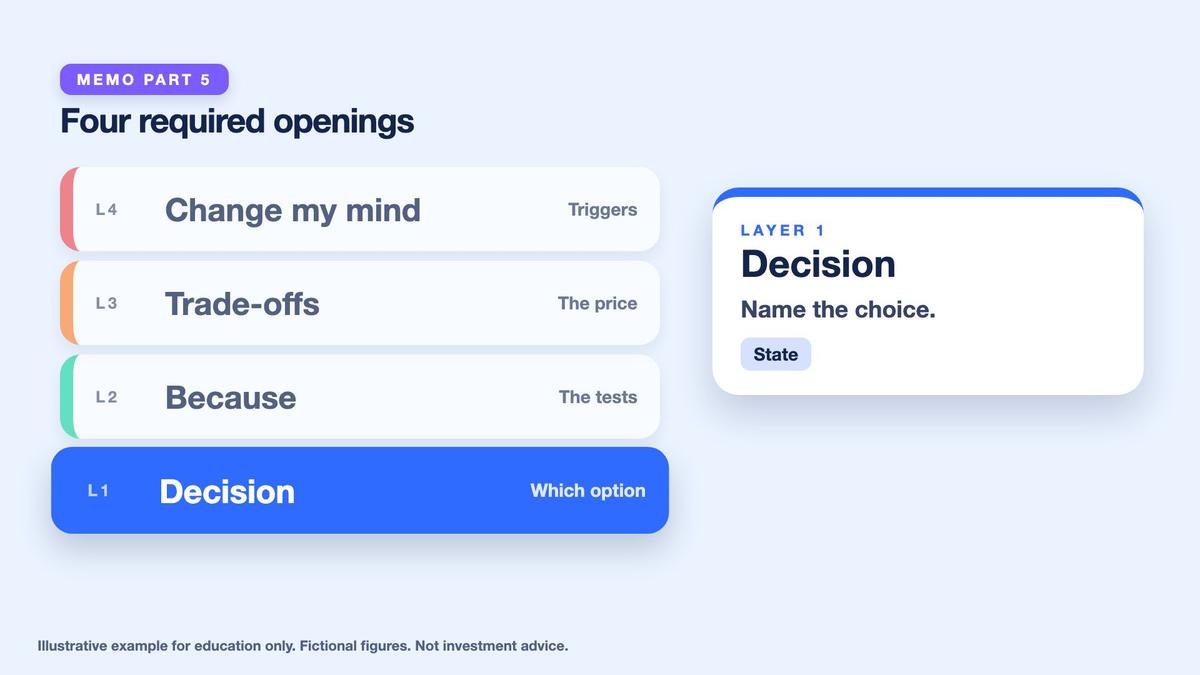
Write the one-page decision memo using seven sections. Begin with a header containing the reference date, last verification date, version and pre-cost convention. Then show the six-holding portfolio snapshot, followed by the objective, horizon, tolerance and allocation limits. Add a compact table with equity -$11,700, crypto -$4,950, currency -$1,600 and combined -$14,710, together with their tolerance shares and pass verdicts. The fifth section is the decision paragraph. It must contain four identifiable openings: Decision, Because, Trade-offs and What would change my mind. End with the limitations of the invented scenario analysis and the verification status, including unresolved numerical qualifications. Keep the memo concise enough to fit a single page without omitting material risks.
Key points
- Options tab: A hold (worst loss $20,350), B small sale ($18,850), C two larger sales ($14,710). Option C is $5,640 lower than holding, a conditional difference, not a guaranteed saving.
- Decision tab: Option C, chosen as a classroom exercise because all four tests pass, with less growth exposure as the trade-off.
- One-page memo: header, snapshot, policy, four results, the four-part decision paragraph, limits and verification status.
The classroom decision is Option C because all four specified reference-basis stress tests pass and the three reference-basis allocation limits pass. The trade-offs are substantial: stock exposure declines from 55% to 39%, cash rises from 5% to 21%, and the fictional portfolio sacrifices some potential growth participation while adding inflation-sensitive cash. The modeled selling cost is $16, while the combined test has only $290 headroom before cost. The final paragraph should state conditions for reconsideration, such as changing objectives, materially different shocks, execution costs, allocation constraints or evidence that the narrow headroom is no longer credible. The memo must not present the decision as real investment advice or use predicted price movements to justify it.
Run Eight Verification Checks and Catch Stale Numbers
The Checks tab contains eight named tests. C1 verifies that all holdings total $100,000 on the pre-cost reference basis and $99,984 if the modeled $16 cost is funded from cash. C2 verifies that the six reference weights total 100.0%. C3 checks that each scenario's individual holding changes add to its stated net portfolio result. C4 divides each absolute scenario loss by $15,000 to obtain the share of tolerance used. C5 ensures every pass-or-breach verdict follows the written rule: losses at or below the tolerance pass, and losses greater than the tolerance breach. Use unrounded dollar amounts for the decisions rather than relying on a rounded percentage display.
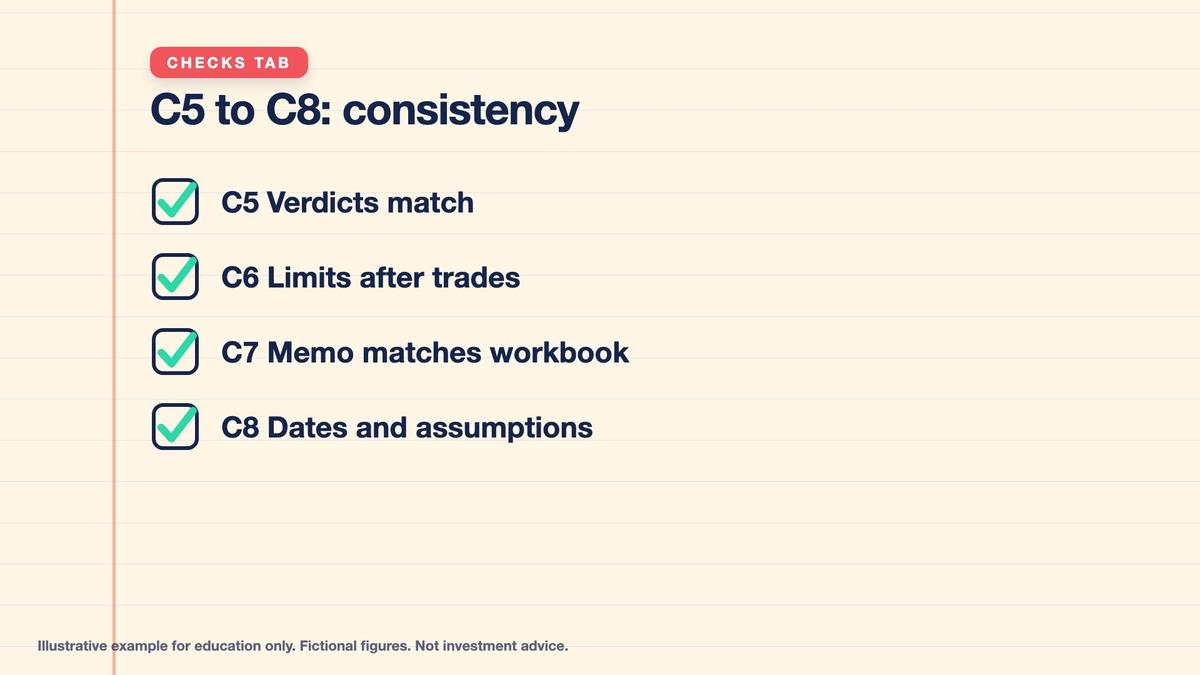
C6 rechecks allocation constraints after the simulated trades. On the main $100,000 reference basis, the largest holding is 30%, crypto is 5%, and cash is 21%, so all three limits pass. On the post-cost $99,984 basis, the exact crypto percentage is slightly above 5%, despite rounding to 5.0% at one decimal. Record that as a precision qualification and do not describe the post-cost portfolio as strictly compliant under an exact, unrounded maximum. C7 compares every memo number with the currently selected Option C workbook result. C8 confirms that dates, sources, assumptions, reference bases, rounding conventions and the invented nature of all shocks are stated, and that the language contains no predictions.
Key points
- Eight checks: C1 holdings sum, C2 weights sum, C3 holding changes add to totals, C4 tolerance shares, C5 verdicts match, C6 limits after trades, C7 memo matches workbook, C8 dates and assumptions.
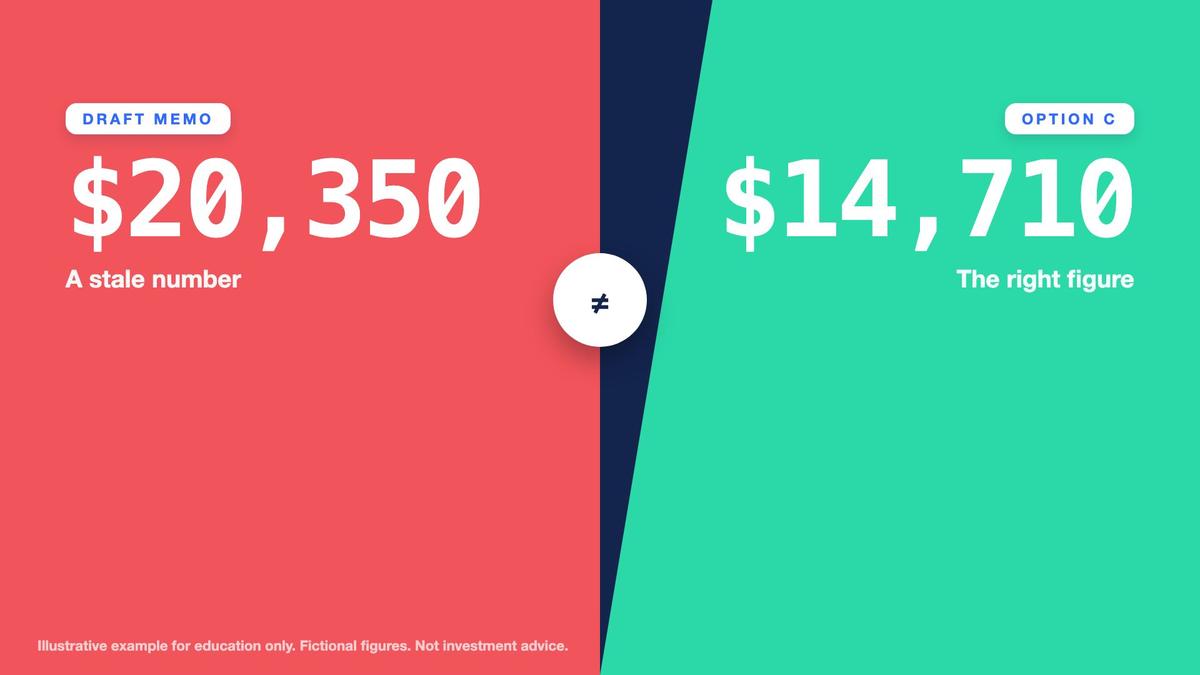
- Stale number: a draft memo quoting $20,350 as the final combined loss is Option A; the final is $14,710 (a $5,640 gap).
- Boundary pass: post-cost coin is 5,000 / 99,984 = 5.0008%, shown as 5.0% under the one-decimal convention; the notes record the exact value.
Use C7 to find a deliberate stale-number error in a draft memo. The draft incorrectly reports a combined stress loss of $20,350 for the final portfolio, but that is Option A's result from the earlier lesson. The final Option C result is $14,710, a difference of $5,640. Correct the memo and confirm that its tolerance share, verdict, headroom and option label are consistent with the workbook. A final verification pass should be repeated after any edit, even if the changed figure appears harmless. This is particularly important when formulas, copied tables and written summaries are maintained separately. The aim of verification is not merely to display eight checkmarks; it is to show evidence for each result and preserve meaningful exceptions.
Complete Three Dated Trading Journal Entries
The first required journal entry records portfolio construction on June 1, 2026. It should state the fictional $100,000 starting value, ten-year growth objective, $15,000 bad-scenario loss tolerance and original allocation constraints. Map every holding to its intended job and primary risk source. Sample Wide Stock ETF provides broad growth exposure and stock market risk. Sample Bond Fund serves income and relative stability while carrying interest rate and credit risk. Sample Gold Fund is a diversifier with gold price and currency risks. Sample Foreign Stock ETF adds growth outside the home market along with equity and SCU currency exposure. Sample Coin has a small speculative purpose and crypto price and custody risk, while cash provides liquidity with inflation risk.
The second journal entry documents the stress-test review. Record all four Option C losses and their tolerance shares, but also preserve the reasons for changing the original portfolio: Option A breached the equity test by $1,500 and the combined test by $5,350. State the underlying invented shock assumptions, including the unchanged SCU rate in equity and crypto scenarios, the 20% SCU depreciation in the currency scenario, and multiplication of 0.70 and 0.80 in the combined scenario. The journal should distinguish the date when the model is assumed to exist from the date this review entry is written. Do not invent a historical review date merely to make the chronology look complete.
Key points
- Journal: three dated entries: build (each holding's job and risk source), stress (four results and the two Option A breaches), decide (Option C, $16 cost, $290 fragile headroom, reasons to revisit).
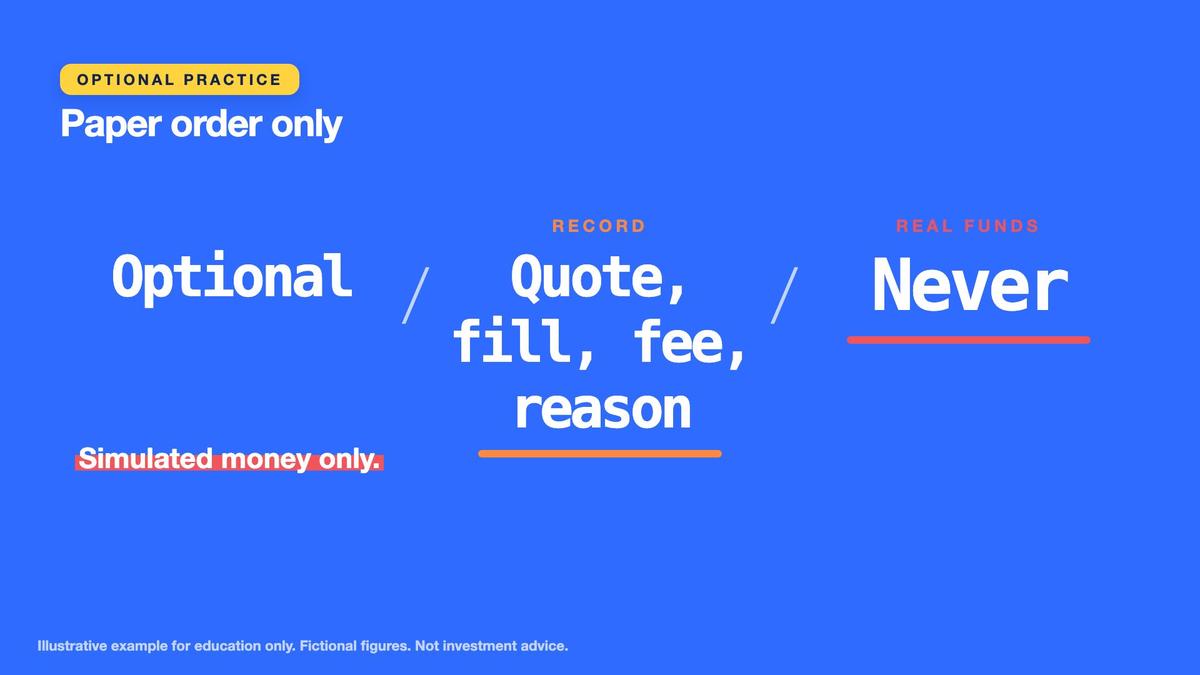
- Optional paper practice: record quote, fill, fee and reason for one small mock order on a demo platform.
- Never connect a wallet or paste keys; simulated money only.
The third entry records the Lesson 30 classroom decision: Option C was selected conditionally, with $10,000 of wide stocks and $6,000 of foreign stocks moved to cash on the pre-cost reference basis. Record the $16 modeled transaction cost and flag the combined stress's $290 pre-cost headroom as fragile. State the potential growth opportunity cost of reducing stock exposure to 39% and raising cash to 21%, as well as the exact post-cost crypto percentage exception. Add what would change the decision, such as new scenario assumptions or a revised written objective. An optional fourth note can document one isolated paper-trading mock order, with its observed quotation, simulated fill, fee and reason. Never describe an unexecuted classroom calculation as a real transaction.
Apply the 100-Point Rubric and Package the Final Files
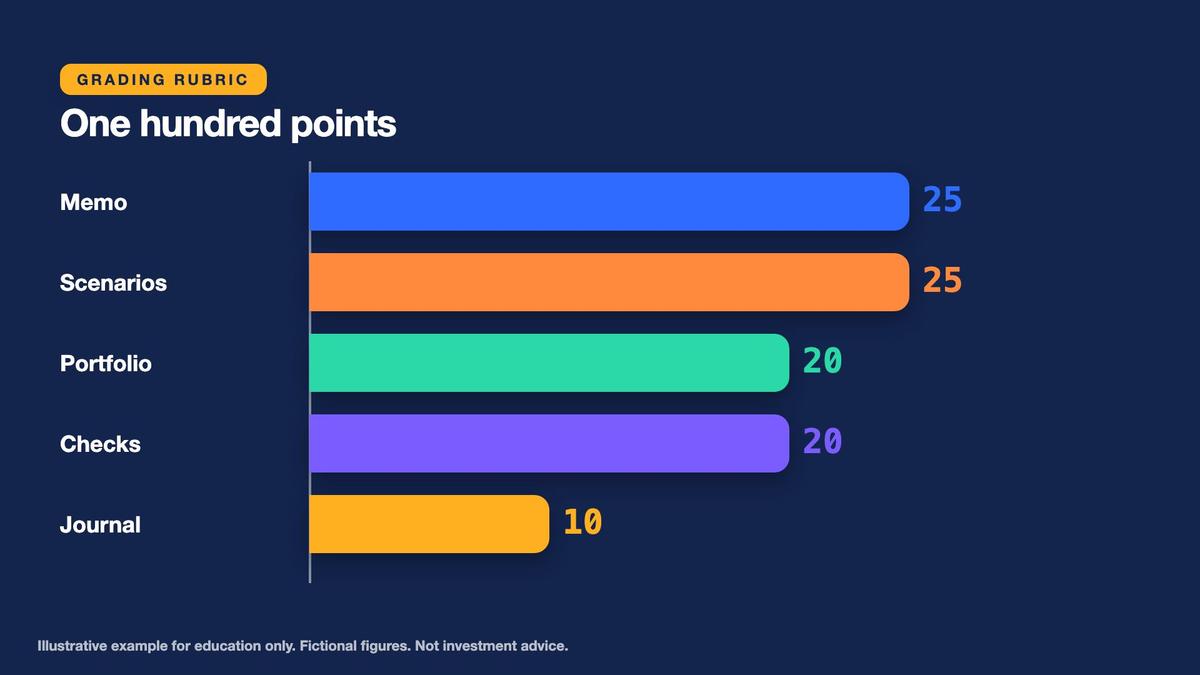
The final grading rubric awards 20 points for the portfolio sheet, 25 for scenarios, 25 for the decision memo, 20 for verification notes and 10 for the trading journal. These categories sum to 100 points. Portfolio sheet quality includes correct holdings, currency conversion, weights, documented objectives and risk sources. Scenario quality includes explicit assumptions, holding-level calculations, correct totals, tolerance shares and verdicts. The memo is evaluated for policy-based reasoning, clarity, numerical agreement and acknowledgment of trade-offs. Verification notes are judged by whether the eight checks can be repeated and whether exceptions are disclosed. The journal is evaluated for chronology, rationale, corrections and distinction between simulated and actual activity.
Use the fictional sample self-assessment of 18 points for the portfolio sheet, 22 for scenarios, 20 for the memo, 16 for verification and 8 for the journal. Their total is 18 plus 22 plus 20 plus 16 plus 8, equaling 84 out of 100. The score measures the completeness and quality of an educational submission, not investment ability, trading profitability or any certification. The learner should identify where the remaining points were lost and what evidence could improve the package. For example, missing a precise accounting qualification or leaving stale numbers in the memo could justify revisions even if the core scenario arithmetic is correct. No financial reward, capital allocation or real funded account is implied by this rubric.

Key points
- Rubric (100): portfolio 20, scenarios 25, memo 25, checks 20, journal 10. Sample self-check: 18 + 22 + 20 + 16 + 8 = 84.
- A passing score measures reproducible documentation, not market skill or predicted returns.
- Name the package consistently, for example mat_week6_submission_v1, with the last check date and version in every document.
Save the three submission artifacts together using a consistent versioned identifier, such as mat_week6_submission_v1, with appropriate file extensions for the workbook, memo and notes. Record the fictional June 1, 2026 reference date separately from the actual date of the last verification. Ensure the document versions agree and avoid leaving an outdated memo next to a newly edited workbook. A reader should be able to locate each memo figure, trace it to a workbook cell or calculation, understand its units and evaluate its supporting assumptions. Before finalizing, rerun C1 through C8 and revise the verification status if anything changes. A polished appearance is useful only when the underlying numerical evidence remains correct.
Perform the Final Checklist and Prepare for Funded Stage Rehearsal
The last review begins with the three required artifacts and confirms that the workbook contains all seven named tabs. Check that the Holdings tab reports six positions totaling $100,000 on the reference basis, with a separately labeled $99,984 cost-funded account value. Check the foreign SCU conversion and verify weights to the stated one-decimal display precision while preserving full formulas. Inspect the Scenarios tab for four completed tests, including the three independent adverse scenarios and the combined case. Verify that the memo reports Option C's $14,710 combined loss rather than Option A's stale $20,350 figure. Confirm that the $290 headroom and the separate $274 cost-inclusive sensitivity are not confused.
Hands-On Final Submission Audit: Workbook, Memo and Verification
Assemble the final three-part Week 6 package using only the fictional Option C portfolio. Create seven workbook tabs named Policy, Holdings, Scenarios, Options, Decision, Journal and Checks. Record the June 1, 2026 reference date, $100,000 pre-cost portfolio, $99,984 cost-funded alternative, six final holdings and stated one-decimal weight convention. Reproduce the four stress losses of $11,700, $4,950, $1,600 and $14,710 using holding-level formulas and the invented $15,000 tolerance. Display the $290 pre-cost combined headroom and separate $274 headroom after simply adding the $16 modeled transaction cost. Explain that the reference-basis crypto weight is exactly 5%, while the exact post-cost weight is approximately 5.0008% and therefore exceeds a strict unrounded 5% maximum despite displaying as 5.0%. Complete the one-page memo with seven required sections, including the four-part Decision, Because, Trade-offs and What would change my mind paragraph. Correct the deliberate stale combined loss of $20,350 to Option C's $14,710. Perform verification checks C1 through C8, write three dated journal entries, score the submission using the 100-point rubric, and save the workbook, memo and verification notes together under a versioned filename such as mat_week6_submission_v1. For optional practice, open https://research-paper-trade-webapp.pages.dev/paper/ only if it allows a safe isolated mock order, record fill, fee and rationale, and never connect real financial accounts, wallets, exchanges or credentials.
- Decision 1: The fictional final Option C holdings are $30,000 wide stocks, $25,000 bonds, $10,000 gold, $9,000 foreign stocks, $5,000 coin and $21,000 cash. The two selling spread charges are $4 and $12. — How should the workbook reconcile the portfolio on both reference and post-cost bases, and what precision qualification must be disclosed?
- Decision 2: The learner must document the final Option C equity, crypto, currency and combined stress results using the fictional $15,000 downside tolerance. — What four results, tolerance shares and verdicts belong in the Scenarios tab and one-page memo?
- Decision 3: A draft one-page memo reports the final combined scenario loss as $20,350, while the final workbook's Option C combined loss is $14,710. — Which verification check catches this problem, what is the correct number, and what is the numerical difference?
- Decision 4: The workbook must contain a complete audit trail for an entirely simulated project, including three dated journal entries and eight verification checks. — What must each journal entry contain, and what should the learner do when a check reveals an unresolved precision issue?
- Decision 5: The grading rubric awards 20 points for portfolio sheet, 25 for scenarios, 25 for decision memo, 20 for verification and 10 for journal. Sample scores are 18, 22, 20, 16 and 8. — Calculate the self-check score and state the final packaging steps before the Week 6 lab.
Answer key
Next examine policy compliance. The reference-basis limits pass, but the exact post-cost crypto weight is approximately 5.0008%, creating a small strict-threshold exception despite its 5.0% displayed value. Document this openly. Confirm that all assumptions are invented, all shocks are labeled as scenarios rather than forecasts, and the $16 trading cost is consistently accounted for. Ensure the journal includes three dated entries and any optional practice note. If a final edit changes a holding, cost or scenario result, repeat every affected calculation and all eight verification checks. Do not submit a package that is numerically inconsistent merely because its formatting looks complete.
Key points
- After the last edit, run all eight checks again: one changed figure can break another.
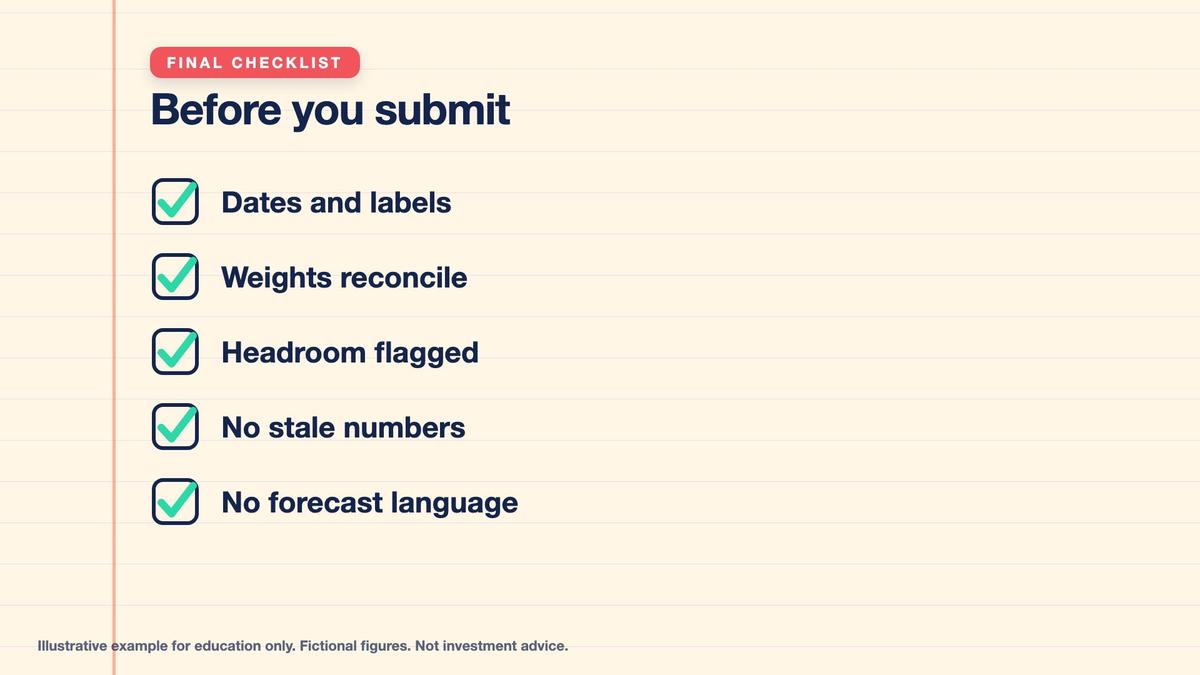
- Final checklist: dates and labels, weights reconcile, headroom flagged, no stale numbers, no forecast language.
- Next: the Week 6 lab, Funded stage rehearsal: reconcile demo fills, fees and closing P&L before assessment.
For optional practice, the learner may open the user-provided Paper Trading section at https://research-paper-trade-webapp.pages.dev/paper/ if it safely supports isolated mock orders without financial connections. Enter one small fictional order and record the simulated quotation, fill price, fee and trade rationale in the journal. Do not connect a real wallet, exchange or funded account; do not paste keys, passwords or recovery phrases; and do not place real orders or transfer money. If the site requires any real financial connection, complete the activity offline instead. The upcoming Week 6 lab, Funded Stage Rehearsal, will reconcile simulated fills, explicit fees and closing profit or loss before assessment. Despite its name, the rehearsal remains strictly paper-based, with no promise or requirement of actual funding.
Worked example at a glance
Key terms
- Workbook: the seven-tab file holding policy, holdings, scenarios, options, decision, journal and checks.
- Memo: the one-page written decision summary.
- Verification notes: the record of the eight checks and the conventions used.
- Reference basis: the $100,000 pre-cost value used for comparisons.
- Post-cost basis: the value after paying modeled costs from cash.
- Stale number: a figure left over from an earlier version.
- Boundary pass: a pass that sits at, or within rounding of, a limit.
- Headroom: tolerance minus the tested loss.
- Rubric: the 100-point grading scheme.
- Journal: dated entries recording the build, stress and decision.
- Check: one repeatable verification of a number or rule.
- Version: a label such as v1 that identifies the saved package.
Multi Asset Trading Lab is an educational course and does not provide investment advice, financial planning recommendations, brokerage instructions, portfolio management advice, accounting advice, tax advice, custody guidance, market forecasts or predictions of prices or future returns. This lesson completes an entirely fictional Week 6 model portfolio assignment using simulated capital and invented financial assumptions. Every asset, fund name, fictional currency, price, transaction, return shock, holding value, allocation percentage, expense rate, trading spread, portfolio decision, stress result and simulated account balance is created for classroom practice. No real fund, issuer, ticker, coin, exchange, financial institution or actual market quotation is identified or recommended. The reference portfolio date of June 1, 2026 is an invented classroom date and not a claim about actual historical prices. The final fictional Option C portfolio contains Sample Wide Stock ETF valued at $30,000, Sample Bond Fund valued at $25,000, Sample Gold Fund valued at $10,000, Sample Foreign Stock ETF valued at $9,000, Sample Coin valued at $5,000 and cash valued at $21,000. These values total exactly $100,000 on the stated pre-cost reference basis. The corresponding weights are 30%, 25%, 10%, 9%, 5% and 21%, totaling 100%. The fictional foreign stock holding is denominated in an invented currency called SCU and represents 7,200 SCU at an assumed conversion rate of one SCU equal to $1.25. Its $9,000 valuation is therefore a classroom conversion rather than an executable exchange rate. The model investment policy seeks long-term growth with moderate risk over ten years, defines a bad-scenario loss tolerance of 15% of the initial $100,000 reference capital, or $15,000, and limits a single holding to no more than 40%, crypto to no more than 5%, and cash to at least 5%. These policy amounts are invented educational constraints, not universally suitable allocations, objective definitions of moderate risk, or guarantees of maximum loss. Actual investment suitability depends on individual needs, risk capacity, legal obligations, financial circumstances, investment knowledge, liquidity requirements and other considerations not evaluated in this exercise. The final classroom allocation follows the Option C decision developed in the earlier simulated lesson. That option notionally sells $10,000 of wide stocks and $6,000 of foreign stocks, retaining those nominal amounts as cash. The fictional wide stock selling spread is 0.04% of $10,000, or $4, and the fictional foreign stock selling spread is 0.20% of $6,000, or $12. The modeled total trading cost is $16. These invented charges do not represent actual costs on any exchange or trading platform and exclude other potential commissions, market impact, taxes, foreign currency conversion costs, custody expenses, market gaps, timing differences and slippage. The lesson makes an explicit distinction between the nominal $100,000 pre-cost reference portfolio, which is the basis for the main holdings, weights and scenario comparisons, and a $99,984 post-cost portfolio if the $16 fee is deducted from cash. Under that second convention, the cash balance becomes $20,984 rather than $21,000, while the other nominal holdings remain unchanged. These two accounting treatments should not be mixed without labels. The main workbook reports allocation weights to one decimal place and performs its classroom reference-basis policy checks using the $100,000 pre-cost portfolio. On that basis, the $5,000 Sample Coin allocation is exactly 5%, complying with the stated maximum. On the $99,984 post-cost basis, however, the exact percentage is $5,000 divided by $99,984 multiplied by 100, or approximately 5.000800128%. Although this appears as 5.0% when displayed to one decimal place, it mathematically exceeds a strict, unrounded 5% maximum by approximately 0.000800 percentage points. Rounding the display does not remove the exact violation. The learner must explicitly record the rounded classroom boundary pass and the exact post-cost threshold exception as separate statements. If strict post-cost compliance were required, an additional specified transaction, allocation adjustment or formally defined policy convention would need to address the discrepancy. The lesson does not silently assume that a rounded pass proves full exact compliance. The reference-basis allocation limits otherwise pass: the largest individual holding is 30%, below the 40% maximum, crypto is exactly 5%, and cash is 21%, above the 5% minimum. These initial allocation checks do not establish that the portfolio is protected against future losses. The four stress results in the final submission are hypothetical consequences of invented shock assumptions. They are not historical returns, forecasts, probability distributions, value-at-risk calculations, confidence intervals, guarantees or estimates of maximum potential loss. The first scenario assumes Sample Wide Stock ETF and Sample Foreign Stock ETF each decline 30%, with the foreign decline measured in SCU and the exchange rate unchanged, Sample Bond Fund rises 3%, Sample Gold Fund rises 5%, Sample Coin declines 25%, and cash remains unchanged. The $30,000 wide stock holding therefore loses $9,000, the $9,000 foreign stock holding loses $2,700, bonds gain $750, gold gains $500, coin loses $1,250 and cash changes by zero. The bond and gold gains exactly offset the crypto loss in this invented example, producing a total portfolio loss of $11,700. The result consumes 78% of the fictional $15,000 downside tolerance and leaves $3,300 headroom. Such exact offsets are properties of chosen numerical assumptions and do not imply that bonds or gold reliably protect against stock or cryptocurrency declines. A real portfolio could have multiple positions falling together, and correlations can change under stress. The second scenario assumes Sample Coin declines 60%, wide stocks decline 5%, foreign stocks decline 5% in SCU with the exchange rate unchanged, and bonds, gold and cash remain constant. The resulting losses are $3,000 on coin, $1,500 on wide stocks and $450 on foreign stocks, totaling $4,950. This consumes 33% of the written $15,000 tolerance and passes. It does not establish that cryptocurrency exposure is safe, that crypto losses are bounded by the modeled amount, or that custody and operational risks can be reduced to a price percentage. Crypto assets can experience extreme volatility, limited liquidity, custody loss, platform failure, irreversible transfer errors and other risks not quantified here. The third scenario assumes the fictional SCU depreciates 20% against USD, moving the invented conversion rate from $1.25 per SCU to $1.00, while the foreign stock fund's local-currency price remains unchanged. The 7,200 SCU foreign position therefore becomes worth $7,200 instead of $9,000, losing $1,800. The scenario also assumes Sample Gold Fund gains 2%, or $200, with other holdings unchanged. The net portfolio loss is $1,600, equal to approximately 10.6667%, displayed as 10.7%, of the $15,000 tolerance. It passes the stated classroom test. This currency example isolates a particular translation mechanism and is not a universal model of real foreign securities, which can have multiple underlying currencies, hedging arrangements, operational exposures and correlated market returns. The fictional gold gain is also an imposed assumption rather than an expected currency response. The fourth combined scenario assumes wide stocks decline 30%, bonds gain 3%, gold gains 5%, Sample Coin declines 60%, cash remains unchanged, and foreign stocks experience both a 30% SCU-denominated equity decline and a 20% SCU depreciation against the dollar. The two foreign shock factors must be multiplied because successive percentage changes act on changing values. The remaining foreign equity factor is 0.70, and the remaining currency factor is 0.80. Their product is 0.56. Applying this to the final $9,000 foreign stock holding produces $5,040 of value and a $3,960 loss. Adding the $9,000 wide stock loss, $750 bond gain, $500 gold gain, $3,960 foreign stock loss, $3,000 coin loss and unchanged cash gives a net loss of $14,710. Relative to the original $100,000 reference portfolio, this is 14.71%. Relative to the written $15,000 tolerance, it consumes approximately 98.0667%, displayed as 98.1%. The reference-basis scenario therefore passes but leaves only $290 of headroom. This is a thin conditional margin, not a safety cushion guaranteed to survive worse shocks, different correlations, wider spreads or more unfavorable execution. For an additional accounting sensitivity, the lesson simply adds the separately modeled $16 trading spread cost to the $14,710 combined scenario loss, producing $14,726 and leaving $274 relative to the original $15,000 limit. The corresponding tolerance utilization is approximately 98.1733%, displayed as 98.2%. This additional calculation is a simplified cost-inclusive comparison using the original tolerance reference and not a complete realized account-path simulation. An exact implementation would require details of transaction execution, cost timing, account funding and subsequent exposure. Both the $290 pre-cost headroom and the $274 simple cost-adjusted sensitivity must be labeled correctly. The $20,350 combined loss from the original Option A portfolio is not the final Option C loss. The difference between $20,350 and $14,710 is $5,640, representing the conditional reduction in that specifically tested combined scenario. It is not an actual profit, a guaranteed saving, expected return or forecast. A draft final memo that accidentally quotes $20,350 as Option C's loss contains a stale-number error. The verification process must identify and correct that inconsistency and recheck all associated headings, tolerance percentages, pass or breach statements and headroom figures. The lesson requires a workbook containing seven tabs named Policy, Holdings, Scenarios, Options, Decision, Journal and Checks. The one-page memo requires seven conceptual components: a header with the reference date and accounting basis, portfolio snapshot, written policy and limits, four-result scenario table, decision paragraph, limitations, and verification status. The decision paragraph must use the openings Decision, Because, Trade-offs and What would change my mind. The classroom Option C decision is conditional on the stated fictional policy and four selected stress tests. It is not a recommendation to increase real cash holdings to 21%, reduce equity allocations to 39%, or execute any actual transaction. The trade-offs include reduced hypothetical participation in future stock market growth, increased cash exposure and the possibility that inflation reduces purchasing power. No probability is supplied for the scenarios, and a passing result under four invented shocks cannot prove that all future adverse events are covered. The verification notes must document eight checks. C1 reconciles the $100,000 pre-cost holdings and $99,984 post-cost account value. C2 verifies that reference weights sum to 100.0%. C3 confirms that each scenario's holding-level changes sum to its net result. C4 divides absolute scenario losses by the $15,000 tolerance to obtain tolerance utilization. C5 confirms that a loss at or below the maximum passes and a loss above it breaches. C6 rechecks allocation limits after the fictional trades and discloses the exact post-cost crypto exception rather than hiding it through rounding. C7 ensures that every memo figure matches the current selected workbook calculation, particularly the final combined loss of $14,710. C8 ensures that assumptions, reference bases, dates, rounding conventions, version information and the hypothetical nature of scenarios are explicitly stated and that the written work does not use forecast language. The status of any check must be supported by evidence. An unresolved exact threshold exception should be recorded as a qualification instead of being concealed by a blanket declaration of full compliance. The journal includes three dated entries: construction of the fictional portfolio on June 1, 2026 with each holding's objective and primary risk source; a stress-test review recording the four final scenario results and the two breaches previously observed under Option A; and a classroom decision entry recording Option C, its $16 modeled transaction cost, $290 thin pre-cost combined headroom, material growth trade-offs, precision exception and reconsideration conditions. If the actual dates of the later reviews are not specified, the learner should record when those entries are genuinely created rather than inventing dates or representing a simulation as a historical transaction. An optional paper-trading note can record a mock quotation, simulated order fill, explicit fee and written reason, but it must not be treated as evidence of actual market execution. The grading rubric has a maximum of 20 points for the portfolio sheet, 25 for scenarios, 25 for decision memo, 20 for verification notes and 10 for the journal, totaling 100. A fictional sample self-check score of 18, 22, 20, 16 and 8 yields 84 out of 100. This rubric evaluates educational documentation, completeness, mathematical consistency and reasoning; it is not a credential, performance forecast, eligibility assessment for financial funding, or proof of trading competence. The learner should preserve the workbook, memo and verification notes together under a versioned identifier such as mat_week6_submission_v1, with corresponding file extensions and the actual date of final verification. All final checks should be repeated after the last numerical edit. Optional paper practice may use the user-provided webpage https://research-paper-trade-webapp.pages.dev/paper/ only if it visibly offers a safe isolated simulation without any requirement to connect financial accounts or submit confidential credentials. The webpage is not independently verified in this lesson and should not be treated as an endorsed broker, exchange, financial institution or authoritative specification source. Learners must never connect a real wallet, funded account, exchange or payment method, never enter private keys, recovery phrases or sensitive credentials, never transfer actual assets and never place real orders for this exercise. If the page does not provide a suitable isolated mock environment, learners should use an offline worksheet or calculator. The next educational activity is the Week 6 lab titled Funded Stage Rehearsal. Despite that title, it remains a simulated exercise intended to reconcile demo order fills, fees and closing profit or loss before an educational assessment; it does not require, promise or recommend actual funding or participation in a real trading program. All calculations, portfolio choices, results, policies, assessment scores and scenarios remain fictional and are provided strictly for education, without investment advice or price predictions.
Lesson Checkpoint
Review what you learned and get feedback on your work.