



This twelve-minute beginner hands-on lab teaches learners to audit a fictional trainee's futures risk sheet before accepting its calculations. The learner acts as a reviewer of Sample Micro Oil futures, using a specification dated April 1, 2026, a superseding margin notice dated April 15, and a simulated review date of April 20. Six submitted assumptions are evaluated: tick value, initial margin, whole-contract sizing, zero-slippage planning, minimum contract size, and commission. Five assumptions fail and one passes. The corrected contract tick value is $1.00 rather than $10.00; updated initial margin for two contracts is $1,400 rather than $1,200; and the valid risk-budget position is two contracts rather than three. The corrected plan has $83 commission-inclusive stop risk, increasing to $89 under an invented three-tick entry-slippage stress. A separate 120-tick-stop proposal fails because its theoretical 0.82-contract size cannot meet the one-whole-contract minimum without exceeding the $100 risk budget. Learners calculate error impacts in dollars, stress a further 25% initial-margin increase, check expiry deadlines, and produce a one-page review memo with an assumptions register and documented pass-or-fail findings. The final activity is a mock order review using a paper-trading platform without connecting real accounts or wallets. The outcome is a reproducible audit of contract specifications, minimum position size, slippage assumptions, and risk-policy compliance. All market values, instruments, notices, orders, and financial outcomes are fictional and educational.
Establish the Clinic and Preserve the Dated Sources
A risk review clinic examines a trading proposal before accepting its assumptions. In this laboratory, the learner is a reviewer evaluating a fictional trainee's submission for Sample Micro Oil futures. The goal is not to decide whether oil will rise or fall. It is to determine whether contract size, tick value, margin requirements, position quantity, execution assumptions and commissions have been calculated consistently with the written policy. Use a review register rather than relying on the trainee's summarized figures. Each assumption needs its claimed value, a dated source, a verified calculation, a pass-or-fail verdict and a quantified impact where possible. Retain the original submission unchanged so the corrected work can be compared with it.

The fictional specification is dated April 1, 2026. It describes a 100-barrel cash-settled micro oil contract with a $0.01 price tick, minimum order size of one whole contract, $0.75 commission per contract per side, $600 initial margin and $540 maintenance margin. Its stated last trading day is Tuesday, May 19, 2026. A separate fictional margin notice dated April 15 raises initial margin to $700 and maintenance margin to $630 per contract. The review takes place Monday, April 20, 2026. Because the later notice precedes that review date and supersedes the earlier margin requirements, it must be applied. Do not merge the old and new margin figures or average them.

Key points
- A risk review clinic checks someone else sheet against dated sources before a plan is approved; precise numbers can still be wrong.
- Collect the April 1 specification and the April 15 margin notice; record the review date, Monday April 20, and 29 days to the May 19 last trading day.
- Build an assumptions register: claim, source and date, claimed value, verified value, verdict and dollar impact. Six claims, five fail, one passes.
The sample account contains $10,000 of simulated equity and follows a written 1% planned-risk rule, creating a $100 risk budget. The submitted trade idea is a long position at the $70.02 ask, with an intended stop at $69.62. The displayed bid is $70.00, making the spread two one-cent ticks. The submitted sheet contains six claims: $10 micro tick value, $600 current initial margin, a three-contract size obtained by rounding upward, zero slippage as a planning certainty, a valid 0.82-contract order for another wider-stop proposal, and $0.75 commission per contract per side. The learner will audit these claims independently, even when some are internally inconsistent.

Audit Tick Value and Identify the Wrong Multiplier
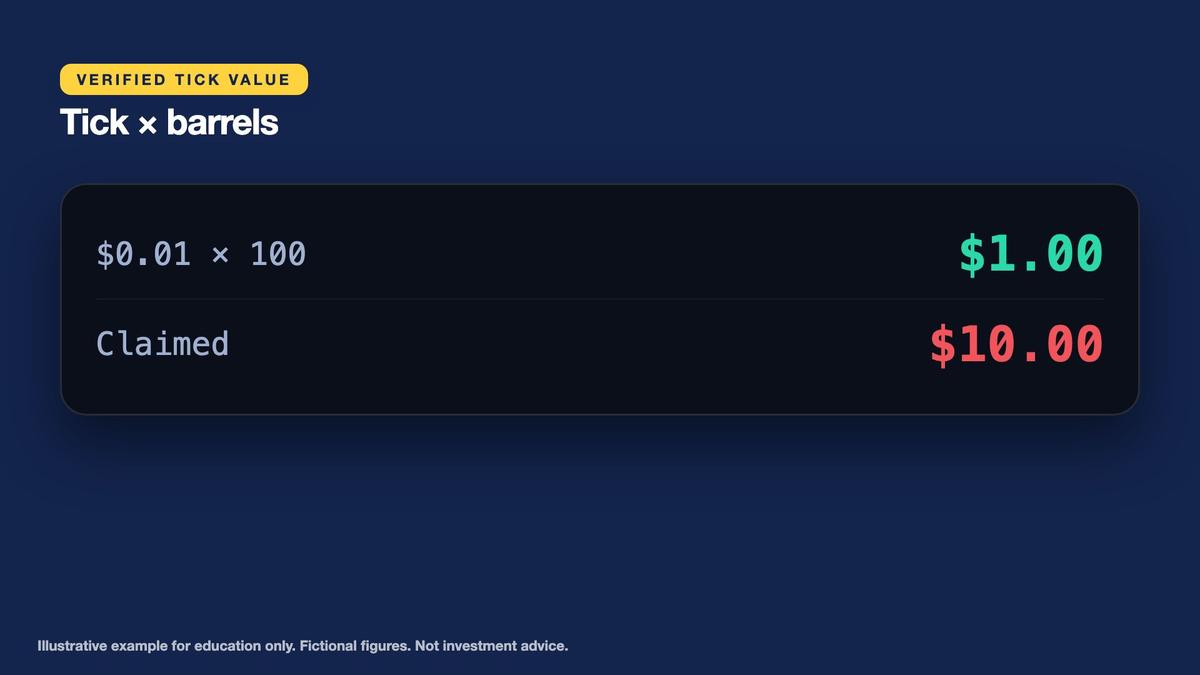
The first submitted assumption states that one price tick is worth $10 per Sample Micro Oil contract. To verify it, use the dated contract specification rather than the trainee's calculation. One fictional micro contract represents 100 barrels, and the minimum price tick is $0.01 per barrel. Tick value is therefore 100 multiplied by $0.01, or $1.00 per contract. The fictional standard comparison contract represents 1,000 barrels, so its corresponding tick value is $10. The submitted claim appears to have imported the standard multiplier into the micro calculation. Mark the micro tick-value assumption as failed and record the corrected $1.00 figure.
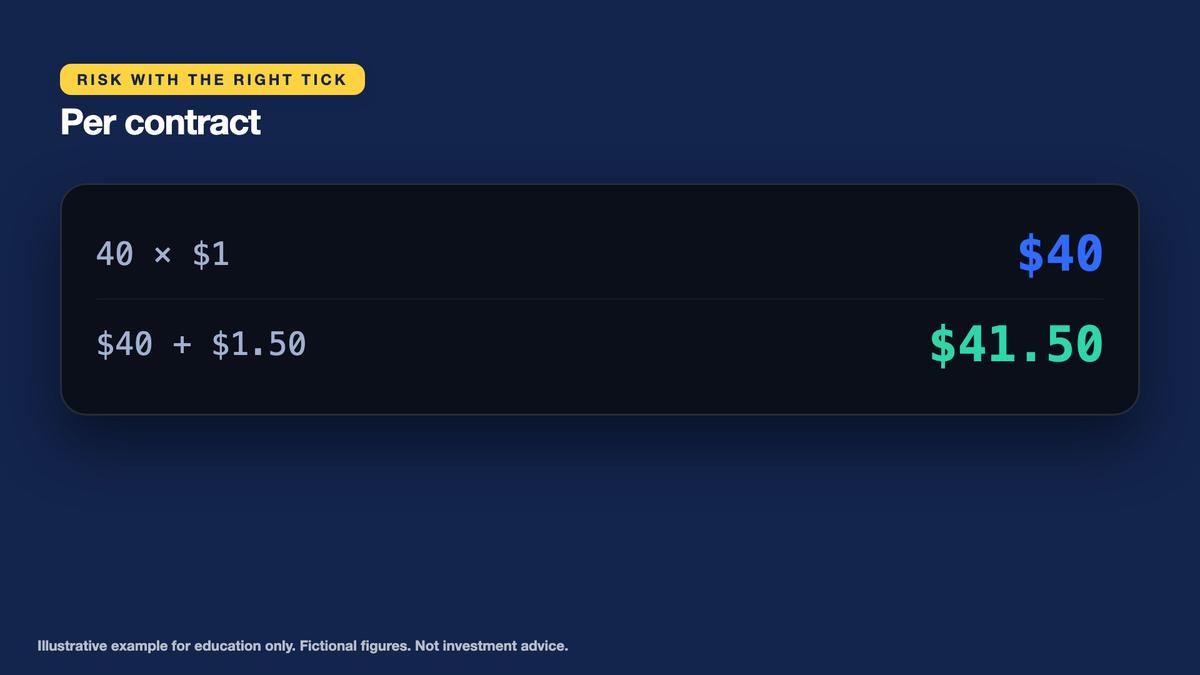
The mistake materially distorts the proposed stop-risk calculation. The planned entry is $70.02 and the intended stop is $69.62, so the adverse movement is $0.40 per barrel, equivalent to 40 ticks. If the reviewer incorrectly used $10 per tick, that would imply $400 price risk per contract. Adding the correct $1.50 round-trip commission per contract would produce $401.50. Using the verified micro tick value of $1, the same 40 ticks represent only $40 of price risk. Adding $1.50 commission gives $41.50 of correct planned risk per contract. The erroneous estimate therefore overstates per-contract risk by $360.
Key points
- Claim 1: tick value $10.00. Verify: $0.01 x 100 barrels = $1.00; $10.00 belongs to the fictional 1,000-barrel standard contract.
- Wrong tick: 40 x $10 + $1.50 = $401.50 risk per contract. Right tick: 40 x $1 + $1.50 = $41.50.
- A tenfold multiplier error overstates the per-contract risk by $360.
The incorrect tick value is ten times the correct tick value, although the commission-inclusive risk totals are not exactly ten times apart because the same $1.50 fee appears in each. In the assumptions register, distinguish the multiplier error from the resulting monetary discrepancy. Record that the submitted $10 figure belongs to the fictional standard contract and cannot be used to evaluate the micro position. This also reveals an internal inconsistency: the trainee's later theoretical size of approximately 2.41 contracts comes from using the correct $41.50 per-contract risk, not the claimed $401.50. A reviewer must investigate each formula separately instead of treating inconsistent fields as jointly verified.
Verify Margin Version Control and Required Collateral
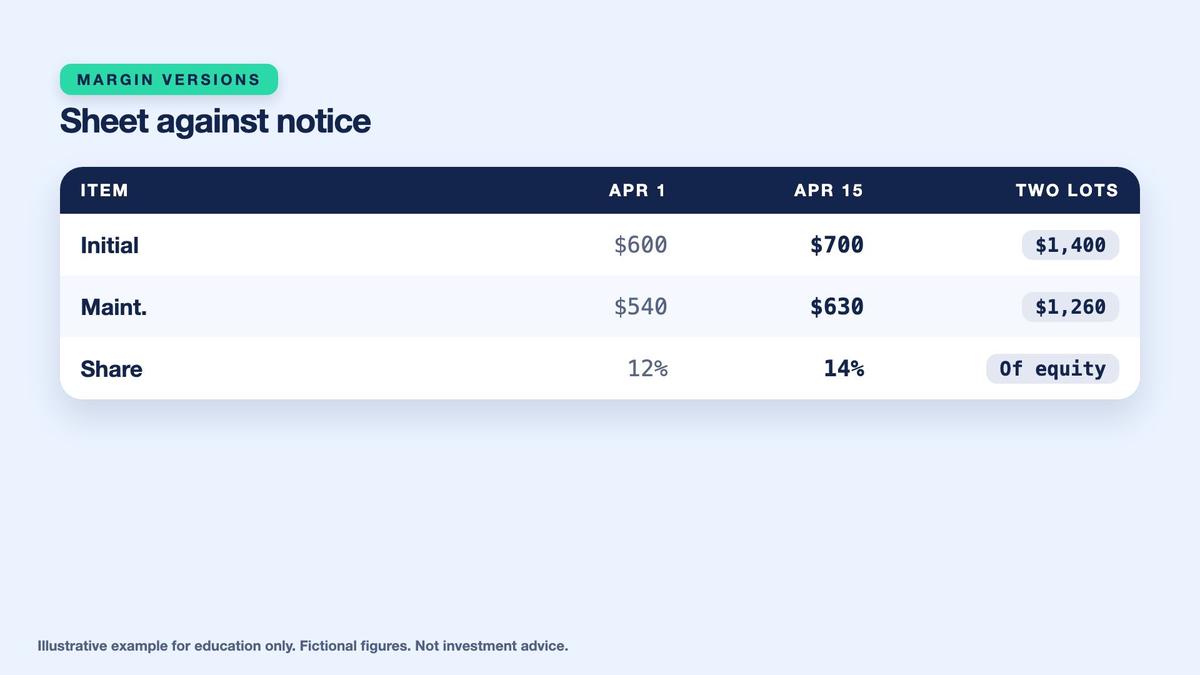
The second submitted assumption uses $600 initial margin per contract. That was the figure in the fictional April 1 specification, so the source existed, but the value is obsolete for the April 20 review. The April 15 notice supersedes it with a $700 initial requirement and $630 maintenance requirement. The distinction demonstrates why identifying an apparently official document is not sufficient: the reviewer must check its effective date and later revisions. Mark the $600 current-margin claim as failed. Retain the original document date in the register while identifying the later notice as the controlling source for the reviewed simulation.

For two correctly sized contracts, the outdated $600 figure would imply $1,200 initial margin, equal to 12% of the $10,000 account. The updated $700 figure requires $1,400, or 14% of equity. The submitted plan therefore understates initial collateral by $200. Updated maintenance margin is two times $630, or $1,260. Under the lesson's simplified calculation, free equity before commissions, price changes and other obligations is $10,000 minus $1,400, or $8,600. This is a collateral accounting illustration rather than a claim that $8,600 is always withdrawable from an actual futures account.
Key points
- Claim 2: initial margin $600 from the April 1 sheet. The April 15 notice supersedes it: $700 initial and $630 maintenance.
- Two contracts: 2 x $700 = $1,400 (14% of equity), not 2 x $600 = $1,200; the sheet understates margin by $200.
- Free equity before costs is $10,000 - $1,400 = $8,600; maintenance is 2 x $630 = $1,260.
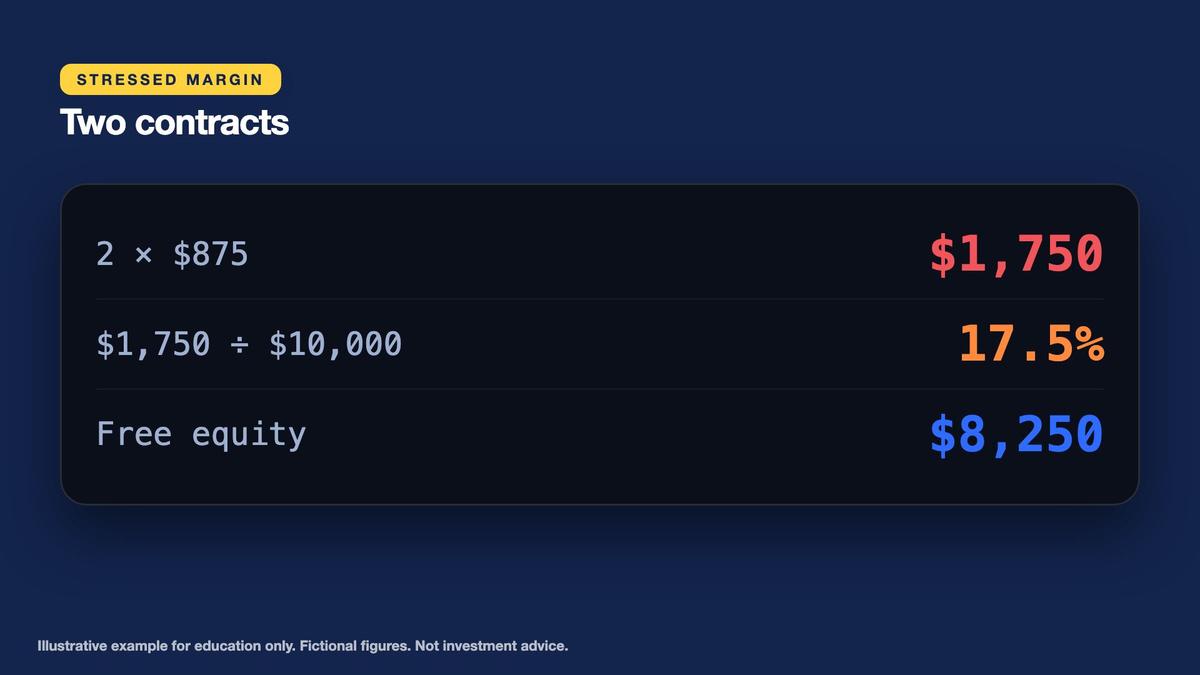
A later stress test assumes that the broker hypothetically raises initial margin by another 25% from the updated $700 figure. The resulting initial margin is $875 per contract, so two contracts require $1,750, or 17.5% of starting equity. Simplified free equity falls to $8,250, a $350 reduction from the prior $8,600 figure. The fictional stress specifies an increase to initial margin only, so do not invent another maintenance margin change. Margin requirements influence collateral availability and possible liquidation pressure, but they do not change the contract's $1-per-tick value. Keep contract sensitivity, initial margin, maintenance margin and stress assumptions as separate journal fields.
Recalculate Whole-Contract Sizing and Reject Oversizing
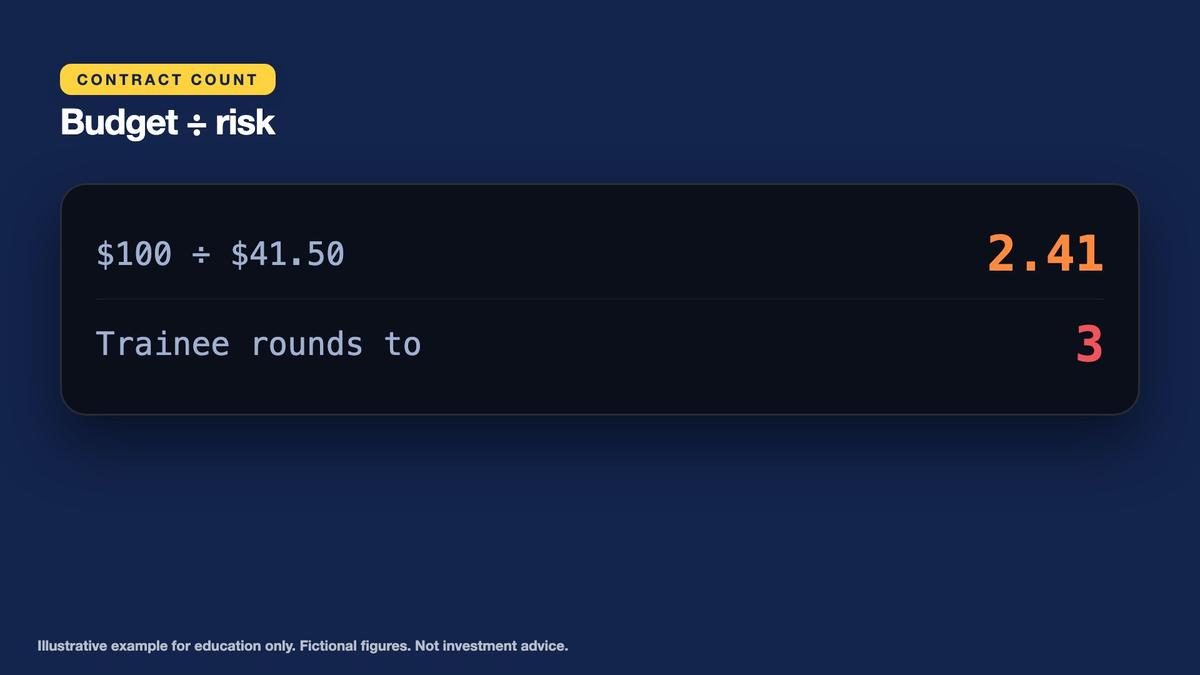
The third assumption claims that a theoretical position size of 2.41 contracts should be rounded upward to three. Begin with the $100 risk budget derived from 1% of the fictional $10,000 account. The planned stop is 40 ticks away. With the verified $1 tick value, price risk is $40 per contract. Add the specified $0.75 entry commission and $0.75 exit commission for a $1.50 round trip, creating $41.50 commission-inclusive planned risk per contract. Dividing $100 by $41.50 gives approximately 2.40963855. Because the fictional instrument trades in whole contracts, the allowable size must be rounded down, not up.

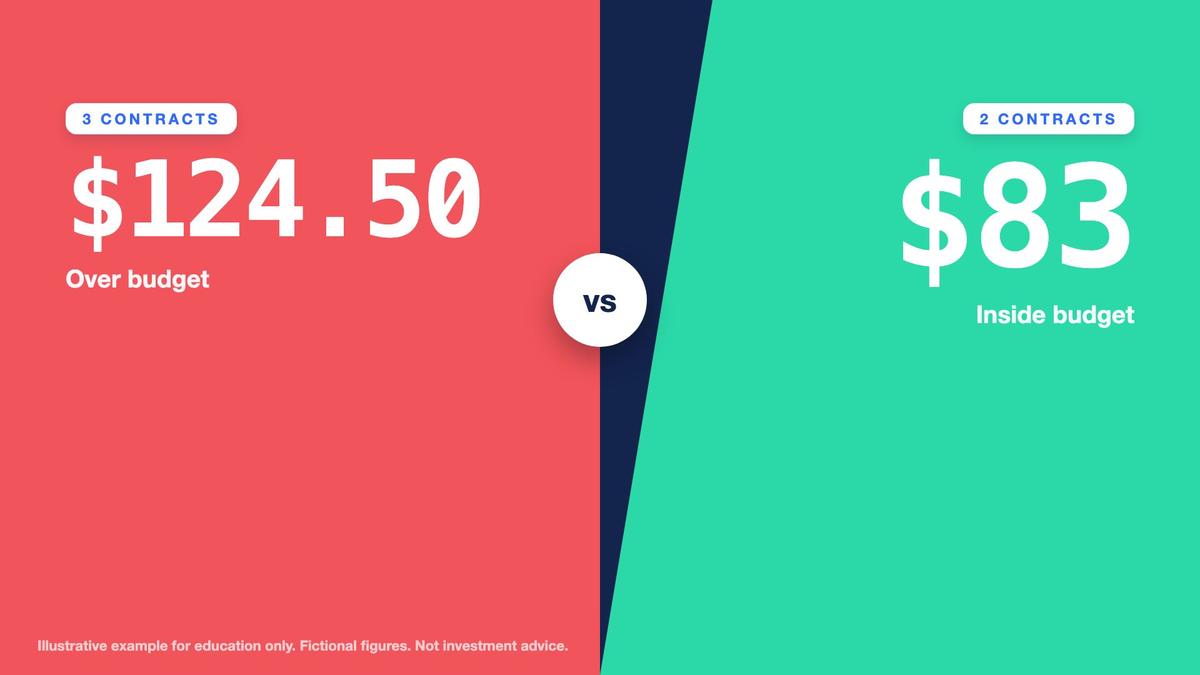
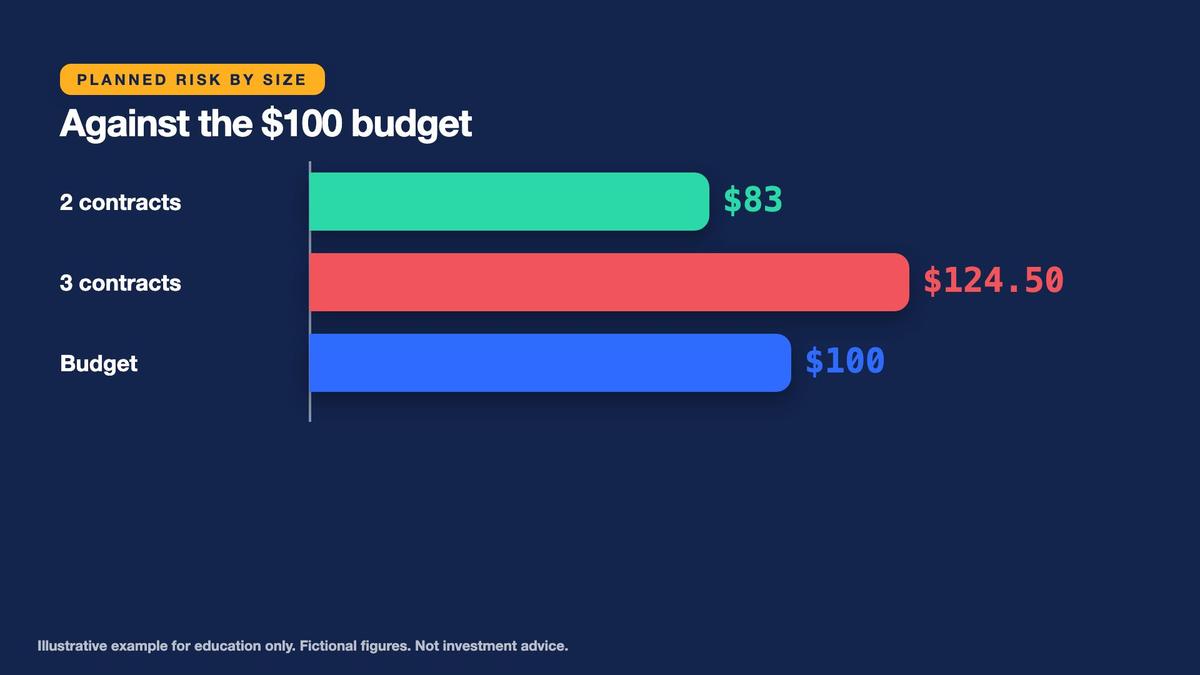
Two whole contracts create planned risk of two times $41.50, or $83.00, equivalent to 0.83% of starting equity. Three contracts would create three times $41.50, or $124.50, equivalent to 1.245%. The three-contract submission exceeds the $100 budget by $24.50. Compared with the valid two-contract plan, the incorrect extra contract increases planned risk by $41.50. That is exactly 50% above $83 because three equal contracts represent 50% more quantity than two. Mark the submitted three-contract size as failed. The corrected quantity is two contracts, totaling 200 barrels and a combined price sensitivity of $2 per tick.
Key points
- Budget 1% x $10,000 = $100; risk per contract $41.50; 100 / 41.50 = 2.41 contracts.
- Claim 3: round 2.41 up to 3. Verify: only whole contracts, so round down to 2.
- Three contracts risk $124.50 (1.245%), $24.50 over budget and $41.50 (50%) above the valid $83.
The corrected position also has a reference notional of 200 barrels multiplied by the invented $70.02 entry, or $14,004. That equals 140.04% of starting equity and is distinct from the $1,400 updated initial margin requirement. The fact that sufficient margin might be available for additional contracts does not establish compliance with the separate planned-loss budget. The reviewer should write both tests: whether the collateral requirement can be met and whether the planned stop risk respects policy. A position fails the risk rule if either its computed loss or its rounding method violates the stated limit. Sizing discipline follows the earlier XAUUSD contract and Micro Oil futures laboratories.
Stress Slippage and Apply the Minimum-Size No-Trade Rule
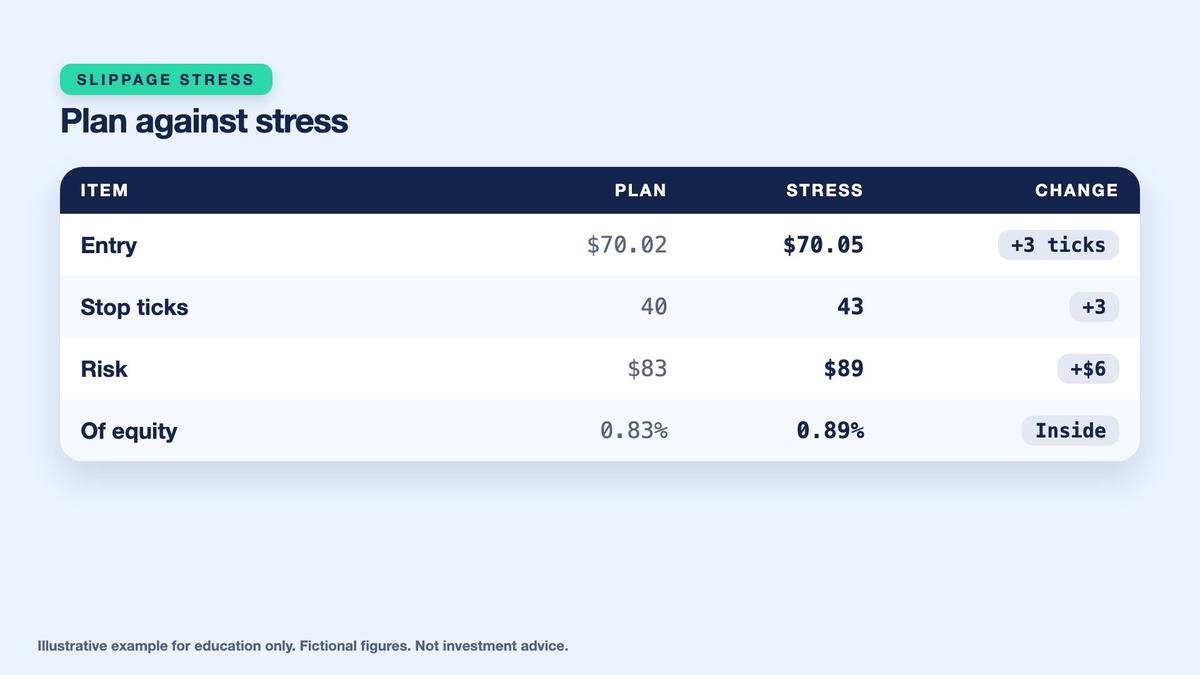
The fourth assumption treats zero slippage as a certain outcome. That is not a sound risk-planning assumption for market orders or stops. Use a separate fictional three-tick adverse entry stress, moving the filled price from the originally observed $70.02 ask to $70.05. Keep the intended stop at $69.62. The distance from actual stressed entry to unchanged stop becomes $0.43 per barrel, or 43 ticks. Across two micro contracts, that produces $86 of gross stop-price risk. Add the same $3 total round-trip commission to obtain $89 commission-inclusive stressed risk, equivalent to 0.89% of starting equity.

The stressed $89 risk is $6 greater than the original $83 plan. Divide $6 by $83 to obtain approximately 7.23%, presented as 7.2% after rounding to one decimal place. The simulated position still fits within the $100 written budget, leaving an $11 difference under the exact-stop assumption. However, three ticks is an invented sensitivity test, not a maximum possible slippage amount. Larger gaps, worse fills, changed commissions or operational issues could cause greater losses. Mark the zero-slippage certainty claim as failed while recording both the base plan and the stressed outcome. Do not erase the original planned entry when the stress uses a different hypothetical fill.
Key points
- Claim 4: zero slippage. Stress 3 ticks: fill $70.05, stop distance 43 ticks, 43 x $2 = $86 + $3 = $89 (0.89%).
- The stress adds $6 (7.2%) to the $83 plan and stays inside the $100 budget; it is a stress, not a prediction.
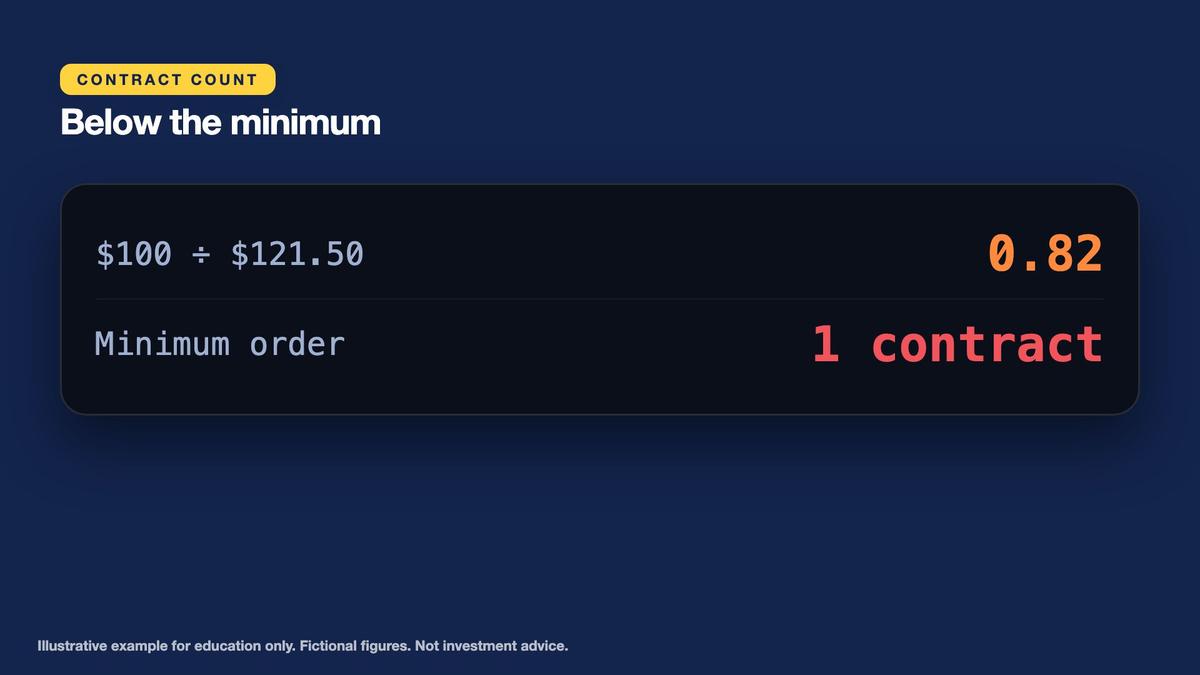
- Claim 5: a 120-tick stop gives $121.50 per contract and 100 / 121.50 = 0.82; the minimum is 1 whole contract, so the answer is no trade.
The fifth assumption concerns a separate trade idea with a 120-tick stop. One minimum whole contract would have $120 price risk plus $1.50 round-trip commission, totaling $121.50. The $100 budget divided by $121.50 produces approximately 0.823045 contracts, or 0.82 when rounded to two decimals. But the fictional minimum order size is one whole contract. Rounding the allowable quantity down results in zero contracts, while entering one contract would risk 1.215% of equity and exceed the written budget by $21.50. The correct verdict is no trade under the current stop and policy. Any different stop or budget requires separate written justification rather than being manipulated merely to force the proposal through.

Verify Commission and Rank the Six Findings
The sixth submitted assumption correctly states commission of $0.75 per contract per side. It matches the fictional specification, so mark this claim as passed. A completed round trip in one contract costs $0.75 on entry and $0.75 on exit, totaling $1.50. For the corrected two-contract position, commission is two contracts multiplied by two sides multiplied by $0.75, or $3.00. This cost has already been included in the $83 planned-risk and $89 slippage-stressed calculations. It should not be added a second time after the risk totals are recorded. A useful audit identifies correct claims as well as errors.
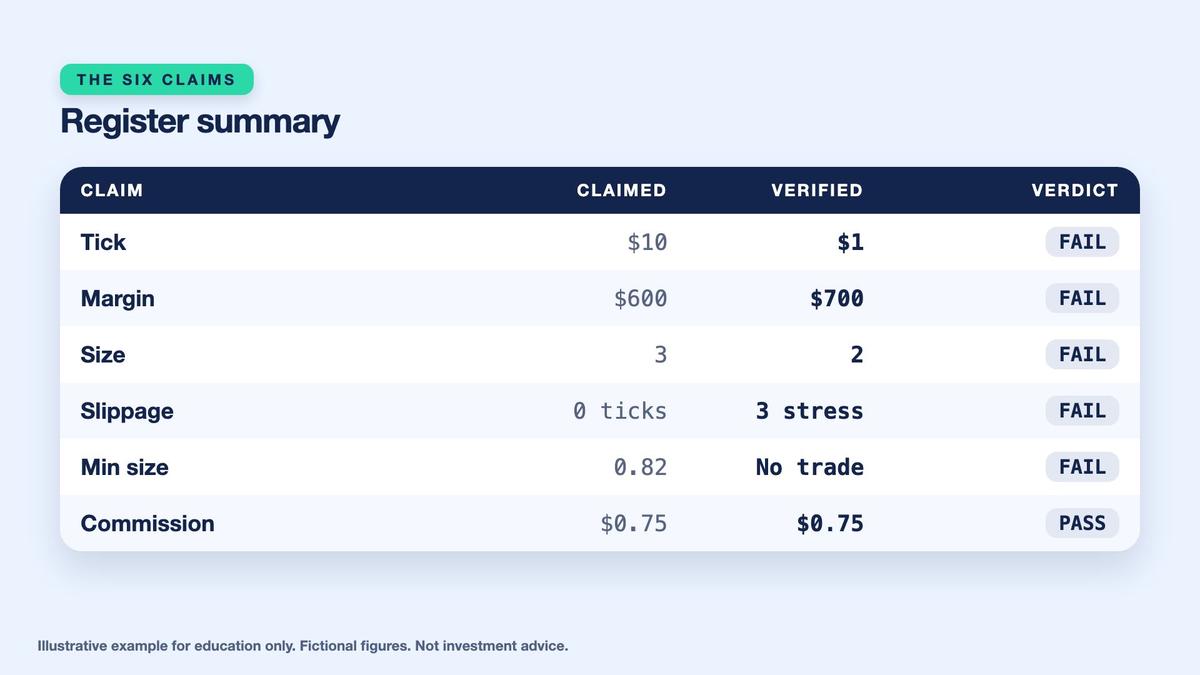
The six independent review verdicts are now complete. The tick value, current initial margin, rounded-up three-contract size, zero-slippage certainty and fractional minimum-size proposal fail. The commission assumption passes. That gives five failed assumptions out of six, equal to approximately 83.3%, and one passing assumption, approximately 16.7%. These percentages describe the fictional worksheet's validation results, not probabilities of trading failure or estimates of future performance. The register should preserve the original claims, their verified replacements and any evidence of internal inconsistency. The result is a corrected calculation document, not a judgment about the trainee's personal competence or intentions.
Key points
- Claim 6: commission $0.75 per side matches the specification; two contracts round trip 2 x 2 x $0.75 = $3: pass.
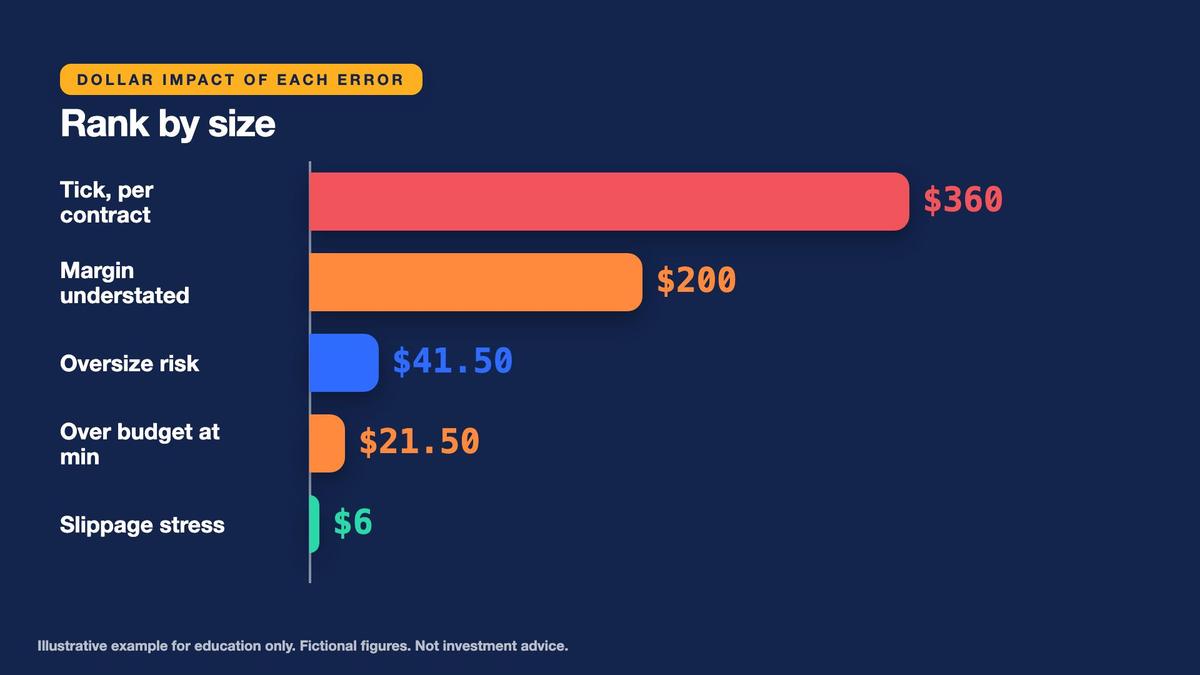
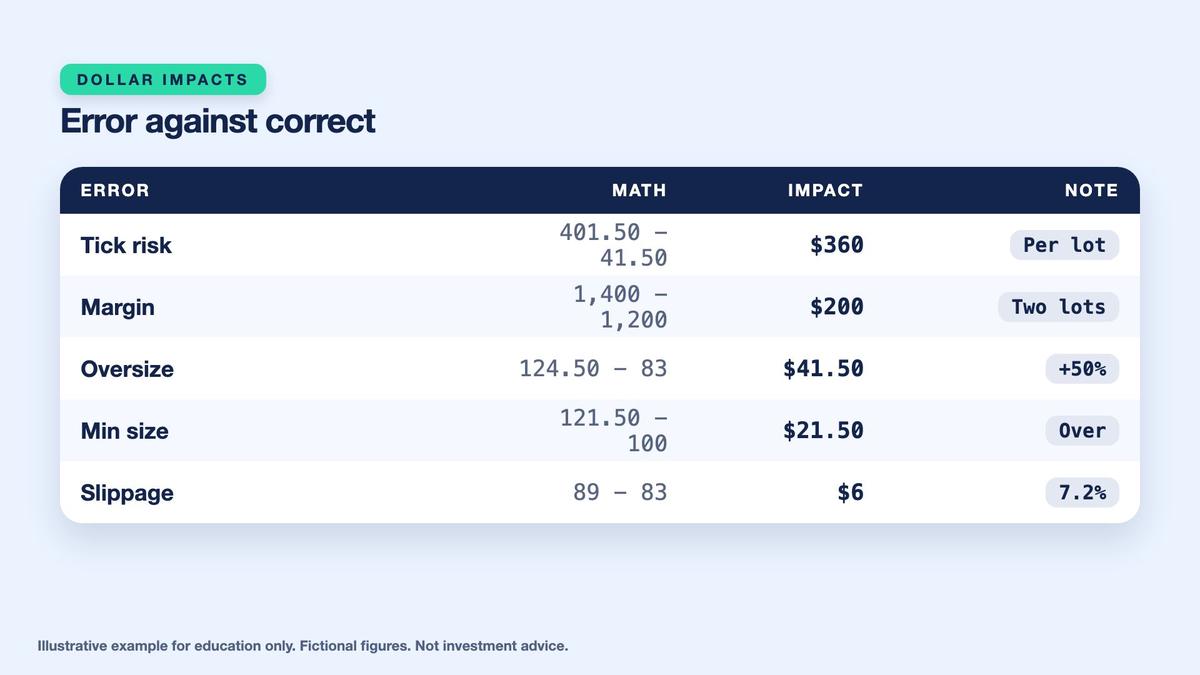
- Rank dollar impacts: tick $360 per contract, margin $200, oversize $41.50, minimum size $21.50 over budget, slippage $6.
- Five of six fail (83.3%); a tidy sheet can still contradict itself, so audit every field on its own.
Rank the corrections by their relevant dollar impacts, while keeping their meanings distinct. The erroneous tick calculation overstates per-contract planned risk by $360. The wrong size adds $41.50 relative to the valid two-contract plan and exceeds the budget by $24.50. The outdated margin understates required initial collateral by $200. The separate 120-tick proposal breaches the budget by $21.50 if one minimum contract is entered. The three-tick slippage stress adds $6 to the two-contract plan. The commission figure requires no correction. These numbers cannot be added into one aggregate realized loss because they measure different errors, assumptions and proposed transactions. Explain each impact in its own register row.
Issue the Corrected Sheet and Review Expiry Risk
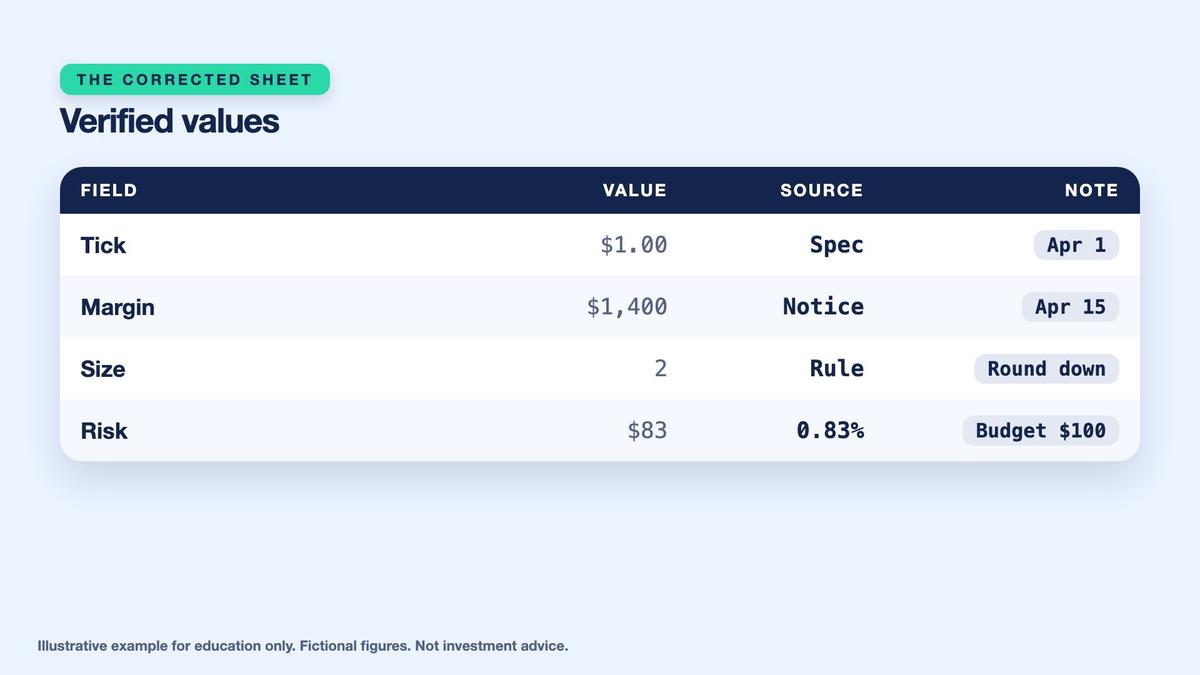
The corrected sheet states that Sample Micro Oil futures represents 100 barrels per contract with a $0.01 tick worth $1.00. The sample quote is $70.00 bid and $70.02 ask, a two-tick spread. The account contains $10,000 simulated equity and allows $100 planned risk. The reviewed long idea buys two whole contracts at $70.02 and uses a $69.62 intended stop, 40 ticks away. Price risk is $80 across the two contracts, and round-trip commission is $3, giving $83 total planned risk or 0.83% of equity. The separate three-tick adverse entry stress increases the entry to $70.05 and risk to $89, or 0.89%. Both results are calculated under assumed exact stop execution.

The applicable initial margin is $700 per contract, or $1,400 for two, equal to 14% of starting equity. Maintenance margin is $630 per contract, or $1,260 total. Simplified free equity before costs and market changes is $8,600. A hypothetical additional 25% initial margin increase raises the requirement to $875 per contract, $1,750 total and 17.5% of equity, leaving $8,250 under the same simplified calculation. The separate 120-tick-stop idea remains rejected because one minimum contract would require $121.50 planned risk against the $100 budget. Record these findings without merging the original idea, the wider-stop alternative and the independent margin stress into one transaction history.
Key points
- Corrected sheet: tick $1.00, margin $1,400 (14%), free equity $8,600, maintenance $1,260, size 2, planned risk $83 (0.83%), stressed risk $89.
- Margin stress: initial +25% is $875 per contract, 2 x $875 = $1,750 (17.5%), free equity $8,250.
- Expiry: 29 days from April 20 to May 19, 7 days on May 12; cash settled, but flag the deadline.
The fictional instrument settles in cash, with its last trading day on Tuesday, May 19, 2026. The Monday, April 20 review occurs 29 calendar days beforehand. On Tuesday, May 12, seven calendar days remain. The corrected memo must record the last trading day, the settlement method and any unanswered questions about earlier broker cutoffs or contract-specific expiry rules. Cash settlement does not eliminate final price risk, and physically delivered contracts may have different obligations. Actual dates and rules would need verification against current official documentation. The expiry review completes the connection to the earlier futures curve, expiry and roll lesson without opening a real position.
Write the Clinic Memo and Cross-Check a Mock Order
Create a one-page clinic memo with a clear purpose, reviewed documents, review date, six assumption verdicts, corrected calculations, monetary impacts and open questions. State that the original sheet should not be approved without correction. Include the verified $1 tick value, $700 updated initial margin per contract, two-contract valid size, $83 planned risk, $89 slippage-stressed risk, $3 round-trip commission, $1,260 maintenance requirement and May 19 last trading day. Explain why the proposed three-contract trade exceeds budget and why the separate 0.82-contract wide-stop idea must be rejected. Record that five claims fail and one passes. Use constructive reviewer language that corrects the sheet instead of criticizing the trainee.

Hands-On Review: Correct a Fictional Futures Risk Sheet
Act as the reviewer of a fictional trainee's Sample Micro Oil futures submission. Begin with the invented April 1, 2026 contract specification, the April 15 margin notice and the April 20 review date. Build an assumptions register with columns for claimed value, dated source, verified value, pass or fail, and dollar impact. Check all six claims independently: $10 micro tick value, $600 current initial margin, three contracts from rounding 2.41 upward, zero slippage, 0.82 contracts as a valid minimum-size order under a 120-tick stop, and $0.75 commission per contract per side. Correct the two-contract plan using $10,000 starting equity, a $100 planned-risk budget, the $70.02 ask and $69.62 stop. Stress three ticks of adverse entry slippage and an additional 25% initial-margin increase. Confirm the May 19 last trading day and the seven-day checkpoint on May 12. Write the one-page clinic memo and explain each failure without blaming the fictional trainee. For optional paper practice, visit https://research-paper-trade-webapp.pages.dev/paper/, use only a simulated order, and check its displayed numbers against the register; do not connect real accounts, wallets or funds, enter secrets, or place real orders.
- Decision 1: The trainee claims that one Sample Micro Oil tick is worth $10. The fictional contract represents 100 barrels with a $0.01 price tick, while a fictional standard contract represents 1,000 barrels. — Verify both tick values, calculate commission-inclusive risk per contract at a 40-tick stop under the wrong and correct values, and give the audit verdict.
- Decision 2: The submitted sheet uses April 1 initial margin of $600 per contract, while the April 15 notice raises it to $700. The simulated review is April 20, and the proposed corrected position contains two contracts. — Identify the effective margin requirement, calculate the collateral understatement, current maintenance, free equity and additional 25% initial-margin stress.
- Decision 3: A $10,000 simulated account follows a $100 risk budget. The intended entry is $70.02, stop $69.62, tick value $1 per contract and completed commission $1.50 per contract. The trainee rounds the theoretical 2.41-contract quantity up to three. — Calculate the valid whole-contract size, planned risk and budget breach caused by rounding upward.
- Decision 4: The submitted sheet assumes zero slippage and separately claims that 0.82 contracts can be ordered with a 120-tick stop. The reviewer tests three adverse entry ticks while retaining the original 40-tick-stop plan and its two-contract size. — Calculate slippage-stressed risk, test the separate wide-stop minimum-size proposal, and give the two verdicts.
- Decision 5: The sixth assumption states commission is $0.75 per contract per side. The reviewer must issue a clinic memo after finding five failures among the six claims and verifying that May 19 is the fictional last trading day. — Verify round-trip commission, calculate the review pass-fail percentages, record expiry days remaining and state the final memo conclusion.
Answer key
For an optional mock demonstration, open the user-provided Paper Trading page at https://research-paper-trade-webapp.pages.dev/paper/ and enter its paper-trading section. This is a provided practice destination, not a verified exchange or an authoritative source for the fictional contract specification. Use a small simulated order with invented amounts only, and compare the displayed contract quantity, tick value and planned risk against the independent assumptions register. If the interface does not support the invented Sample Micro Oil contract or appropriate simulated settings, record the mismatch and perform the exercise entirely on paper. Never connect a real wallet, exchange or funded account; never enter recovery phrases, keys or other secrets; and never submit a real order.
Key points
- Memo: each claim with source and date, claimed and verified value, verdict, dollar impact, corrected plan and open questions.
- Tone: fix the sheet, not the person; cite the evidence and keep the original submission.
- Practice on a demo platform with simulated money only: compare quantity, tick and risk with your register.
Finish the review checklist by verifying dates, contract units, tick math, commission, margin version, whole-contract minimum, position sizing, adverse slippage, expiry and settlement. Preserve the original submission alongside the corrected memo and note any remaining assumptions that require updated documentation. This lab extends the earlier XAUUSD contract and sizing, Micro WTI demonstration, and trading journal and execution-risk lessons. The upcoming Week 5 mission will require two calculations for XAUUSD and oil from dated specifications, followed by Week 6's Portfolio Lab. The learning outcome is a reproducible, source-aware risk audit, not a trading recommendation, market prediction or proof that a position is safe.
Worked example at a glance
Key terms
- Risk review clinic: a structured check of a trade plan against its sources.
- Assumptions register: a table of claims with source, claimed value, verified value and verdict.
- Tick value: the dollars one tick is worth per contract.
- Initial margin: the funds required to open a position.
- Maintenance margin: the lower funds level required to keep a position open.
- Free equity: equity left after initial margin, before costs and price changes.
- Whole contracts: contracts only trade in indivisible units, so size is rounded down.
- Minimum size: the smallest order the product allows.
- Slippage: a fill worse than the intended price.
- Stress test: a deliberately adverse assumption used to check a plan.
- No trade: the correct decision when the minimum size breaks the risk budget.
- Clinic memo: the one-page written result of a review.
Multi Asset Trading Lab is an educational course and does not provide investment advice, trading recommendations, commodity price forecasts, financial advice, legal advice, tax advice, brokerage guidance, exchange instructions or personalized risk-management recommendations. Every market price, product specification, futures contract, trainee submission, margin notice, order assumption, stress result and proposed position in this laboratory is fictional. Sample Micro Oil futures is an invented classroom contract and not a representation of any actual futures exchange product. The specification dated April 1, 2026, margin notice dated April 15, 2026, simulated review dated April 20, 2026, and last trading day dated May 19, 2026 are invented example records. No real exchange, current contract code, broker, investment fund, actual quote or live market is used. All monetary values are simulated, and all activities may be performed with paper calculations only. Learners are not asked to place real orders, open funded accounts, connect actual exchange accounts or trade any instrument. The fictional contract represents 100 barrels, quotes dollars per barrel, and changes in minimum increments of $0.01 per barrel, giving a tick value of $1.00 per micro contract. A separate fictional standard contract represents 1,000 barrels, giving a $10.00 value for the same one-cent price movement. These contract multipliers and tick values are specific to the invented teaching example and must not be assumed to describe actual futures contracts. The trainee's incorrect claim that the micro contract has a $10 tick value demonstrates a multiplier error. At a 40-tick intended stop, the incorrect calculation gives $400 price risk and $401.50 including the stated $1.50 round-trip commission per contract. Using the correct $1 tick value gives $40 price risk plus $1.50 commission, or $41.50 per contract. The erroneous commission-inclusive figure therefore overstates planned risk by $360 per contract. This numerical discrepancy is a calculation error, not a realized loss or gain. The incorrect tick-value claim also conflicts with the trainee's theoretical position count of approximately 2.41 contracts, which depends on the correct $41.50 per-contract risk. The reviewer must audit each formula independently rather than accepting mutually inconsistent figures. The original fictional specification lists initial margin of $600 and maintenance margin of $540 per contract. The later fictional notice raises those requirements to $700 and $630, respectively. For the April 20 review, the later notice applies. Two correctly sized contracts require $1,400 initial margin rather than $1,200 under the outdated amount. The difference is a $200 understatement of collateral requirements, not an additional commission or realized trading loss. Updated maintenance margin totals $1,260 for two contracts. The sample account begins with $10,000 simulated equity, so the simplified amount remaining after accounting for the current $1,400 initial requirement is $8,600 before commissions, market price changes or other account obligations. Margin is collateral required to support contractual exposure. It is not the maximum possible loss, an automatic stop-loss or a fee that has permanently left the account. Real margin requirements can change, and futures accounts may be subject to daily settlement, variation margin, maintenance calls, restrictions, liquidation rules, additional fees or financial losses exceeding a trader's expectations. The laboratory also includes a separate hypothetical additional 25% initial-margin increase from the updated $700 figure. The resulting stressed amount is $875 per contract, $1,750 for two contracts and 17.5% of the $10,000 starting equity. The simplified amount remaining is then $8,250, a reduction of $350 from the earlier $8,600. This is an invented stress scenario, not an actual margin announcement. No additional maintenance margin change is specified by the stress, and learners must not invent one. The written classroom risk budget is 1% of $10,000, equal to $100 in planned loss per trade. The proposed fictional long entry is the $70.02 ask, with a planned stop exit at $69.62, making the intended distance $0.40 per barrel or 40 ticks. The $1 tick value per contract implies $40 gross stop-price risk per contract. The specified commission is $0.75 per contract per side, giving $1.50 for a completed round trip in one contract and $3.00 across a two-contract round trip. Planned risk is therefore $41.50 per contract, and the theoretical contract count is $100 divided by $41.50, approximately 2.40963855. The fictional contract permits whole-contract orders with a minimum of one contract. The theoretical count must be rounded down to two whole contracts to stay within the written budget. Two contracts carry $83 planned commission-inclusive stop risk, or 0.83% of starting equity. Three contracts would carry $124.50, or 1.245% of equity, exceeding the $100 budget by $24.50. Compared with the valid two-contract plan, the third contract adds $41.50 planned risk, equivalent to a 50% increase over the original $83. These figures assume an exact stop fill, the stated commission schedule and no additional costs. They do not guarantee a maximum realized loss or establish an appropriate position size for any actual account. The separate three-tick adverse-entry stress assumes a worse long fill at $70.05 instead of the observed $70.02 ask. Keeping the intended stop at $69.62 expands the distance from 40 to 43 ticks. Across two contracts, stressed gross stop-price risk equals $86, and the $3 assumed round-trip commission produces $89 total planned risk under this adverse-entry scenario. This is $6 above the original $83 plan, an increase of approximately 7.2289%, rounded to 7.2%, and equals 0.89% of the $10,000 account. It remains under the $100 written budget under the assumed exact-stop exit. The three-tick slippage amount is an invented stress assumption, not an estimate of actual or maximum future slippage. Real fills could be better or worse, and orders may experience gaps, partial execution, rejection, liquidity shortages, trading restrictions or wider spreads. A stop may execute beyond the intended price and cannot guarantee a loss ceiling. The separate 120-tick-stop proposal demonstrates a minimum-size constraint. One minimum whole contract carries $120 gross stop-price risk plus $1.50 round-trip commission, totaling $121.50, or 1.215% of the original $10,000 account. Dividing the $100 budget by $121.50 yields approximately 0.823045 contracts, or 0.82 when rounded to two decimal places. Because the fictional minimum order size is one whole contract, this fractional theoretical quantity is not executable. Rounding down gives zero valid contracts. Entering one contract would exceed the planned-risk budget by $21.50. Under the unchanged written policy and proposed stop distance, the compliant decision is no trade. Any revised stop or budget would require a separately documented rationale and written rule rather than a numerical adjustment made solely to force the order to fit. Changing risk parameters cannot make actual future fills predictable or eliminate market risk. The sixth reviewed assumption, commission of $0.75 per contract per side, correctly matches the fictional specification and passes. Completing a two-contract round trip involves two contract-side executions on entry and two on exit, producing four $0.75 commission charges, or $3 in total. That commission is already included in the applicable commission-inclusive risk calculations and must not be deducted a second time when comparing them. The review of six assumptions produces five failures and one passing claim. Five divided by six is approximately 83.3333%, displayed as 83.3%, while one divided by six is approximately 16.6667%, displayed as 16.7%. These percentages describe only how many fictional claims failed the classroom audit. They are not probabilities of account failure, trading loss, exchange default, slippage, margin calls or future investment performance. The register's monetary impacts quantify different kinds of discrepancies and must not be added together as though they were components of a single realized transaction loss. The tick-value error overstates per-contract risk by $360; the margin error understates required collateral by $200; the three-contract sizing error adds $41.50 planned risk relative to the correct two-contract plan and breaches the budget by $24.50; the 120-tick minimum-size proposal would exceed the budget by $21.50 if a minimum one-contract order were forced; the specified three-tick entry-slippage stress adds $6 to the two-contract planned risk; and the commission assumption requires no correction. These effects have different meanings and may involve mutually exclusive proposed trades or independent stress assumptions. Their arithmetic accuracy does not imply that the corrected trade is safe, profitable or advisable. The fictional contract is cash settled and specifies Tuesday, May 19, 2026 as its last trading day. The April 20 review date is 29 calendar days earlier, while May 12 is seven calendar days before that deadline. These are calendar-day counts, not necessarily available trading sessions. Cash settlement still exposes a holder to a final reference price and financial profit or loss. Other actual futures contracts can have physical delivery obligations, earlier notice dates, different settlement procedures, broker cutoffs or operating restrictions. Learners must check current official documentation rather than assuming the fictional terms apply elsewhere. The optional paper-practice page supplied for this course is https://research-paper-trade-webapp.pages.dev/paper/. It is a user-provided practice destination, not an independently verified exchange, official specification source or endorsement. Learners should use that page only if it visibly provides an isolated simulation that does not require real orders, funded accounts, wallet connections, exchange credentials, recovery phrases, private keys or personal financial secrets. Never connect a real wallet or exchange, never paste keys or recovery phrases, never transfer money, and never authorize a real trading transaction for this exercise. If the page is unavailable or does not support the invented contract specification, the entire activity can be completed using a paper journal and calculator. No assumptions about the webpage's safety, availability, displayed contract terms or ability to place a genuine mock order should be treated as established by this educational content. The review clinic is intended to produce a one-page memo listing each claimed assumption, its dated source, verified value, verdict, numerical impact, corrected calculation and unresolved documentation questions. The memo should preserve the original trainee submission and use professional language focused on fixing the sheet rather than blaming the person. Common errors include trusting an unaudited worksheet, using outdated margin figures, confusing micro and standard contract multipliers, rounding up beyond a risk budget, treating minimum size as flexible, assuming zero slippage, overlooking commission, ignoring last trading days or combining independent dollar impacts as one realized loss. Earlier XAUUSD sizing, Micro Oil futures and trading journal lessons provide the conceptual foundation, and the upcoming Week 5 mission and Week 6 Portfolio Lab are educational extensions, not real-money trading assignments. The corrected worksheet establishes only consistency with the specified fictional arithmetic and classroom risk rule. It does not establish reliable future market execution, an effective trading strategy, a suitable portfolio allocation, a safe level of leverage, or future profitability. No financial result, contract size, stop distance, stress scenario, expiry date, commission figure or audit verdict in this lab constitutes a price forecast or recommendation to buy, sell, hold, roll, borrow against or trade any actual oil, gold, futures contract, CFD, option, security, cryptocurrency or other financial instrument. All calculations, instructions and outcomes remain fictional, simulated and strictly educational.
Lesson Checkpoint
Review what you learned and get feedback on your work.