



In this sixteen-minute beginner lesson, learners create a practical one-page Investment Policy Statement (IPS) for a simulated portfolio. They define financial goals, time horizons, liquidity needs, emergency reserves, risk limits, asset exclusions, position sizes, concentration limits, costs, rebalancing rules, review schedules, and decision-log procedures. By the end, learners produce a dated and signed personal policy that guides simulated decisions without relying on market predictions or emotional reactions.
What Is an Investment Policy Statement and Why Write One?
An Investment Policy Statement, commonly called an IPS, is a written framework describing the purpose, boundaries, and management rules for a portfolio. It explains what the portfolio is intended to achieve, when money may be needed, which risks are acceptable, and how decisions will be reviewed. A beginner can use a simplified IPS to organize simulated investment exercises. The document does not need complicated language or extensive financial knowledge to become useful.

Writing a policy before acting reduces the need to invent new rules whenever market prices change. Without a written framework, a learner might increase exposure after exciting gains, abandon a strategy after temporary losses, or purchase unfamiliar assets without evaluating their suitability. A policy makes these decisions easier to examine because the intended rules already exist. It cannot eliminate emotional reactions, but it can provide a consistent reference when those reactions occur.

Key points
- An IPS is a written framework for how a portfolio is managed.
- Write it before you act, not after prices move.
- Simulated money only: all numbers here are illustrations.
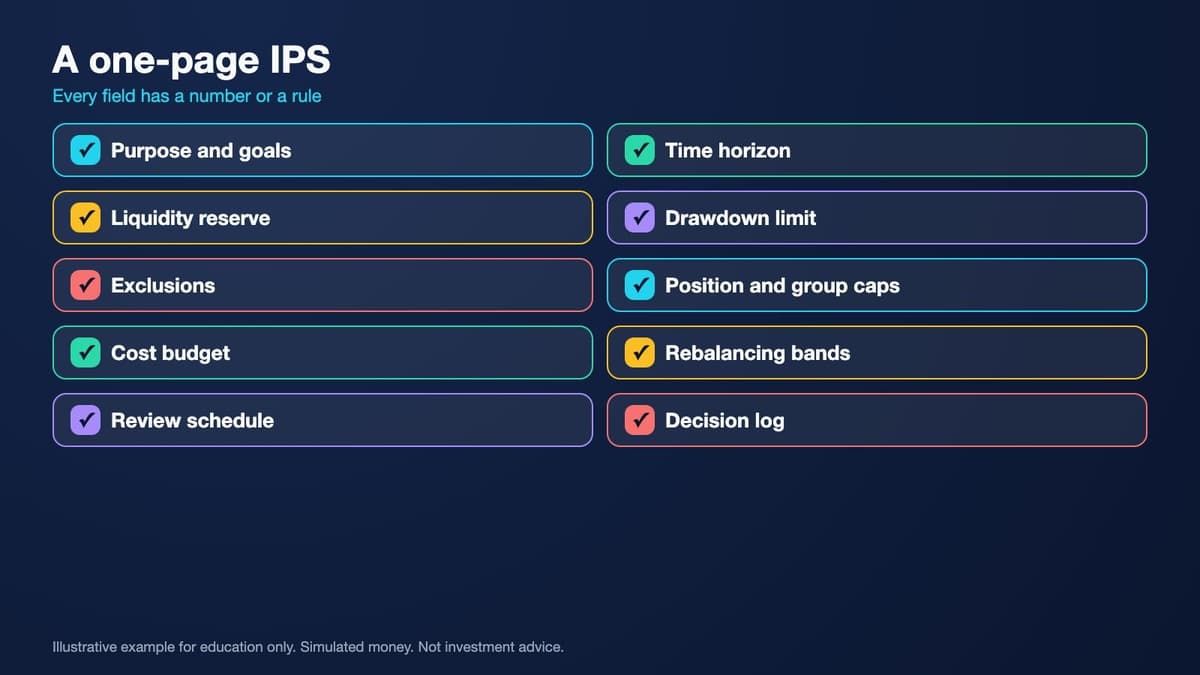
A useful beginner IPS should fit on one page. It should contain a clear purpose, a defined time horizon, liquidity assumptions, risk boundaries, asset exclusions, position limits, cost rules, rebalancing instructions, and review procedures. Each rule should be specific enough to evaluate objectively. The policy is not a prediction of market returns or a guarantee against loss. It is a document that guides and records decisions made with simulated capital.
Define Your Purpose, Goals, and Time Horizon
Every investment policy begins with a purpose. A financial goal might involve preparing for a future expense, pursuing long-term growth, generating income, or learning the behavior of different asset classes. In this course, your immediate purpose is educational: practicing portfolio decisions using simulated money. A useful goal explains what the portfolio is meant to accomplish and how progress will be evaluated. For example, a learner might aim to follow a predefined allocation throughout a twelve-month simulation.

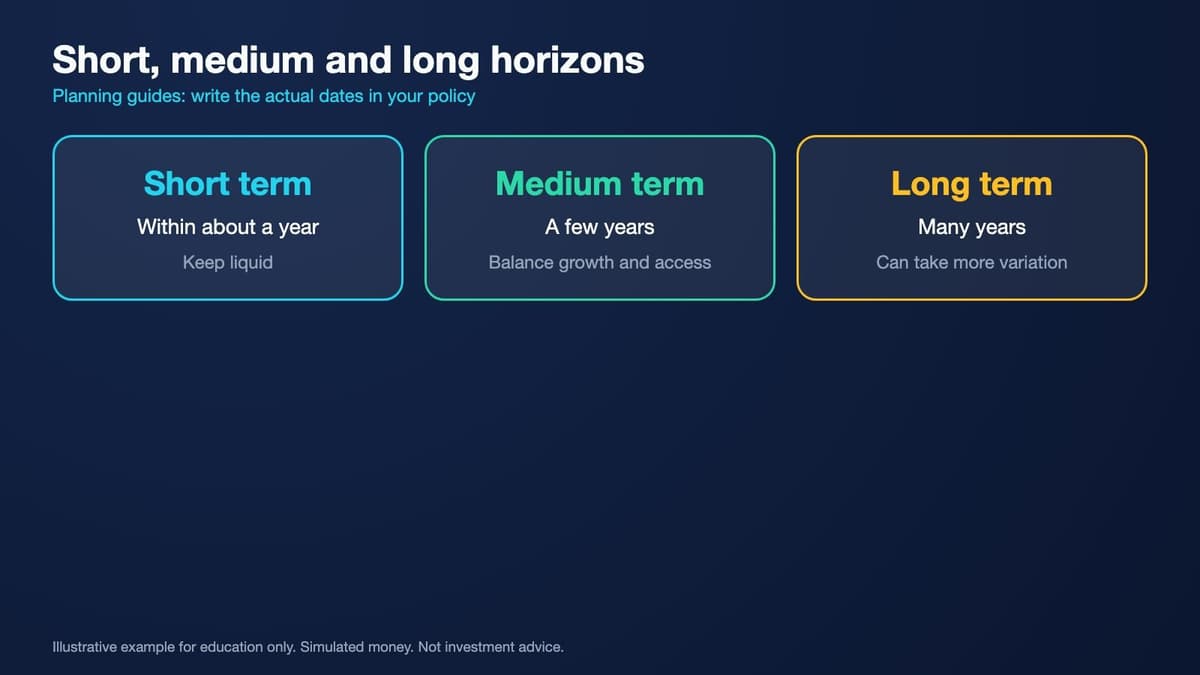
Time horizon describes how long funds are expected to remain available before they may be needed. Short-term objectives might involve expenses expected within a year, medium-term goals may span several years, and long-term goals may extend a decade or longer. These categories are flexible rather than universal. Your policy should state actual dates or approximate periods whenever possible. The need for money on a particular date can matter more than a generic label.
Key points
- State a purpose and a measurable goal.
- Short, medium and long are guides: write actual dates.
- Goals shape the horizon and the risk you can take.
Different goals may require different treatment. Money expected to be needed soon should not automatically be subjected to the same uncertainty as capital assigned to a long-term objective. A person may also have several goals operating simultaneously, such as emergency savings, education expenses, and retirement. In your simulated IPS, separate these purposes instead of treating the entire portfolio as one unrestricted pool. State which objective takes priority when two requirements conflict.

Liquidity Needs, Emergency Reserves, and Financial Flexibility
Liquidity refers to the ability to access money or convert assets into cash at an acceptable price and within an appropriate period. Your investment policy should identify predictable financial needs, including bills, education expenses, repairs, and other planned withdrawals. A financial asset can have an attractive long-term return while still being unsuitable for an immediate cash requirement. Selling quickly during unfavorable market conditions may create losses or transaction costs that could otherwise have been avoided.
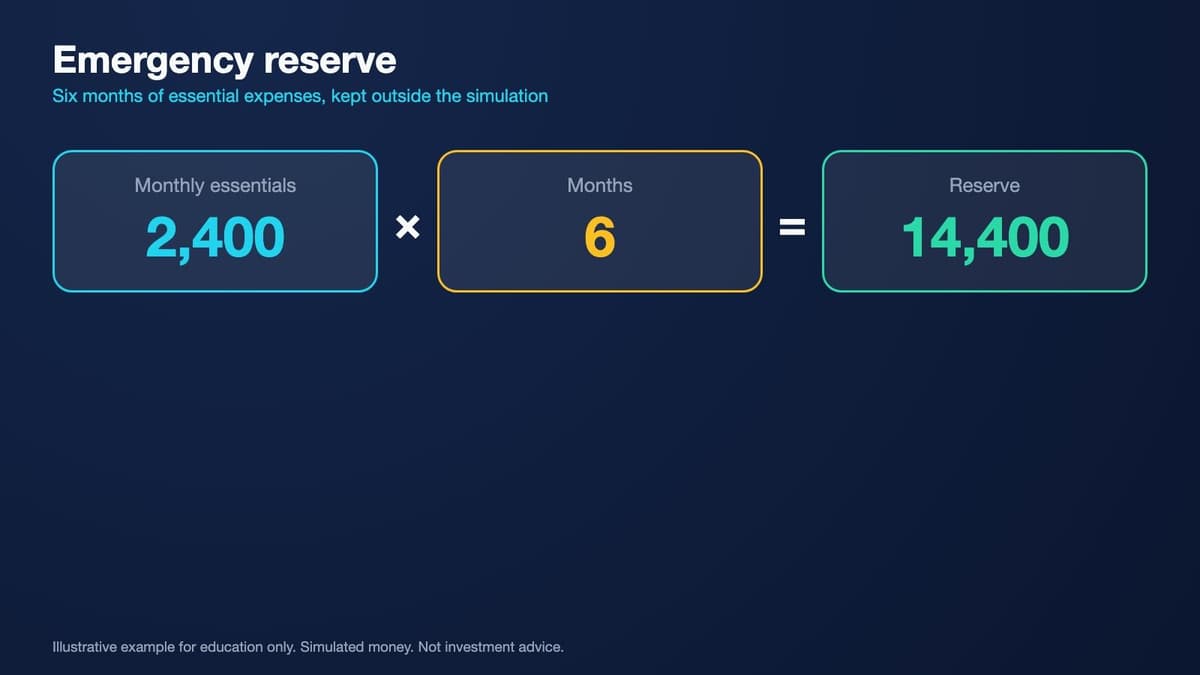
An emergency reserve is money intended to address unexpected financial needs without requiring urgent sales of risky investments. Consider a hypothetical household with essential monthly expenses of $2,400. A six-month reserve would equal exactly $14,400. The calculation is straightforward: monthly essential expenses multiplied by the selected number of months. Six months is an educational example, not a universal recommendation. Actual reserve needs depend on income reliability, dependents, liabilities, and access to other resources.

Key points
- Liquidity = access to money without a rushed sale.
- Reserve example: 6 × 2,400 = 14,400, kept outside the simulation.
- Reserve size depends on income, dependants and obligations.
In your simulated policy, record the assumed monthly expenses, reserve period, required reserve amount, and rules for keeping this reserve separate from risky portfolio activities. For example, the reserve could be excluded from the capital used to calculate simulated investment allocations. A clearly defined liquidity policy makes it easier to distinguish funds needed for essential obligations from funds assigned to educational experiments. Liquidity planning is about maintaining financial flexibility, not maximizing headline returns.

Risk Capacity, Risk Tolerance, and Drawdown Limits
Risk capacity and risk tolerance describe different considerations. Risk capacity concerns the financial ability to absorb losses without undermining essential obligations or planned goals. Risk tolerance concerns the degree of uncertainty and potential loss a person feels willing to experience. Someone might emotionally tolerate substantial price fluctuations but have little financial capacity because funds will be needed soon. Another person might have substantial available resources yet prefer a less volatile investment experience.
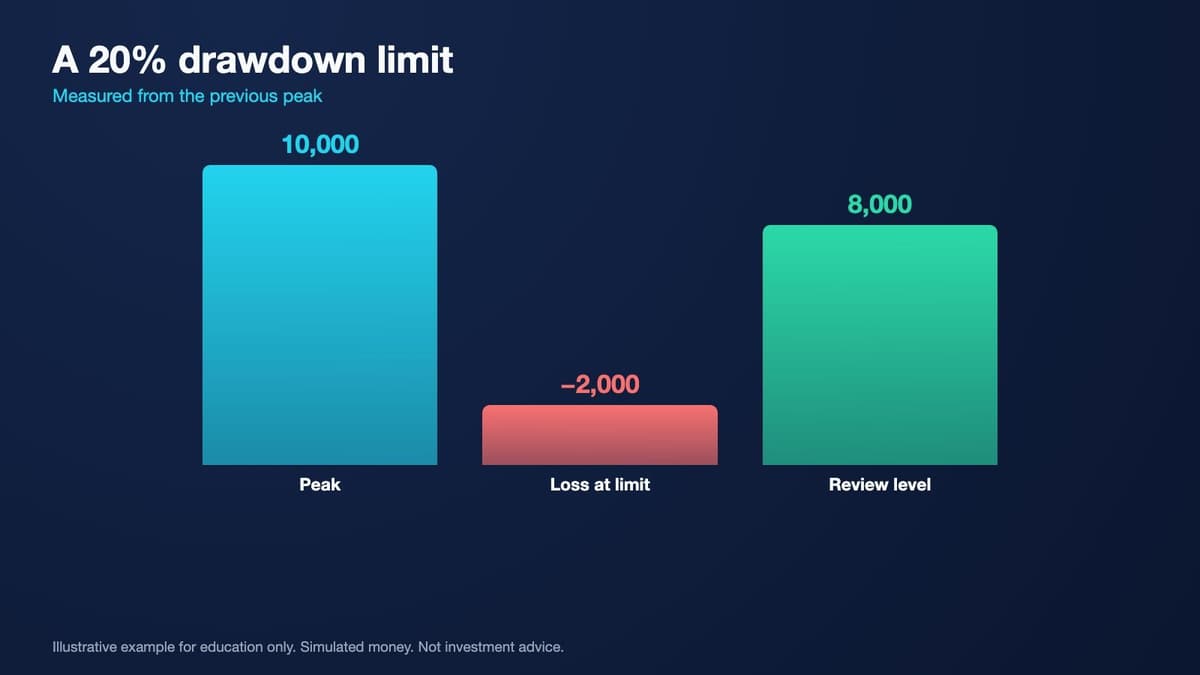
Your IPS should specify a drawdown response threshold. Drawdown measures a portfolio's decline from its previous peak. Suppose a simulated account reaches $10,000 and subsequently falls to $8,000. The decline is exactly $2,000, representing twenty percent of the peak. If the policy identifies twenty percent as its maximum acceptable drawdown, reaching that threshold should trigger the predefined response. The threshold does not guarantee that losses will stop there.
Key points
- Capacity is financial; tolerance is emotional. Capacity comes first.
- A 20% limit on a 10,000 peak means review at 8,000.
- A limit is a warning threshold, not protection.
A practical drawdown rule describes actions rather than merely naming a number. For example, the simulated policy could require pausing new risk-taking, documenting the source of the decline, checking position concentration, and completing a formal review before resuming. Market gaps, liquidity shortages, and execution costs may cause losses to exceed a target threshold. Avoid treating a drawdown percentage as a mechanical safety guarantee. The objective is to define how the learner will respond to adverse outcomes.
Asset Exclusions, Position Limits, and Concentration
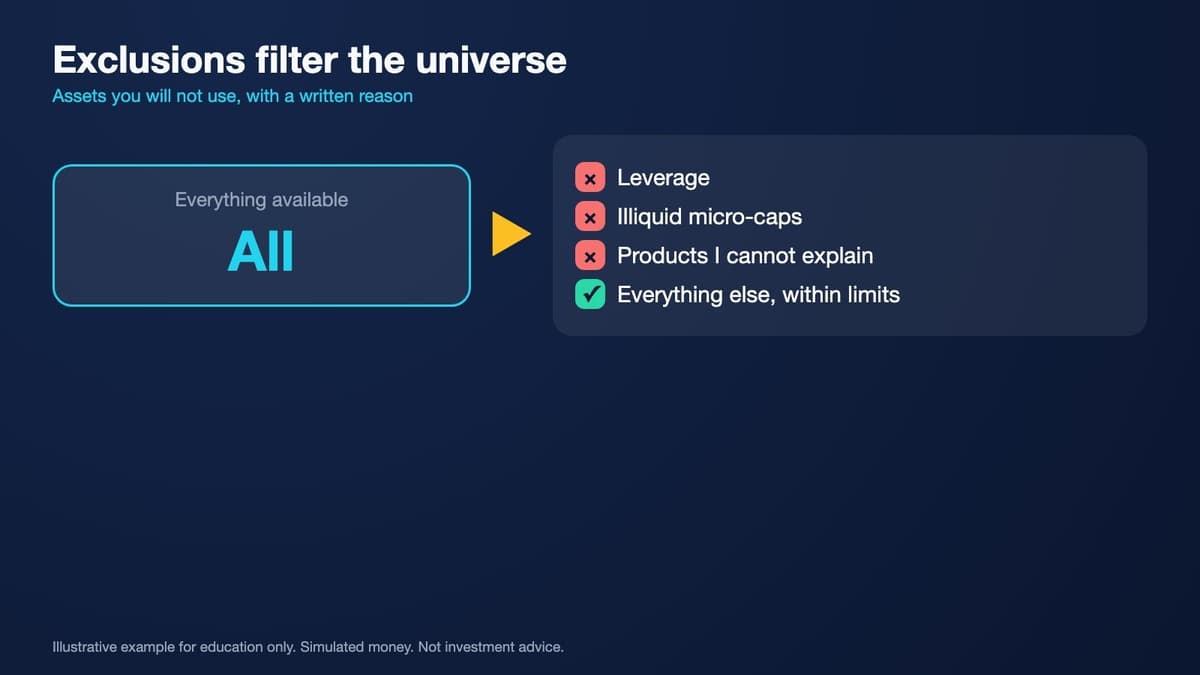
Asset exclusions specify what the simulated portfolio will not hold and why. Beginners may choose to exclude complex derivatives, leveraged products, thinly traded instruments, or assets whose risks they cannot explain. These are examples rather than universal prohibitions. A useful exclusion rule identifies a clear reason, such as insufficient understanding, inadequate liquidity, excessive complexity, or inconsistency with the portfolio's purpose. Writing exclusions before seeing attractive returns reduces the temptation to make impulsive exceptions.
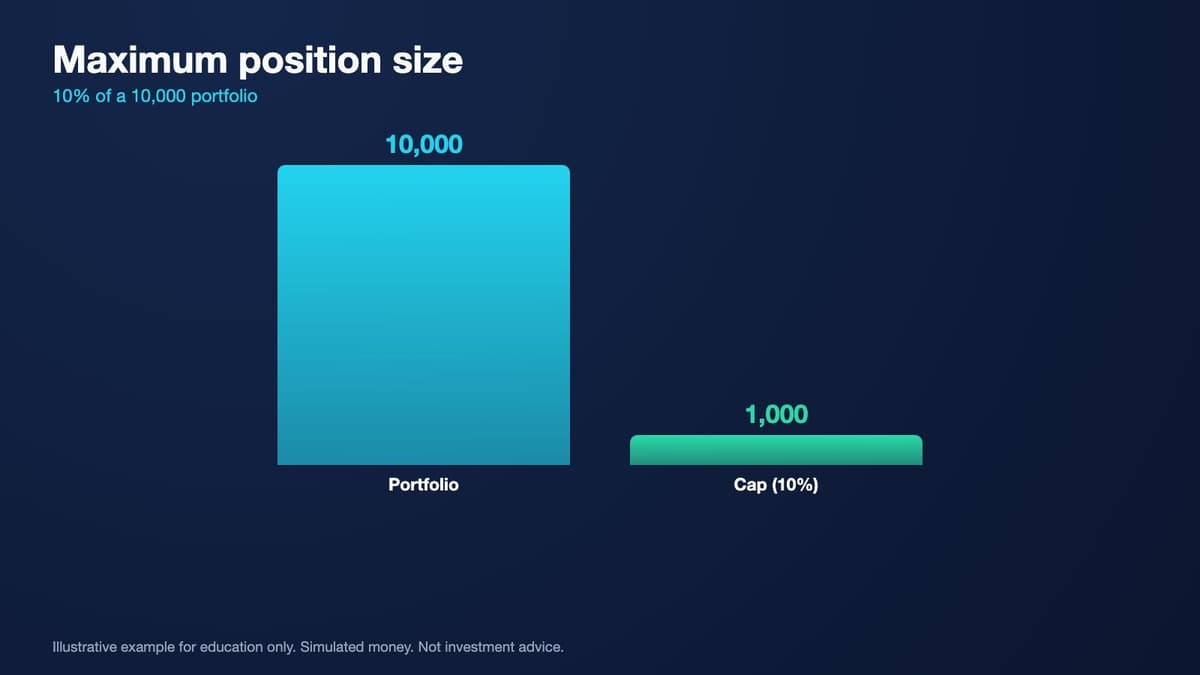
Position limits control the maximum exposure assigned to one holding. For a hypothetical $10,000 portfolio, a ten-percent position cap equals exactly $1,000. The IPS should clarify whether this cap applies at the time of purchase, continuously, or at scheduled reviews. A position that appreciates can exceed its original percentage without any additional purchase. Your policy should specify how such changes are handled and whether they trigger review or rebalancing rather than leaving the response ambiguous.
Key points
- Exclusions list assets you will not use, with reasons.
- A 10% cap on a 10,000 portfolio is 1,000 per position.
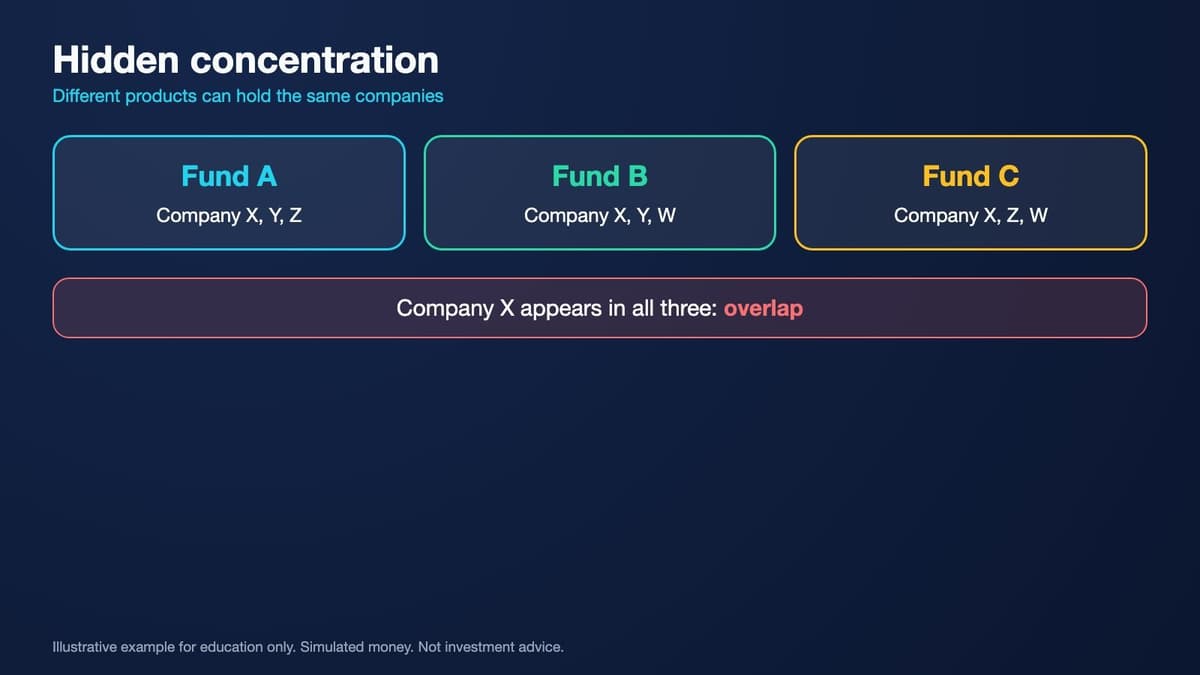
- Check overlapping funds for hidden concentration.
Concentration can also arise across multiple holdings. For example, several funds may own the same underlying companies, sectors, or geographic markets. A portfolio containing many product names is not necessarily well diversified. Your policy can include limits on sector exposure, correlated assets, and other overlapping risks. Diversification may reduce concentration but cannot eliminate market-wide losses. Learners should document both individual position limits and any broader limits relevant to their simulated portfolio.
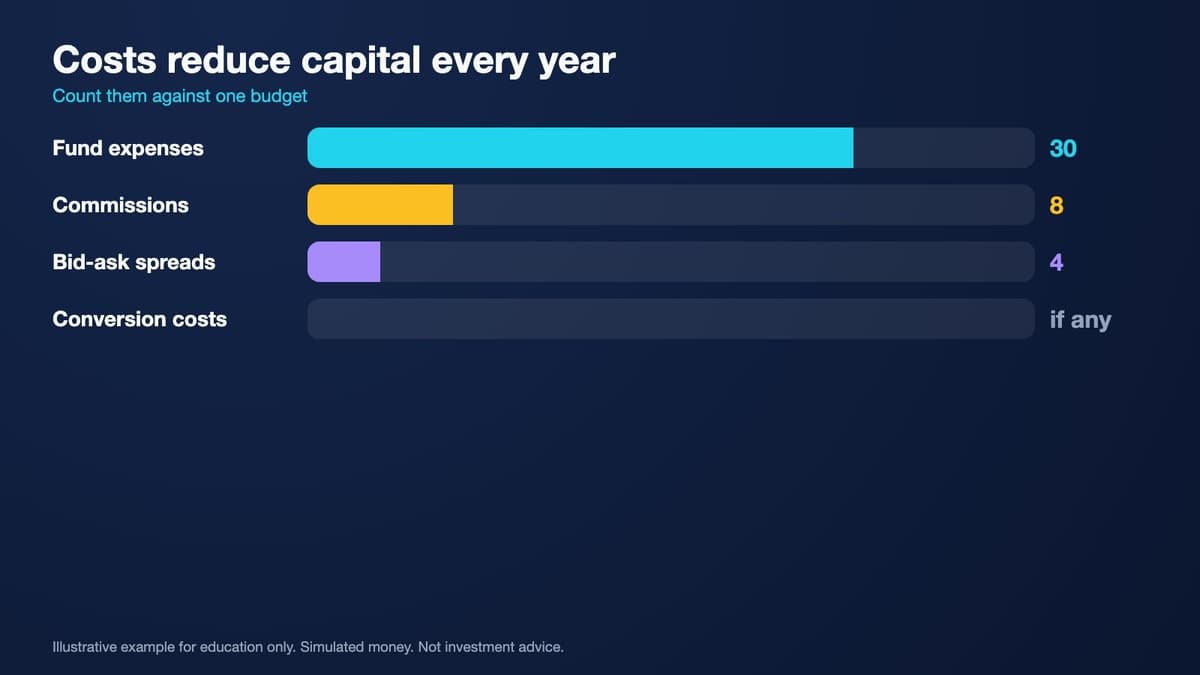
Cost Limits, Rebalancing Bands, and Review Schedules
Investment costs reduce the amount retained from gross returns. Your IPS should explain how fund expense ratios, brokerage commissions, bid-ask spreads, conversion fees, and other applicable expenses will be measured. For simulated learning, you might create an annual cost budget or require estimated trading costs to be recorded before each transaction. Cost rules should distinguish recurring expenses from one-time charges. Avoid subtracting expenses twice when published returns already include particular costs.
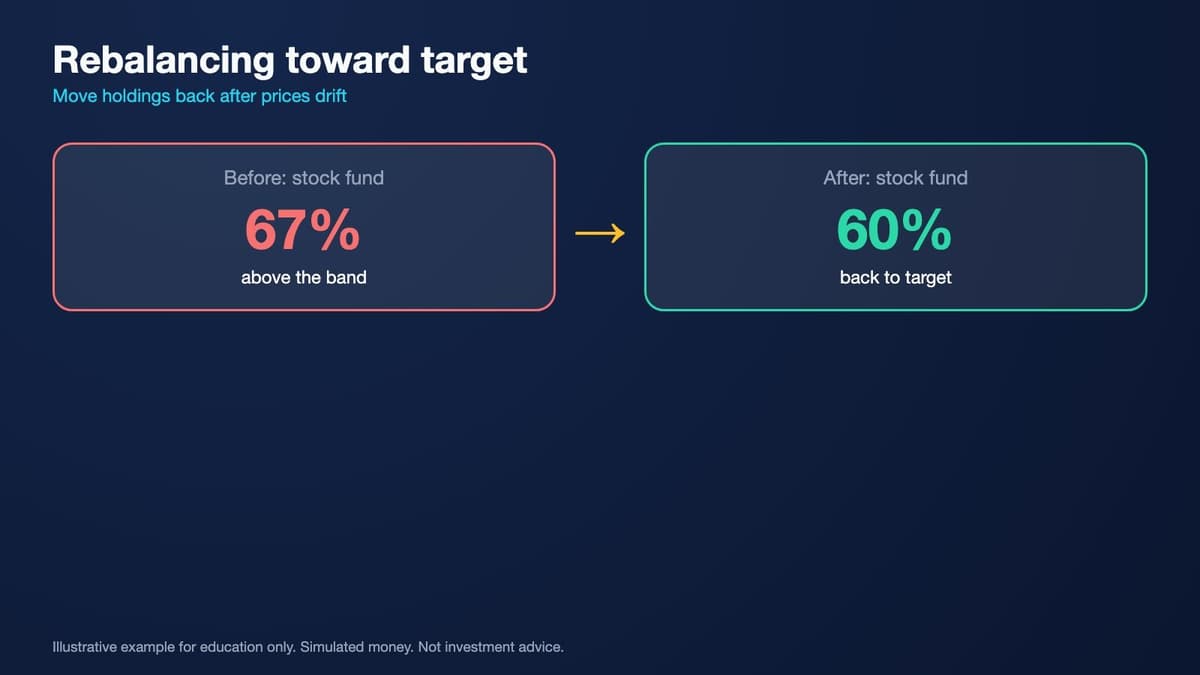
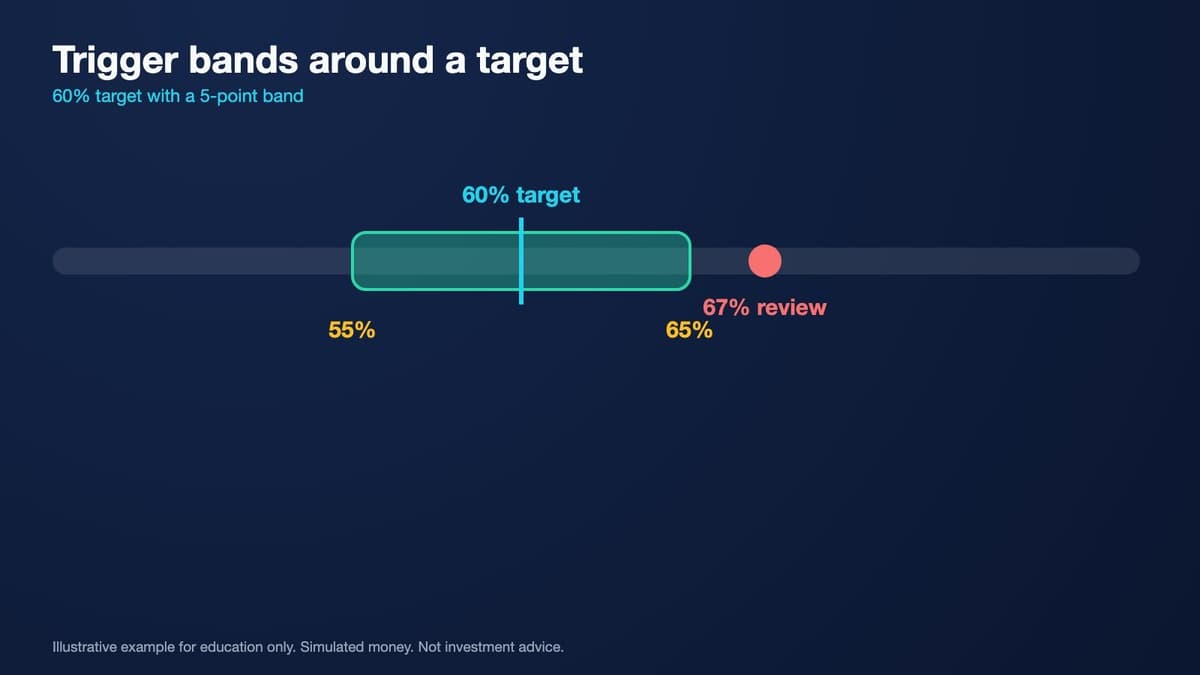
Rebalancing adjusts portfolio weights toward intended allocations after market movements change their proportions. Suppose a simulated asset group has a sixty-percent target and a tolerance band of five percentage points. Its acceptable monitoring range is fifty-five to sixty-five percent, inclusive. A weight of sixty-four percent remains within the band, while sixty-seven percent lies outside. The IPS can require a rebalancing review when the weight moves below fifty-five or above sixty-five percent.
Key points
- Set a cost budget and count every cost once.
- A 60% target with a 5-point band spans 55% to 65%.
- Review on a schedule; a trigger starts a review, not an automatic trade.
A review trigger does not have to mean immediate trading regardless of circumstances. The policy can require evaluating fees, taxes, liquidity, and available cash flows before adjustments. Scheduled reviews might occur quarterly, while additional reviews could follow material changes in personal circumstances or portfolio structure. Avoid rewriting targets merely because a market has recently performed well or poorly. Record the reason for changes so that future reviews can distinguish legitimate policy revisions from reactive market timing.

Decision Logs, One-Page Design, and Policy Governance
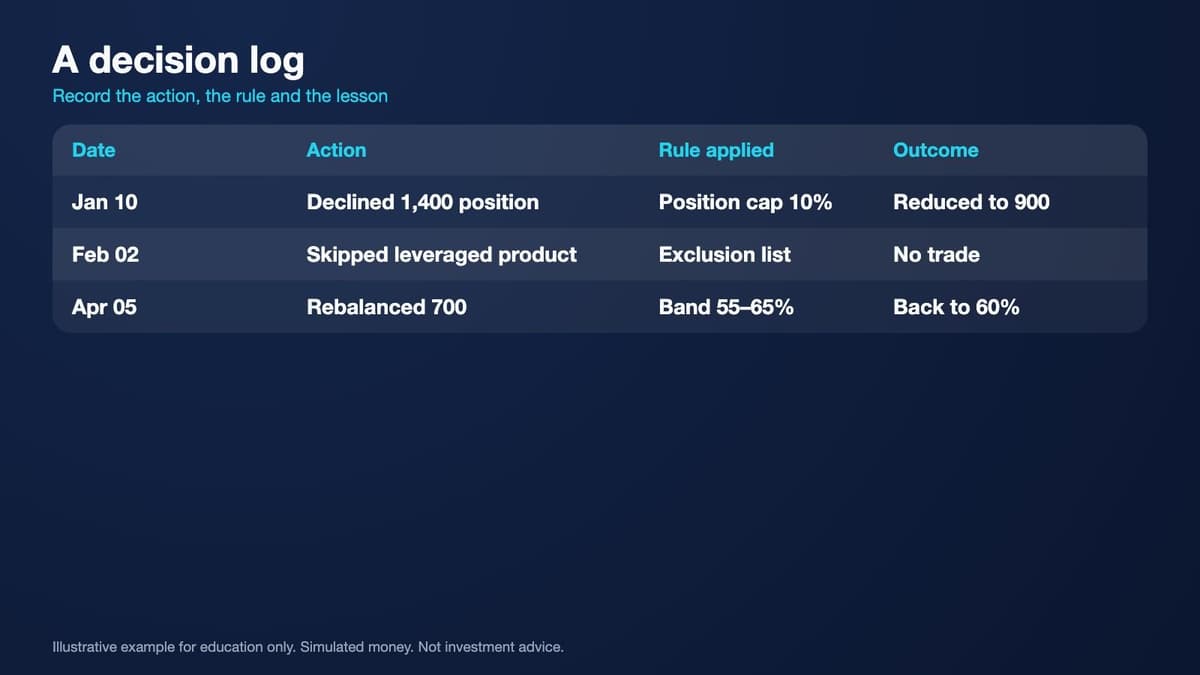
A decision log records how the policy is applied in practice. Useful fields include the date, simulated transaction or proposed action, reason for considering it, relevant IPS rule, estimated costs, and expected effect on portfolio exposure. Afterward, record the outcome and whether the decision followed the original plan. A log does not need to be complicated. Its purpose is to create a reliable learning record that separates the quality of the decision from the short-term financial result.
The IPS itself should remain concise. A one-page layout can contain short sections for purpose, horizon, liquidity, risk, exclusions, allocations, position limits, costs, rebalancing, and reviews. Where possible, write numerical thresholds and observable conditions. For example, replace a vague instruction such as 'avoid large positions' with a specific maximum percentage. Replace 'review often' with an actual calendar schedule or event trigger. Clarity makes the policy easier to follow and evaluate.

Key points
- A decision log records date, action, rule, outcome and lesson.
- Label exceptions and revisit rules if they repeat.
- Keep the policy to one page and change it only for documented reasons.
Sign and date the policy once the initial draft is complete. Include a simple version identifier so later revisions can be compared with the original. Changes should be documented when significant circumstances alter goals, income stability, liquidity requirements, dependents, or risk capacity. A policy should remain adaptable without being rewritten after every market movement. Keep previous versions and explain why each revision occurred. This helps maintain consistency while allowing responsible adjustments.

Final Project: Complete, Test, and Sign Your Investment Policy
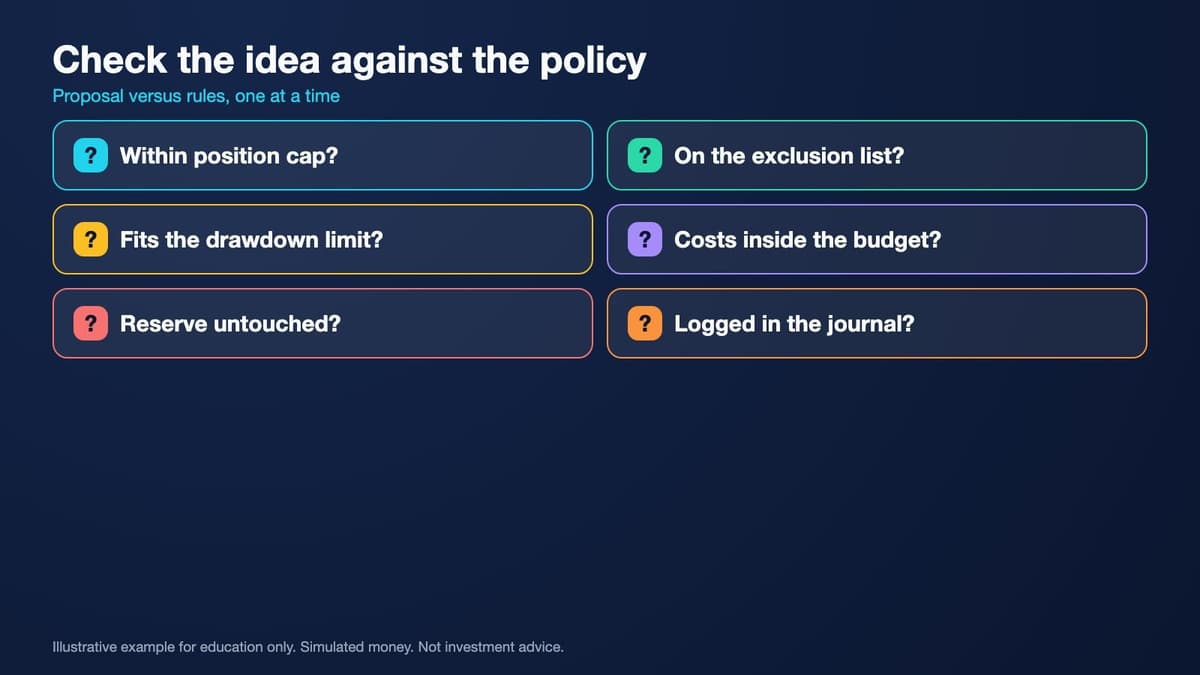
Your final lesson project is a one-page Investment Policy Statement for a completely simulated portfolio. Begin with a clear purpose and time horizon. Add hypothetical liquidity needs, an emergency-reserve calculation, and a distinction between risk capacity and risk tolerance. Next, define a drawdown response threshold, acceptable asset categories, explicit exclusions, and position limits. The document should explain what you intend to do when a rule is triggered rather than merely listing concepts.
Practice Lab: Build and Test Your One-Page Investment Policy
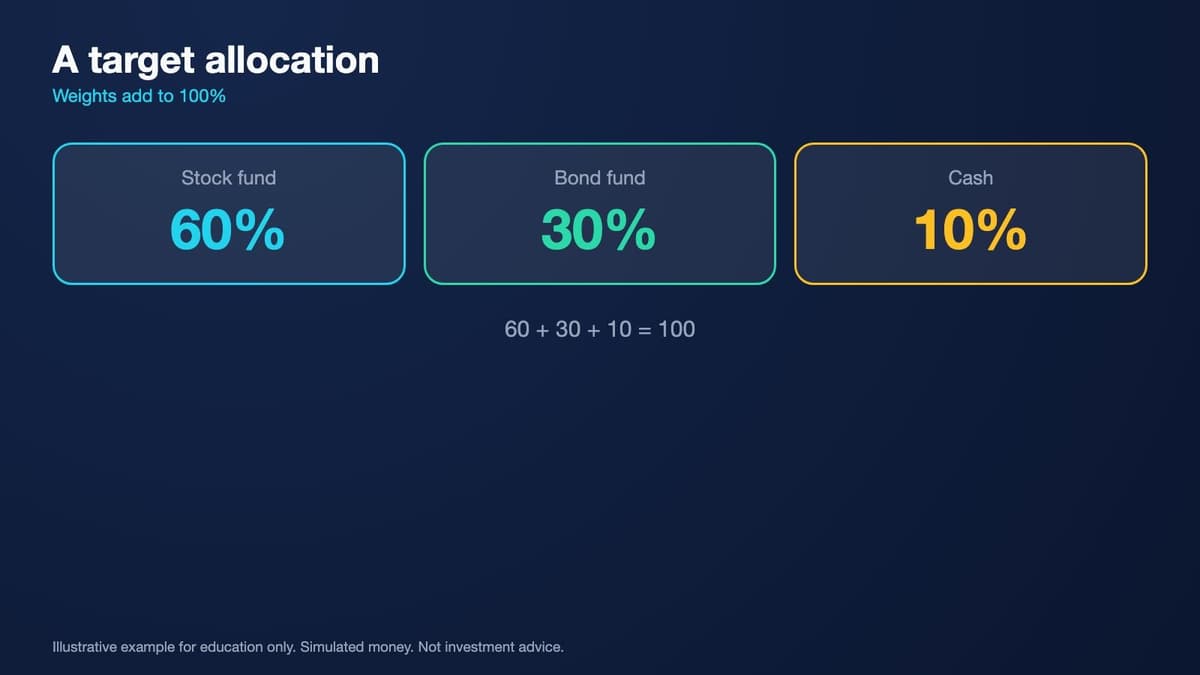
Use a hypothetical $10,000 simulated portfolio and fictional household circumstances. Complete five decisions about liquidity, risk, position concentration, rebalancing, and policy governance. Show calculations, write specific policy rules, and explain how each rule will be reviewed. Do not use personal financial information or real money. After completing the decisions, combine the results into a one-page IPS, sign it using a fictional learner name, and assign a simulated approval date.
- Decision 1: A fictional household has essential monthly expenses of $2,400 and selects a six-month emergency-reserve assumption for its educational IPS. The reserve must remain separate from risky simulated portfolio activities. — What reserve amount should the policy record, and why should it be separated from the investment portfolio?
- Decision 2: A simulated portfolio reaches a peak of $10,000. The draft IPS states that a twenty-percent drawdown triggers a pause in new positions and a formal risk review. — At what equity value is the threshold reached, what is the dollar decline, and what action should follow?
- Decision 3: A simulated $10,000 portfolio has a policy limiting each individual position to ten percent of portfolio equity at the time of purchase. A proposed new position requires $1,400. — Does the proposed position comply with the IPS, and what is the maximum permitted amount at entry?
- Decision 4: A simulated asset group has a target allocation of sixty percent with a tolerance band of five percentage points. Its current allocation increases to sixty-seven percent. — Is the allocation inside the permitted band, and what should the policy require?
- Decision 5: A learner's hypothetical IPS excludes leveraged products and requires quarterly reviews. After an exciting market rally, the learner wants to open a leveraged position and immediately rewrite the policy. — What response best follows the original policy, and when should the IPS be reconsidered?
Answer key
Test your policy with simple calculations. Six months of expenses at $2,400 per month requires $14,400. A twenty-percent drawdown from a $10,000 peak equals $2,000. A ten-percent single-position limit on a $10,000 portfolio equals $1,000. A sixty-percent target with a five-percentage-point band permits weights from fifty-five through sixty-five percent before triggering a review outside that range. Verify these calculations independently and document any additional assumptions.

Finish by specifying costs, rebalancing procedures, review dates, and decision-log requirements. Sign, date, and assign a version to your completed IPS. During later course exercises, compare each simulated decision with the policy before recording its outcome. Remember that the document is a learning framework, not a market forecast, individualized recommendation, or guarantee against financial loss. The goal is to establish a disciplined process that can be examined, tested, and improved responsibly.

Worked example at a glance
Key terms
- Investment policy statement (IPS): a written framework describing what a portfolio is for and the boundaries that guide it.
- Time horizon: when money may be needed.
- Liquidity: access to money without a rushed sale at a poor price.
- Emergency reserve: protected savings for essential expenses, kept outside the risk portfolio.
- Risk capacity: the financial ability to absorb losses.
- Risk tolerance: the emotional willingness to accept uncertainty.
- Drawdown limit: a decline from the previous peak that triggers a pause and review.
- Exclusion: an asset or strategy you will not use, with a written reason.
- Position cap: the maximum share of the portfolio in one holding.
- Trigger band: the range around a target weight; leaving it starts a review.
- Decision log: a record of actions, rules applied, outcomes and lessons.
Multi Asset Trading Lab is an educational course and does not provide personalized investment, trading, financial, legal, or tax advice. All portfolios, allocations, emergency-reserve examples, drawdown limits, asset exclusions, position sizes, and policy rules in this lesson are hypothetical and intended for simulated money only. No real-money investment or trading activity is required or encouraged. An Investment Policy Statement is a planning and governance tool, not a prediction of market returns, a guarantee of capital preservation, or a substitute for professional advice. Drawdown limits, concentration limits, diversification, liquidity reserves, and rebalancing procedures may help organize decisions but cannot eliminate market, liquidity, execution, inflation, currency, or other financial risks. Portfolio values may decline beyond planned thresholds because of price gaps, slippage, market stress, or insufficient liquidity. Historical performance and simulated results do not guarantee future outcomes. Emergency-reserve needs, investment horizons, financial obligations, and risk capacity vary across individuals and circumstances. The numerical examples, including a six-month reserve, a twenty-percent drawdown threshold, a ten-percent position limit, and a five-percentage-point rebalancing band, are illustrative rather than recommended personal settings. Learners should use fictional data for exercises and seek qualified professional advice before making actual financial decisions.
Lesson Checkpoint
Review what you learned and get feedback on your work.