



This 11-minute beginner lesson explains how foreign exchange movements affect the value of international investments when measured in a learner's base currency. Using simulated examples, learners separate local asset returns from currency returns, calculate combined returns accurately, compare hedged and unhedged exposure, and maintain a currency-aware decision journal.
Introduction: Why Foreign Investment Returns Look Different
Imagine buying shares of a foreign company through a simulated investment account. The shares increase ten percent in their local currency, but your account shows a smaller gain when measured in the currency you normally use. This difference can occur because exchange rates move during the investment period. International investing therefore introduces an additional variable beyond the price performance of the asset itself. Understanding this variable is essential for interpreting financial results accurately.

Currency exposure means that changes in exchange rates can influence the value of an asset, liability, income stream, or portfolio when measured in another currency. An investor does not need to actively trade foreign exchange to experience this exposure. Simply holding an asset denominated in a foreign currency may be enough. Currency movements can increase or decrease the measured value of a holding, sometimes offsetting asset performance and sometimes magnifying it.

Key points
- A foreign stock can gain 10% and still show a smaller gain at home.
- Price and exchange rate both affect your result.
- Simulated money only: all numbers here are illustrations.
This lesson focuses on separating two return components: local asset return and foreign-exchange return. You will learn to interpret exchange-rate quotes, calculate combined returns, recognize conversion costs, and understand basic currency hedging. The central outcome is being able to explain exactly how foreign asset performance translates into your chosen base currency. All exercises use simulated money, and none requires opening an actual financial position.

Base Currency, Asset Currency, and FX Quotes
Your base currency is the currency you choose for measuring financial performance and purchasing power. For example, a learner may use US dollars as the base currency because their simulated account is evaluated in dollars. Another learner may use Vietnamese dong, euros, or another currency. The base currency does not necessarily match the currency in which every investment is traded. Choosing a consistent base currency helps keep portfolio comparisons meaningful.
An asset currency is the currency used to quote or measure the value of a particular holding. A European share may be quoted in euros, while a US-listed share may be quoted in dollars. If your base currency differs from the asset currency, translating the investment into your base currency introduces an exchange-rate calculation. Additional economic currency exposure may also arise from a company's international revenue, expenses, debt, and operations, even when its shares trade in your home currency.
Key points
- Base currency = the currency you measure performance in.
- Asset currency = the currency the holding is priced in.
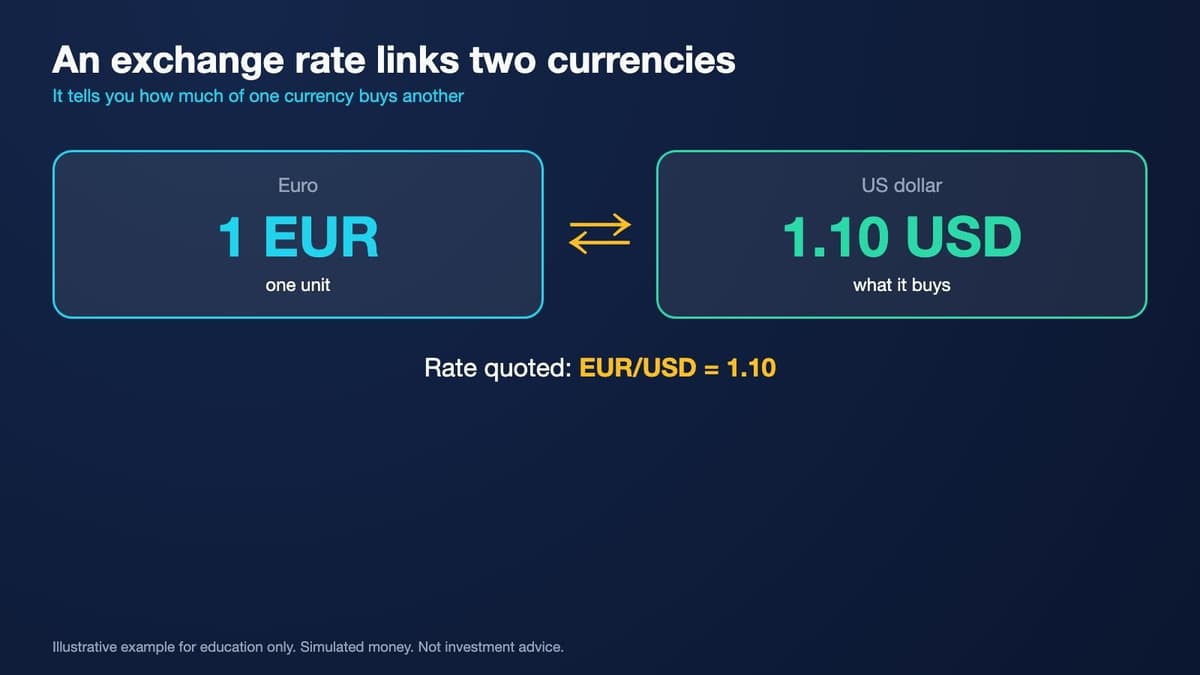
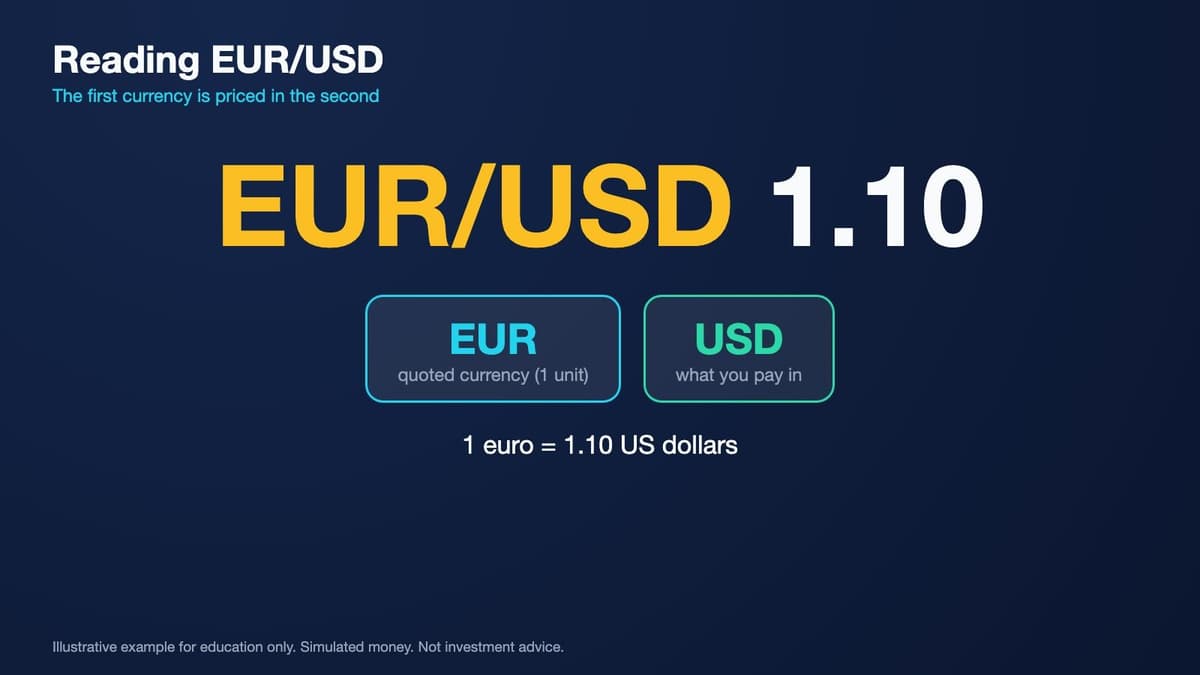
- EUR/USD 1.10 means 1 euro = 1.10 US dollars.
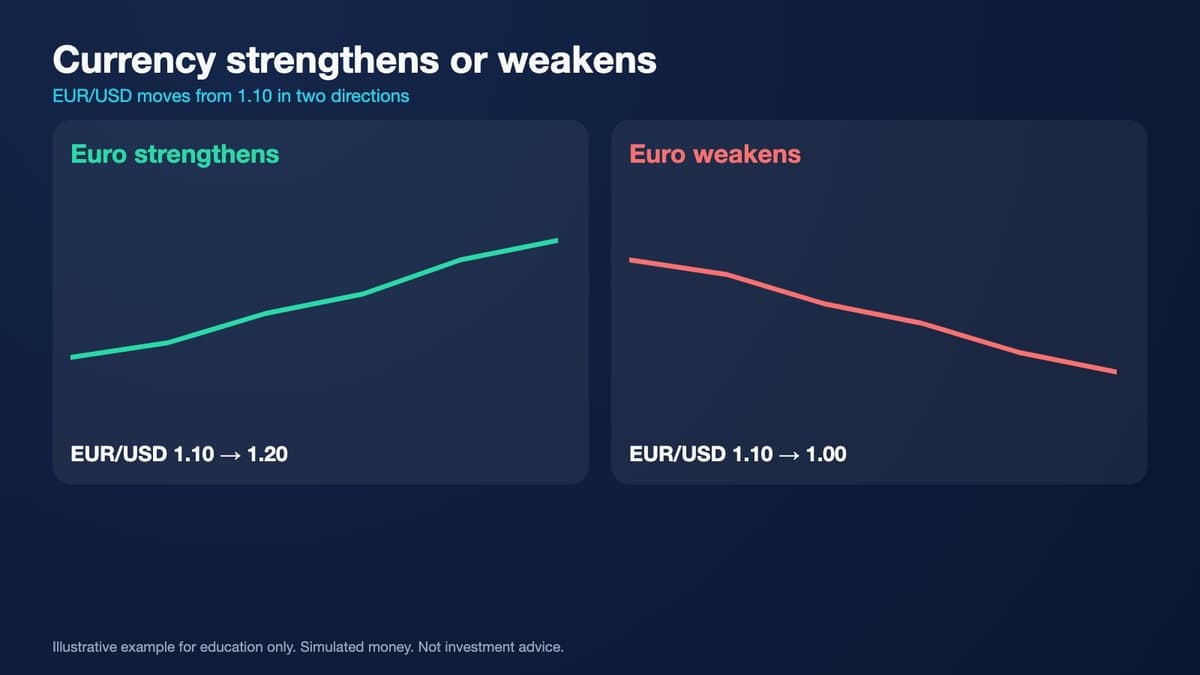
Exchange-rate quotes describe how much of one currency is required to purchase another. EUR/USD means the number of US dollars per one euro. At EUR/USD 1.10, one euro is worth $1.10. If the rate rises to 1.20, the euro has strengthened against the dollar. If it falls to 1.00, the euro has weakened. Always confirm the quote direction because reversing the currency pair changes the calculation.
Separating Local Asset Return and Currency Return
Local asset return describes how an investment performs when measured in its own currency. Suppose a hypothetical European asset begins at €100 and finishes at €110, with no dividends, fees, or other cash flows. Its local return is ten percent. This calculation does not yet tell a US-dollar investor how much the investment changed in dollar terms. To determine that result, we also need the exchange rate at the beginning and end of the period.
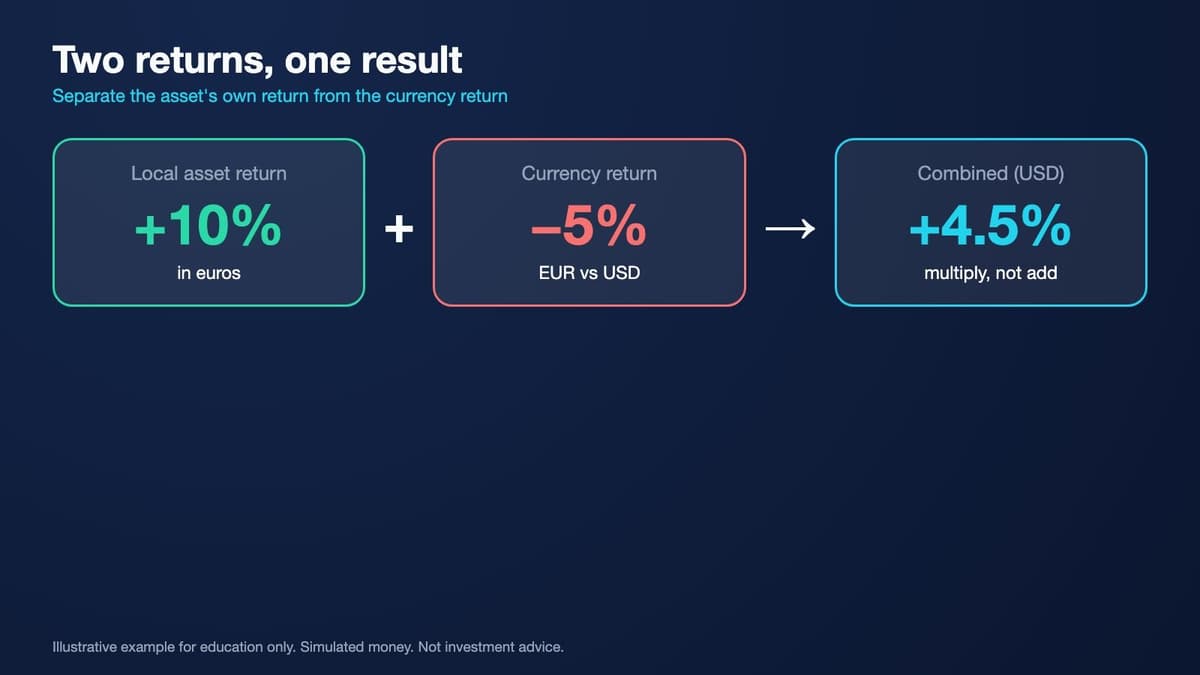
Currency return measures the percentage change in the asset currency's value relative to the investor's base currency. For EUR/USD, the currency return is the ending EUR/USD rate divided by the starting rate, minus one. For example, a decline from 1.20 to 1.14 represents a five-percent decline in the euro's dollar value. Under these conditions, a dollar-based investor experiences a negative currency effect even if the foreign asset itself increases in euro terms.
Key points
- Local return is measured in the asset currency.
- Currency return is the exchange-rate change against your base currency.
- Combined return = (1 + local) × (1 + FX) − 1.
The two returns must be combined multiplicatively rather than simply added. The formula is: base-currency return equals one plus local asset return, multiplied by one plus FX return, minus one. In symbols, R_base = (1 + R_local) × (1 + R_FX) - 1. The formula assumes consistent measurement periods and an FX return defined as the foreign currency's change relative to the base currency. Fees, taxes, income timing, and hedging can require additional adjustments.
Worked Examples: Currency Movements Can Help or Hurt
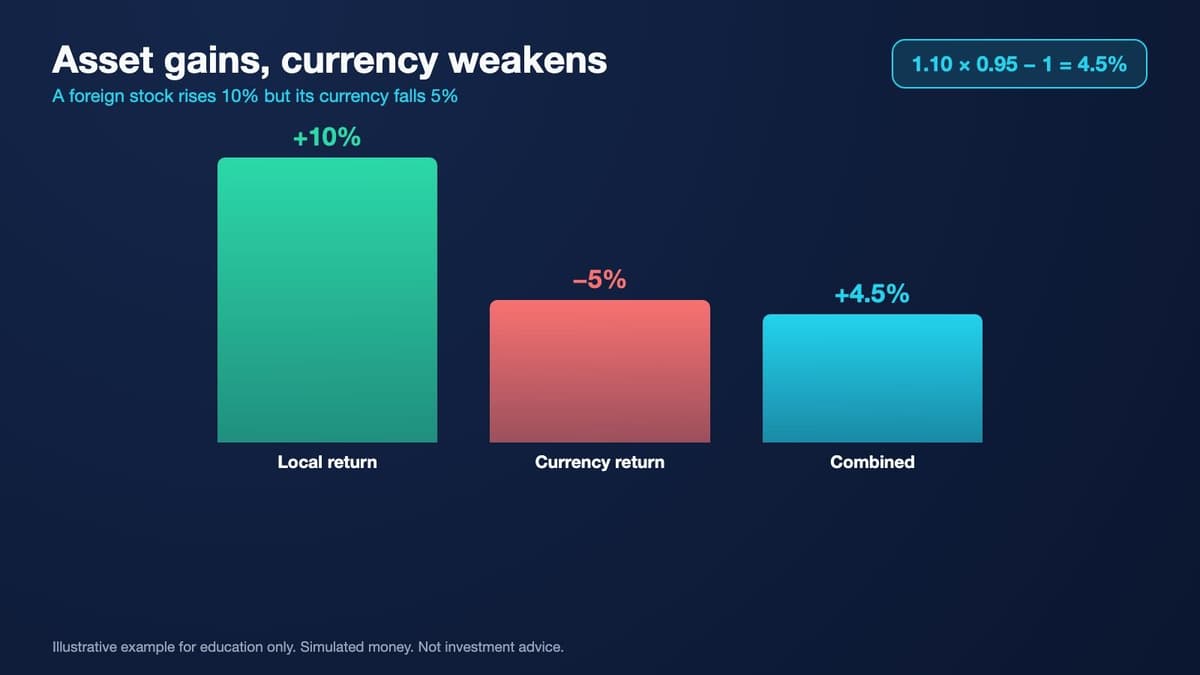
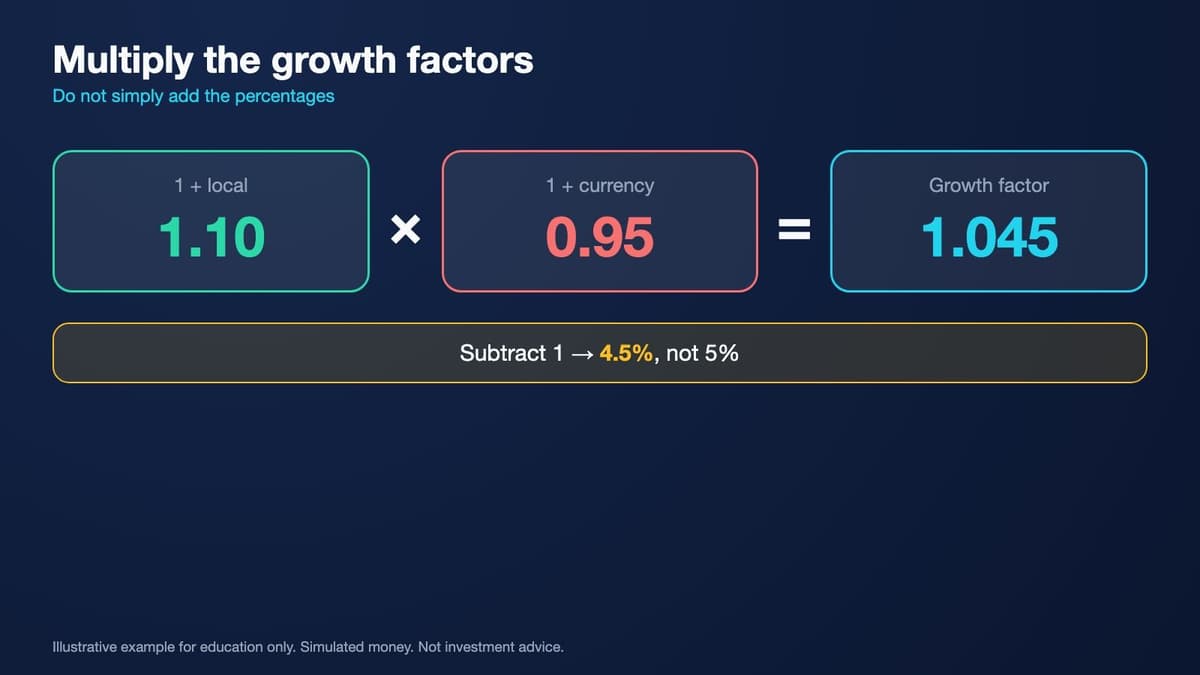
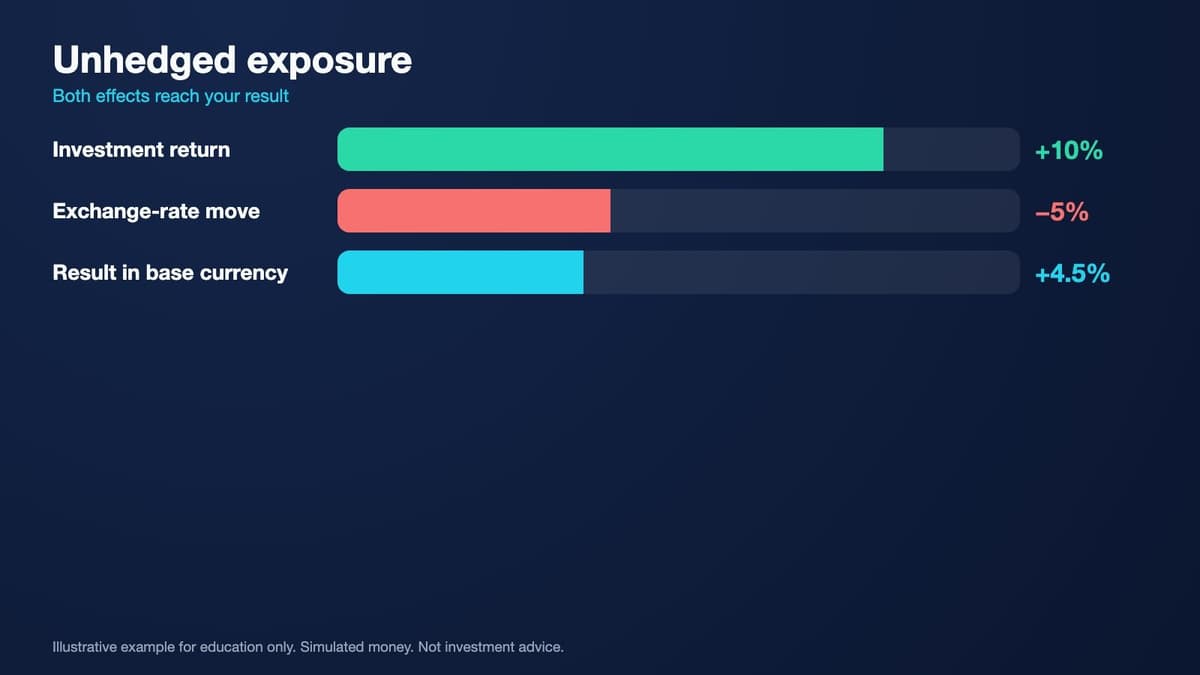
Consider a simulated asset that gains ten percent in its local currency while that currency loses five percent against the investor's base currency. The asset growth factor is 1.10, and the currency factor is 0.95. Multiplying produces 1.045. Subtracting one gives a combined return of exactly 4.5 percent. Simply subtracting five percent from ten percent gives five percent, which is incorrect because the interaction between the two percentage changes must also be included.
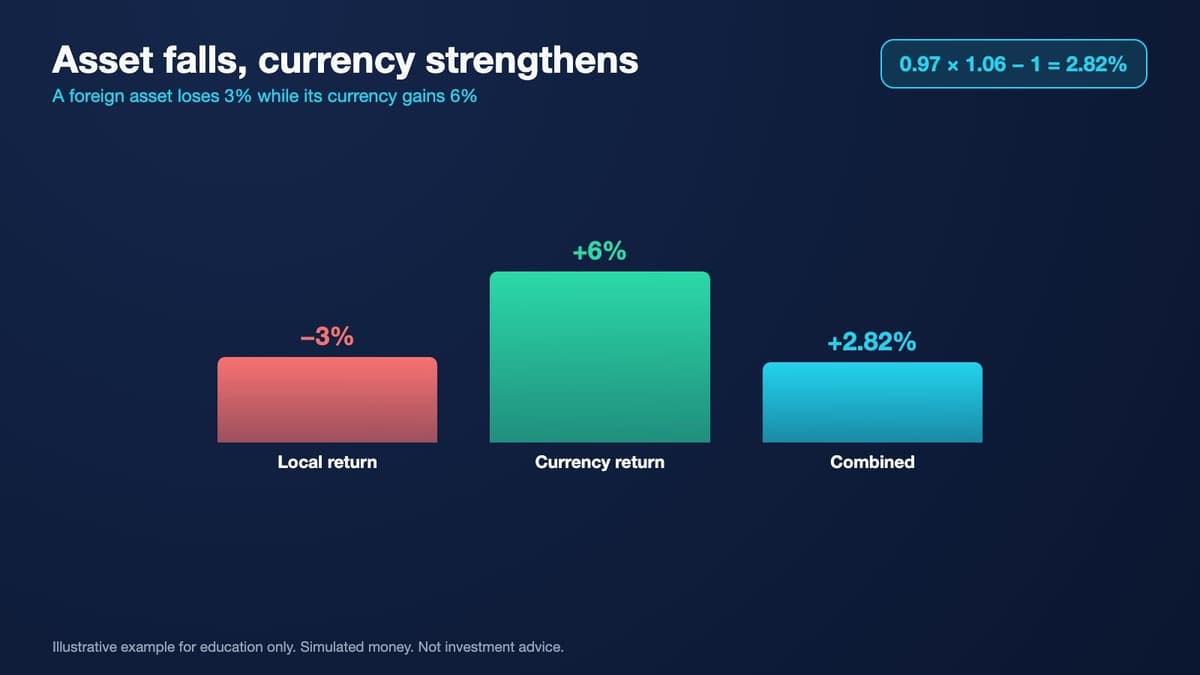
Now consider the opposite case. A simulated foreign asset loses three percent locally, while its currency strengthens six percent against the base currency. The corresponding growth factors are 0.97 and 1.06. Their product is exactly 1.0282, producing a positive combined return of 2.82 percent. The currency appreciation more than offsets the asset's local decline. However, this mathematical example does not imply that currency movements will reliably protect investors from losses.
Key points
- +10% asset and −5% currency gives +4.5%, not +5%.
- −3% asset and +6% currency gives +2.82%.
- FX can help or hurt, and neither is guaranteed.
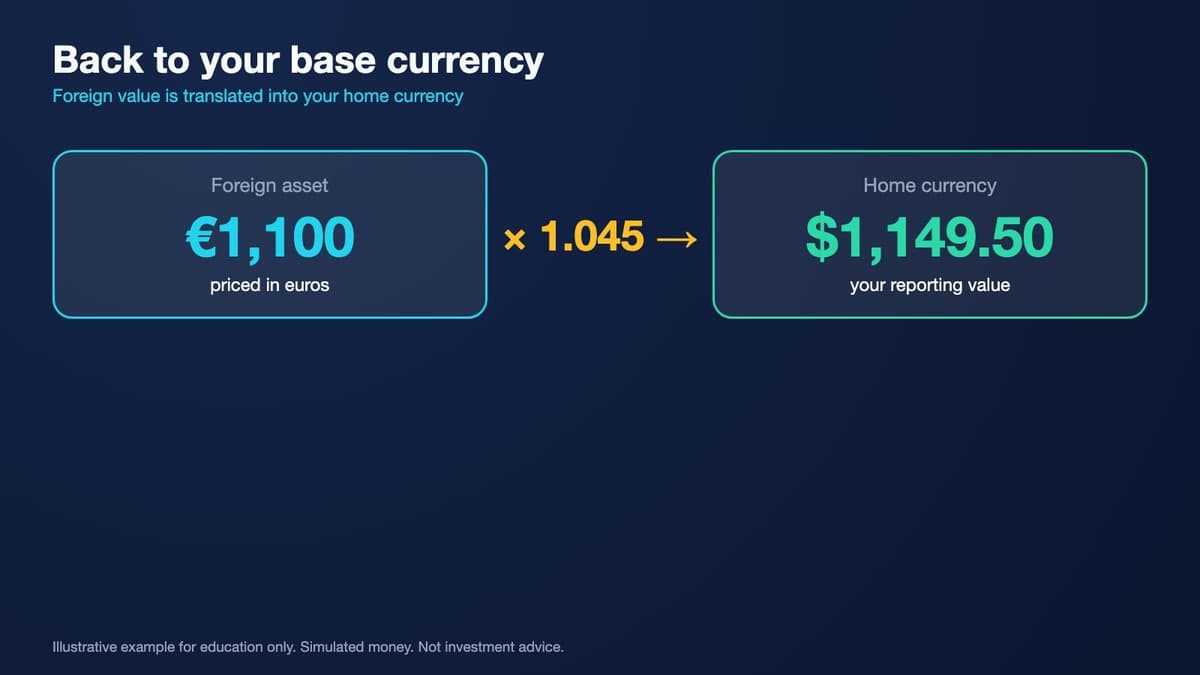
You can verify these examples by translating the starting and ending asset values directly. Suppose an asset starts at €100 with EUR/USD 1.20. Its starting dollar value is $120. After a ten-percent local gain, the asset is worth €110. If the euro depreciates five percent, EUR/USD becomes 1.14. The ending value is $125.40, producing a $5.40 gain on $120, or exactly 4.5 percent.

Currency Exposure, Currency Trading, and Hedging
Currency exposure and currency trading are not identical activities. Currency trading deliberately seeks gains or manages positions based on exchange-rate movements. Currency exposure can arise simply because a person owns foreign-denominated investments, receives income in another currency, or has foreign-currency obligations. A long-term investor holding overseas shares may experience substantial exchange-rate effects without entering a single dedicated foreign-exchange trade. Understanding the distinction helps learners classify the source of financial performance correctly.

An unhedged foreign investment retains exposure to relevant currency movements. When the foreign currency strengthens against the investor's base currency, the currency component generally helps the investment's base-currency return. When it weakens, the currency component generally hurts. These movements can occur independently of the underlying asset's local performance. An international portfolio can also involve multiple currencies, including indirect exposure through the revenues and costs of multinational businesses.
Key points
- Owning foreign assets creates exposure even if you never trade currencies.
- Unhedged exposure keeps the FX effect, good or bad.
- Hedging reduces exposure but adds costs and complexity.
Currency hedging attempts to reduce exchange-rate uncertainty, often through financial instruments or hedged investment products. A hedge may reduce certain currency effects but can introduce costs, imperfect matching, financing considerations, and additional complexity. It can also prevent an investor from benefiting from favorable exchange-rate movements. Hedging therefore does not automatically produce a better return or eliminate all risks. For beginner exercises, compare hedged and unhedged outcomes conceptually using clearly stated hypothetical assumptions.

Conversion Costs, Spreads, and Holding Periods
Converting money between currencies can involve explicit commissions, service fees, and bid-ask spreads. The exchange rate offered by a financial provider may differ from a reference market rate. For example, a provider might quote different rates for buying and selling euros. That difference creates a cost even when no separate commission appears on the transaction record. Repeated conversions can reduce the performance of an international investment, particularly when the expected gains are relatively small.
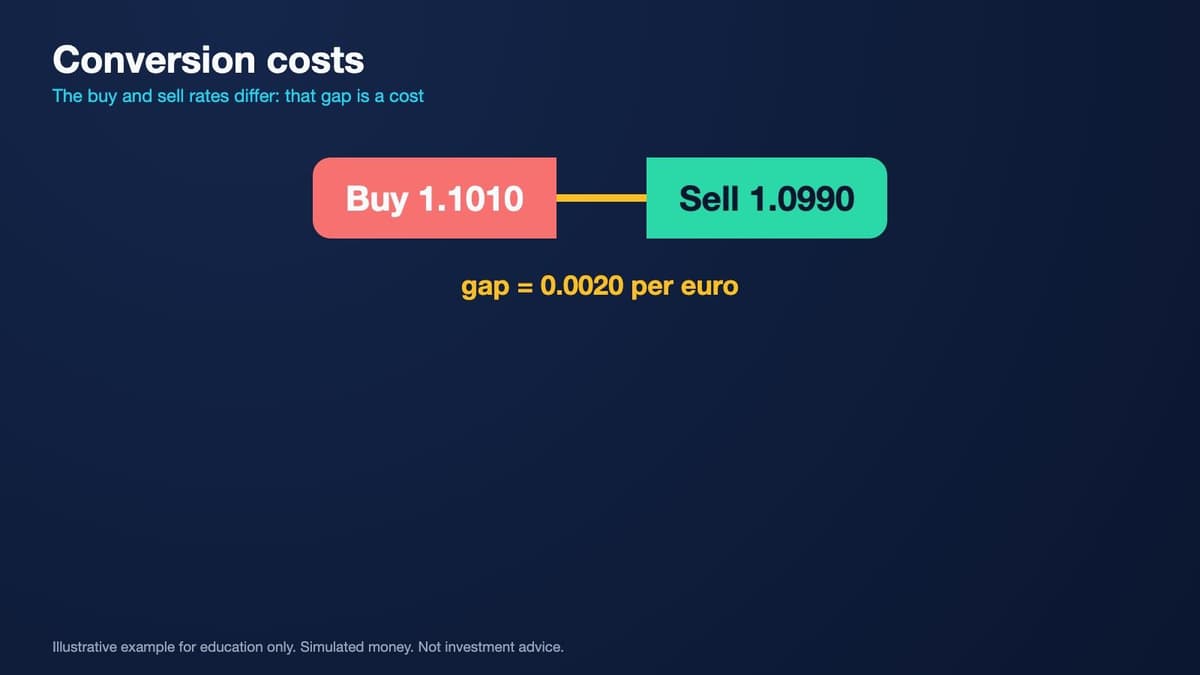
Costs may also arise in the asset's local currency. A foreign brokerage commission, custody charge, dividend withholding tax, or fund expense can influence the amount eventually retained. Tax treatment depends on jurisdiction and personal circumstances, so there is no universal rule that applies to every investor. When calculating simulated returns, identify which costs are already reflected in account values and avoid subtracting the same expense twice. Use a consistent currency when comparing total costs.

Key points
- Conversion costs reduce the amount actually invested.
- Convert fees and record them once, consistently.
- The FX effect at purchase can differ from the effect at sale.
Time horizon affects the practical significance of currency exposure. An investor who expects to spend money in a foreign currency may have different concerns from someone who plans to convert everything back into their home currency. Exchange rates may fluctuate many times during ownership, and future rates cannot be known in advance. A short investment horizon may leave less time for an unfavorable currency movement to reverse, while a longer horizon does not guarantee that reversal will occur.

Demo-Account Journal and Currency Decision Checklist
A currency-aware journal helps learners identify why an international investment gained or lost value. Record the asset name, asset currency, portfolio base currency, starting asset value, ending asset value, and corresponding exchange rates. Then calculate the local asset return and currency return separately. Finally, combine the two growth factors to obtain the base-currency return before additional costs. Comparing this calculation with the directly converted starting and ending values provides a useful accuracy check.

Your journal should also identify conversion spreads, commissions, other expenses, and whether any currency hedge is assumed. Record the investment horizon and any expected future currency needs. If a simulated position receives dividends or other payments during the holding period, those cash flows may require separate conversion at their respective dates. Avoid forcing complicated situations into an oversimplified two-factor formula without stating the assumptions and limitations of the exercise.
Key points
- Record asset currency, base currency, local return, FX return and costs.
- Check quote direction first.
- Compare hedged and unhedged on the same basis.
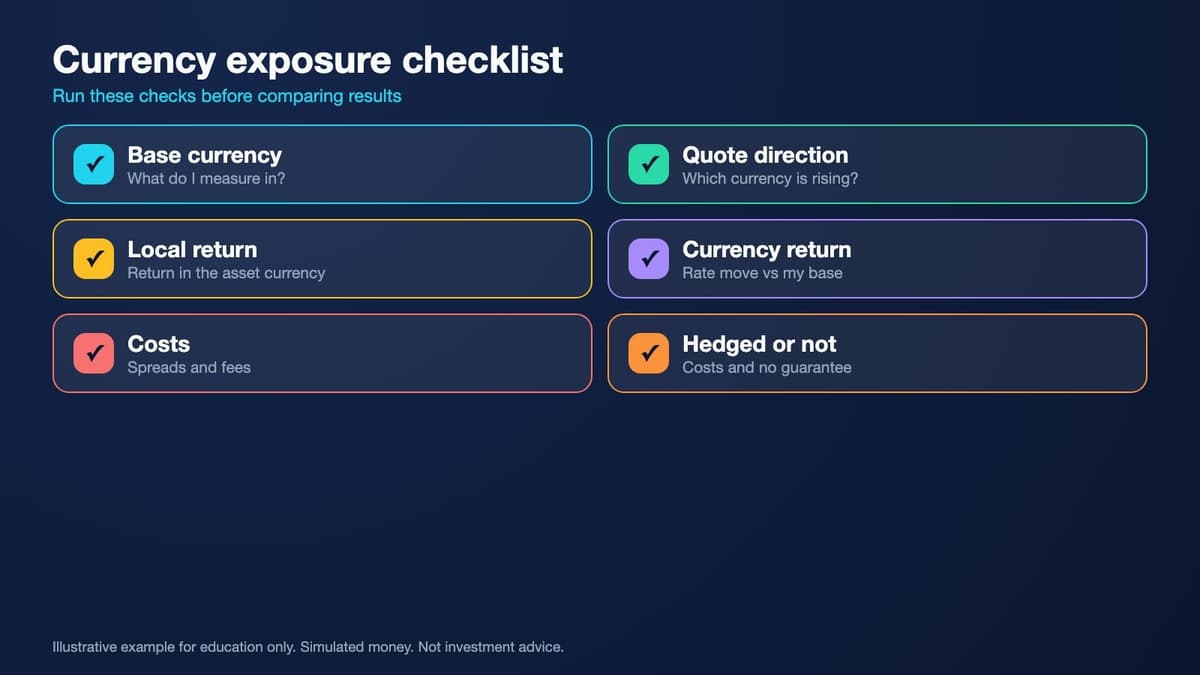
Before evaluating a simulated foreign investment, apply a five-part checklist. First, identify the base and asset currencies. Second, read the exchange-rate direction correctly. Third, calculate local and currency returns over matching periods. Fourth, account for transaction costs, taxes, and any hedge assumptions. Fifth, assess uncertainty, liquidity, and time horizon. This process helps distinguish asset selection from currency exposure and discourages decisions based solely on attractive local-market performance.
Practice, Recap, and the Currency Exposure Checkpoint
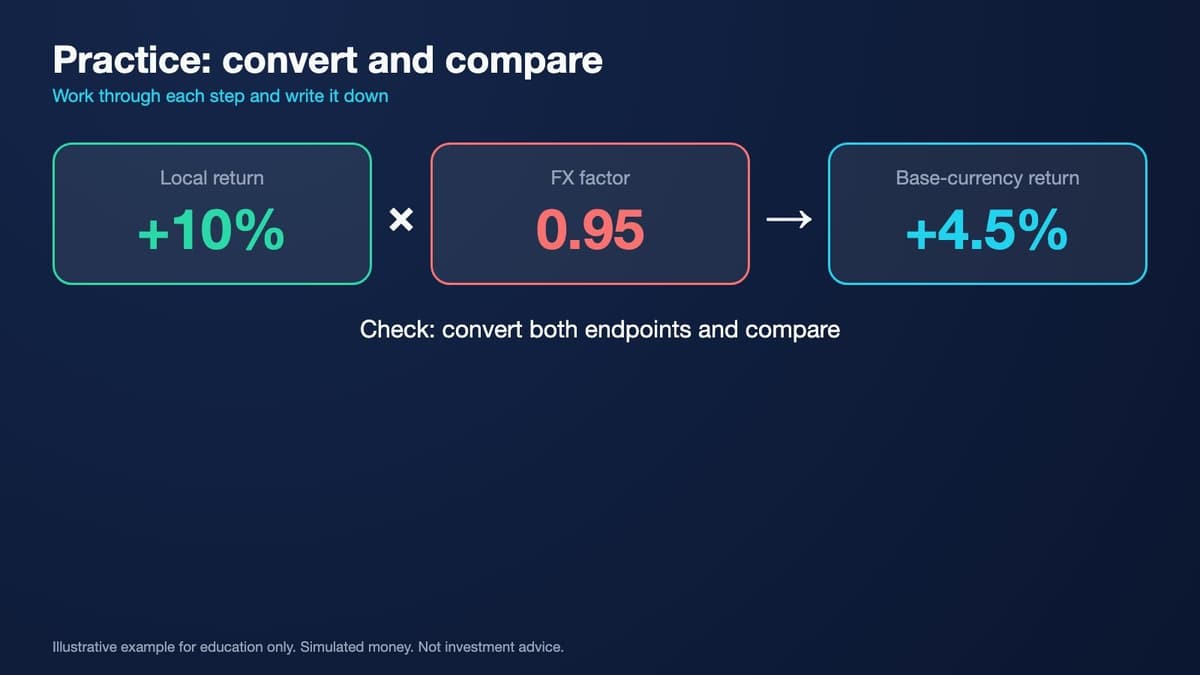
The central checkpoint asks you to separate asset performance from exchange-rate performance. Start with a foreign asset that gains ten percent while its currency depreciates five percent relative to your base currency. Convert these percentages into growth factors of 1.10 and 0.95. Multiply them to obtain 1.045, then subtract one. The exact combined return is 4.5 percent. Explain why the simple arithmetic difference of five percent is not the correct result.
Practice Lab: Separate Asset Return From FX Return
Use simulated money only. Assume no dividends, deposits, withdrawals, taxes, fees, or hedging unless specified. Define FX return as the percentage change in the asset currency's value relative to the portfolio base currency. Calculate local asset return and FX return separately, then apply (1 + R_local) × (1 + R_FX) - 1. Show calculations and explain how currency exposure changes the outcome.
- Decision 1: A simulated European investment gains 10% in euros. Over the same year, the euro depreciates 5% against the US dollar. The portfolio base currency is USD. — What is the combined USD return, and why is it not simply 5%?
- Decision 2: A simulated foreign asset declines 3% in its local currency while that currency appreciates 6% against the investor's base currency during the same period. — Does the portfolio gain or lose value in its base currency?
- Decision 3: A simulated asset begins at €100 when EUR/USD equals 1.20. One year later, the asset remains at €100, while EUR/USD equals 1.14. — What is the asset's local return and its USD return?
- Decision 4: Two simulated funds hold equivalent foreign assets. Fund A is unhedged, while Fund B uses a currency hedge that has costs and imperfect protection. — Which fund is guaranteed to deliver a higher base-currency return?
- Decision 5: A simulated investor converts $1,000 into a foreign currency, then converts the proceeds back after an unchanged exchange rate. The provider charges a total round-trip conversion cost of $20. — What is the net dollar result and net return, assuming the underlying asset value also remains unchanged?
Answer key
Next, calculate the return when the asset declines three percent and the foreign currency appreciates six percent. Multiply 0.97 by 1.06 to obtain 1.0282. The exact combined return is positive 2.82 percent. This exercise demonstrates that asset returns and currency returns can move in opposite directions. Practice additional cases with negative currency returns, different base currencies, and explicit conversion costs while keeping every assumption clear.
The most important lesson is that international investment performance depends on more than the foreign asset's quoted price. Exchange-rate movements can change the result when expressed in your base currency. Currency exposure can exist without active currency trading, while hedging may reduce some uncertainty at an additional cost. Record local returns, FX returns, and total returns separately. All examples are educational simulations and do not provide personal investment, trading, or currency recommendations.

Worked example at a glance
Key terms
- Base currency: the currency you use to measure wealth and performance.
- Asset currency: the currency in which an investment is priced.
- Exchange rate: how much of one currency buys another.
- EUR/USD: the number of US dollars needed to buy one euro.
- Local return: return measured in the asset’s own currency.
- Currency return: the percentage change of the asset currency against your base currency.
- Combined return: (1 + local) × (1 + FX) − 1.
- Currency exposure: sensitivity of your result to exchange-rate moves.
- Hedging: reducing exchange-rate exposure, usually at a cost.
- Spread: the gap between buy and sell rates.
Multi Asset Trading Lab provides educational information only and does not constitute investment, trading, financial, legal, or tax advice. All examples use hypothetical exchange rates, simulated assets, and simulated money. No real-money financial transactions are required. Foreign currency exposure can increase or decrease investment values when measured in another currency. Exchange rates may change rapidly and unpredictably, and local asset gains can be offset or exceeded by unfavorable currency movements. Currency hedging may reduce certain exposures but introduces costs, complexity, counterparty risks, and imperfect protection. Hedging does not guarantee profits or eliminate investment losses. Transaction fees, conversion spreads, taxes, and execution conditions can materially affect realized performance. The combined-return formula assumes consistent measurement periods, correctly directed exchange rates, and appropriately defined cash flows; more complex portfolios may require additional calculations. Simulated performance does not predict actual results, and all financial investments involve uncertainty and possible capital loss.
Lesson Checkpoint
Review what you learned and get feedback on your work.