



Define the Exposure Before Choosing the Contract
An effective futures hedge starts with a measurable exposure, not a market opinion. Identify the asset, quantity, pricing date, currency, and direction of risk. A business that owns inventory or expects to sell an asset is harmed by falling prices and normally uses a short hedge. A business that expects to buy an asset is harmed by rising prices and normally uses a long hedge. The hedge objective should also be explicit: stabilize a budget, protect a minimum selling price, or reduce profit volatility rather than maximize trading profit.
Suppose a wheat producer expects to sell 500,000 bushels in three months. The producer is economically long wheat because the future sale value rises and falls with wheat prices. Selling wheat futures creates an offsetting short position. Conversely, a manufacturer expecting to buy 250,000 pounds of copper is economically short copper before the purchase and can buy futures to offset the risk of a price increase.
The exposure estimate must reflect the quantity that is genuinely price-sensitive. If only 70% of the wheat crop is highly probable, hedging the entire forecast can create a speculative short position if production disappoints. A probability-adjusted planning estimate would be 500,000 × 70% = 350,000 bushels, although accounting rules or risk policy may require a different treatment. Quantity uncertainty, timing uncertainty, and quality differences should be documented before calculating contracts.
Calculate the Hedge Ratio and Contract Count
The simplest hedge uses a hedge ratio of 1.00, meaning one unit of futures exposure for each unit of cash exposure. If a wheat futures contract represents 5,000 bushels, a full hedge of 500,000 bushels requires N = 500,000 ÷ 5,000 = 100 short contracts. If management wants to hedge only 80%, the contract count becomes N = 0.80 × 500,000 ÷ 5,000 = 80 short contracts.
Assume cash wheat is initially $6.20 per bushel and the futures price is $6.35. At the sale date, cash wheat is $5.55 and futures are $5.68. Selling 80 futures contracts at $6.35 and buying them back at $5.68 produces a gain of ($6.35 − $5.68) × 5,000 × 80 = $268,000. Cash revenue is $5.55 × 500,000 = $2,775,000. Total hedged proceeds are therefore $3,043,000, or $6.086 per bushel across the entire crop. The hedge did not lock in $6.35 because only 80% of the quantity was hedged and the local cash price did not move exactly with futures.
For a long hedge, assume a manufacturer will buy 250,000 pounds of copper and each futures contract represents 25,000 pounds. A 1.00 hedge ratio requires 10 long contracts. If futures rise from $4.05 to $4.38 per pound while the cash purchase price rises from $4.00 to $4.35, the cash cost is $1,087,500 and the futures gain is ($4.38 − $4.05) × 250,000 = $82,500. Net cost is $1,005,000, equivalent to $4.02 per pound before commissions, financing, and operational adjustments.
Measure Basis Risk
Basis is defined here as cash price minus futures price: b = S − F. In the copper example, initial basis is $4.00 − $4.05 = −$0.05 per pound. At the purchase date, basis is $4.35 − $4.38 = −$0.03. For a correctly sized long hedge held to the pricing date, the effective purchase price is approximately F0 + bT. The result is $4.05 + (−$0.03) = $4.02 per pound, matching the detailed cash-and-futures calculation.
For a full short hedge, effective selling price is also approximately F0 + bT. Futures protect against the common movement in cash and futures prices, but they do not eliminate uncertainty in the closing basis. If the basis strengthens from −$0.15 to −$0.05, a short hedger generally benefits because the cash price performs better relative to futures. If the basis weakens, the short hedger receives a lower effective price. Long hedgers have the opposite economic preference.
Basis risk arises from location, grade, delivery timing, transportation costs, storage conditions, and contract expiration. A hedge should therefore use the contract whose price behavior is most closely linked to the exposure, not automatically the contract with the nearest name. Historical basis should be analyzed around the intended transaction month. The range and standard deviation of basis are more useful for risk planning than a single historical average.

Design a Minimum-Variance Cross-Hedge
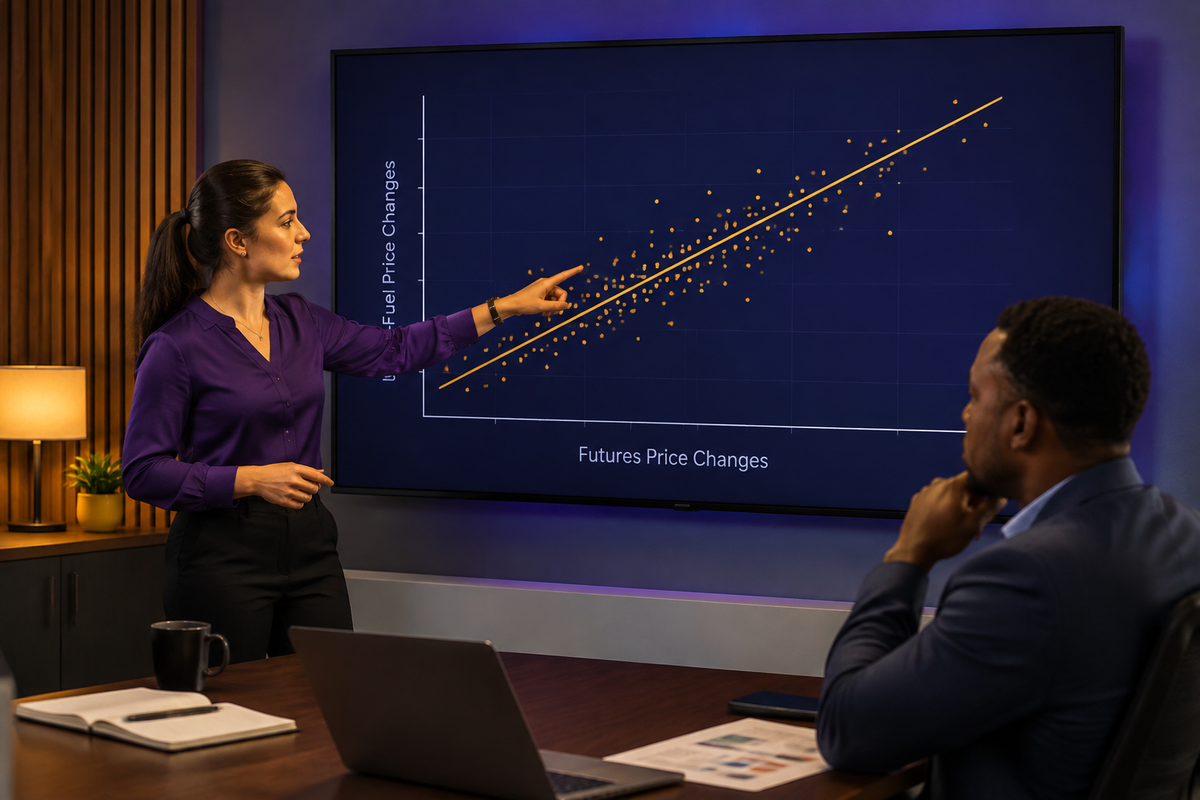
An exact futures contract may not exist for the asset being hedged. For example, a firm exposed to jet fuel may use a liquid refined-product futures contract whose price is strongly, but imperfectly, correlated with jet fuel. This is a cross-hedge. Contract selection should consider economic similarity, historical return correlation, liquidity, contract units, currency, delivery location, and whether the relationship remains stable during stressed markets.
A common quantitative estimate is the minimum-variance hedge ratio h* = ρ × σS ÷ σF, where ρ is the correlation between changes in the spot exposure and futures price, σS is the standard deviation of spot price changes, and σF is the standard deviation of futures price changes. Both volatilities must use compatible units and observation intervals. The ratio can also be estimated as the slope from a regression of spot price changes on futures price changes.
Assume monthly jet-fuel price changes have a standard deviation of $0.12 per gallon, related futures changes have a standard deviation of $0.10 per gallon, and correlation is 0.82. The hedge ratio is 0.82 × $0.12 ÷ $0.10 = 0.984. If the exposure is 1,200,000 gallons and the assumed futures contract size is 42,000 gallons, the estimated contract count is 0.984 × 1,200,000 ÷ 42,000 = 28.11 contracts. Because contracts are indivisible, the firm must choose 28 or 29 after comparing residual exposure, transaction costs, and risk limits.
Under stable statistical relationships, approximate variance reduction from the minimum-variance hedge is ρ². Here, 0.82² = 0.6724, so the hedge may reduce price-change variance by about 67.24%, not 98.4%. The hedge ratio describes position size; it is not the percentage of risk eliminated. The remaining risk comes from imperfect correlation, parameter estimation error, contract rounding, and future changes in the relationship.
Stress-Test Execution, Margin, and Timing
A hedge can be economically sound but fail because of liquidity pressure. Futures require initial margin and daily variation margin. Consider a short position of 28 contracts, each covering 42,000 gallons. If futures rise by $0.60 per gallon, the variation loss is 28 × 42,000 × $0.60 = $705,600. The underlying inventory or expected sale may gain similar economic value, but that gain might not generate cash until months later. The hedger therefore needs a margin liquidity reserve separate from the expected hedge outcome.
Expiration should be later than, but reasonably close to, the cash pricing date. If the exposure extends beyond the liquid contract month, the hedge may need to be rolled by closing the nearby contract and opening a later one. The price difference between contract months creates roll risk. Timing mismatches also matter: closing the futures hedge one week before the cash transaction leaves the exposure unhedged during that week.
Stress tests should include adverse basis moves, correlation breakdown, quantity changes, delayed transactions, contract rounding, and large margin calls. Leverage does not reduce the required hedge notional; it only reduces the cash posted initially relative to that notional. A small margin deposit can therefore support a large and appropriate hedge, but it can also create severe cash demands if futures move against the position before the cash exposure is settled.
Final Hedge Decision Framework
A defensible hedge connects every contract to a documented exposure. First estimate quantity and timing, determine whether the required futures direction is long or short, select the closest contract, estimate a 1.00 or minimum-variance hedge ratio, calculate the contract count, and evaluate rounding. Then quantify basis risk, transaction costs, margin liquidity, and roll requirements before execution.
Performance should be evaluated using the combined cash and futures result rather than the futures profit alone. A futures loss can indicate a successful hedge when the underlying exposure gains value. After settlement, compare actual effective price with the target, separate basis effects from quantity and timing errors, and update the hedge ratio only when sufficient new evidence shows that the price relationship has changed.
Lesson Checkpoint
Review what you learned and get feedback on your work.