



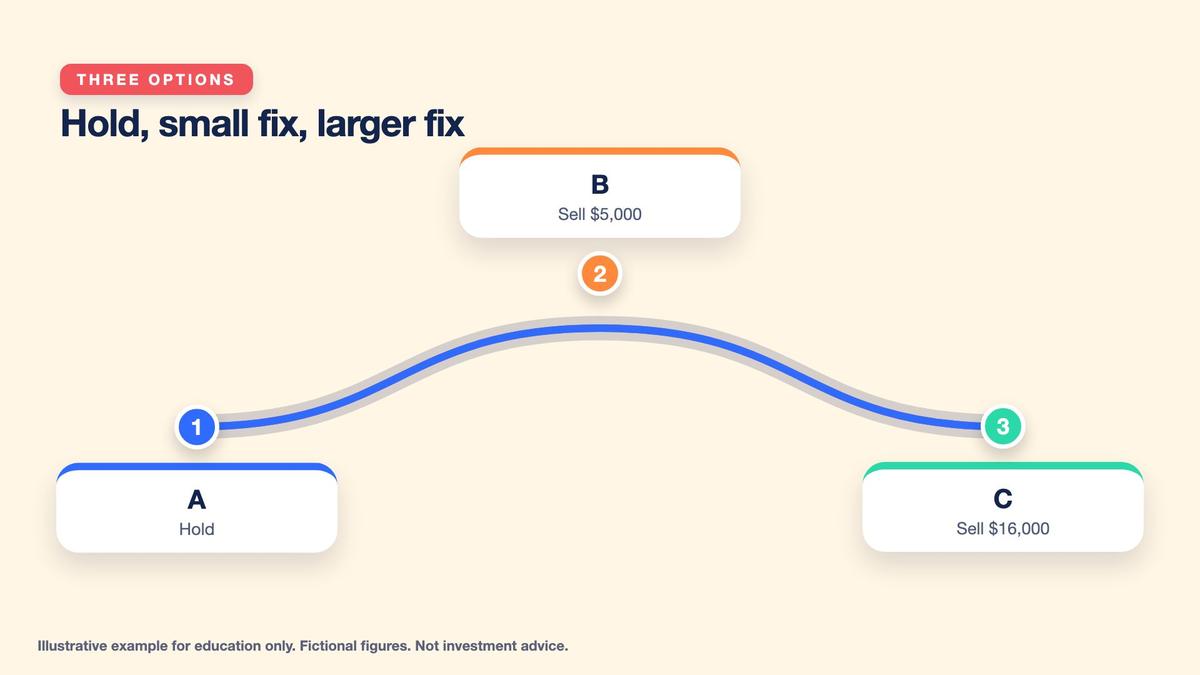
This thirteen-minute beginner hands-on Portfolio Lab lesson teaches learners to explain a simulated rebalancing decision against a written investment policy. Continuing the entirely fictional $100,000 portfolio from Lessons 28 and 29, learners compare three alternatives: Option A, hold the original allocation; Option B, move $5,000 from Sample Wide Stock ETF into cash; and Option C, move $10,000 from Sample Wide Stock ETF and $6,000 from Sample Foreign Stock ETF into cash. The portfolio's ten-year growth objective, $15,000 bad-scenario loss tolerance, 40% maximum individual holding, 5% maximum crypto allocation and 5% minimum cash requirement remain unchanged. Under the four previously defined hypothetical stress scenarios, Option A breaches the loss tolerance twice, with a worst loss of $20,350. Option B reduces the worst loss to $18,850 but still breaches the combined scenario. Option C creates a 39% stock allocation and 21% cash allocation, with a modeled $16 transaction spread cost, and produces scenario losses of $11,700 for equity, $4,950 for crypto, $1,600 for currency and $14,710 for the combined stress. Option C passes all four tests and all three allocation limits, but the combined test has only $290 of remaining headroom. Learners verify post-trade values and weights, calculate transaction costs, rerun each scenario, compare losses avoided with modeled costs, and identify the trade-off between reduced tested downside and diminished growth exposure. The classroom decision is Option C, documented in a one-paragraph memo using the required Decision, Because, Trade-offs and What would change my mind structure. The learner also prepares a dated journal entry and optionally rehearses one small mock order using simulated money only. Every asset, price, currency, trade, stress scenario and outcome is fictional. The lesson provides no investment advice, probabilities or price predictions.
Reopen the Written Policy and Define the Decision Test
Rebalancing means deliberately changing portfolio weights, typically by selling some holdings, buying others or redirecting cash flows. It differs from ordinary market drift, which changes weights without any transaction. In this lesson, begin with the unchanged fictional $100,000 model portfolio from Lessons 28 and 29. Sample Wide Stock ETF is worth $40,000, Sample Bond Fund $25,000, Sample Gold Fund $10,000, Sample Foreign Stock ETF $15,000, Sample Coin $5,000 and cash $5,000. The foreign holding remains valued at 12,000 fictional SCU using one SCU equal to $1.25. All prices, assets and values are invented classroom inputs, and no actual investment transaction takes place.

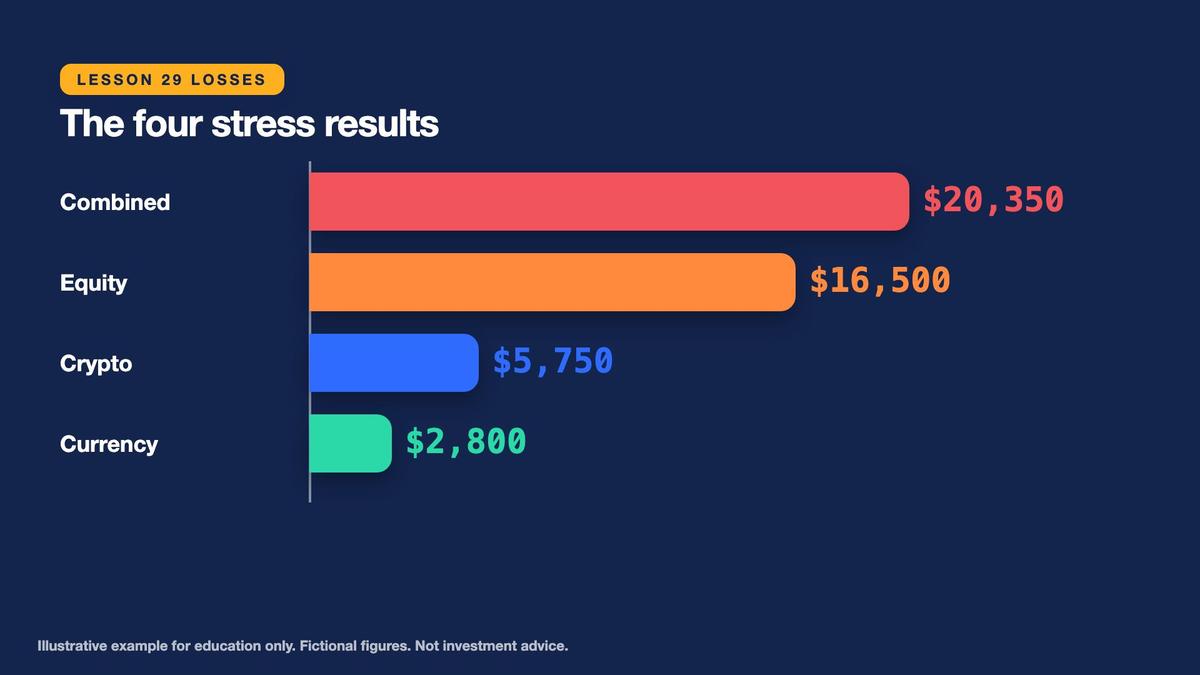
The written policy seeks long-term growth with moderate risk over ten years. It permits a bad-scenario loss of 15% of initial portfolio value, or $15,000. A single holding cannot exceed 40%, crypto cannot exceed 5%, and cash cannot fall below 5%. These restrictions remain unchanged throughout the comparison. Lesson 29 found that the original portfolio loses $16,500 in the equity scenario, $5,750 in crypto, $2,800 in currency and $20,350 in the combined scenario. Thus the equity and combined tests breach the loss tolerance, while the other two pass. The opening portfolio remains compliant with allocation limits, illustrating that allocation compliance and downside compliance are separate questions.


Key points
- Rebalancing is a decision that must follow the written policy, not a reaction to recent prices. The decision test has four questions: any stress test over tolerance, limits still passing, trading cost small against the loss avoided, growth objective still served.
- Starting point: the fictional $100,000 portfolio, a $15,000 tolerance and limits of 40% per holding, 5% crypto maximum and 5% cash minimum.
- Lesson 29 results for Option A (hold): equity -$16,500 and combined -$20,350 breach; crypto -$5,750 and currency -$2,800 pass.
Write the decision framework before analyzing alternative outcomes. First, does any tested stress scenario exceed the loss tolerance? Second, do all written allocation limits remain satisfied after the proposed transaction? Third, is the modeled transaction cost small relative to the reduction in hypothetical loss? Fourth, does the revised allocation continue to serve the ten-year growth objective? A decision must explain all four questions instead of choosing a convenient calculation. The written decision must include the openings Decision, Because, Trade-offs and What would change my mind. This structure keeps the policy and supporting evidence visible and discourages changing the rules after seeing an unfavorable result.
Compare Holding With the Small Stock-to-Cash Adjustment
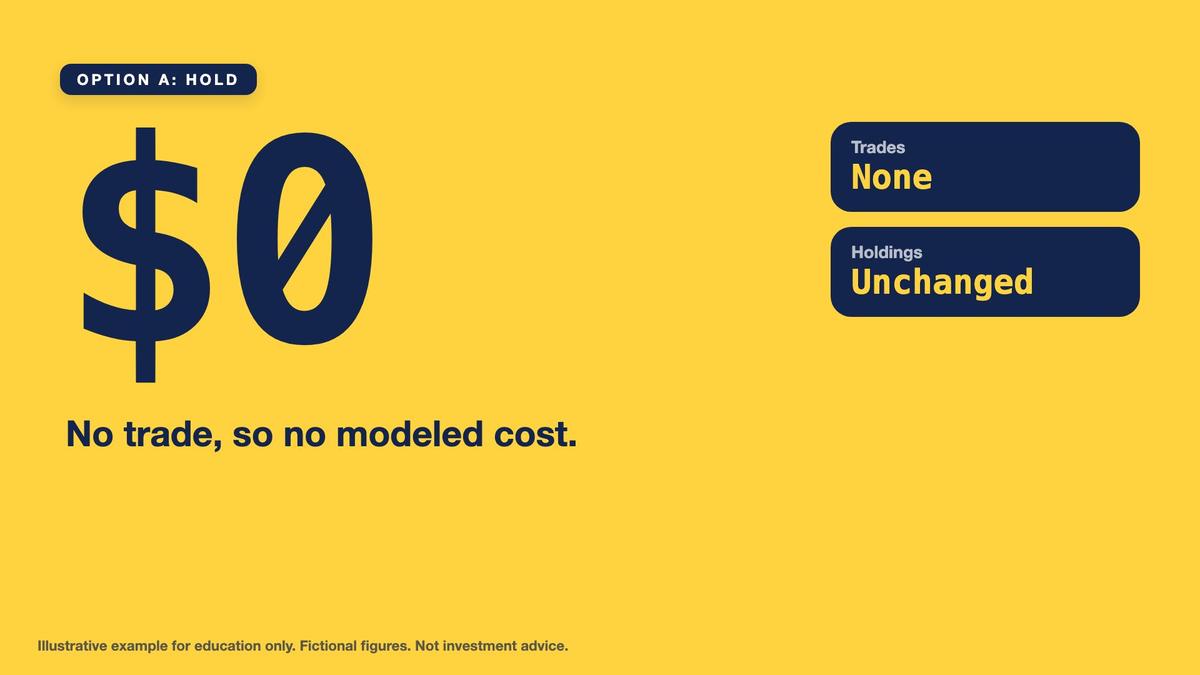
Option A is to hold the original six positions without trading. Its modeled rebalancing cost is zero, and its initial stocks allocation remains 55%, consisting of 40% wide stocks and 15% foreign stocks. The largest holding remains at its 40% policy maximum, crypto remains at its 5% maximum, and cash remains at its 5% minimum. All three allocation constraints pass. However, the equity shock loses $16,500, using 110% of the $15,000 loss tolerance and breaching it by $1,500. The combined stress loses $20,350, consuming approximately 135.7% of tolerance and breaching by $5,350. Holding therefore fails the requirement that the tested losses remain within the written tolerance.
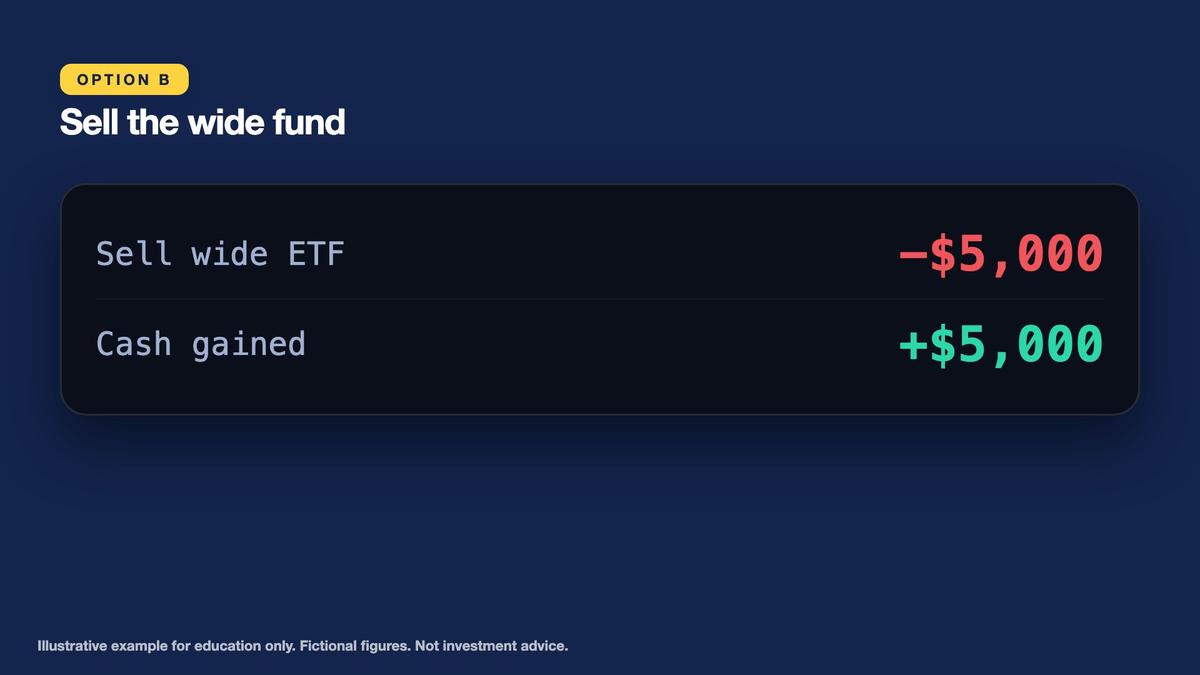
Option B is the small adjustment previewed in Lesson 29: sell $5,000 of Sample Wide Stock ETF and retain that amount as cash before the modeled transaction spread. Wide stocks fall to $35,000, or 35%, while cash rises to $10,000, or 10%. Bonds remain $25,000, gold $10,000, foreign stocks $15,000 and coin $5,000. The six values still total $100,000 before transaction costs. Combined stock exposure becomes 50%. The assumed wide-stock selling spread is 0.04% of the $5,000 transaction, giving $2 in modeled cost. This cost is kept in a separate accounting line so that the stress comparisons use consistent $100,000 pre-cost reference portfolios.
Key points
- Option A, hold: no trade, $0 cost, two breaches of four tests. Holding anyway would require amending the policy in writing first.
- Option B: sell $5,000 of wide stocks into cash: wide $35,000, cash $10,000, spread 0.04% x $5,000 = $2.
- Option B results: equity -$15,000 (100.0%, zero headroom), crypto -$5,500, currency -$2,800, combined -$18,850 (125.7%, breach by $3,850). One test still fails.
Under Option B, a 30% equity decline causes $10,500 loss on wide stocks and $4,500 on foreign stocks. As in Lesson 29, the $750 bond gain and $500 gold gain exactly offset the $1,250 crypto loss. Net equity-scenario loss is therefore $15,000, reaching the tolerance exactly with zero remaining headroom. The crypto scenario loses $5,500, and the currency scenario loses $2,800, so both pass. But the combined test still loses $18,850, or approximately 125.7% of the tolerance, breaching by $3,850. Option B solves the isolated equity test while leaving the combined test outside the policy. A reviewer must not describe this partial improvement as full compliance.
Build Option C and Recalculate Its Holdings, Currency and Costs
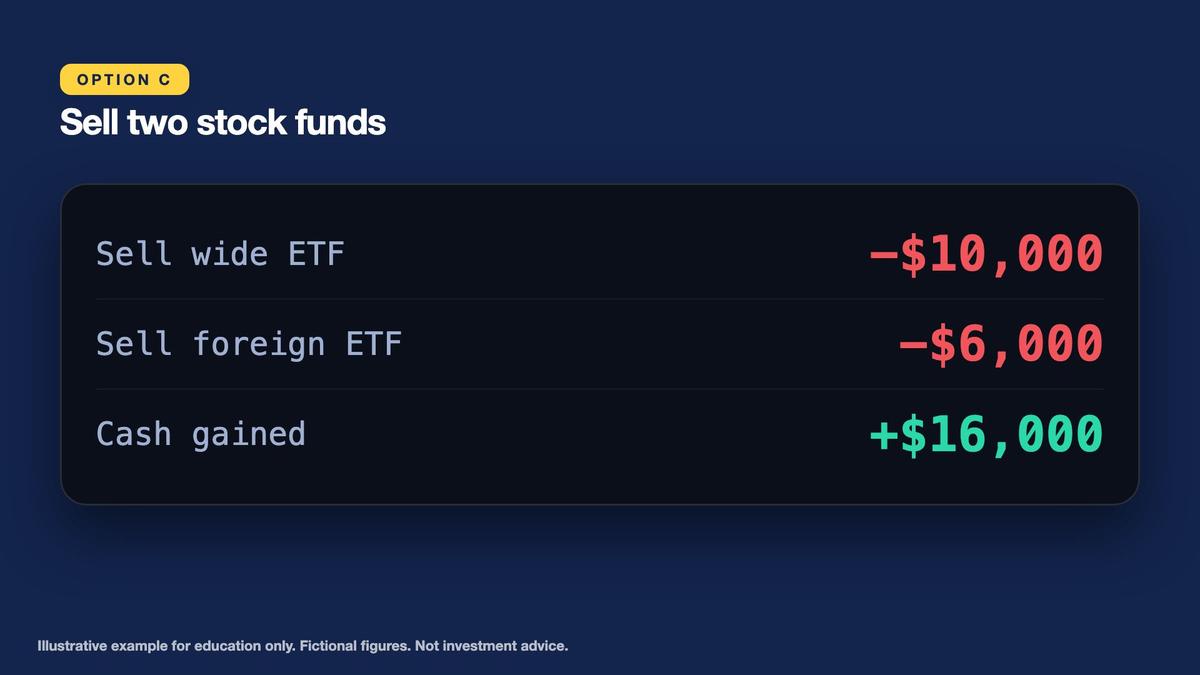
Option C is the larger adjustment. Sell $10,000 of Sample Wide Stock ETF and $6,000 of Sample Foreign Stock ETF, retaining both amounts as cash in the fictional portfolio. Wide stocks decline from $40,000 to $30,000, or 30%. Foreign stocks decline from $15,000 to $9,000, or 9%. Cash rises from $5,000 to $21,000, or 21%. The other positions remain unchanged at $25,000 bonds, $10,000 gold and $5,000 crypto. Adding all six post-trade reference values yields exactly $100,000 before modeled selling costs. Stock exposure falls from 55% to 39% of the portfolio.
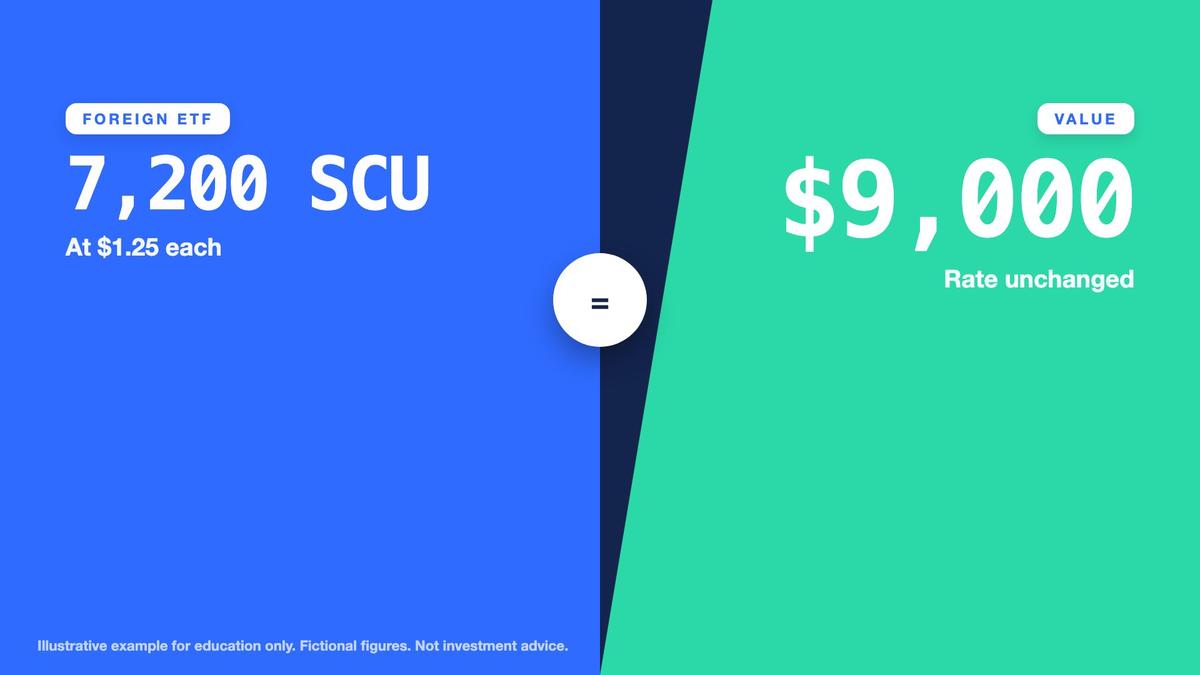
The foreign stock position originally represented 12,000 SCU at the invented rate of one SCU equal to $1.25. After the $6,000 equivalent sale, its remaining dollar value is $9,000. Dividing by $1.25 gives 7,200 SCU. This matters because a later SCU shock must affect the smaller foreign position rather than the original $15,000 holding. The revised weights are 30% wide stocks, 25% bonds, 10% gold, 9% foreign stocks, 5% Sample Coin and 21% cash. The largest individual position is 30%, below the 40% maximum. Crypto remains exactly at its 5% maximum, and cash remains above its 5% minimum. All three allocation limits pass.
Key points
- Option C: sell $10,000 of wide stocks and $6,000 of foreign stocks. New holdings: wide $30,000, bonds $25,000, gold $10,000, foreign $9,000 (7,200 SCU), coin $5,000, cash $21,000.
- Limits after the trades: largest 30% (max 40%), coin 5% (max 5%), cash 21% (min 5%): all pass.
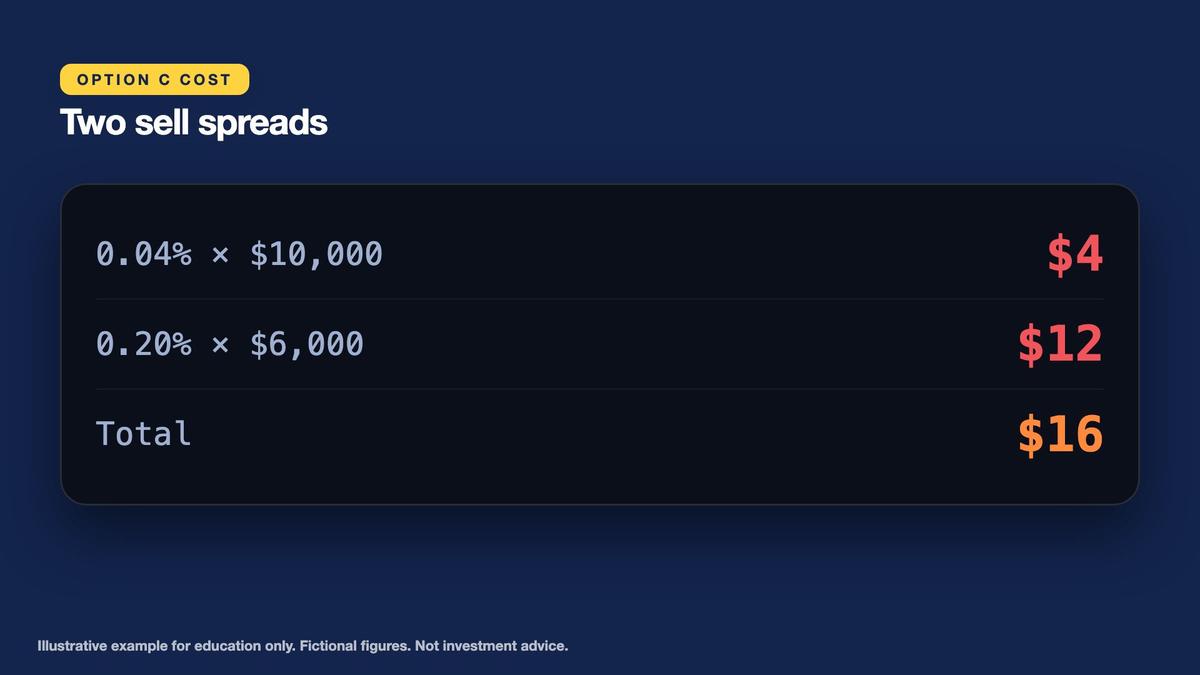
- Cost: $4 + $12 = $16, or 0.016% of $100,000.
Option C has two modeled transaction-spread charges. Selling $10,000 of wide stocks at a 0.04% spread costs $4. Selling $6,000 of foreign stocks at a 0.20% spread costs $12. Together, they cost $16, equivalent to 0.016% of the starting $100,000 portfolio. For transparent comparison, the lesson reports these costs separately from the nominal post-trade holdings and excludes them from the main scenario results. If the $16 were actually deducted from the cash balance, cash would be $20,984 and total portfolio value $99,984 before any subsequent price changes. Such execution accounting depends on the chosen fill and fee conventions; additional real-world costs are excluded.
Rerun the Equity, Crypto and Currency Scenarios for Option C
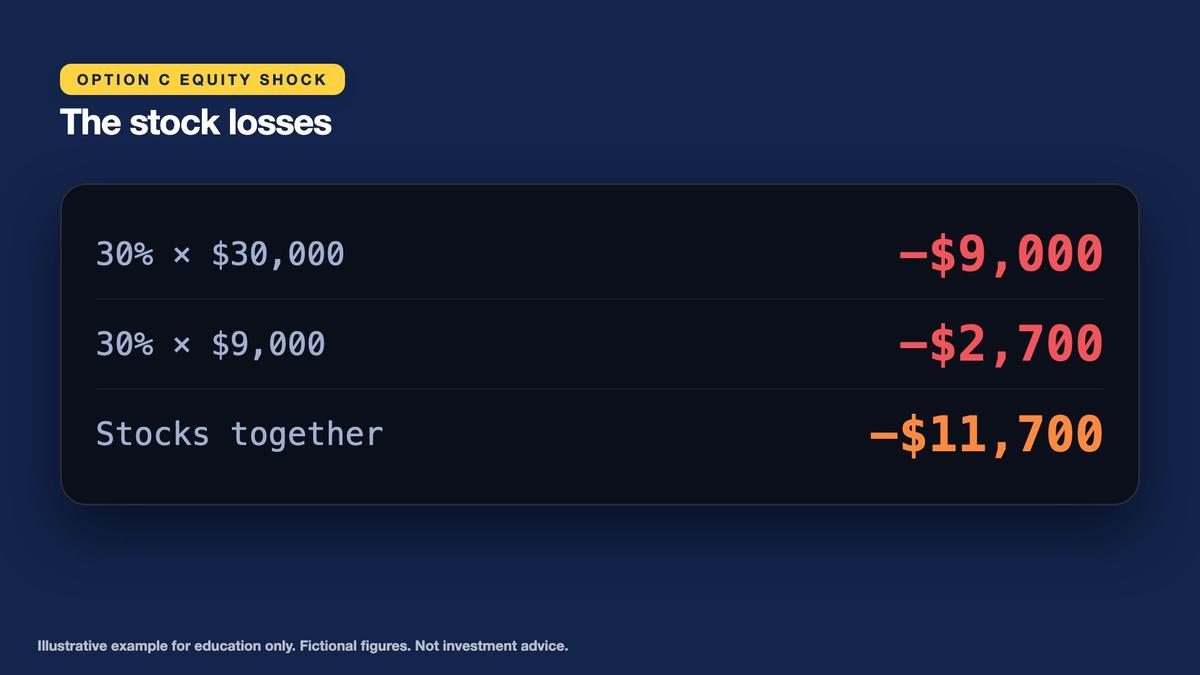
Begin with the same invented equity-shock assumptions from Lesson 29. Wide stocks decline 30%, foreign stocks decline 30% in SCU terms while the SCU exchange rate remains unchanged, bonds gain 3%, gold gains 5%, Sample Coin declines 25%, and cash stays constant. The smaller $30,000 wide-stock position loses $9,000. The $9,000 foreign stock position loses $2,700. Bond gains remain $750, gold gains remain $500 and crypto loses $1,250. The non-stock changes still sum to zero, leaving total equity-scenario loss of $11,700. This is 78% of the $15,000 tolerance, so Option C passes the test with $3,300 of headroom.
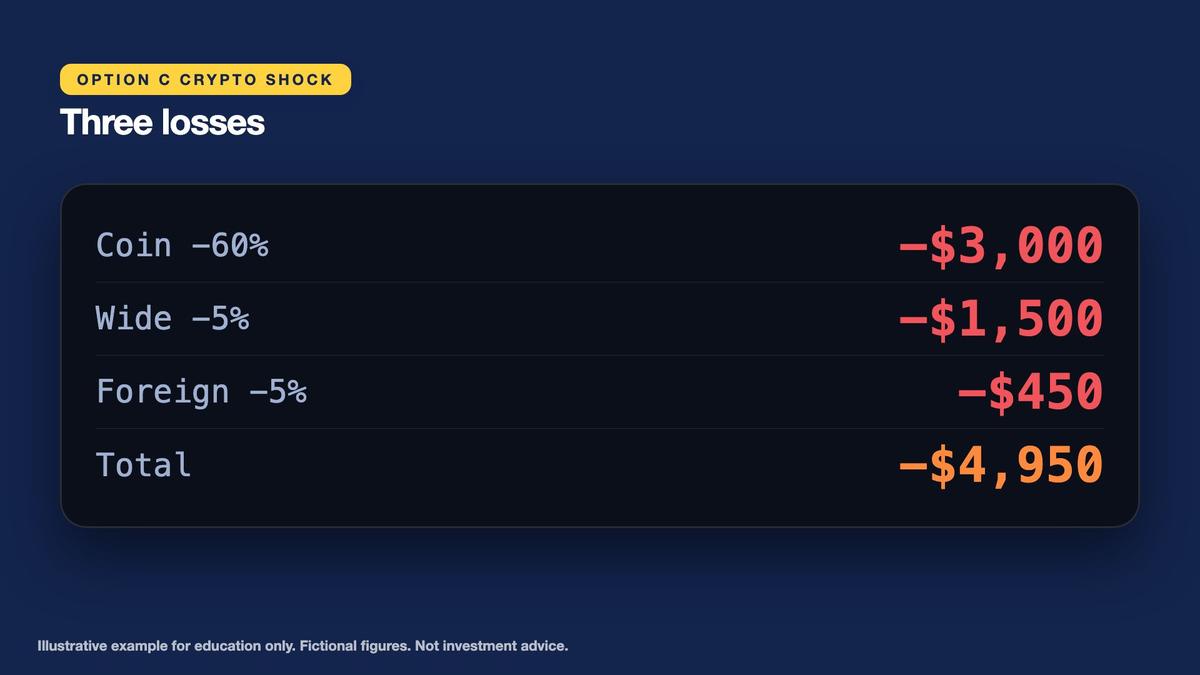
Next apply the crypto scenario without changing its assumptions. Sample Coin loses 60% of $5,000, or $3,000. Wide stocks lose 5% of $30,000, or $1,500. Foreign stocks lose 5% of $9,000, or $450, with the SCU exchange rate unchanged. Bonds, gold and cash remain constant. Summing those three losses gives $4,950. This equals 4.95% of the $100,000 starting portfolio and 33% of the $15,000 loss tolerance. The result passes. The smaller equity allocations reduce additional losses that accompany the unchanged 60% fictional coin decline, although the speculative coin position itself still loses most of its value.
Key points
- Equity: wide -$9,000, foreign -$2,700, offsets net zero: -$11,700, 78.0% of tolerance, headroom $3,300.
- Crypto: coin -$3,000, wide -$1,500, foreign -$450: -$4,950, 33.0%.
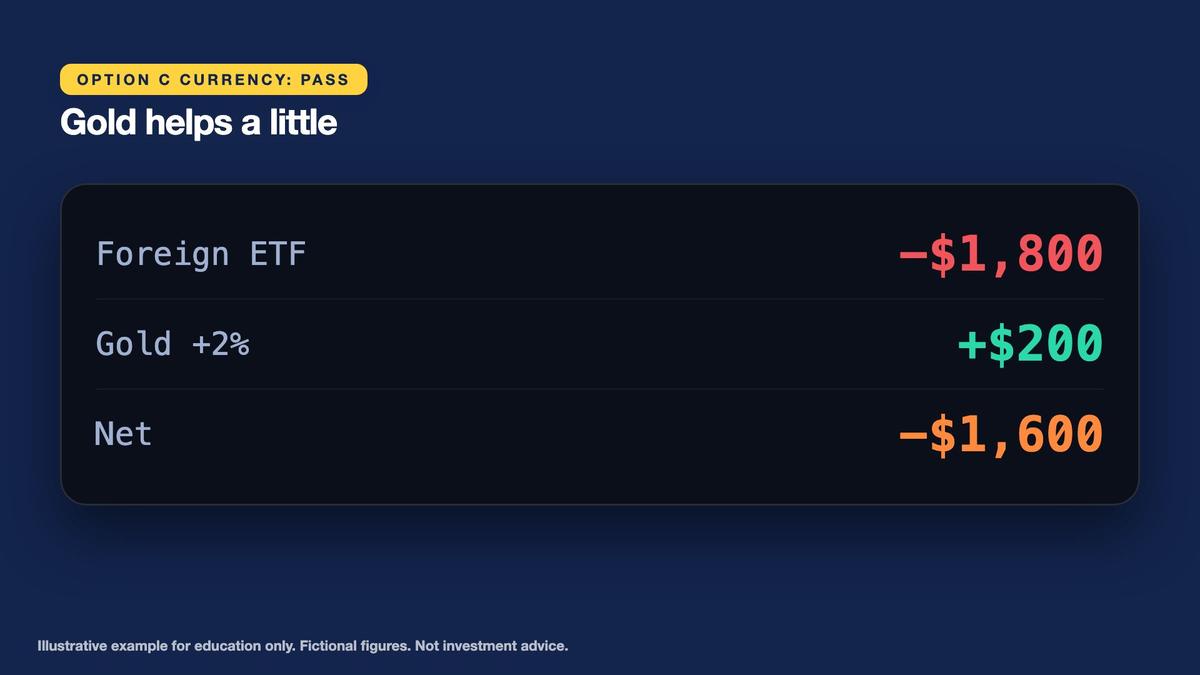
- Currency: foreign -$1,800 plus gold +$200: -$1,600, 10.7%.
For the currency scenario, SCU declines 20% against USD, moving from the invented $1.25 rate to $1.00 per SCU. The remaining foreign ETF holds 7,200 SCU, so its dollar valuation becomes $7,200 instead of $9,000. The foreign-currency loss is $1,800. Gold gains the same fictional 2%, or $200, as before. All other holdings remain unchanged. Net loss is therefore $1,600, equal to 1.6% of portfolio capital and approximately 10.7% of the $15,000 tolerance. This third independent test passes. The conclusion relies on the specified reduced SCU exposure and does not imply that currency and gold always move in offsetting directions.
Retest Combined Stress and Examine Thin Headroom
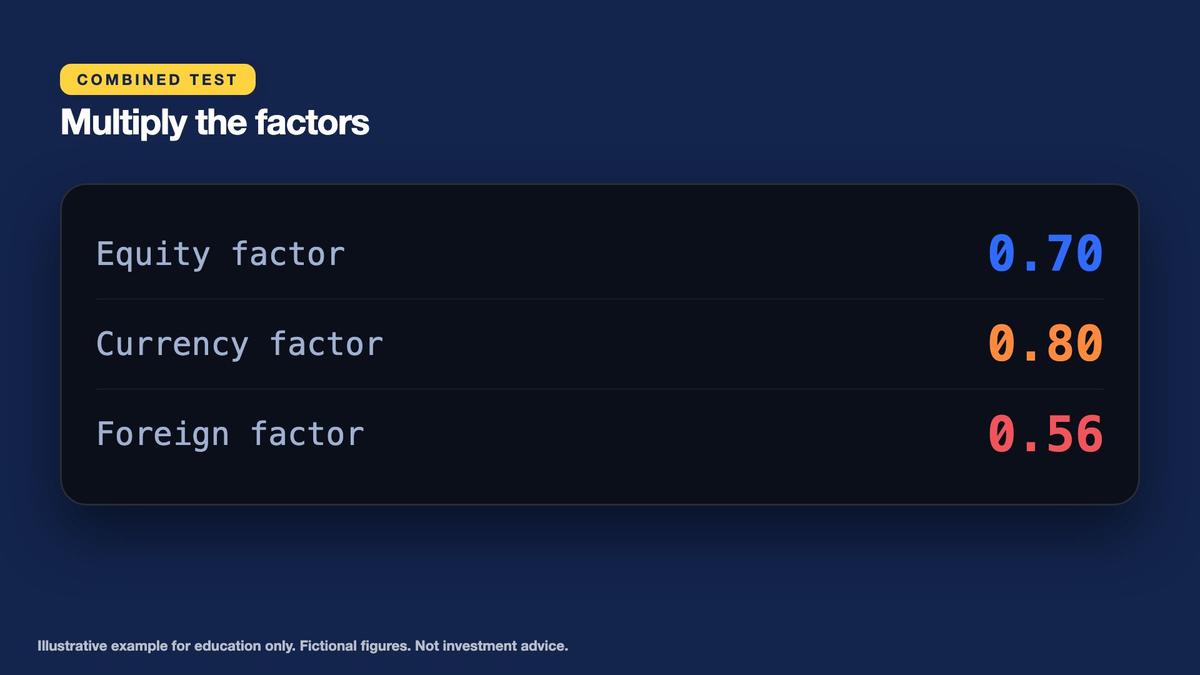
The combined scenario is the decisive fourth calculation. Keep every invented shock from Lesson 29: wide stocks decline 30%, bonds gain 3%, gold gains 5%, Sample Coin declines 60%, and cash remains unchanged. The foreign stock position experiences both a 30% SCU-denominated equity decline and a 20% SCU depreciation against the dollar. Its two remaining-value factors must be multiplied. The product of 0.70 and 0.80 is 0.56. Applying that factor to Option C's $9,000 foreign position gives a new value of $5,040, so the holding loses $3,960. Adding the two percentage declines directly would incorrectly calculate the foreign position's loss.
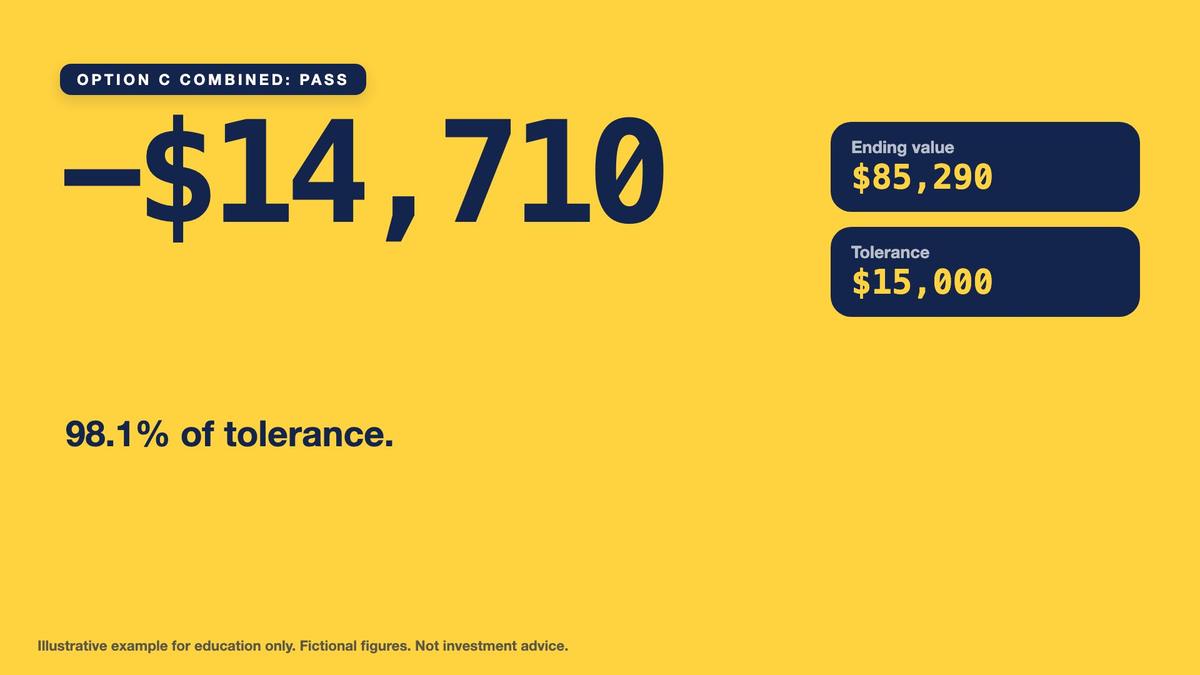
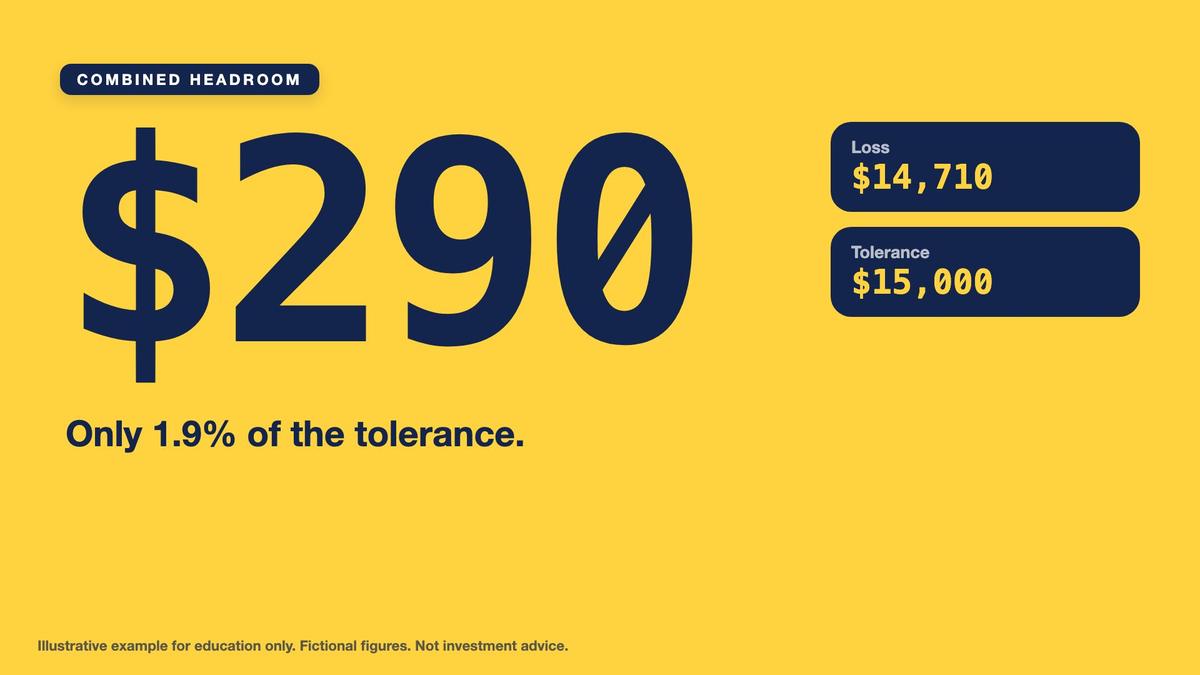
The wide-stock loss is $30,000 multiplied by 30%, or $9,000. Bond gains are $750, gold gains are $500, foreign stock loss is $3,960, crypto loss is $3,000 and cash is unchanged. Summing negative $9,000, positive $750, positive $500, negative $3,960 and negative $3,000 produces a net loss of $14,710. The fictional portfolio would have $85,290 remaining from the $100,000 pre-cost reference after this scenario. The $14,710 loss equals 14.71% of initial capital and approximately 98.1% of the $15,000 tolerance. It passes the written test, leaving $290 of headroom.
Key points
- Combined: foreign factor 0.70 x 0.80 = 0.56, so $9,000 becomes $5,040 (loss $3,960).
- Changes: -$9,000, +$750, +$500, -$3,960, -$3,000: total -$14,710, 98.1% of tolerance, ending $85,290.
- Headroom is only $290 (1.9%): a fragile pass that must be flagged in the journal.
A $290 margin below a $15,000 loss threshold is thin. It does not prove the revised portfolio is robust to other shocks, different correlations, wider spreads or more severe currency moves. The $16 modeled transaction cost is excluded from the four core loss results to preserve a consistent pre-cost comparison; simply adding it to the combined loss produces $14,726, leaving $274 of headroom against the original $15,000 reference, before any further trading costs or execution uncertainty. This sensitivity illustrates why cost accounting matters, but a complete realized account calculation would require actual fills and funding treatment. The accurate statement is that Option C passes all four specifically defined fictional stress tests, not that it guarantees portfolio safety.
Compare Worst Loss, Transaction Cost and Growth Trade-Offs
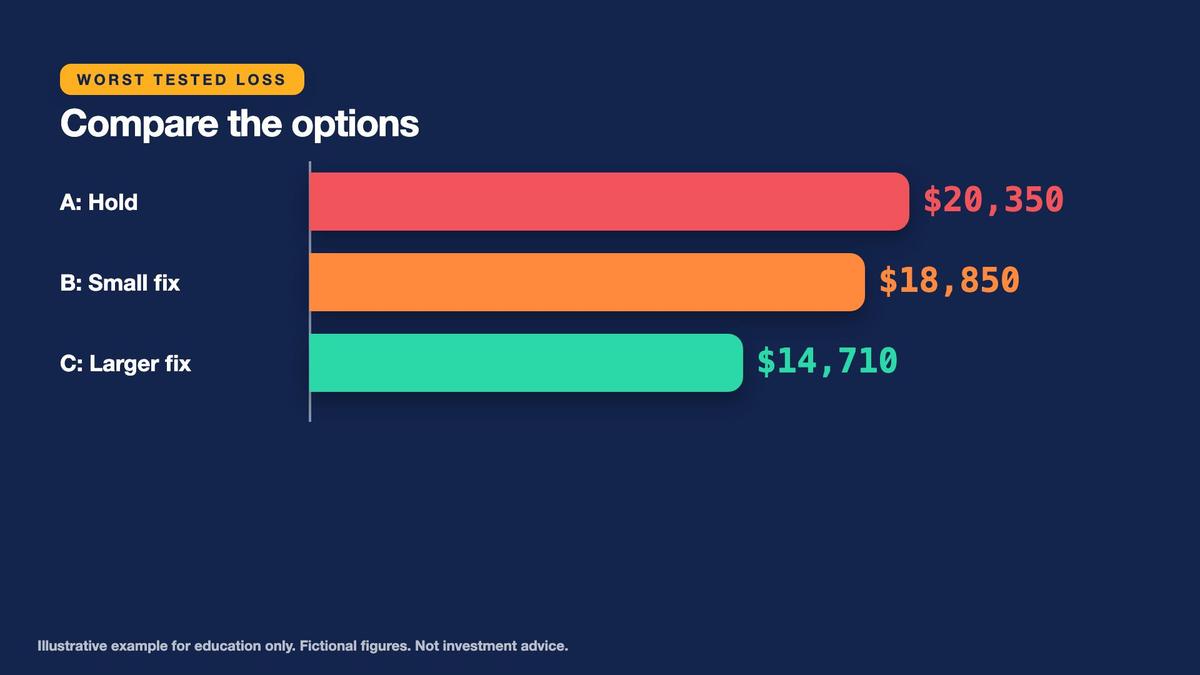
Arrange the three options in one comparison table using the same four stress scenarios. Option A has a worst tested loss of $20,350, two tolerance breaches and zero rebalancing cost. Option B has a worst loss of $18,850, one tolerance breach and $2 modeled transaction cost. Option C has a worst loss of $14,710, no breaches and $16 modeled transaction cost. The Option C combined-scenario loss is $5,640 lower than Option A, calculated as $20,350 minus $14,710. Compared with Option B, Option C reduces that same tested loss by $4,140. These are differences between hypothetical outcomes, not realized savings or expected economic benefits.
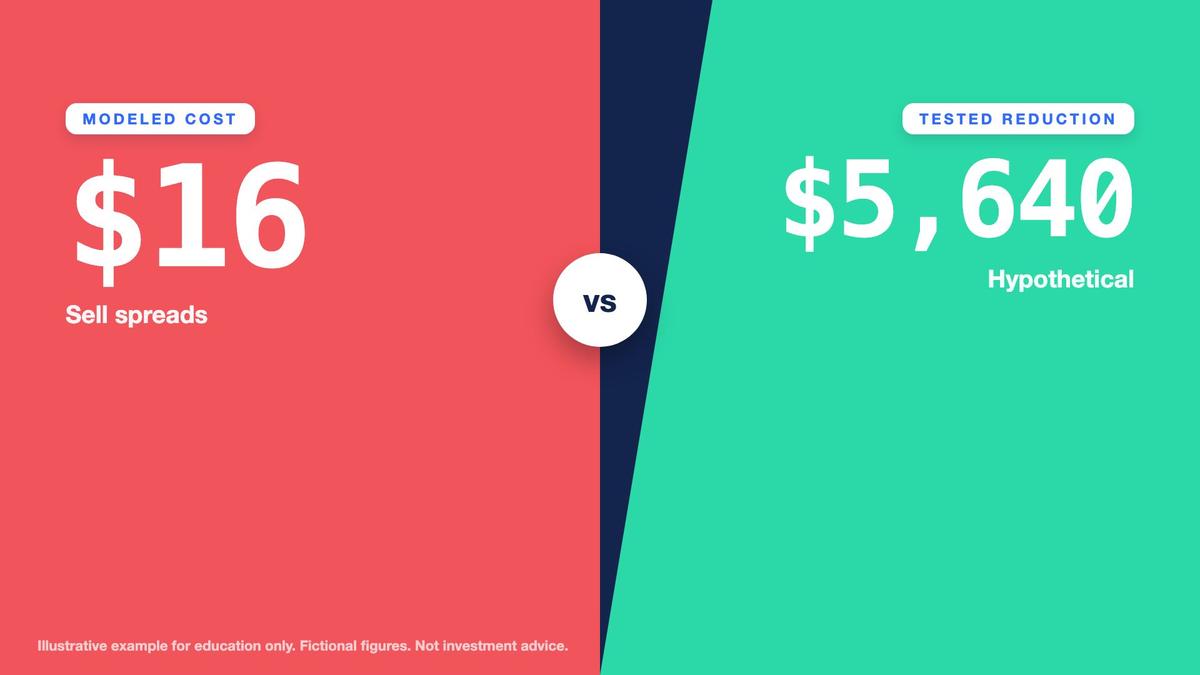
The cost comparison is straightforward but must be interpreted carefully. Option C's modeled selling spreads total $16, or 0.016% of starting capital, while its combined test reduces the hypothetical loss by $5,640 relative to holding. The modeled cost is numerically small compared with that conditional reduction. However, the analysis does not include taxes, market impact, extra commissions, slippage, order-size constraints, bid-ask changes, price movement during execution or the opportunity cost of holding additional cash. The tested reduction is not a guaranteed financial gain; it occurs only if the invented shocks happen as stipulated. A fair decision memo should say that costs are small relative to the modeled benefit, not that a certain profit has been created.
Key points
- Worst tested loss: A $20,350, B $18,850, C $14,710. Option C cuts the combined loss by $5,640 against holding, for $16 of modeled cost.
- Those two figures are hypothetical differences, not guaranteed savings.
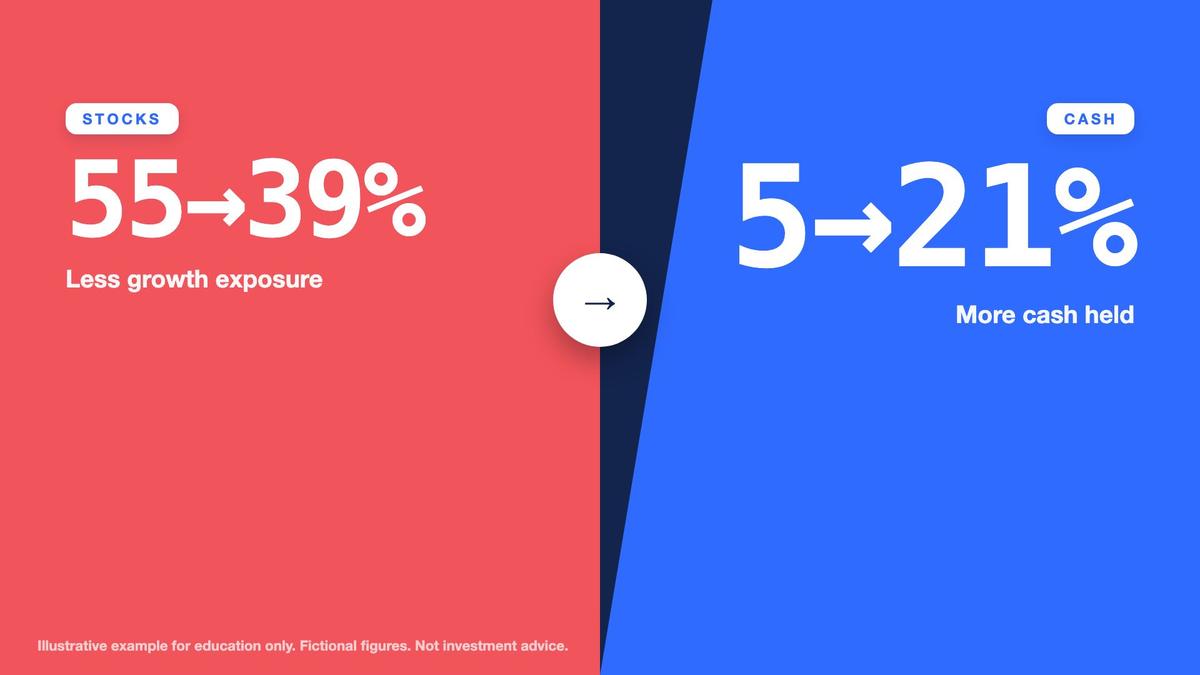
- Trade-off: stocks fall from 55% to 39% and cash rises from 5% to 21%: less growth exposure, and cash faces inflation.
The growth objective introduces a meaningful trade-off. Option A maintains 55% combined stock exposure and 5% cash, giving the largest fictional equity allocation of the three options. Option B reduces stock exposure to 50% and increases cash to 10%. Option C reduces stocks to 39% and raises cash to 21%. These changes reduce the dollar sensitivity to the specified equity declines, but they also reduce capital participating in potential future stock growth. Cash may preserve nominal liquidity yet lose purchasing power through inflation. Selling everything would conflict more strongly with the ten-year growth objective. The classroom decision must balance this growth trade-off against the unchanged written tolerance rather than minimizing scenario losses without considering purpose.
Apply the Four-Question Test and Write the Decision Memo
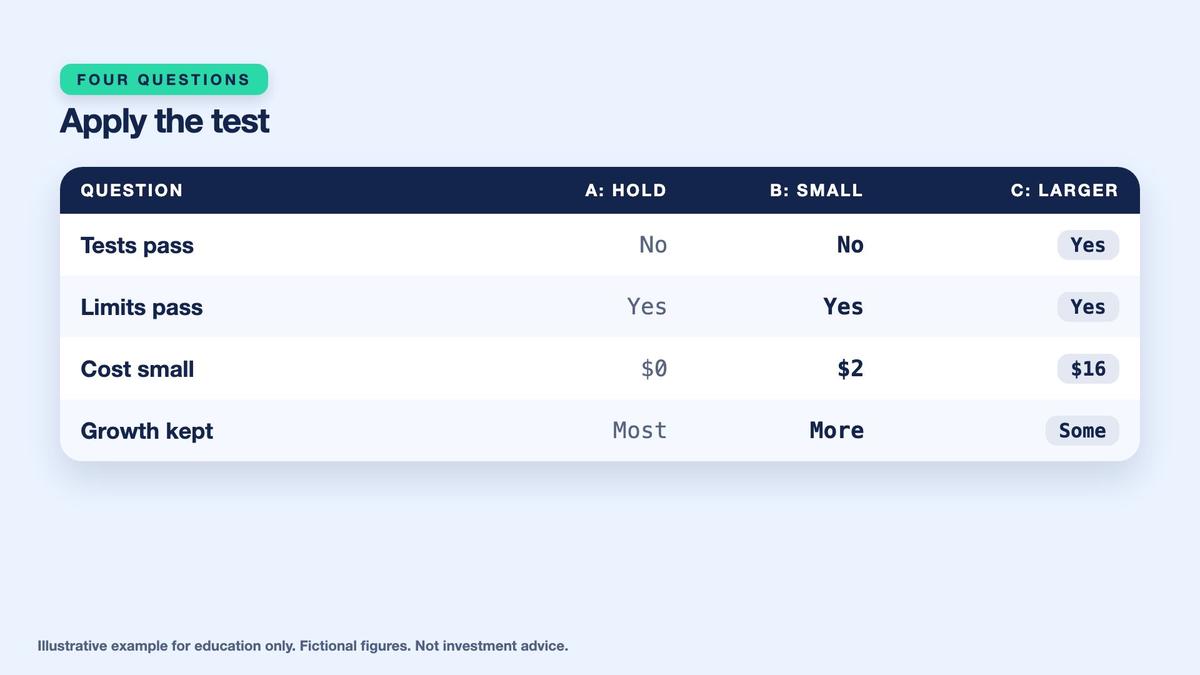
The first decision question asks whether any tested scenario breaches the written $15,000 loss tolerance. Option A breaches twice, Option B breaches once, and Option C breaches none. The second asks whether the resulting allocation respects all three limits. Each option passes the individual holding, crypto and cash constraints under its stated pre-cost holdings, although the boundaries and available headroom differ. The third compares the modeled transaction cost with the conditional loss reduction. Option C's $16 selling cost is small against its $5,640 lower combined-scenario loss relative to Option A. The fourth asks whether the ten-year growth purpose survives. Option C retains 39% stock exposure alongside bonds, gold, crypto and cash, but has less growth-oriented equity exposure than the original allocation.
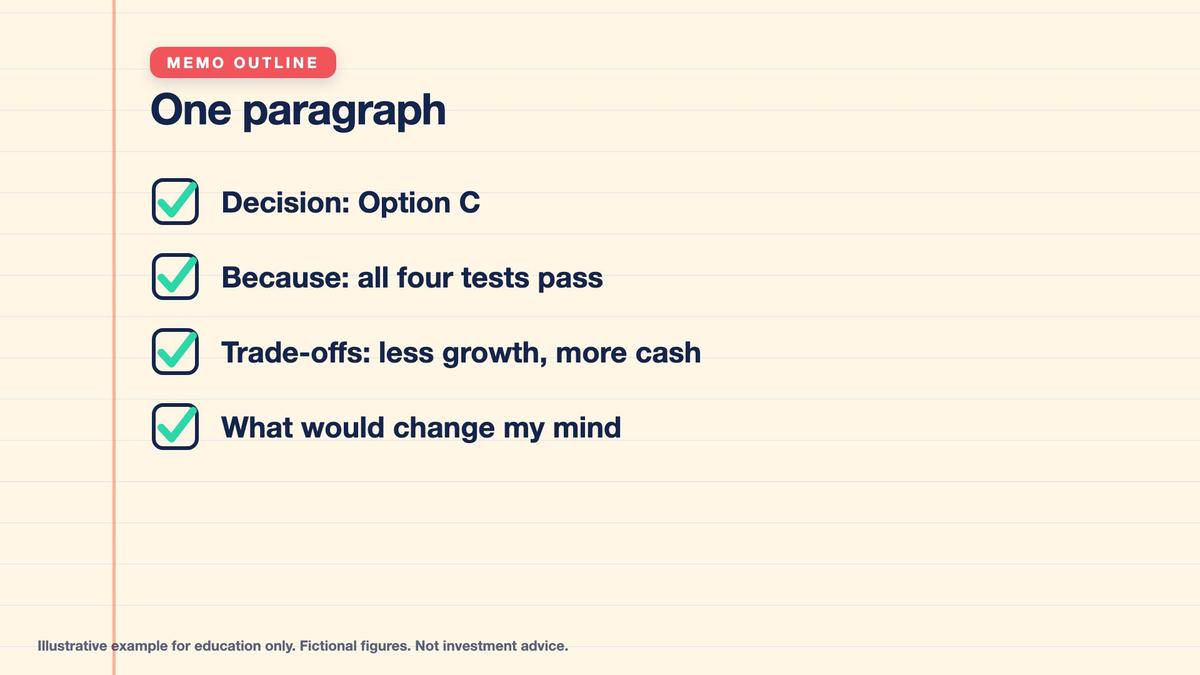
For this fictional classroom exercise, choose Option C as the alternative most consistent with the unchanged downside policy across the four tested cases, while explicitly recording the growth trade-off and the thin $290 combined-test headroom. Write one paragraph whose parts begin Decision, Because, Trade-offs and What would change my mind. Decision should identify Option C and its two simulated sales. Because should cite the change from two breaches under holding to no breaches under the four specified tests, plus the all-limits pass. Trade-offs should mention $16 modeled selling spreads, stock exposure falling from 55% to 39%, cash rising to 21% and inflation risk. What would change my mind should identify a revised documented policy, more severe or differently correlated stresses, materially different transaction costs, or changed investment objectives.
Key points
- Four-question test: tests (only C passes all four), limits (all three pass for every option), cost ($0, $2, $16), growth (A most, C least).
- Classroom decision: Option C. This is a fictional exercise, not advice to hold more cash.
- Memo: one paragraph with four openings, Decision, Because, Trade-offs, What would change my mind, each backed by numbers.
Do not rewrite the policy simply to make a preferred option appear compliant after the results are known. If a fictional learner wanted to keep Option A despite the breaches, the appropriate governance response would be to examine whether the original risk tolerance still reflects the objective and amend it openly before proceeding, rather than silently ignoring the breach. A policy amendment is a distinct decision requiring its own documented rationale. Equally, the choice of Option C does not make its asset mix universally suitable or establish that it will perform better in future markets. The exercise rewards traceable reasoning and consistency with written assumptions, not confidence about predicted asset prices.
Complete the Journal, Rehearse a Mock Order and Prepare Submission
The final portfolio worksheet should preserve the original six holdings and values, the unchanged policy, and the four Lesson 29 stress results. Add separate columns for Options A, B and C showing proposed sale amounts, resulting holdings, weights, modeled transaction spreads, allocation tests, four stress losses, tolerance utilization and remaining headroom. Retain the foreign SCU amounts before and after the proposed sale so that the combined equity and currency calculations remain reproducible. Show the core scenario results on the same $100,000 pre-cost reference and place transaction costs in separate lines. A brief note should explain how cash would differ if those costs were deducted from the account.
Hands-On Lab: Audit Three Fictional Rebalancing Decisions
Begin with the unchanged fictional $100,000 model portfolio and the four invented stress scenarios from Lesson 29. Record the written $15,000 loss tolerance, 40% maximum single holding, 5% maximum crypto allocation, 5% minimum cash allocation and ten-year growth objective. Compare Option A, which holds all positions; Option B, which sells $5,000 of Sample Wide Stock ETF into cash; and Option C, which sells $10,000 of wide stocks and $6,000 of foreign stocks into cash. Recalculate all post-trade values and weights using the $100,000 pre-cost reference, then record modeled selling spread costs separately. Rerun the equity, crypto, currency and combined stresses for Options B and C. Multiply 0.70 by 0.80 for the foreign equity and currency effect in the combined test. Compare losses with the $15,000 tolerance, identify pass-or-breach results and compute remaining headroom. Evaluate transaction cost against conditional loss reduction and explain the growth trade-off from moving stock exposure into cash. Choose fictional Option C for the classroom decision, while stating that its $290 combined-test headroom is thin. Write the final decision as one paragraph with Decision, Because, Trade-offs and What would change my mind, followed by a dated journal entry. For optional practice, use https://research-paper-trade-webapp.pages.dev/paper/ only if an isolated mock order is available, without connecting real wallets, exchanges, funded accounts or credentials.
- Decision 1: Option A preserves the original fictional holdings and incurs no rebalancing cost. Its four Lesson 29 losses are $16,500 equity, $5,750 crypto, $2,800 currency and $20,350 combined. — How many tests breach the written $15,000 tolerance, what is the worst tested loss, and can holding be described as fully compliant without changing the policy?
- Decision 2: Option B sells $5,000 of wide stocks into cash, leaving $35,000 wide stocks, $15,000 foreign stocks, $25,000 bonds, $10,000 gold, $5,000 crypto and $10,000 cash. — Calculate the transaction spread, all four scenario losses, policy verdicts and explain why this adjustment is insufficient.
- Decision 3: Option C sells $10,000 wide stocks and $6,000 foreign stocks into cash. The resulting positions are $30,000 wide, $25,000 bonds, $10,000 gold, $9,000 foreign, $5,000 coin and $21,000 cash. — Verify weights, foreign SCU exposure, allocation limits and modeled selling spread cost.
- Decision 4: Option C retains $30,000 wide stocks, $9,000 foreign stocks, $25,000 bonds, $10,000 gold, $5,000 crypto and $21,000 cash. The combined scenario applies wide -30%, bonds +3%, gold +5%, coin -60%, foreign factors 0.70 and 0.80, and unchanged cash. — Calculate all four Option C scenario losses, the combined tolerance share, remaining headroom and worst-loss reduction relative to holding.
- Decision 5: The three alternatives have worst tested losses of $20,350 for A, $18,850 for B and $14,710 for C, with modeled rebalancing costs of $0, $2 and $16, respectively. The policy still seeks ten-year growth. — Which option is chosen in the classroom decision, and what must its four-part memo explain?
Answer key
The journal entry should be dated and should document the policy question, considered alternatives, calculations, chosen fictional option and reasons for rejecting the other two. Record that Option A breaches the equity and combined tests, Option B still breaches the combined test, and Option C passes all four while retaining only $290 of pre-cost combined headroom. Include the $16 modeled spread cost, the reduction of stock exposure to 39%, the increase of cash to 21%, and the risk that stronger or different shocks could invalidate the pass. Identify the next review trigger as a change in the written policy, market exposure, tested assumptions, transaction terms or available headroom, without pretending a future event can be forecast.
Key points
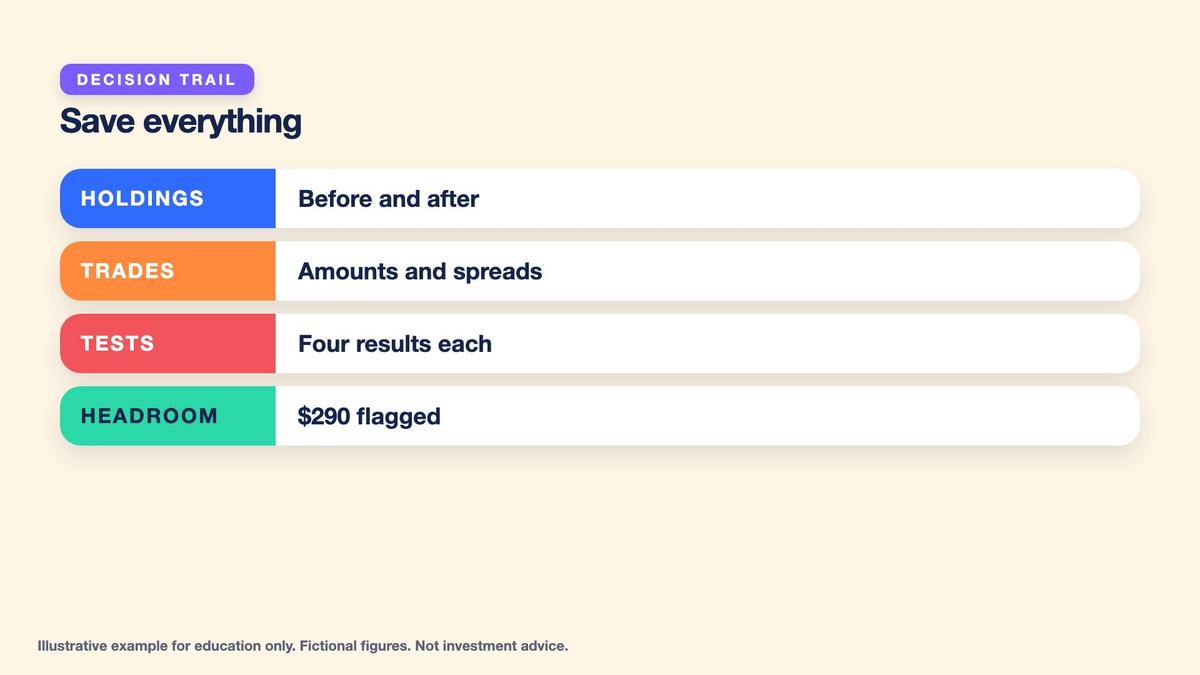
- Save the decision trail: holdings before and after, trade amounts, spreads, all test results, limit checks and the $290 headroom flag.
- Limits of the analysis: invented shocks, no probabilities, spreads only, no tax, slippage, minimum trade sizes or timing.
- Practice on a demo platform with simulated money only: one small mock order, record fill, fee and reason. Never connect a wallet or paste keys.
For optional practice, visit the user-provided Paper Trading page at https://research-paper-trade-webapp.pages.dev/paper/ if it visibly supports an isolated simulation. Rehearse one small fictional order and record its intended quantity, observed quotation, simulated fill, explicit fee and one-sentence reason tied to the written policy. Never connect a real wallet, exchange, funded brokerage account or payment method, never provide private keys or recovery phrases, and never submit live orders. If the page requires real credentials or does not support suitable mock transactions, complete the exercise in an offline worksheet. The next lesson is the Final Submission Walkthrough, assembling the workbook, one-page decision memo and verification notes.
Worked example at a glance
Key terms
- Rebalance: trade holdings to bring the portfolio back inside written limits.
- Hold: make no trade.
- Option: one candidate response, tested against the same scenarios.
- Policy: the written objective, tolerance and limits.
- Tolerance: the largest accepted bad-scenario loss, here $15,000.
- Headroom: tolerance minus the tested loss.
- Breach: a result that exceeds the tolerance or a limit.
- Trading cost: the modeled cost of the trades, here sell spreads.
- Spread: the gap between buy and sell prices, as a percent.
- Trade-off: what is given up to gain a benefit.
- Decision memo: a one-paragraph written explanation of the choice.
- Decision trail: the saved record of holdings, trades and test results.
Multi Asset Trading Lab provides educational material only and does not constitute personalized investment advice, financial planning, trading recommendations, portfolio management advice, legal advice, tax advice, brokerage instructions, custody guidance or predictions of market prices. Every asset name, valuation, share quantity, fictional currency, exchange rate, scenario assumption, transaction cost and rebalancing alternative in this lesson is invented for classroom use. The simulated portfolio contains $100,000 of reference capital allocated among Sample Wide Stock ETF at $40,000, Sample Bond Fund at $25,000, Sample Gold Fund at $10,000, Sample Foreign Stock ETF at $15,000, Sample Coin at $5,000 and cash at $5,000. No named holding represents a real product, fund, issuer, exchange, cryptocurrency, ticker or executable market quotation. The fictional foreign stock holding is denominated in an invented currency called SCU, at an illustrative rate of one SCU equal to $1.25. The original foreign holding therefore represents 12,000 SCU, and the reduced Option C foreign holding represents 7,200 SCU or $9,000 using that same fictional rate. These values are not actual foreign exchange prices or forecasts. The written classroom investment policy seeks long-term growth with moderate risk over ten years, tolerates a bad-scenario loss of 15% of starting capital or $15,000, prohibits a single holding above 40%, limits crypto to no more than 5%, and requires cash of at least 5%. These are arbitrary educational policy choices, not broadly suitable allocations, objectively safe thresholds or guarantees of capital preservation. Actual investment suitability depends on individual financial needs, circumstances, objectives, legal restrictions, loss capacity and many other factors that this fictional case does not address. The lesson's four stress scenarios are inherited from the prior portfolio stress exercise. They are invented conditional calculations, not forecasts, probability estimates, investment return expectations, actual historical events or complete risk models. The equity scenario assumes both stock funds fall 30%, with the foreign stock decline measured in SCU and the SCU exchange rate unchanged, while bonds gain 3%, gold gains 5%, crypto declines 25% and cash does not move. The crypto scenario assumes Sample Coin falls 60%, wide stocks fall 5%, foreign stocks fall 5% in SCU with the currency unchanged, and all other holdings remain constant. The currency scenario assumes SCU falls 20% against USD, taking its invented conversion rate from $1.25 to $1.00 per SCU, the foreign stock fund's local share price remains unchanged, gold gains 2%, and other holdings remain unchanged. The combined scenario assumes wide stocks decline 30%, bonds gain 3%, gold gains 5%, Sample Coin falls 60%, cash remains constant, and the foreign stock fund experiences both a 30% SCU-denominated equity decline and a 20% SCU depreciation. The foreign changes are combined by multiplying remaining-value factors 0.70 and 0.80, producing 0.56, not by adding the percentage declines. Therefore the foreign holding loses 44% of its original dollar value under the combined stress. These assumptions are not claims about how bonds, gold, stocks, crypto or currencies necessarily behave together in actual markets. They do not quantify correlations, probabilities or a time horizon for the shocks, and they cannot establish the worst possible future outcome. Under fictional Option A, the six positions are held without rebalancing. Modeled transaction cost is zero. The original equity scenario produces a $16,500 loss, equal to 110.0% of the $15,000 downside tolerance and a $1,500 breach. The crypto scenario produces a $5,750 loss, approximately 38.3% of tolerance, and passes. The currency scenario produces a $2,800 loss, approximately 18.7% of tolerance, and passes. The combined scenario produces a $20,350 loss, approximately 135.7% of tolerance, and breaches by $5,350. Thus holding fails two of four specified stress tests even though it satisfies the initial single-holding, crypto and cash allocation restrictions. A decision to continue holding despite those breaches would need an explicit written policy review and any resulting amendment, rather than silently disregarding the existing policy. Revising a policy after observing unfavorable hypothetical outcomes can create hindsight bias or conceal a conflict between stated intentions and preferred positions. A policy amendment does not make losses disappear and is not automatically justified merely because the existing portfolio fails its own test. Option B is a hypothetical sale of $5,000 of Sample Wide Stock ETF, retaining the proceeds as cash. Before modeled transaction costs, its post-trade holdings are $35,000 wide stocks, $25,000 bonds, $10,000 gold, $15,000 foreign stocks, $5,000 Sample Coin and $10,000 cash. These total $100,000, with weights of 35%, 25%, 10%, 15%, 5% and 10%. The fictional sell spread is 0.04% of $5,000, giving a modeled $2 transaction cost. Under the unchanged equity scenario, the $35,000 wide stock holding loses $10,500 and the $15,000 foreign holding loses $4,500. The bond gain of $750 and gold gain of $500 exactly offset the coin loss of $1,250, so Option B's equity scenario loses $15,000, equal to 100% of the tolerance. Equality passes the maximum as written but provides zero headroom under those assumptions. The crypto scenario loses $5,500, consisting of $3,000 crypto loss, $1,750 wide stock loss and $750 foreign stock loss. This uses approximately 36.7% of the downside tolerance and passes. The currency scenario remains a $2,800 net loss, approximately 18.7% of tolerance, because the foreign stock allocation remains $15,000 and the gold offset remains $200. Under the combined stress, wide stocks lose $10,500, foreign stocks lose $6,600 because $15,000 multiplied by 0.56 leaves $8,400, bonds gain $750, gold gains $500, and coin loses $3,000. The net loss is $18,850, using approximately 125.7% of the $15,000 tolerance and breaching by $3,850. Option B therefore passes three of four stress scenarios but still fails the requirement that all specified tested losses remain within the unchanged downside tolerance. It is not appropriate to call Option B fully compliant merely because its isolated equity test reaches the limit exactly. Option C is a larger hypothetical rebalance consisting of selling $10,000 of Sample Wide Stock ETF and $6,000 of Sample Foreign Stock ETF, retaining both nominal sale amounts as cash before modeled transaction spreads. Its nominal post-trade holdings are $30,000 wide stocks, $25,000 bonds, $10,000 gold, $9,000 foreign stocks, $5,000 Sample Coin and $21,000 cash. These total $100,000 before costs, with weights of 30%, 25%, 10%, 9%, 5% and 21%. The combined stock allocation falls from 55% to 39%, while cash increases from 5% to 21%. The largest individual holding is Sample Wide Stock ETF at 30%, which passes the 40% maximum. Crypto remains exactly at its 5% maximum, and cash at 21% exceeds the 5% minimum. All three allocation limits therefore pass under the specified nominal reference values. The selling spread on the $10,000 wide stock transaction is 0.04%, producing a $4 modeled cost. The spread on the $6,000 foreign stock transaction is 0.20%, producing a $12 modeled cost. Total modeled selling cost is $16, equal to 0.016% of starting capital. These are invented spread assumptions, not actual exchange rates, commissions or executable fees. For consistent comparison, the lesson's core post-trade allocations and four scenario results use the nominal $100,000 pre-transaction-cost reference, with rebalancing costs tracked separately. A real executed transaction would have to reconcile the actual cash proceeds and fees. Under a simple convention where the $16 cost is deducted from cash, Option C cash becomes $20,984 and total portfolio value becomes $99,984 before subsequent market movement. Under the same simple convention, Option B cash becomes $9,998 and portfolio value $99,998 after its $2 cost. These cost-funded figures are provided only to clarify accounting and are not the reference bases for the lesson's main stress tables. They do not include changing execution prices, minimum order quantities, foreign conversion charges, taxes or other transaction effects. Under the unchanged fictional equity scenario, Option C wide stocks lose 30% of $30,000, or $9,000, and foreign stocks lose 30% of $9,000, or $2,700. Bonds gain $750, gold gains $500 and crypto loses $1,250, so the non-stock movements cancel under the stipulated assumptions. Total equity-scenario loss is $11,700, equal to 11.70% of the $100,000 reference and 78.0% of the $15,000 tolerance. The scenario passes with $3,300 of headroom. Under the crypto scenario, Sample Coin loses $3,000, wide stocks lose $1,500 and foreign stocks lose $450, with all other holdings unchanged. Net loss is $4,950, equal to 4.95% of portfolio capital and 33.0% of the loss tolerance. The crypto scenario passes. Under the currency scenario, the remaining foreign stock holding begins at $9,000, representing 7,200 fictional SCU at the $1.25 exchange rate. A 20% SCU depreciation moves the fictional rate to $1.00, reducing the holding's dollar value to $7,200, a $1,800 loss. Gold gains $200, giving a net portfolio loss of $1,600, equal to 1.6% of starting capital and approximately 10.7% of the tolerance. The currency scenario passes. The combined scenario retains the original shocks but applies them to Option C's reduced holdings. The wide stock position loses $9,000, bonds gain $750, gold gains $500, and Sample Coin loses $3,000. The foreign position experiences both a 30% local equity decline and a 20% currency decline. Multiplying the remaining factors 0.70 and 0.80 gives 0.56. Applying that factor to the $9,000 foreign holding produces $5,040 of ending value and a $3,960 loss. Adding negative $9,000, positive $750, positive $500, negative $3,960 and negative $3,000 produces a $14,710 combined loss. The nominal portfolio therefore ends at $85,290 from the original pre-cost $100,000 reference. The loss equals 14.71% of original capital and approximately 98.0667%, displayed as 98.1%, of the $15,000 tolerance. It passes the written test, leaving $15,000 minus $14,710, or exactly $290 of pre-cost headroom. That headroom is small and should be recorded prominently. If the $16 modeled transaction cost is simply added as a separate loss against the original $100,000 reference, the combined amount is $14,726 and the illustrative remaining headroom becomes $274, before any other execution expenses. This is a simplified accounting sensitivity rather than a full realized execution model. Changes in market prices, foreign exchange, commissions, spreads, tax costs or the shock magnitudes could alter the result. Passing under an invented model with $290 pre-cost headroom is not proof of safety or assurance that losses remain below $15,000 under different circumstances. The three options have worst tested losses of $20,350 for A, $18,850 for B and $14,710 for C. These results come from the combined scenario in each case. The modeled rebalancing costs are $0, $2 and $16, respectively. Option B's worst loss is $1,500 lower than Option A's. Option C's worst loss is $5,640 lower than Option A's and $4,140 lower than Option B's. These differences describe outcomes under specified imaginary shocks, not realized gains, cash savings, predicted performance or a probabilistic assessment of portfolio benefit. Comparing Option C's $16 modeled selling cost against its $5,640 reduction in the hypothetical combined loss is a numerical comparison, not evidence that paying $16 will actually prevent a $5,640 loss. The shocks might never occur, might occur differently, or might be accompanied by other losses and execution costs. The scenario comparison also does not quantify the long-term opportunity cost of reducing equity exposure from 55% to 39% or increasing cash from 5% to 21%. A larger cash holding may provide nominal liquidity and reduce exposure to the stipulated equity declines but can face inflation and purchasing-power risk and may participate less in future asset growth. Lower modeled downside in four selected scenarios does not demonstrate superior expected returns or an optimal asset allocation. The fictional classroom choice of Option C is made specifically because it passes all four specified stress tests and all three written allocation limits under the unchanged model, while allowing the learner to discuss transaction costs and growth trade-offs explicitly. It is not financial advice, a recommendation to hold 21% cash, or a claim that these allocations are suitable for any real investor. The written four-question decision framework requires assessing whether the tested scenarios breach tolerance, whether allocation limits still pass, whether modeled trading costs are small relative to tested loss reduction, and whether the ten-year growth objective continues to be served. The associated one-paragraph decision memo must use the openings Decision, Because, Trade-offs and What would change my mind. It should identify the hypothetical trades, explain why Options A and B are insufficient under the original loss policy, document Option C's test results and $290 headroom, acknowledge the $16 modeled cost and reduced stock participation, and state conditions that would justify reassessment. These conditions can include changes in the policy, objective, tested assumptions, correlations, cost estimates, liquidity circumstances or allowable loss tolerance, but should not be invented price predictions. A preference to hold Option A despite its breaches requires an explicit written review of the policy and any amendment rather than disregarding the written restrictions or retroactively changing a rule only to make a desired allocation appear acceptable. No classroom scenario or decision eliminates actual investment risk. Stress outcomes are conditional arithmetic and exclude probabilities, estimation error, market gaps, changing correlations, liquidity constraints, execution delays, bid-ask changes, slippage beyond the stipulated spreads, currency conversion expenses, minimum trade sizes, taxes, commissions not specified, holding costs, settlement restrictions, counterparty failures, custody risks and other real-world considerations. The modeled holding values may not reflect actual tradable quantities or prices, and portfolio rebalancing can change future exposures in unforeseen ways. The decision journal should preserve the original portfolio, all three alternatives, nominal post-trade holdings, transaction cost assumptions, updated foreign SCU quantities, each of the four stress test results, tolerance use, boundary status, headroom and written rationale. It should clearly distinguish plans from executed trades and hypothetical savings from actual profit and loss. Optional paper practice may use the user-provided webpage https://research-paper-trade-webapp.pages.dev/paper/ only if it visibly provides a safe isolated simulated environment. This webpage is not independently verified as a financial service, exchange, broker or authoritative source. Learners should use mock inputs only, never connect a real wallet or exchange, never link a funded account or payment method, never submit private keys or recovery phrases, never enter sensitive financial credentials and never authorize any real transaction. If the page requires actual funds or financial credentials, or does not support a suitable simulation, the practice should be completed offline with a worksheet and calculator. Any simulated fill and fee should be recorded as practice evidence rather than represented as a live execution. Previous lessons on investment policy, portfolio construction, expenses, currency exposure, cryptocurrency custody, gold exposure and multi-asset stress testing support this activity but do not guarantee future investment outcomes. The next lesson, Final Submission Walkthrough, concerns organizing a workbook, one-page memo and verification notes. No result or statement in this lesson constitutes a recommendation to buy, sell, hold, rebalance, hedge or trade any actual asset, fund, equity, bond, commodity, currency, cryptocurrency, futures contract, derivative or other financial instrument. All numerical examples, trades, choices, shocks and conclusions remain invented, simulated and strictly educational, with no price predictions or investment advice.
Lesson Checkpoint
Review what you learned and get feedback on your work.