



In this eighteen-minute beginner hands-on Portfolio Lab lesson, learners stress-test the entirely fictional $100,000 model portfolio established in Lesson 28. The portfolio contains 40% Sample Wide Stock ETF, 25% Sample Bond Fund, 10% Sample Gold Fund, 15% Sample Foreign Stock ETF, 5% Sample Coin and 5% cash. The written policy permits a bad-scenario loss of 15%, or $15,000, and establishes allocation limits of 40% per holding, 5% maximum crypto and 5% minimum cash. Learners apply three independent invented scenarios: an equity shock, a crypto shock and a foreign-currency shock. The equity scenario loses $16,500, or 16.5%, breaching the tolerance by $1,500. The crypto scenario loses $5,750, or 5.75%, and passes. The currency scenario loses $2,800, or 2.8%, and also passes. A fourth combined stress uses multiplicative equity and currency factors for the foreign holding, producing a $20,350 loss, or 20.35%, which breaches the policy by $5,350. Learners calculate holding-level effects, offsets, portfolio values after each shock, shares of the loss tolerance, recovery requirements, and the equity decline that exactly exhausts the risk budget. The lesson also previews how moving $5,000 from broad stocks to cash would bring the isolated equity scenario exactly to the 15% tolerance, without implementing a rebalance. Learners finish with a one-page stress report, an initial review journal, and optional paper-trading practice. All holdings, prices, exchange rates and shocks are fictional. Scenarios are not forecasts, probabilities, guarantees or investment advice.
Restate the Model Portfolio, Policy and Stress-Test Method
A stress test asks how a portfolio would change if specified market movements occurred. It is an exercise in conditional arithmetic, not a forecast of future prices or a probability estimate. Continue with the entirely fictional $100,000 model portfolio established on June 1, 2026. Sample Wide Stock ETF holds $40,000, Sample Bond Fund $25,000, Sample Gold Fund $10,000, Sample Foreign Stock ETF $15,000, Sample Coin $5,000 and cash $5,000. The foreign stock holding represents 12,000 units of fictional SCU at an initial exchange rate of $1.25 per SCU. No investments are bought, sold or rebalanced during this lesson.

The written investment policy seeks long-term growth over ten years with moderate risk and permits a bad-scenario loss of 15% of starting capital. On $100,000, this tolerance equals $15,000. Separate allocation restrictions permit no individual holding above 40%, crypto no higher than 5%, and cash no lower than 5%. All three allocation checks passed at the portfolio's opening date. However, weight limits do not guarantee that a portfolio will remain within a desired loss tolerance. The purpose of this lab is to compare hypothetical dollar losses with that $15,000 boundary, while preserving the original allocation and documenting each scenario's assumptions.

Key points
- A stress test is conditional arithmetic: if these stipulated moves happened, what would change? It is not a forecast and carries no probability.
- Start from the fictional $100,000 portfolio of 1 June 2026: wide stocks $40,000, bonds $25,000, gold $10,000, foreign stocks $15,000, coin $5,000, cash $5,000.
- Tolerance from the policy: 15% of capital, or $15,000. Weight limits passing at the start does not mean the loss tolerance passes.
Use one repeatable calculation for every holding: starting value multiplied by the assumed percentage change equals its dollar gain or loss. Add holding-level changes to obtain the portfolio's net change, then add that net change to $100,000 to obtain the ending value. Divide the absolute loss by $100,000 to calculate the portfolio loss percentage, and divide it by $15,000 to find the share of tolerance used. If losses exceed $15,000, mark a breach and calculate the excess. If not, mark a pass. Record hypothetical assumptions separately for each scenario, and never treat one scenario's outcome as a realized trade or historical event.

Calculate the Equity Shock and Reconcile All Six Holdings
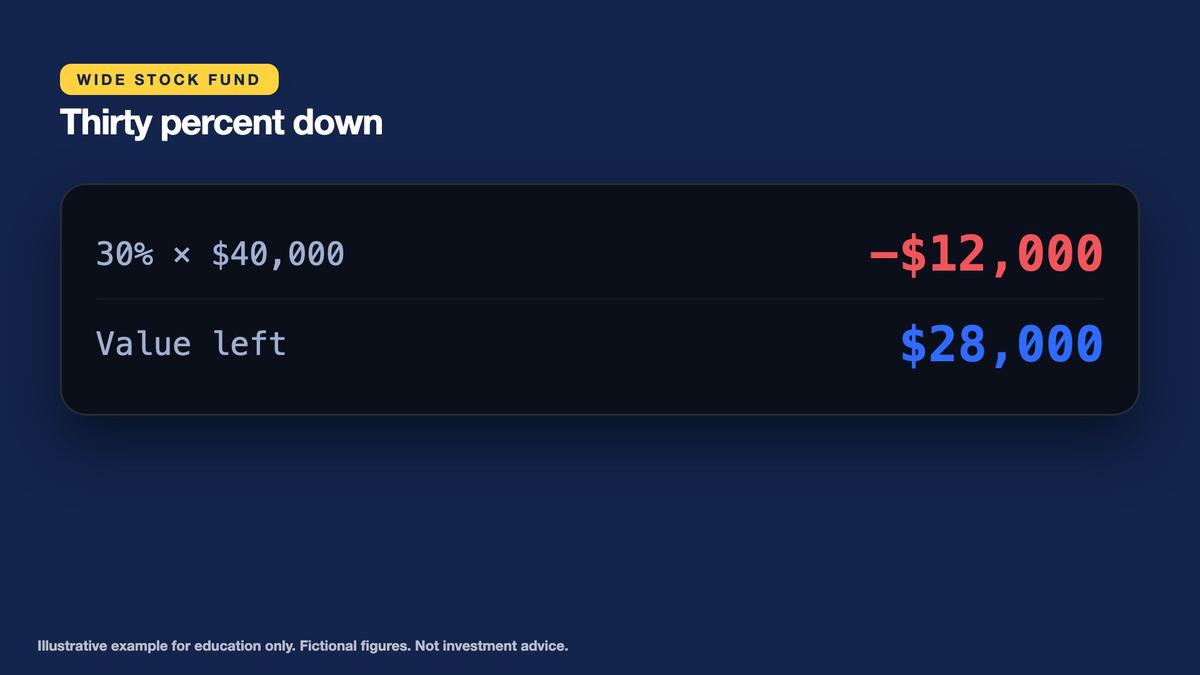
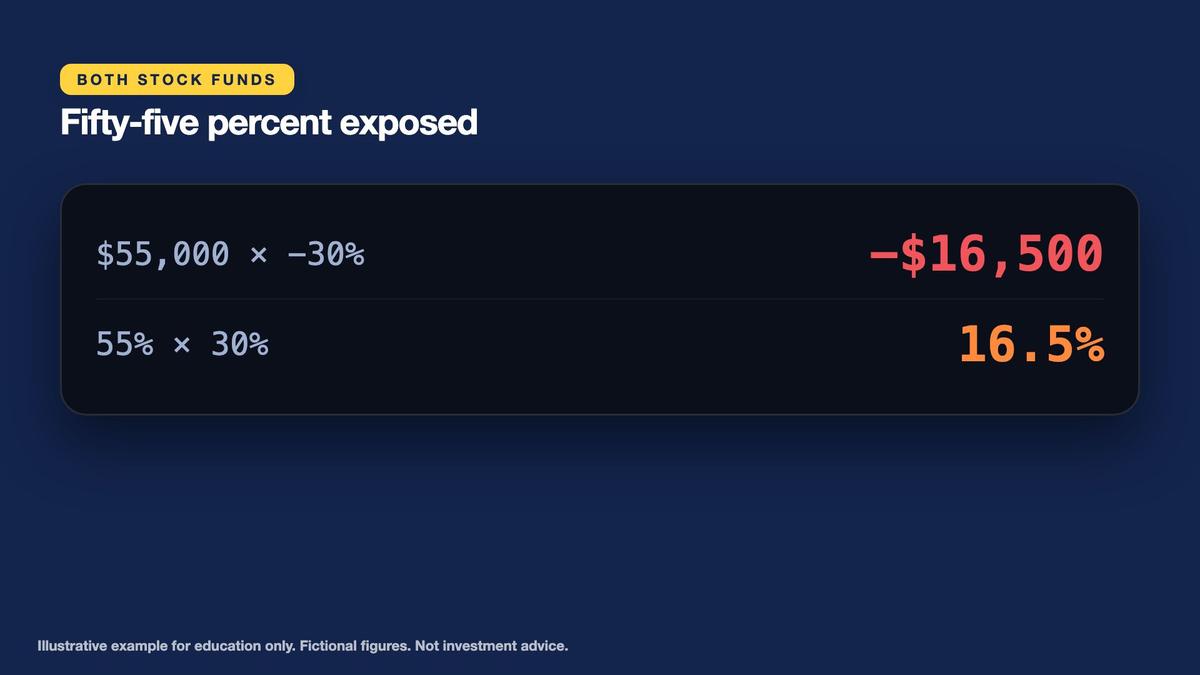
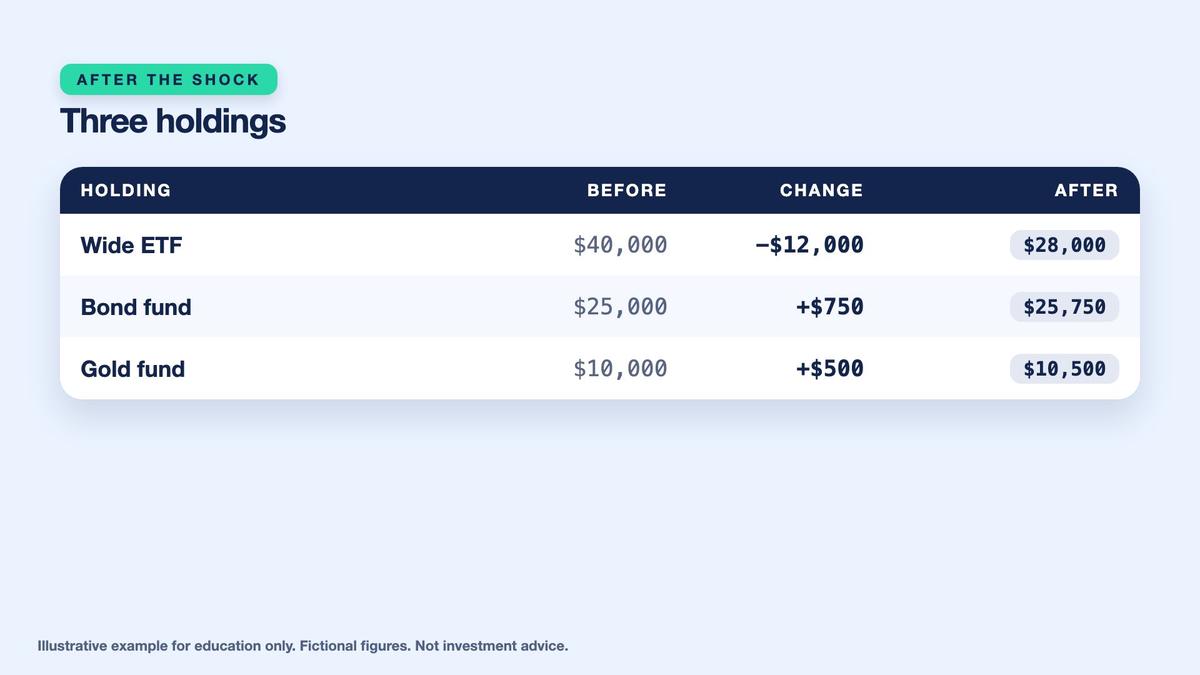
Scenario one assumes Sample Wide Stock ETF declines 30%, Sample Foreign Stock ETF declines 30% in SCU terms, and the SCU exchange rate remains unchanged. The $40,000 wide stock position loses $12,000 and ends at $28,000. The $15,000 foreign stock position loses $4,500 and ends at $10,500. Combined stock losses equal $16,500, which also follows from the opening 55% stock allocation: $55,000 multiplied by 30% equals $16,500. Next, assume bonds gain 3%, producing $750 and ending at $25,750, while gold gains 5%, producing $500 and ending at $10,500. These movements are stipulated, not predicted responses to falling equities.
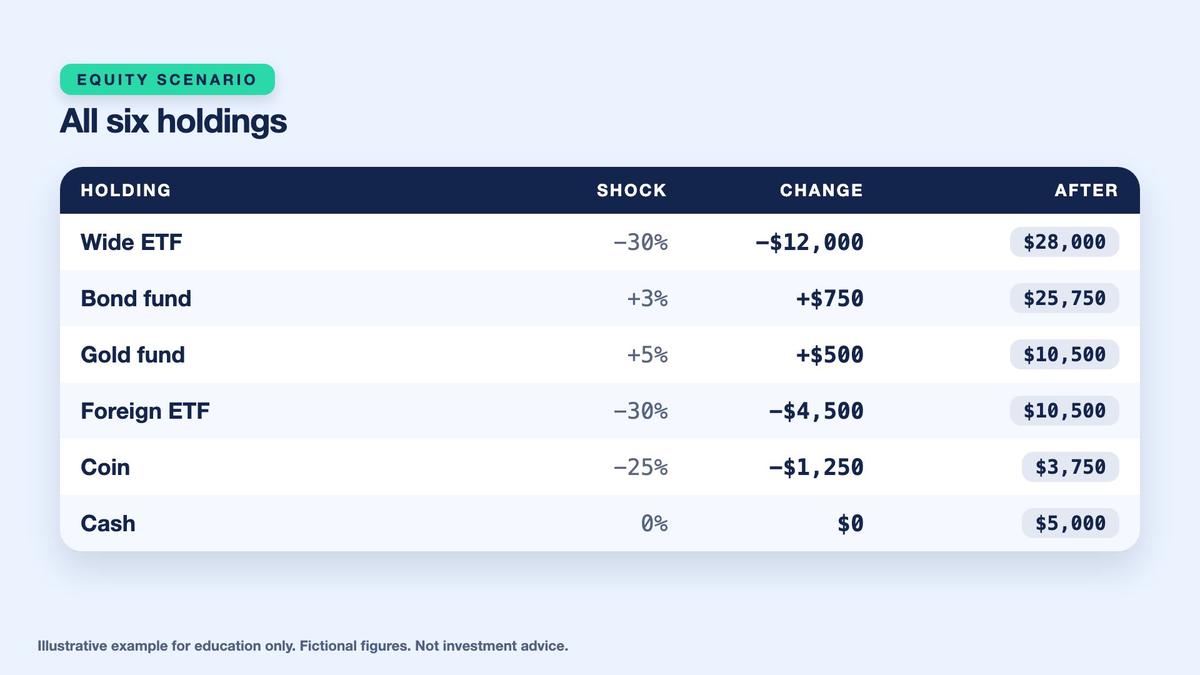
Sample Coin declines 25%, losing $1,250 and ending at $3,750. Cash remains at $5,000. Add all six changes: negative $12,000, positive $750, positive $500, negative $4,500, negative $1,250 and zero. The total is negative $16,500. An important arithmetic detail is that the $750 bond gain and $500 gold gain add to $1,250, exactly offsetting the coin's $1,250 loss. Thus the non-stock changes net to zero in this specific example. This is not a general rule that bonds and gold protect against crypto losses. It is a deliberately constructed numerical offset within one fictional scenario.
Key points
- Equity shock: wide stocks -30% (-$12,000), foreign stocks -30% in SCU (-$4,500), bonds +3% (+$750), gold +5% (+$500), coin -25% (-$1,250), cash unchanged.
- Total -$16,500; ending $83,500; 16.5% loss; 110.0% of tolerance; breach by $1,500.
- The bond and gold gains ($1,250) exactly offset the coin loss in this invented case only.
The ending portfolio is $83,500, or 16.5% below its $100,000 starting value. Compared with the $15,000 bad-scenario tolerance, its $16,500 loss consumes 110% of the allowance and breaches it by $1,500. The six ending holding values are $28,000 wide stocks, $25,750 bonds, $10,500 gold, $10,500 foreign stocks, $3,750 coin and $5,000 cash. They sum to exactly $83,500. The correct verdict is breach, despite every opening allocation constraint having passed. This distinction between initial allocation compliance and portfolio-level downside tolerance is the principal finding of the first scenario.
Measure Weight Drift, Recovery and the Meaning of Offsets
A stress test can reveal how asset weights change even if no trading takes place. After the equity shock, divide each ending holding value by $83,500 rather than the original $100,000. Wide stocks become approximately 33.5%, bonds 30.8%, gold 12.6%, foreign stocks 12.6%, coin 4.5% and cash 6.0%. These displayed percentages are rounded; the underlying values reconcile to the full ending portfolio. The previously largest 40% holding now represents around one-third of the portfolio, while the bond fund occupies a larger relative share. These changes result from different asset returns, not an intentional rebalance.
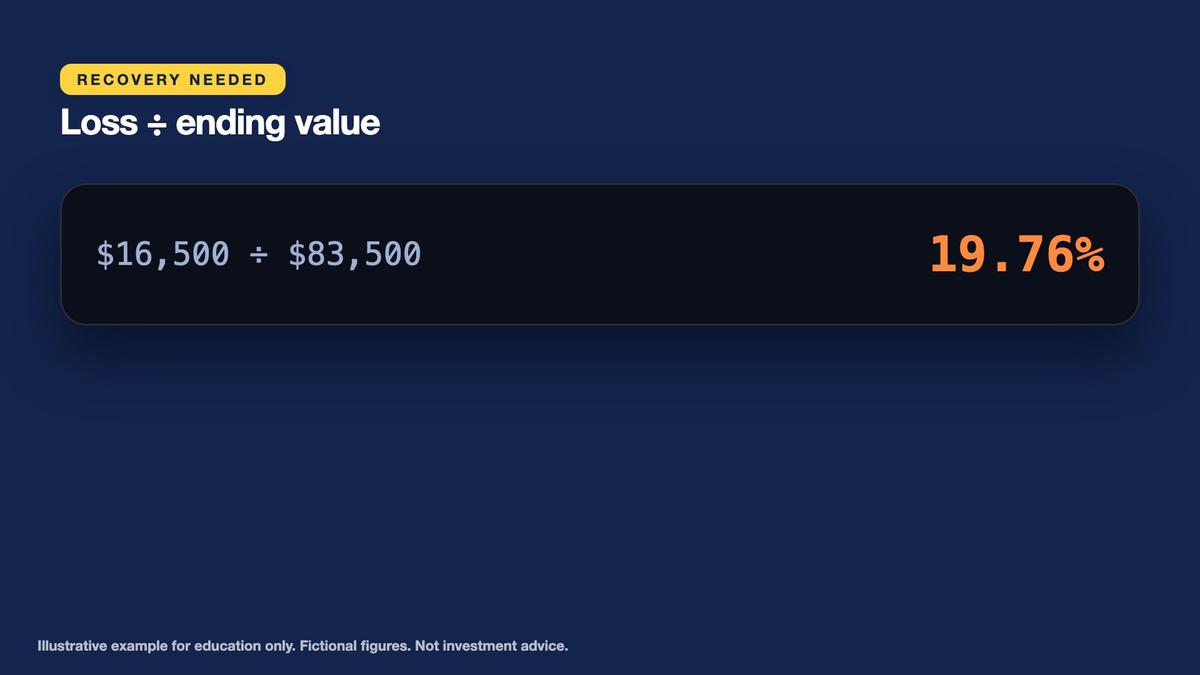
Recovery mathematics uses a different denominator from the original loss percentage. The equity scenario loses $16,500, leaving $83,500. To restore the original $100,000, a future gain would have to equal the lost $16,500 divided by the remaining $83,500. That is approximately 19.76%, not 16.5%. A 16.5% gain applied to the smaller ending value would not recover the entire original loss. This difference becomes more pronounced as drawdowns grow. The calculation is a hypothetical restoration requirement, not a prediction that the portfolio will recover or an estimate of how long recovery would take.
Key points
- After the shock, weights are measured on $83,500: wide 33.5%, bonds 30.8%, gold 12.6%, foreign 12.6%, coin 4.5%, cash 6.0%. No trade was made.
- Recovery uses the smaller base: $16,500 / $83,500 = 19.76%, not 16.5%.
- Record holding-level changes as well as the total; offsets in one scenario are not a rule.
Offsets must be recorded without exaggerating their reliability. In this invented equity scenario, the bond and gold gains exactly match the crypto loss, leaving the stock holdings responsible for the net decline. In another scenario, bonds, gold and crypto could move in different directions, and correlations among assets might change under stress. The journal should therefore record both the individual holding changes and the total rather than displaying only a single portfolio percentage. Holding-level detail explains whether losses are concentrated, which assumptions produce offsetting gains, and which diversifiers might fail if the chosen scenario were different.
Run the Crypto Shock and Evaluate Position-Level Damage
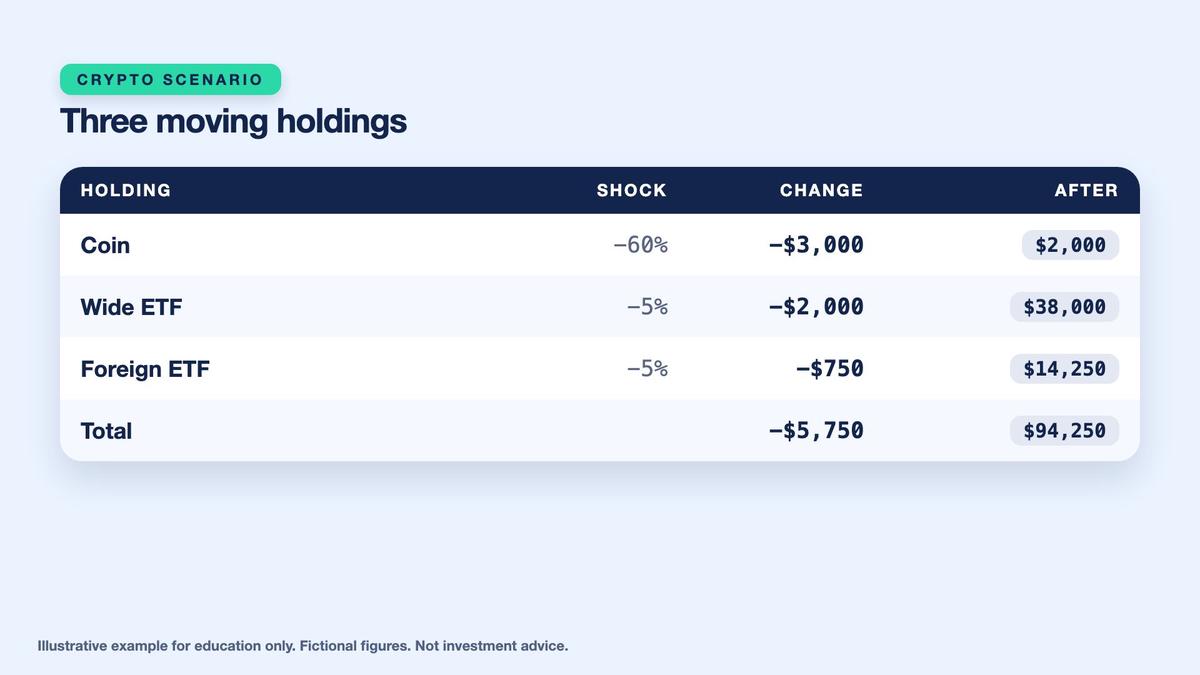
Scenario two assumes Sample Coin declines 60%, Sample Wide Stock ETF declines 5%, and Sample Foreign Stock ETF declines 5% in SCU terms with the SCU exchange rate unchanged. Bonds, gold and cash do not move. The coin position begins at $5,000 and loses $3,000, leaving $2,000. Wide stocks begin at $40,000 and lose $2,000, ending at $38,000. Foreign stocks begin at $15,000 and lose $750, ending at $14,250. Adding these changes produces a total portfolio loss of $5,750. The ending portfolio is therefore $94,250.
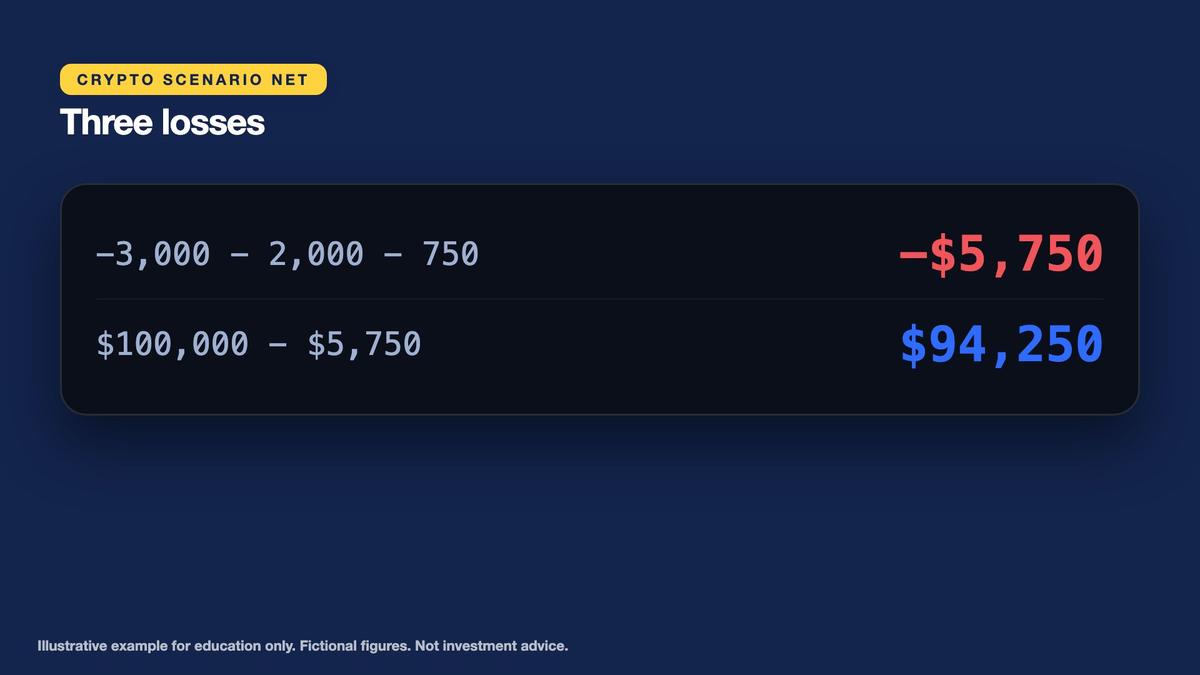
The $5,750 total loss is 5.75% of starting portfolio value. Dividing it by the $15,000 tolerance shows that this scenario uses approximately 38.3% of the permitted bad-scenario loss. It passes the stated test. To return from $94,250 to $100,000, the portfolio would need a gain of $5,750 divided by $94,250, or approximately 6.10%. The learner should distinguish the coin's position-level damage from the portfolio-level outcome. A 60% loss in a holding that originally represents 5% of capital subtracts $3,000, equivalent to 3% of the full portfolio. The position itself suffers a much larger percentage loss than the diversified account.
Key points
- Crypto shock: coin -60% (-$3,000), wide stocks -5% (-$2,000), foreign stocks -5% (-$750); the rest unchanged.
- Total -$5,750; ending $94,250; 5.75% loss; 38.3% of tolerance; pass; recovery 6.10%.
- A 5% position limits direct damage, but the position itself still loses 60%.
The result illustrates both the benefit and the limits of a small speculative allocation. A 5% starting position constrains its direct dollar impact under a 60% price decline, but it does not eliminate the possibility of a total loss, custody failure or correlated declines in other assets. The invented wide and foreign stock losses add another $2,750 to the scenario. A different combination of shocks could produce a substantially different outcome. The journal should record the precise assumption for each holding and avoid claiming that a crypto allocation below a particular percentage always guarantees acceptable portfolio risk.
Run the Currency Shock Using the Fictional SCU Exchange Rate
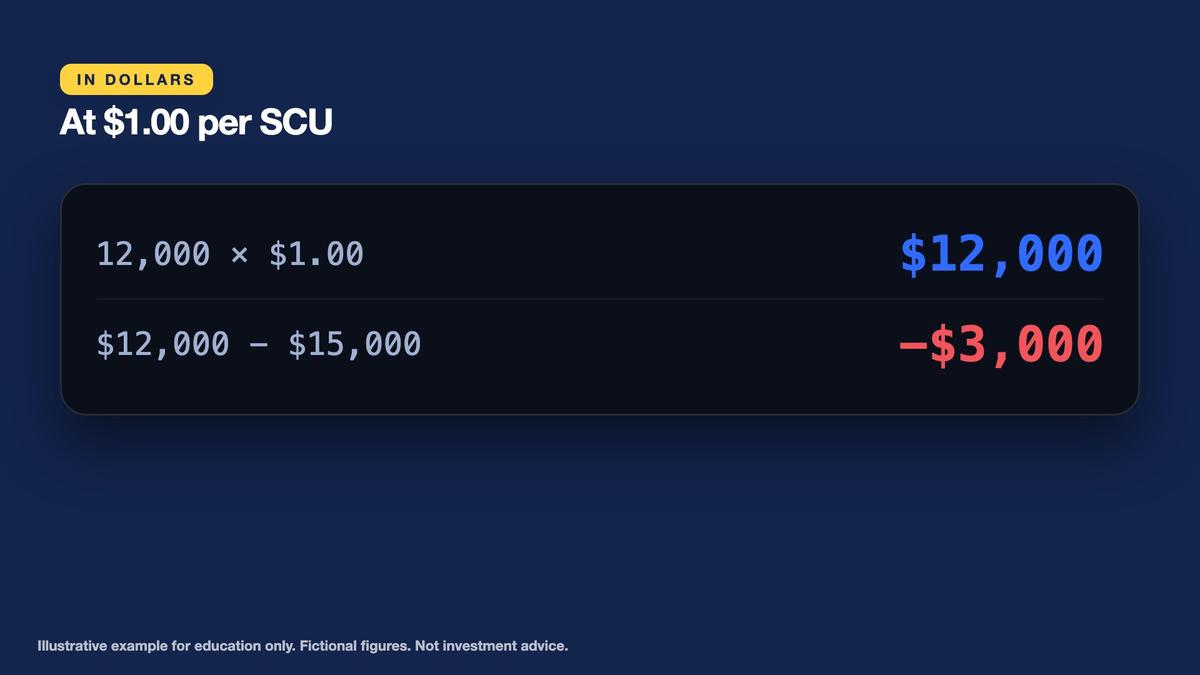
Scenario three isolates foreign exchange risk. The fictional SCU depreciates 20% against the dollar, moving from $1.25 per SCU to $1.00 per SCU. The calculation is $1.25 multiplied by 0.80. The Sample Foreign Stock ETF share price remains unchanged at 30 SCU per share, and the portfolio still owns 400 shares. Consequently, its local-currency value remains 12,000 SCU. Converting that amount at the new exchange rate produces a dollar value of $12,000 instead of the original $15,000. The foreign holding loses $3,000 solely because of the stipulated currency movement.
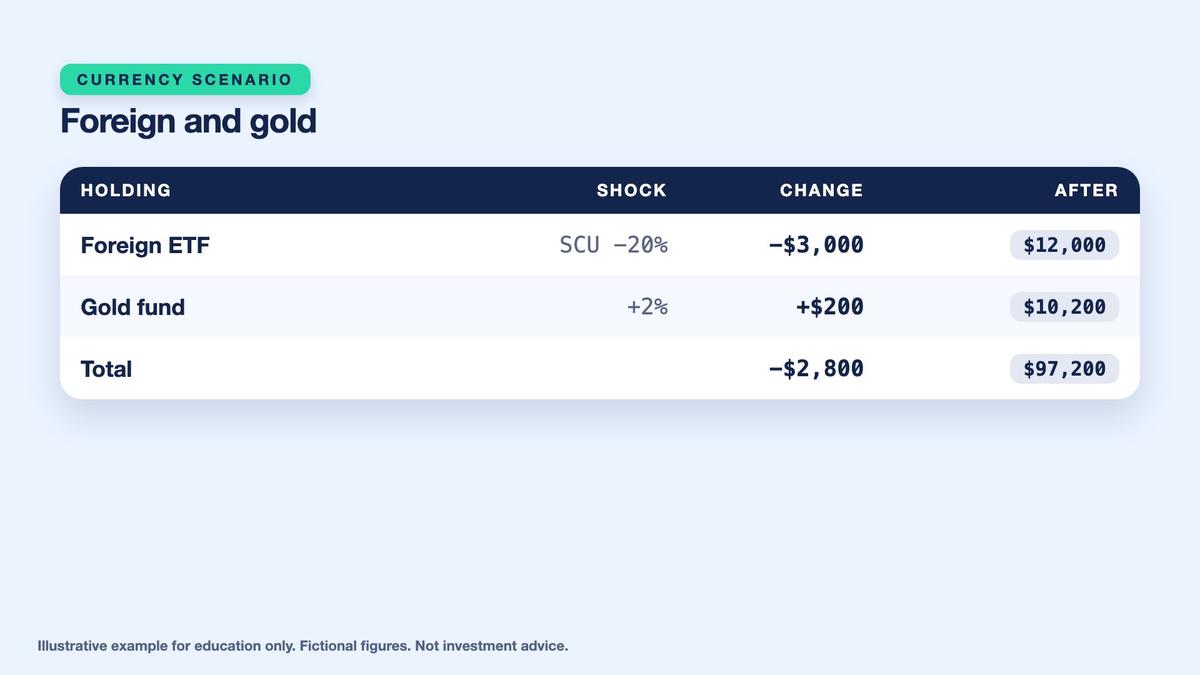
The scenario also assumes the Sample Gold Fund rises 2%, increasing its value by $200 from $10,000 to $10,200. Wide stocks, bonds, Sample Coin and cash remain unchanged. Net portfolio change is negative $3,000 plus positive $200, or negative $2,800. The ending value is $97,200, representing a 2.8% loss from the original portfolio. Compared with the $15,000 tolerance, the loss uses approximately 18.7% of the allowance and passes the test. Recovering from $97,200 to $100,000 requires a gain of $2,800 divided by $97,200, or approximately 2.88%.
Key points
- Currency shock: SCU falls 20%, from $1.25 to $1.00. The fund still holds 12,000 SCU, now worth $12,000: a loss of $3,000.
- Gold +2% adds $200, so the net is -$2,800; ending $97,200; 2.8% loss; 18.7% of tolerance; pass; recovery 2.88%.
- The foreign fund price stays at 30 SCU: the loss is pure currency translation.
The exercise separates the foreign ETF's local investment return from its dollar translation effect. Real foreign stock valuations may involve several operating currencies, different share classes, hedging arrangements and the possibility that stock and currency changes occur together. Here, the share price remains constant in SCU by assumption, allowing learners to see the conversion arithmetic clearly. Gold's 2% gain is also invented and should not be interpreted as a necessary response to a weakening currency. This isolated scenario does not account for additional foreign-currency sensitivities that were not quantified in the original model portfolio.
Combine Shocks Through Multiplication and Calculate Recovery
The fourth scenario combines several hypothetical stresses, using the original $100,000 starting portfolio rather than adding the results of the preceding independent tests. Wide stocks decline 30%, bonds gain 3%, gold gains 5%, Sample Coin declines 60%, and cash remains unchanged. The foreign stock holding experiences both a 30% decline in its SCU-denominated share value and a 20% decline in SCU against the dollar. These two percentage changes must be applied multiplicatively because the currency change acts on the value remaining after the stock-price change. Treating the percentages as additive would be incorrect.
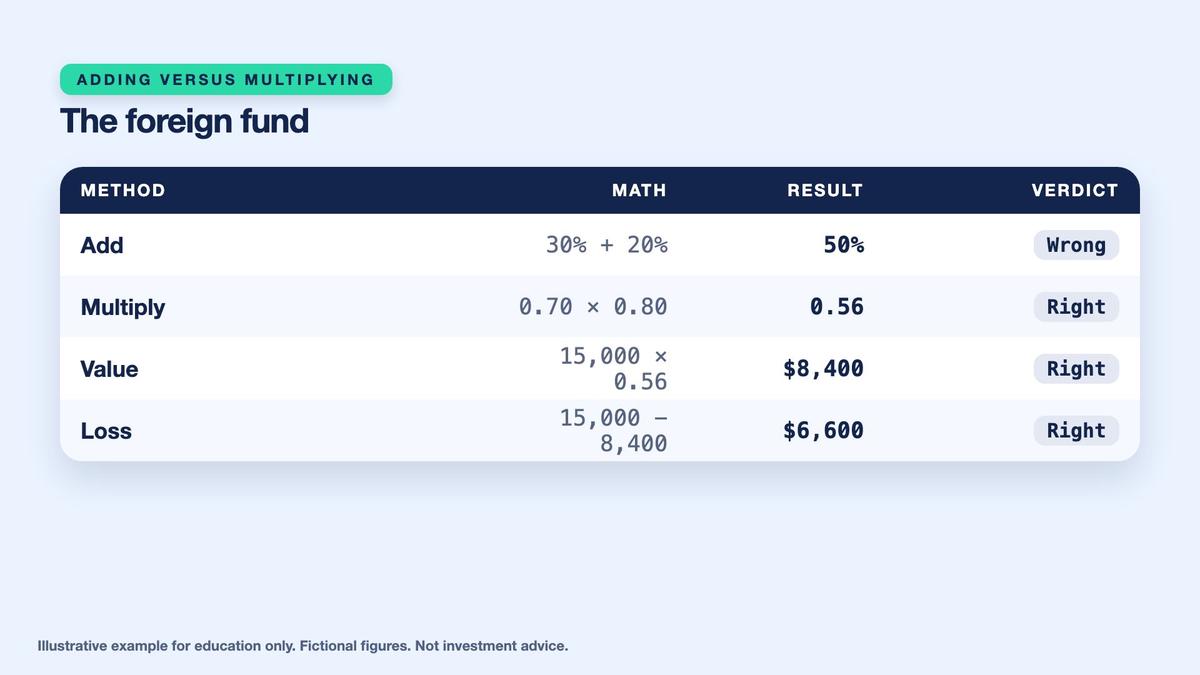
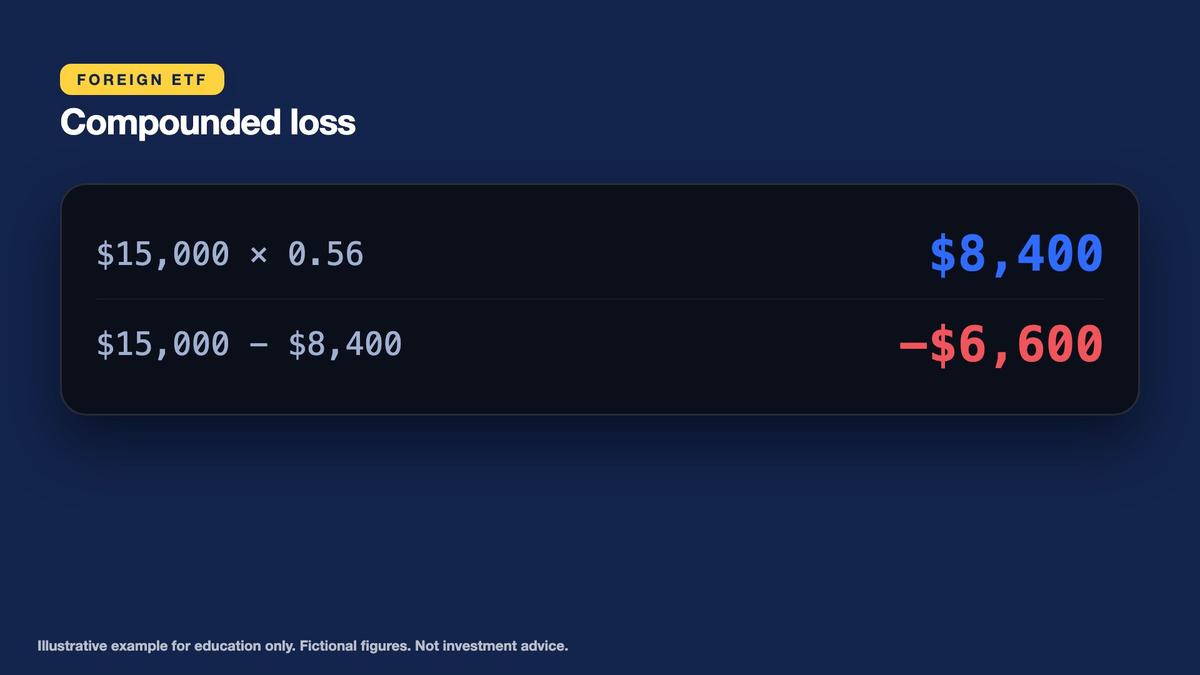
The foreign holding retains 70% of its original local share value and then 80% of that amount after the currency movement. Multiplying 0.70 by 0.80 gives 0.56, meaning the dollar-denominated holding retains 56% of its original value. Its new value is $15,000 multiplied by 0.56, or $8,400, representing a $6,600 loss and a combined decline of 44%. The same calculation can be checked in SCU: 12,000 SCU declines to 8,400 SCU, which converts at the new $1.00 rate to $8,400. Incorrectly adding 30% and 20% would imply a 50% loss, or $7,500, overstating the correct foreign holding loss by $900.
Key points
- Combined stress: foreign factor 0.70 x 0.80 = 0.56, so $15,000 becomes $8,400 (-$6,600, a 44% decline). Adding 30% and 20% would wrongly give -$7,500.
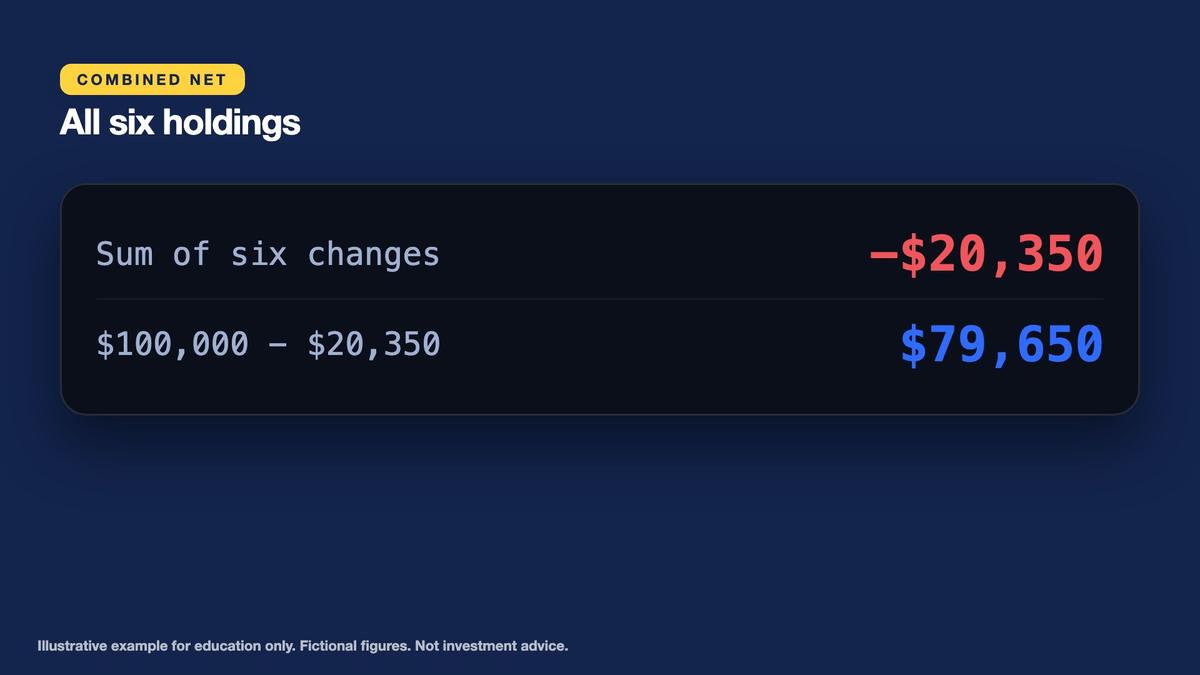
- Changes: -$12,000, +$750, +$500, -$6,600, -$3,000 and 0 for cash: total -$20,350; ending $79,650.
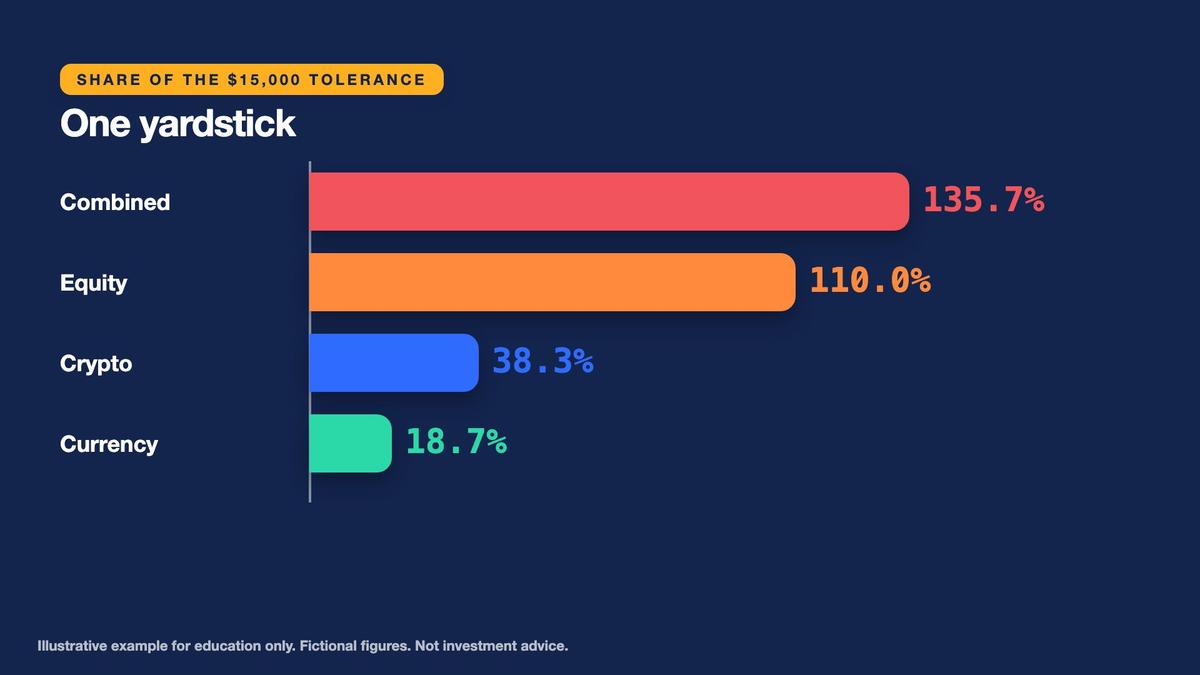
- 20.35% loss; 135.7% of tolerance; breach by $5,350; recovery 25.55%.
Add the remaining holding changes: negative $12,000 wide stocks, positive $750 bonds, positive $500 gold, negative $6,600 foreign stocks and negative $3,000 coin, with zero cash change. The net result is negative $20,350. The portfolio finishes at $79,650, a decline of 20.35%. This loss consumes approximately 135.7% of the written $15,000 tolerance and breaches it by $5,350. Recovering from $79,650 to $100,000 requires $20,350 divided by $79,650, or approximately 25.55%. This combined scenario is the most severe of the four examples, but no probability or forecast is attached to its assumptions.
Rank Scenario Severity and Find the Equity Tolerance Threshold
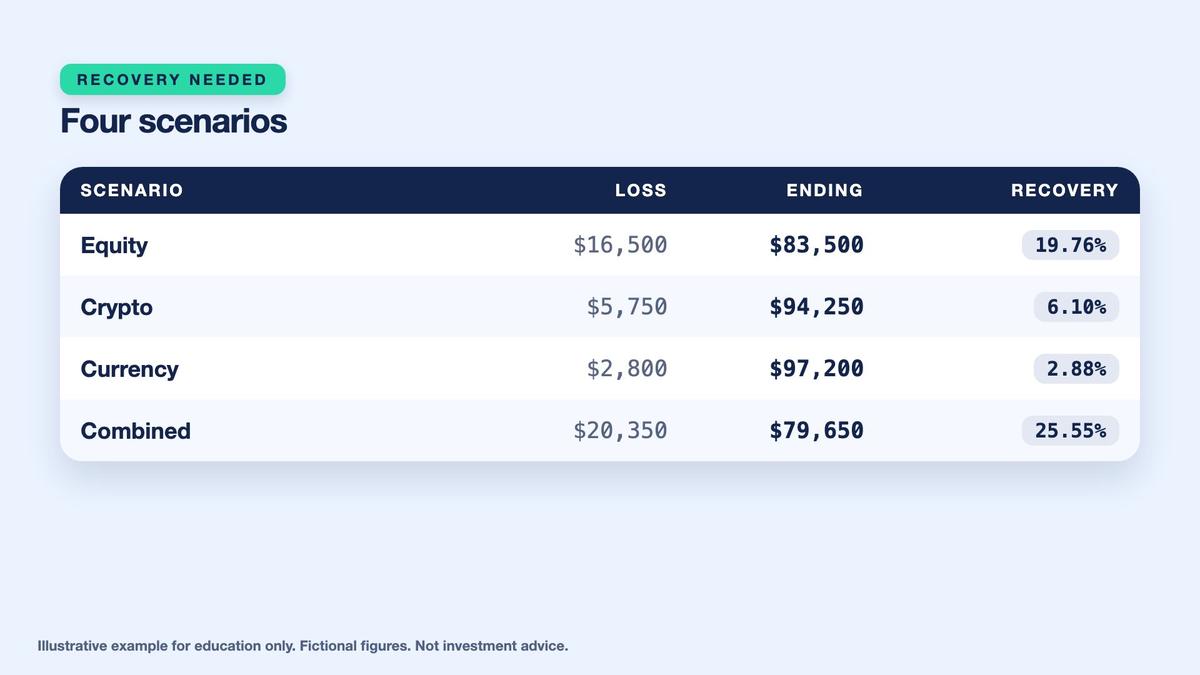
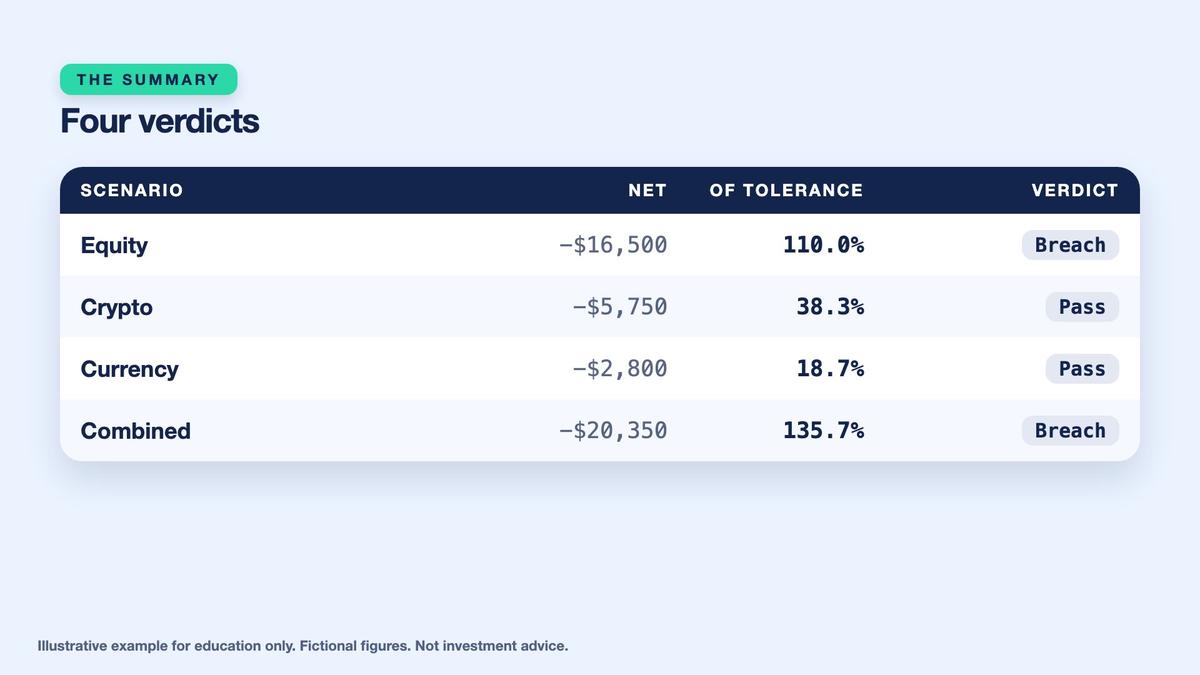
The completed comparison contains four rows. The equity shock loses $16,500, or 16.5%, consumes 110.0% of tolerance and breaches policy. The crypto shock loses $5,750, or 5.75%, consumes approximately 38.3% of tolerance and passes. The currency shock loses $2,800, or 2.8%, consumes approximately 18.7% of tolerance and passes. The combined shock loses $20,350, or 20.35%, consumes approximately 135.7% of tolerance and breaches. Ranking the results from largest to smallest loss gives combined, equity, crypto and currency. The ranking describes only these four invented tests and does not establish that one actual risk source is always more dangerous than another.
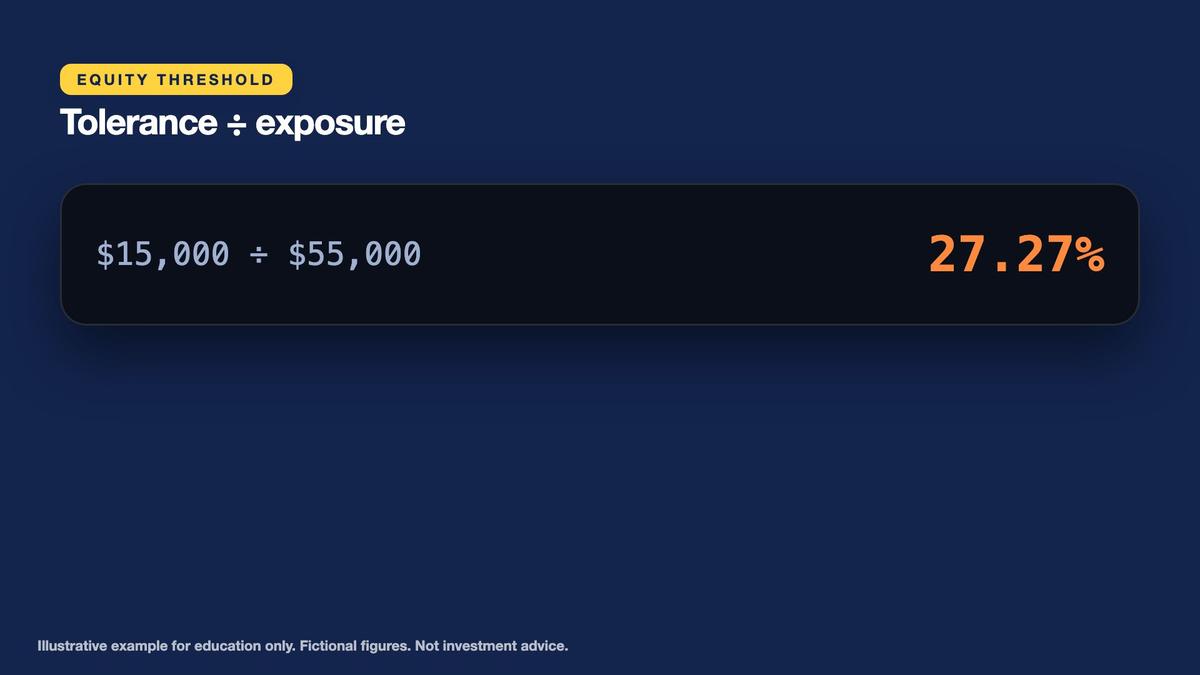
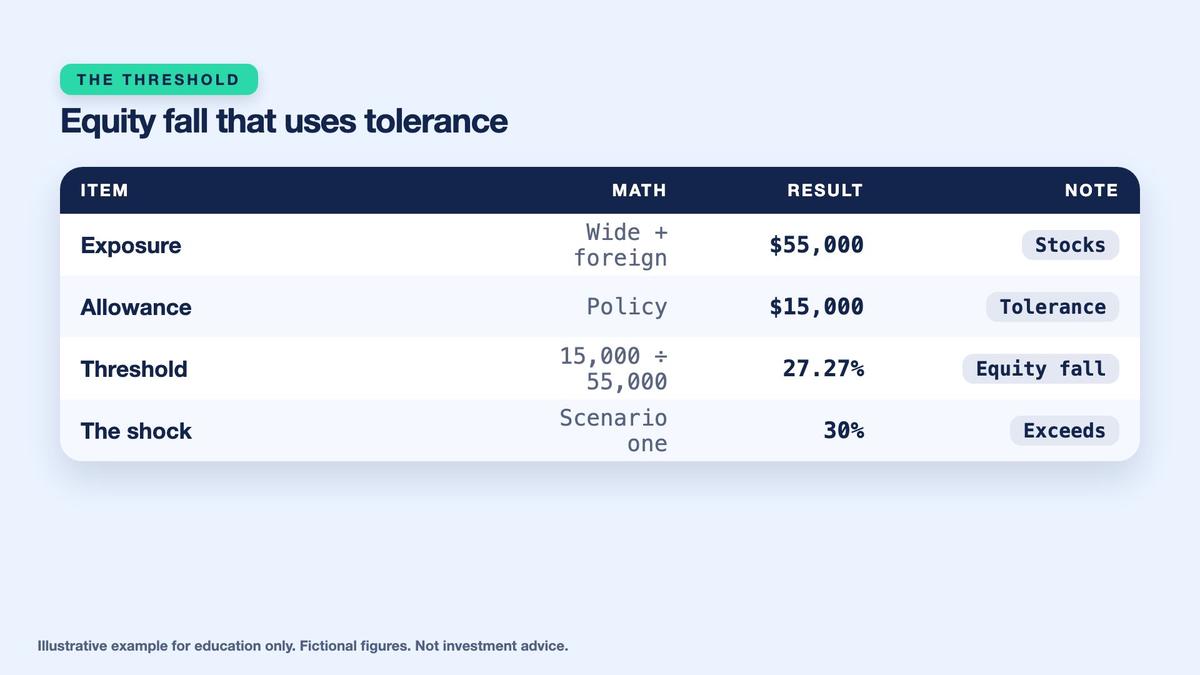
Now return to scenario one to calculate the stock decline that would exactly exhaust the $15,000 loss tolerance. In the stated equity scenario, the bond gain of $750 and gold gain of $500 exactly offset the crypto loss of $1,250. The net loss therefore comes entirely from the original $55,000 stock allocation. Divide the $15,000 tolerance by $55,000 to obtain approximately 27.27%. Under the same assumed offsets and unchanged SCU rate, a 27.27% stock decline would use the full tolerance, while the specified 30% decline breaches it. This is a conditional threshold for the given assumptions, not a predicted market level or a fixed stop price.
Key points
- Ranking by loss: combined $20,350, equity $16,500, crypto $5,750, currency $2,800. Two breaches, two passes.
- Break-even stock decline: $15,000 / $55,000 = 27.27% under the same offsets; the 30% shock breaches.
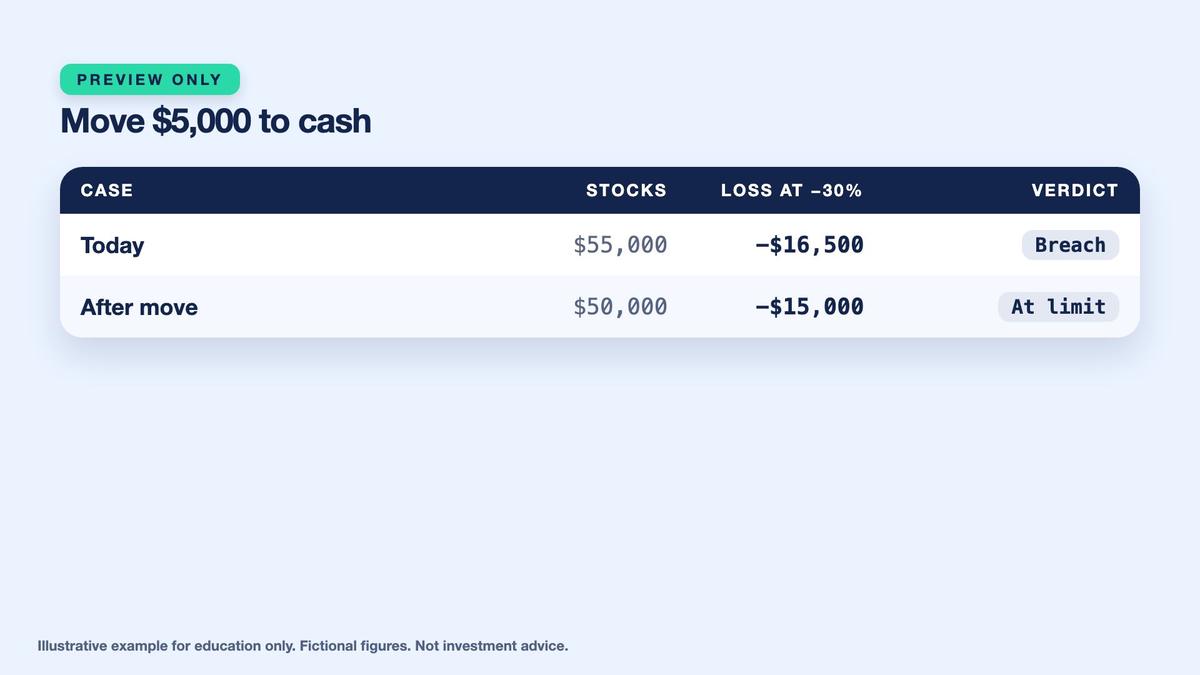
- Preview only: moving $5,000 from wide stocks to cash makes the equity loss exactly $15,000 (15%). The combined case would need retesting.
Finally, preview a possible allocation change without implementing it. Moving $5,000 from Sample Wide Stock ETF into cash would reduce wide stocks to $35,000 and increase cash to $10,000. Combined stock exposure would become $50,000 because the $15,000 foreign position remains unchanged. A 30% stock decline would then create a $15,000 loss. Keeping the same bond, gold and crypto assumptions, their gains and losses would still cancel, leaving a total equity-scenario loss of exactly $15,000, or 15%. This meets rather than breaches the written tolerance. However, the combined scenario would need separate retesting. The actual rebalance-or-hold decision belongs to the next lesson.
Complete the Stress Report, Journal Entry and Paper Practice
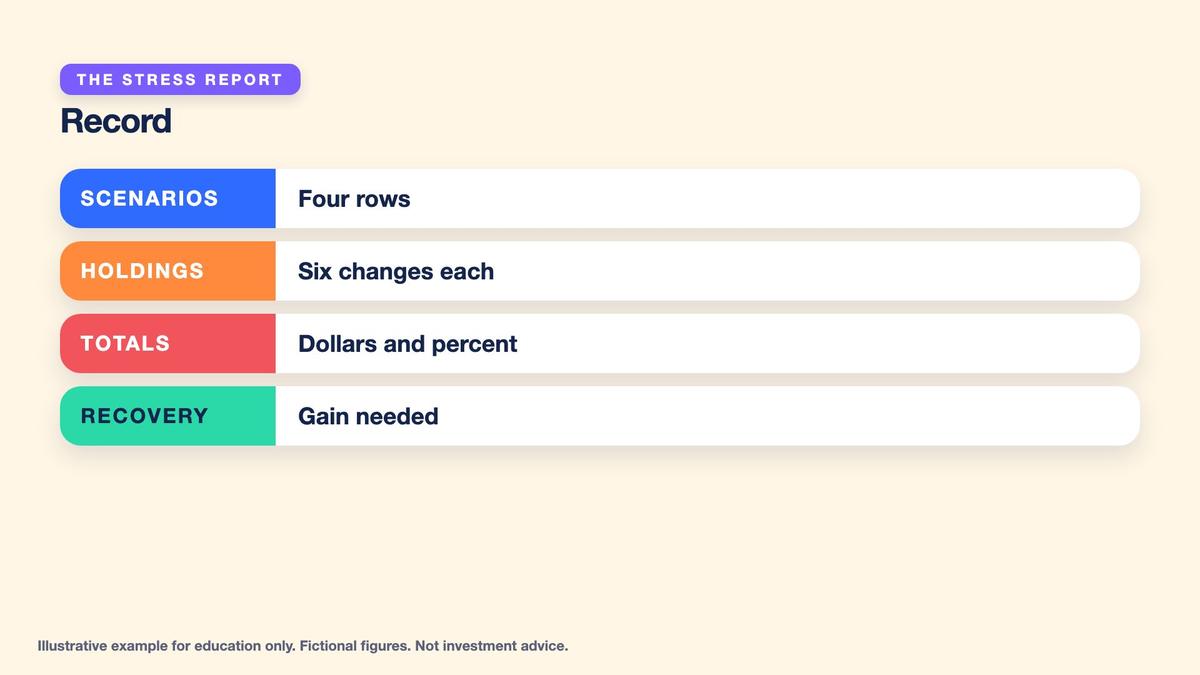
Finish a one-page stress report beginning with the original six holdings, the June 1, 2026 reference date, the $100,000 portfolio value and the $15,000 bad-scenario tolerance. For each scenario, list the exact shock applied to each holding, the local-currency assumption where relevant, the holding-level dollar change and the ending portfolio value. Record the net change as both dollars and a percentage of starting value, then calculate the share of the tolerance used and the pass-or-breach verdict. Include the dollar amount exceeding tolerance when applicable. Keep the four scenarios separate because they are alternatives, not cumulative historical trades.
Hands-On Lab: Four Fictional Stress Tests on the Same $100,000 Portfolio
Use only the six fictional holdings and the unchanged $100,000 starting values from Lesson 28. Record the $15,000 bad-scenario loss tolerance and the three initial allocation limits. For every scenario, write the asset-level shock assumptions before calculating results. Compute each holding's dollar change, total portfolio loss, ending value, percentage loss, percentage of tolerance used, pass-or-breach verdict and recovery gain. For foreign stocks, preserve the distinction between SCU-denominated share returns and the SCU-to-USD exchange rate. In the combined scenario, multiply the 0.70 equity factor by the 0.80 currency factor rather than adding percentage declines. Rank the four scenario losses and determine the equity decline that exactly exhausts the original tolerance. Preview, without implementing, the effect of shifting $5,000 from wide stocks into cash. Save a one-page stress report with a dated journal entry that identifies assumptions, breaches, offsets, limitations and unresolved questions. Optional paper practice: use https://research-paper-trade-webapp.pages.dev/paper/ only for an isolated mock order and stop-recording exercise, without connecting wallets, exchanges, funded accounts, keys or real funds.
- Decision 1: The unchanged fictional portfolio begins at $100,000 with a $15,000 downside tolerance. Under the equity stress, wide stocks and foreign stocks each decline 30%, with SCU unchanged; bonds gain 3%, gold gains 5%, coin declines 25%, and cash is unchanged. — Calculate all six holding changes, the net portfolio result, tolerance use, breach amount and ending portfolio value.
- Decision 2: The crypto stress assumes Sample Coin declines 60%, wide stocks decline 5%, foreign stocks decline 5% in SCU with exchange rates unchanged, and all other holdings remain constant. — Calculate the coin-only impact, combined portfolio result, tolerance percentage, recovery gain and verdict.
- Decision 3: The fictional foreign stock holding contains 12,000 SCU initially worth $15,000 at $1.25 per SCU. SCU depreciates 20% against USD, the stock's SCU price remains unchanged, and gold gains 2%. — Calculate the new exchange rate, foreign holding value, net portfolio change, tolerance utilization and recovery requirement.
- Decision 4: The combined stress assumes wide stocks fall 30%, bonds gain 3%, gold gains 5%, coin falls 60%, and foreign stocks face a simultaneous 30% SCU-denominated share decline and 20% SCU depreciation. — Calculate the foreign combined return correctly, the portfolio result, tolerance breach and recovery requirement.
- Decision 5: Under the equity scenario, bond and gold gains offset the coin loss, leaving a $55,000 initial stock allocation as the driver of downside. The learner is considering a non-executed $5,000 transfer from wide stocks to cash. — Calculate the stock decline that exactly exhausts tolerance, rank the four scenarios, and evaluate the proposed allocation preview without making a trade.
Answer key
The journal entry should identify two breaches and two passes, explain which holdings create the largest losses, note how bond and gold gains offset crypto losses in the equity case, and show why the foreign equity and currency factors must be multiplied in the combined case. Include recovery percentages of approximately 19.76%, 6.10%, 2.88% and 25.55%. Document the 27.27% equity tolerance threshold and the optional $5,000 stock-to-cash adjustment preview without treating it as an executed rebalance. State the limitations: shocks are invented, probabilities are unspecified, correlations are imposed by the scenario, and liquidity, taxes, slippage, transaction costs and actual trading constraints are ignored.
Key points
- Stress report: holdings, date, $100,000, $15,000 tolerance; for each scenario the shocks, dollar changes, ending value, percent loss, tolerance share and verdict.
- Journal: two breaches, two passes, the offsets, the multiplication rule, recoveries 19.76%, 6.10%, 2.88% and 25.55%, and the 27.27% threshold.
- Limits: shocks are invented, no probabilities, correlations are imposed, and liquidity, tax, slippage and costs are ignored. Practice only with simulated money.
For optional practice, open the user-provided Paper Trading section at https://research-paper-trade-webapp.pages.dev/paper/ only if it offers a safe isolated simulation. Rehearse one small mock order and record the intended stop, assumed fill, execution difference and hypothetical loss. A stop does not guarantee that a real order would fill at the specified price, especially during market gaps. Do not connect real wallets, exchanges or funded accounts, enter private keys or recovery phrases, or place live orders. If the interface does not support safe fictional inputs, complete the practice entirely on paper. This lesson builds on the model portfolio, currency exposure and investment-policy materials; the next lesson asks whether to rebalance or hold.
Worked example at a glance
Key terms
- Stress test: a what-if calculation of portfolio change under stipulated moves.
- Scenario: one set of assumed moves for every holding.
- Shock: a large assumed price or currency move.
- Tolerance: the largest loss the written policy accepts, here $15,000.
- Breach: a result that exceeds the tolerance or a limit.
- Multiplicative: combined by multiplying factors, not adding percentages.
- Recovery gain: the gain needed on the reduced value to return to the start.
- Offset: a gain in one holding that cancels part of a loss in another.
- Weight drift: the change in weights caused by unequal returns, with no trading.
- Threshold: the decline that exactly uses the whole tolerance.
- Combined stress: several shocks applied together to the original portfolio.
- Stress journal: a dated record of assumptions, results and limits.
Multi Asset Trading Lab is an educational program and does not provide personalized investment advice, trading recommendations, financial planning, portfolio management, tax advice, legal advice, brokerage guidance, custody advice or price forecasts. This lesson uses an entirely fictional $100,000 portfolio dated June 1, 2026 and applies invented stress assumptions to illustrate conditional arithmetic. All funds, asset names, quantities, prices, foreign currency units, conversion rates, shock percentages, simulated gains and losses, risk-policy thresholds and proposed allocation adjustments are invented. No real fund, issuer, broker, exchange, cryptocurrency, ticker, actual exchange rate, current market price or historical market event is represented. The exercises require only a paper worksheet, calculator or safely isolated simulation. No real-money transaction, actual portfolio rebalance, market order, wallet connection or financial commitment is needed or encouraged. The fictional portfolio contains Sample Wide Stock ETF at $40,000 or 40%, Sample Bond Fund at $25,000 or 25%, Sample Gold Fund at $10,000 or 10%, Sample Foreign Stock ETF at $15,000 or 15%, Sample Coin at $5,000 or 5%, and cash at $5,000 or 5%. These six starting values total $100,000, and their weights total 100%. The Sample Foreign Stock ETF is modeled as 400 shares at 30 fictional SCU each, totaling 12,000 SCU. The invented initial exchange rate is one SCU equal to $1.25, making the holding worth $15,000 in the portfolio's dollar reference currency. The portfolio's written policy seeks long-term growth with moderate risk over ten years, sets a bad-scenario loss tolerance of 15% of starting value or $15,000, limits any individual holding to no more than 40%, limits cryptocurrency to no more than 5%, and requires cash of at least 5%. These limits are fictional classroom assumptions, not universal recommendations, appropriate limits for any real investor, or guarantees of a maximum loss. The opening portfolio complies with the three stated allocation limits, but compliance with holding weights does not establish that the portfolio can withstand any particular market decline. The purpose of a stress test is to calculate what would happen if explicitly specified changes occurred. It is not to claim that those changes will occur, that they are likely, or that the tested cases cover all plausible outcomes. No scenario in this lesson carries an empirical probability, an estimated likelihood or a predicted time of occurrence. The first independent fictional equity scenario assumes Sample Wide Stock ETF falls 30%, Sample Foreign Stock ETF falls 30% in SCU terms while the SCU exchange rate remains unchanged, Sample Bond Fund gains 3%, Sample Gold Fund gains 5%, Sample Coin declines 25%, and cash remains unchanged. The wide stock loss is $40,000 multiplied by 30%, or $12,000. The foreign stock loss is $15,000 multiplied by 30%, or $4,500. The bond gain is $25,000 multiplied by 3%, or $750. The gold gain is $10,000 multiplied by 5%, or $500. The coin loss is $5,000 multiplied by 25%, or $1,250. Cash does not change. Adding all holding-level changes produces negative $16,500. Under the stipulated assumptions, the $750 bond gain and $500 gold gain exactly offset the $1,250 crypto loss, so the total portfolio decline equals the combined $16,500 stock loss. This offset is a feature of the chosen numbers and does not imply that bonds and gold reliably rise or offset crypto declines during real equity-market stress. The portfolio ends at $83,500, a decline of 16.5% from the original $100,000. The $16,500 loss is 110% of the written $15,000 tolerance and breaches it by $1,500. The ending holding values are $28,000 for wide stocks, $25,750 for bonds, $10,500 for gold, $10,500 for foreign stocks, $3,750 for crypto and $5,000 for cash. These total $83,500. Dividing the respective ending values by $83,500 produces approximate weights of 33.5%, 30.8%, 12.6%, 12.6%, 4.5% and 6.0%. These displayed figures are rounded, and the original dollar values should be used for exact reconciliation. Allocation weights can drift when market values change even without new trades. A return to the original $100,000 from $83,500 requires a $16,500 gain relative to the reduced balance, or approximately 19.76%. The initial 16.5% loss and the required 19.76% recovery gain use different denominators. The calculation does not establish that recovery will occur or predict its timing. The second independent fictional crypto scenario assumes Sample Coin declines 60%, Sample Wide Stock ETF declines 5%, Sample Foreign Stock ETF declines 5% in SCU while the exchange rate remains unchanged, and bonds, gold and cash remain constant. The coin loss equals $3,000, the wide stock loss equals $2,000, and the foreign stock loss equals $750. Net portfolio change is negative $5,750, or negative 5.75% of starting capital, leaving $94,250. This uses approximately 38.33%, displayed as 38.3%, of the $15,000 downside tolerance, so the scenario passes the stated policy test. Recovery from $94,250 to $100,000 would require $5,750 divided by $94,250, or approximately 6.10%. The $5,000 opening crypto allocation represents 5% of starting portfolio capital, and a 60% loss on that position directly subtracts $3,000, equal to 3% of the initial portfolio. The fact that the overall portfolio loss remains below the written tolerance does not make the 60% position-level decline harmless, predictable or necessarily representative of actual cryptocurrency risk. Digital assets may experience much larger losses, custody failures, liquidity disruptions, operational risks or complete loss of value. The third independent fictional currency scenario assumes SCU depreciates 20% against USD, taking the invented exchange rate from $1.25 per SCU to exactly $1.00 per SCU. The Sample Foreign Stock ETF remains priced at 30 SCU per share, with 400 shares totaling 12,000 SCU. Its local-currency valuation is unchanged, but translating at the new $1.00 rate gives $12,000 instead of $15,000, a $3,000 foreign exchange loss. The scenario separately assumes Sample Gold Fund gains 2%, or $200, while wide stocks, bonds, crypto and cash remain unchanged. Net portfolio change is negative $2,800, or negative 2.8%, leaving $97,200. This loss uses approximately 18.67%, displayed as 18.7%, of the $15,000 tolerance and passes the test. Recovery from $97,200 to $100,000 requires approximately 2.88%. The fictional SCU is an invented currency unit, not a real exchange rate, and the 20% depreciation is not a forecast. A real foreign security may have underlying revenue, costs, currency hedges, share-class arrangements and market behavior that complicate the relationship between its trading currency and economic exposure. The lesson isolates one specified currency conversion effect and does not claim that all real foreign stocks behave in the same way. The fourth fictional scenario combines several simultaneous assumptions and must be calculated independently from the original opening portfolio rather than by adding the total losses from the preceding three scenarios. It assumes wide stocks fall 30%, bonds gain 3%, gold gains 5%, crypto falls 60%, cash remains unchanged, and foreign stocks experience both a 30% decline in their SCU-denominated share price and a 20% depreciation in SCU against USD. The foreign stock change is calculated by multiplying the remaining-value factors, not by adding the two negative percentage changes. After a 30% share-price decline, 70% of original local value remains. After a further 20% currency depreciation, the dollar conversion factor is 80% of its previous level. Multiplying 0.70 by 0.80 gives 0.56. The foreign holding's correct new dollar value is $15,000 multiplied by 0.56, or $8,400. The holding loses $6,600, equal to a 44% decline. Adding the negative 30% and negative 20% figures directly would incorrectly imply a 50% decline and a $7,500 loss, overstating the correct loss by $900. An equivalent calculation converts the original 12,000 SCU foreign position to 8,400 SCU after the local share-price loss, then multiplies by the new $1.00 exchange rate to arrive at $8,400. Under the combined scenario, the wide stock position loses $12,000, bonds gain $750, gold gains $500, foreign stocks lose $6,600, Sample Coin loses $3,000 and cash remains unchanged. The net portfolio loss is $20,350, leaving $79,650 from the starting $100,000. This is a negative 20.35% return in the hypothetical scenario. Compared with the written $15,000 bad-scenario tolerance, $20,350 represents approximately 135.67%, presented as 135.7%, and exceeds that tolerance by $5,350. The combined outcome therefore breaches the policy. Recovery from $79,650 to the initial $100,000 requires a gain of $20,350 divided by $79,650, or approximately 25.55%. These calculations are not forecasts, investment return expectations or probabilities. The four scenario summary results are: equity stress negative $16,500, or negative 16.5%, using 110.0% of tolerance and breaching; crypto stress negative $5,750, or negative 5.75%, using approximately 38.3% of tolerance and passing; currency stress negative $2,800, or negative 2.8%, using approximately 18.7% of tolerance and passing; and combined stress negative $20,350, or negative 20.35%, using approximately 135.7% of tolerance and breaching. Ranked by loss magnitude, the combined stress is the most severe, followed by equity, crypto and currency. This ranking refers only to the four selected sets of assumptions and does not establish the relative future likelihood or true maximum severity of the underlying risks. A different set of shocks could change both rankings and compliance verdicts. The lesson also calculates a conditional equity decline threshold for the first scenario. Under its specified assumptions, the $750 bond gain and $500 gold gain exactly offset the $1,250 coin loss. Therefore the $15,000 tolerance can be treated as the amount available to absorb losses from the original $55,000 combined stock allocation. Dividing $15,000 by $55,000 gives approximately 0.272727, or a 27.27% stock decline. This is the hypothetical decline that exactly uses the written tolerance if all the other scenario-one assumptions remain unchanged. It is not a market forecast, historical support level, order recommendation or guaranteed stop. The lesson previews, without implementing, a hypothetical movement of $5,000 from Sample Wide Stock ETF into cash. This would reduce wide stocks from $40,000 to $35,000, increase cash from $5,000 to $10,000, and leave the foreign stock holding at $15,000. Combined stock exposure would become $50,000. A 30% decline in that stock allocation would produce a $15,000 loss. Keeping the same invented bond, gold and coin offset from scenario one would produce a total portfolio loss of exactly $15,000, or 15%, which meets rather than breaches the written tolerance. This is only a preview of an allocation idea, not an executed rebalance, recommendation or statement that moving to cash is always safer. The portfolio's broader risk, opportunity costs, inflation sensitivity, currency exposure and combined scenario results would need independent reevaluation. A change that resolves one isolated scenario may not resolve other downside cases. The stress tests ignore transaction fees, taxes, fund expenses, bid-ask spreads, slippage, forced liquidation, liquidity limitations, market closures, settlement delays, currency conversion charges, custody events, correlation changes not explicitly represented, and the possibility that actual prices move more severely than any of the assumed shocks. They also do not quantify probabilities, expected returns, variance, correlation estimates or the time horizon over which losses may develop. A stress test should not be interpreted as a complete risk model. A loss tolerance is a written policy threshold for reviewing hypothetical outcomes, not an assurance that realized losses cannot exceed the threshold. Even assets intended to diversify a portfolio may fall simultaneously with other holdings under some circumstances. The lesson's recovery calculations are mathematical requirements for regaining the original account value after a specified drawdown, not predictions of future price movement or guarantees that recovery will occur. The final one-page stress report should preserve the starting portfolio, stated policy, asset-level shock assumptions, foreign exchange calculations, individual dollar changes, ending portfolio values, percentage returns, shares of tolerance, pass-or-breach verdicts, breach amounts, recovery requirements, severity ranking, conditional equity threshold, possible allocation preview and important limitations. The associated journal entry should distinguish reported observations from assumptions and avoid altering the original values after seeing the scenario results. Optional paper practice may use the user-provided webpage https://research-paper-trade-webapp.pages.dev/paper/ if it offers a safe isolated simulated environment. This webpage is not independently verified in this lesson and should not be treated as an official exchange, financial institution, product specification source or endorsement. Learners should never connect a real wallet, funded account, brokerage service or exchange; never enter private keys, recovery phrases or confidential credentials; and never place real orders or transfer actual funds. The optional mock activity may rehearse recording an entry, stop and hypothetical fill, but a real stop order does not guarantee execution at a specified price or a maximum loss, especially during market gaps or periods of low liquidity. If the provided page is unavailable, unsafe or incompatible with fictional inputs, use an offline paper worksheet or calculator instead. Earlier lessons on investment policy, currency exposure, portfolio construction, crypto custody, execution costs, gold risk and commodity contract mechanics provide background but do not guarantee any real investment outcome. The next lesson, Rebalance or Hold?, will evaluate potential allocation changes and their tradeoffs after reviewing the stress results. Nothing in this lesson recommends buying, selling, holding, rebalancing, hedging, leveraging or trading any actual investment, currency, cryptocurrency, fund, security, commodity, futures contract, option or other financial instrument. All numerical examples, scenarios, choices and outcomes are entirely fictional, simulated and strictly educational.
Lesson Checkpoint
Review what you learned and get feedback on your work.