



In this seventeen-minute beginner hands-on laboratory, learners read a dated fictional XAUUSD contract specification and use it to size, simulate, and reconcile a leveraged gold trade. The fictional Sample Broker specification, dated March 2, 2026, defines a 100-troy-ounce standard lot, 0.01 minimum lot, 0.01 lot increment, 0.01 price tick, 20:1 leverage, commission of $5 per lot per side, long swap of $20 per lot per night, and stop-out at 50% of used margin. Using a $5,000 simulated account and a predefined 1% risk budget, learners calculate a $50 maximum planned loss, derive a theoretical position of approximately 0.0495 lot, and round down to 0.04 lot. They verify $40.40 initial planned risk including round-trip commission, $400 used margin, and four-ounce price sensitivity. They then calculate gross and net profit or loss across target, stop, and slippage scenarios, account for five nights of financing, distinguish embedded spread friction from explicit charges, and find a $2,001.30 fee-adjusted break-even exit. An oversized 0.40-lot example demonstrates excessive planned loss and a much closer margin stop-out, while a $500 account reveals why the minimum permissible lot can exceed a risk budget. The lab finishes with a dated specification record, a complete simulated trade log, and a reproducible risk and cost checklist. All market prices, broker terms, probabilities, transactions, and outcomes are fictional educational examples; no real trading, investment advice, or price prediction is involved.
Read the Dated Fictional Contract Specification
Begin by opening the fictional Sample Broker XAUUSD specification sheet, version dated March 2, 2026. The date belongs in the first line of the laboratory journal because a trading calculation is only valid for the contract terms being used. Broker specifications can change through revisions to contract size, margin, trading hours, commissions, financing schedules, minimum quantities or stop-out policies. This example is deliberately fictional, not a real broker document or current market quote. It defines XAUUSD as a CFD-style contract whose value depends on gold prices quoted in US dollars per troy ounce. The learner obtains contractual exposure rather than legal ownership of physical bullion.


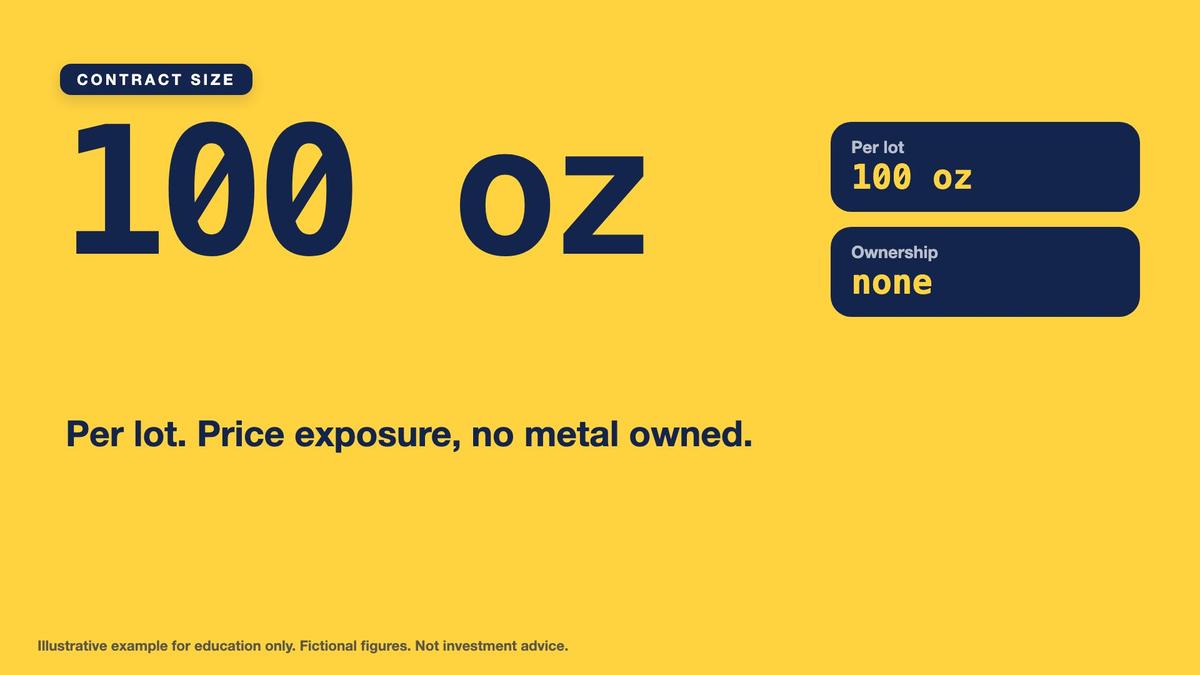
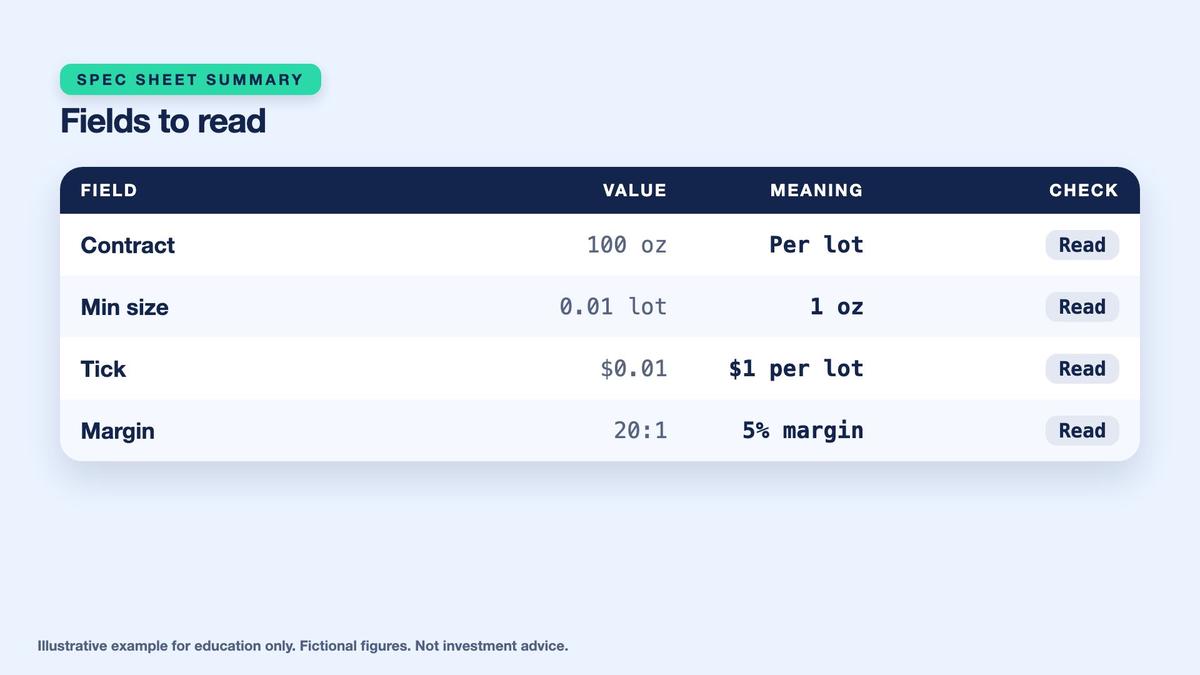
Read the quantity fields first. One standard lot represents 100 troy ounces, the minimum trade is 0.01 lot or one ounce, and the allowed lot increment is also 0.01. The price tick is $0.01 per ounce. For a full 100-ounce lot, one tick is worth 100 multiplied by $0.01, or $1.00. The USD account currency avoids additional currency-conversion arithmetic in this particular laboratory. However, the multiplier, tick definition and account currency must be recorded rather than assumed from the instrument name. A different fictional specification could yield a different tick value, notional exposure or minimum permissible risk.

Key points
- Record the spec version date: Sample Broker, 2026-03-02. Specs change, so a calculation is only valid for the version used.
- Contract size 100 oz per lot; minimum 0.01 lot (1 oz); lot step 0.01; tick $0.01 = $1.00 per lot.
- Leverage 20:1, commission $5 per lot per side, long swap $20 per lot per night, stop-out at 50% of used margin.
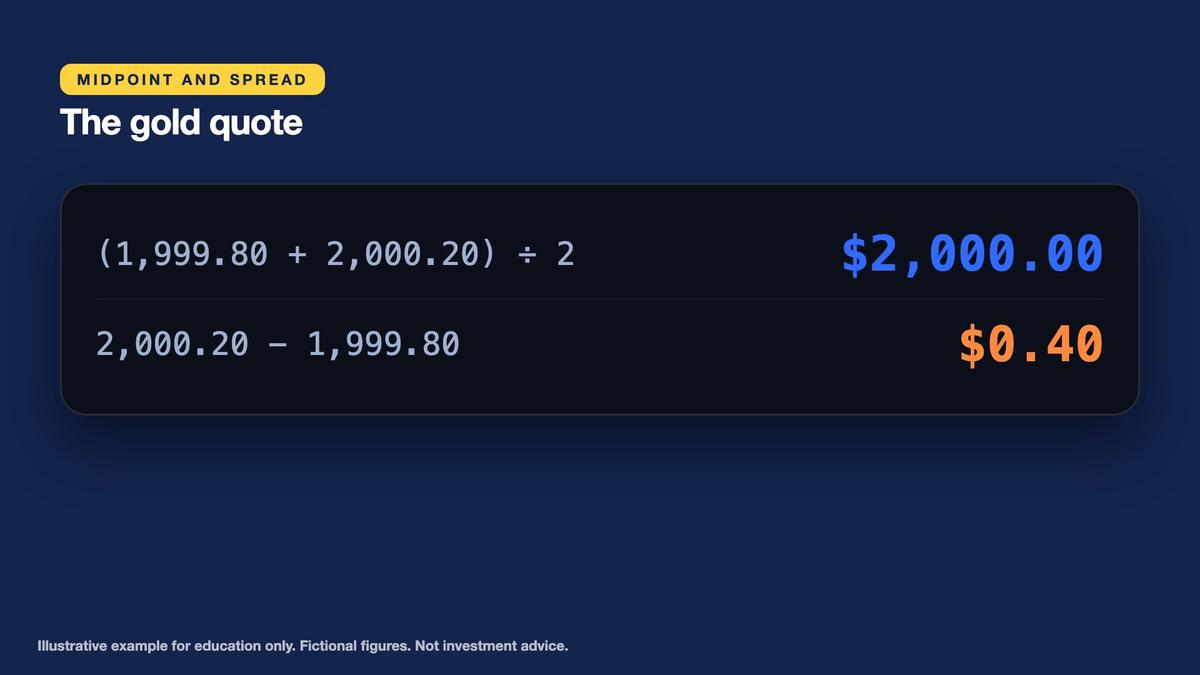
Continue to the cost and margin fields. The fictional leverage is 20:1, with margin calculated from the stipulated $2,000.00 per-ounce reference price. Commission is $5.00 per full lot per side, equivalent to $10.00 per full lot for a completed buy and sell. The long swap is $20.00 per full lot per night. The broker defines stop-out when equity reaches 50% of used margin. Finally, record the fictional quotation: $1,999.80 bid and $2,000.20 ask. Their midpoint is $2,000.00 and their spread is $0.40 per ounce. These fields establish the rules for every subsequent calculation.
Define the Trade Plan and Calculate a Valid Position
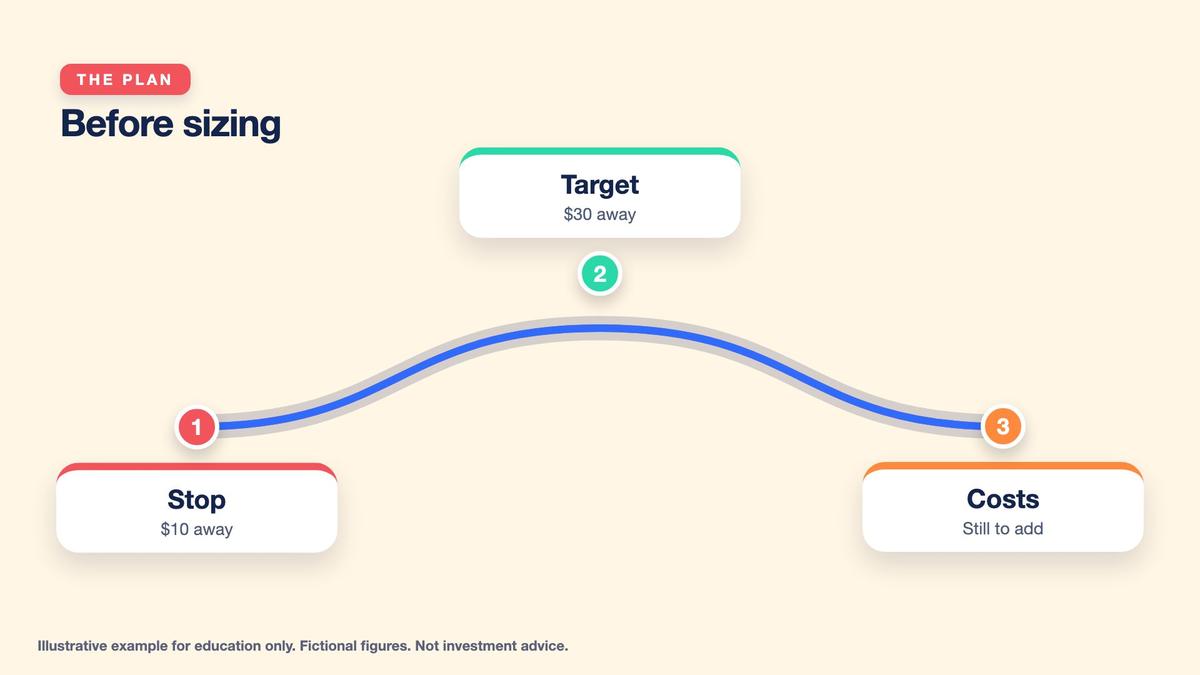
Open a simulated account with $5,000 starting equity. The written risk-per-trade rule permits an initial planned loss no greater than 1% of equity, which equals $50. Record the rule before examining the target or deciding on position size. The fictional long trade enters at the $2,000.20 ask and uses an intended stop exit at the $1,990.20 bid. The adverse distance between executed entry and intended stop exit is exactly $10.00 per ounce. The target exit bid is $2,030.20, producing a favorable $30.00 movement. The planned gross reward-to-price-risk ratio is therefore 30 divided by 10, or 3:1.
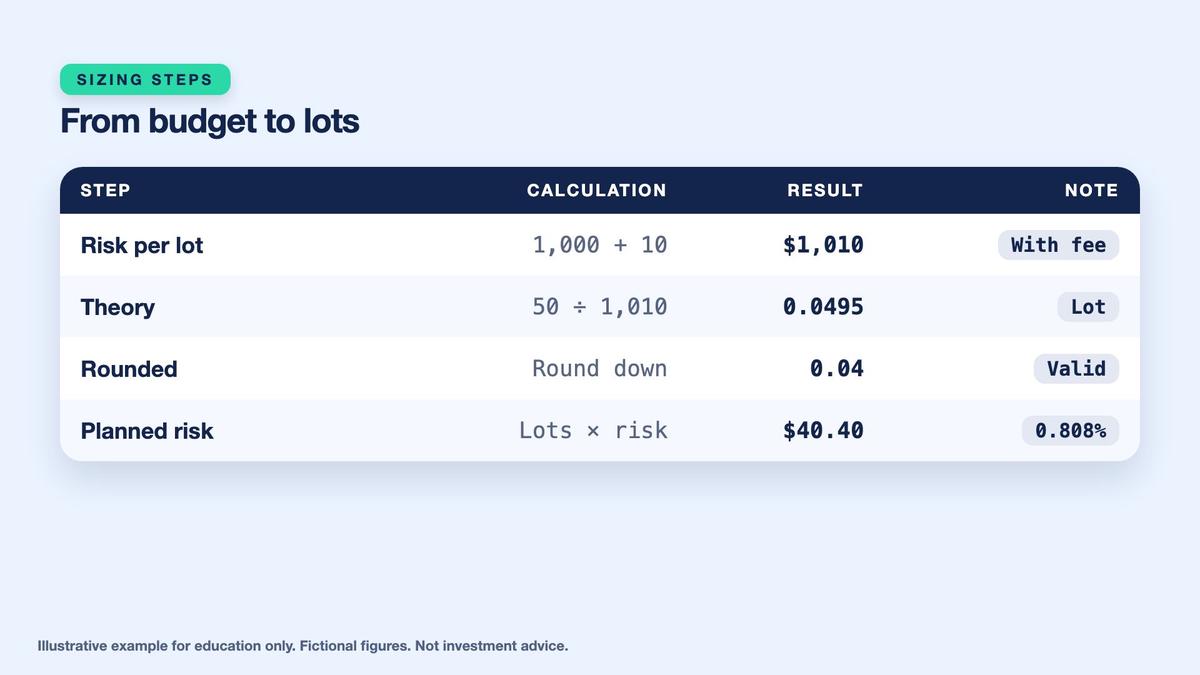
To derive lot size, first calculate the loss for a full standard lot if the stop executes exactly. A $10.00 adverse movement across 100 ounces creates $1,000 of gross price loss. Add the fictional $10 full-lot round-trip commission, producing $1,010 of planned loss per full lot, before financing and slippage. Divide the $50 allowed loss by $1,010. The result is approximately 0.0495049505 lot. That number is not an executable order size under the stated specification because the broker accepts hundredth-lot increments. Rounding up to 0.05 lot would create $50.50 planned risk and breach the $50 budget.
Key points
- Account equity $5,000; 1% risk rule = $50. Long at ask 2,000.20, stop at bid 1,990.20, target at bid 2,030.20.
- Stop loss per lot = $10 x 100 = $1,000; plus $10 commission = $1,010 per lot.
- Size = 50 / 1,010 = 0.0495 lot; round DOWN to 0.04 lot (4 oz); planned risk 0.04 x 1,010 = $40.40 (0.808%).
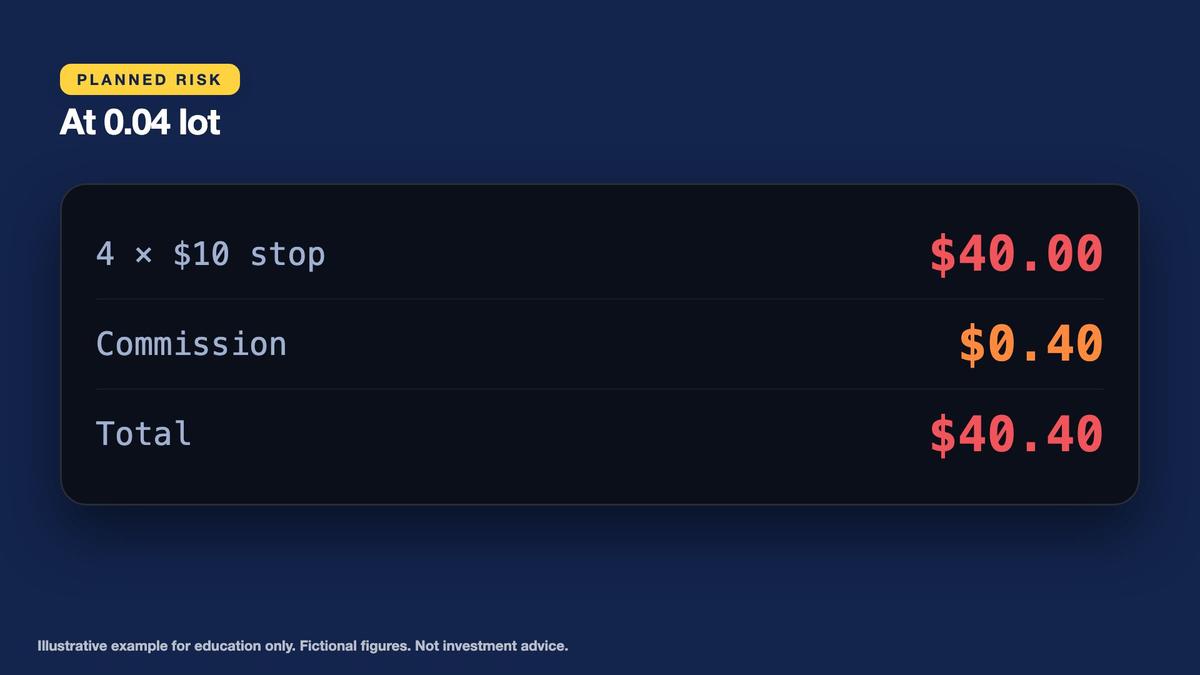
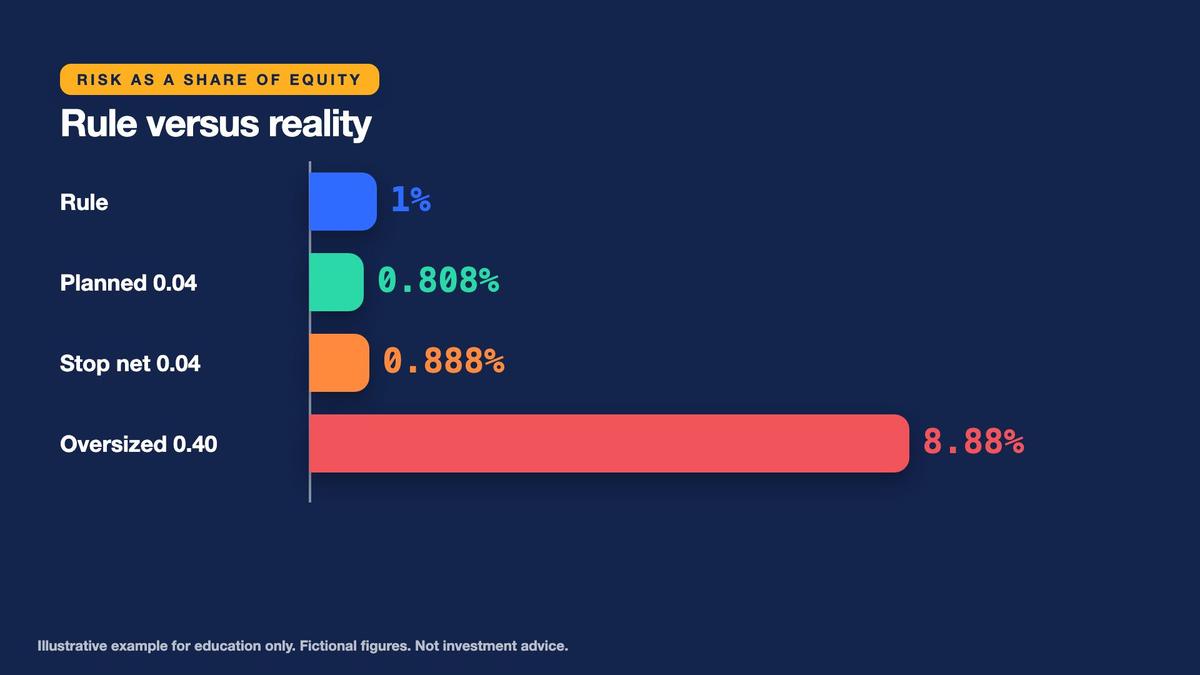
Round down to 0.04 lot, representing four ounces. At that size, the $10 stop distance produces $40 of price loss, and round-trip commission contributes $0.40. Initial planned loss is therefore $40.40, or 0.808% of $5,000 equity. This is below the 1% limit. The calculation deliberately excludes holding-period swap and adverse execution slippage. Those exclusions must be stated in the journal because the final net stop loss may exceed the initial sizing figure. A valid lot step and a stated risk budget are two separate checks: satisfying one does not automatically satisfy the other.
Verify Notional, Margin, Tick Value and Trading Costs
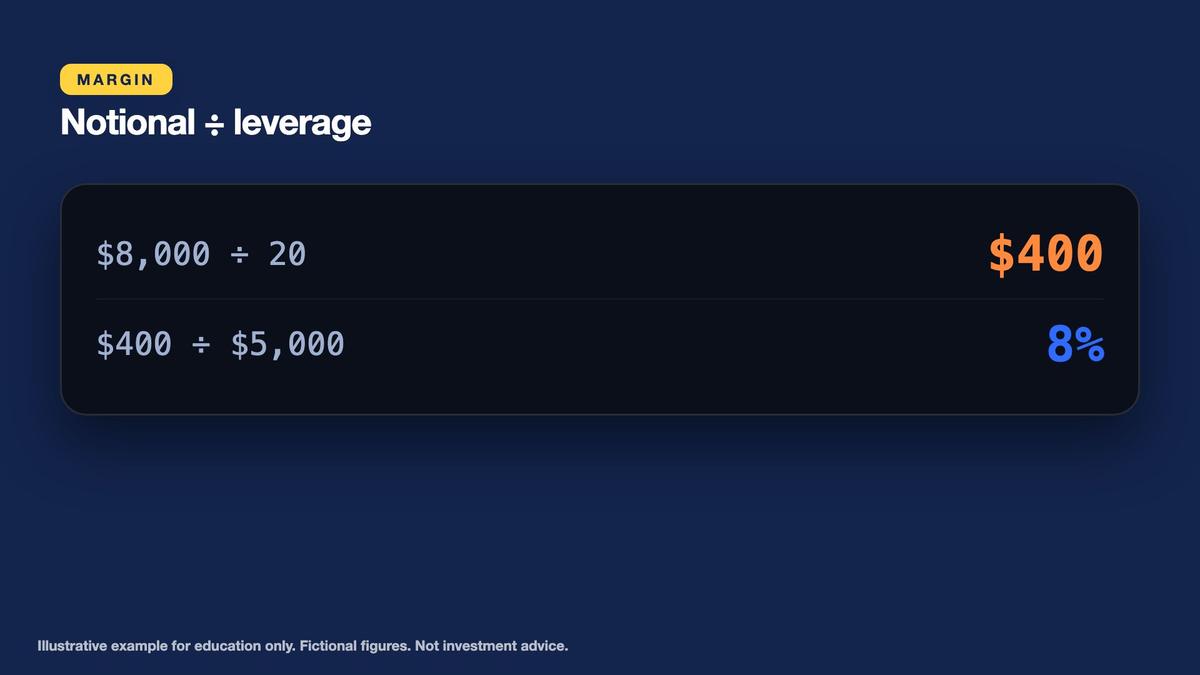
The selected 0.04-lot position represents 0.04 multiplied by 100, or four troy ounces of gold price exposure. At the fictional $2,000.00 margin reference, notional exposure is four multiplied by $2,000, or $8,000. The broker's 20:1 leverage requires margin of $8,000 divided by 20, which is $400. That equals 8% of the $5,000 starting account equity and leaves $4,600 of free margin before trading costs under this simplified setup. The margin is collateral supporting the contract, not a purchase of $8,000 in physical metal. A small margin requirement does not make the economic risk small.
Calculate the tick value using the actual position size. One tick represents $0.01 per ounce, so four ounces change in gross value by $0.04 for each tick. A larger $1.00 movement per ounce changes the position's gross value by $4.00. Check these units carefully: lot size multiplied by contract ounces per lot multiplied by price movement gives dollar profit or loss. This proportional sensitivity will later explain why a $30 target movement produces $120 gross profit and why a $10 stop movement produces $40 gross loss. The calculations assume a linear contract, unchanged quantity and USD profit-and-loss settlement.
Key points
- Notional = 4 x $2,000 = $8,000; margin = 8,000 / 20 = $400 (8.0% of equity).
- One tick = 0.04 x 100 x 0.01 = $0.04; a $1.00 move = $4.00.
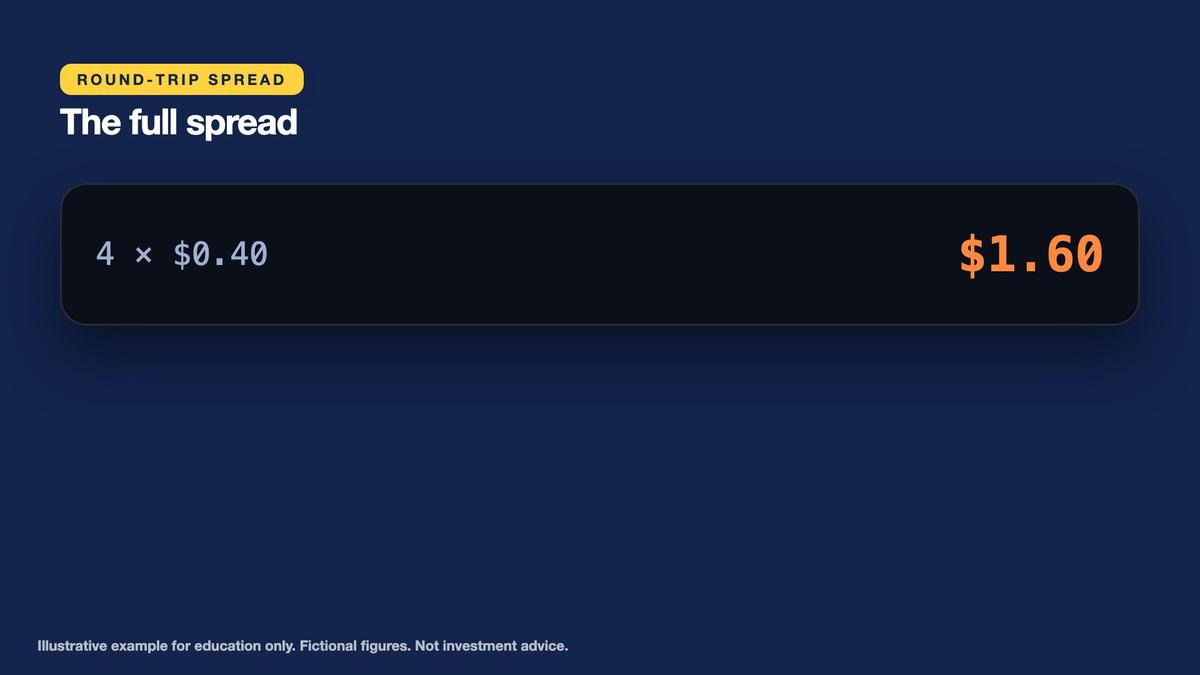
- Spread cost is inside the fills: $0.80 at entry versus the midpoint, $1.60 round trip. Commission $0.40; swap $0.80 a night, $4.00 for five nights.
Now separate execution friction from billed charges. The long enters at the $2,000.20 ask, $0.20 above the $2,000 midpoint, creating $0.80 of midpoint-referenced entry friction across four ounces. A complete $0.40 bid-ask spread corresponds to $1.60 across four ounces. This is not a separate commission: it is already included in gross P&L when the calculation uses the entry ask and exit bid. Commission is separately charged at 0.04 multiplied by $10 round trip, or $0.40. Long financing is 0.04 multiplied by $20, or $0.80 per night. Across five nights, financing totals $4.00.
Scenario A: Target Hit After Five Nights
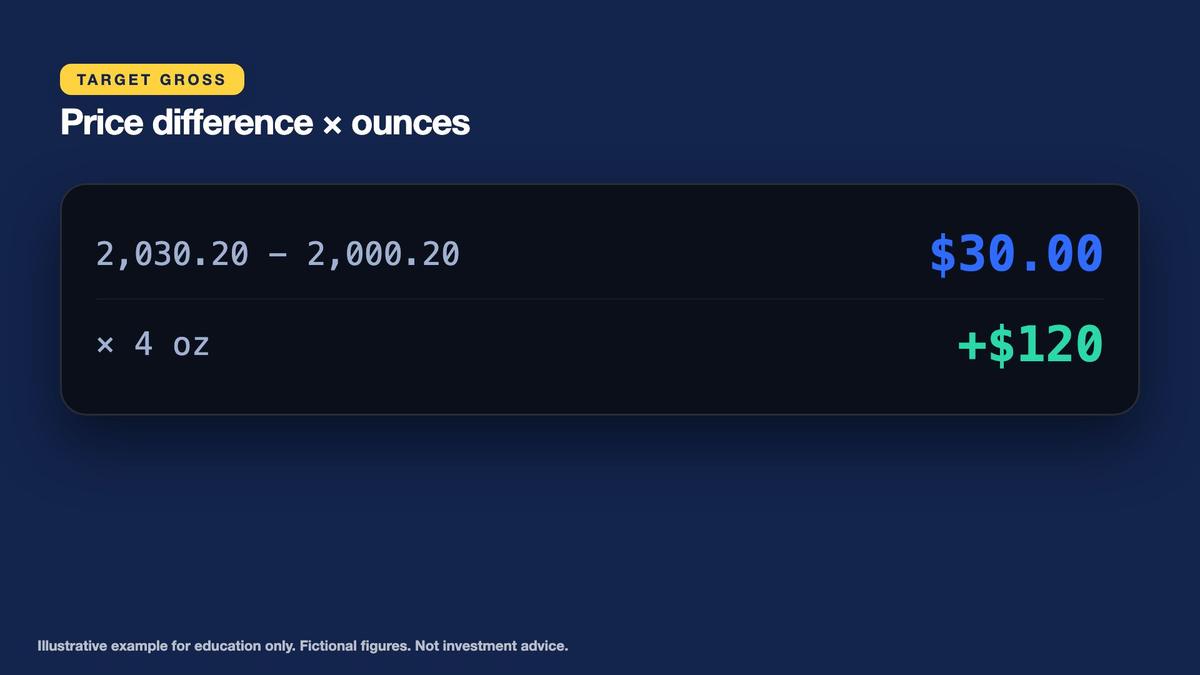
Scenario A assumes the fictional long position enters at the $2,000.20 ask and closes after five nights at the planned $2,030.20 target bid. This is an invented complete fill, not a prediction or guarantee that a target order will execute. The executable price difference is $30.00 per ounce. With four ounces of exposure, gross trading profit is four multiplied by $30.00, or $120.00. Gross P&L already reflects the stipulated entry and exit quotations, including their execution-side pricing. It does not yet deduct the separately charged broker commission or the overnight financing accumulated during the holding period.
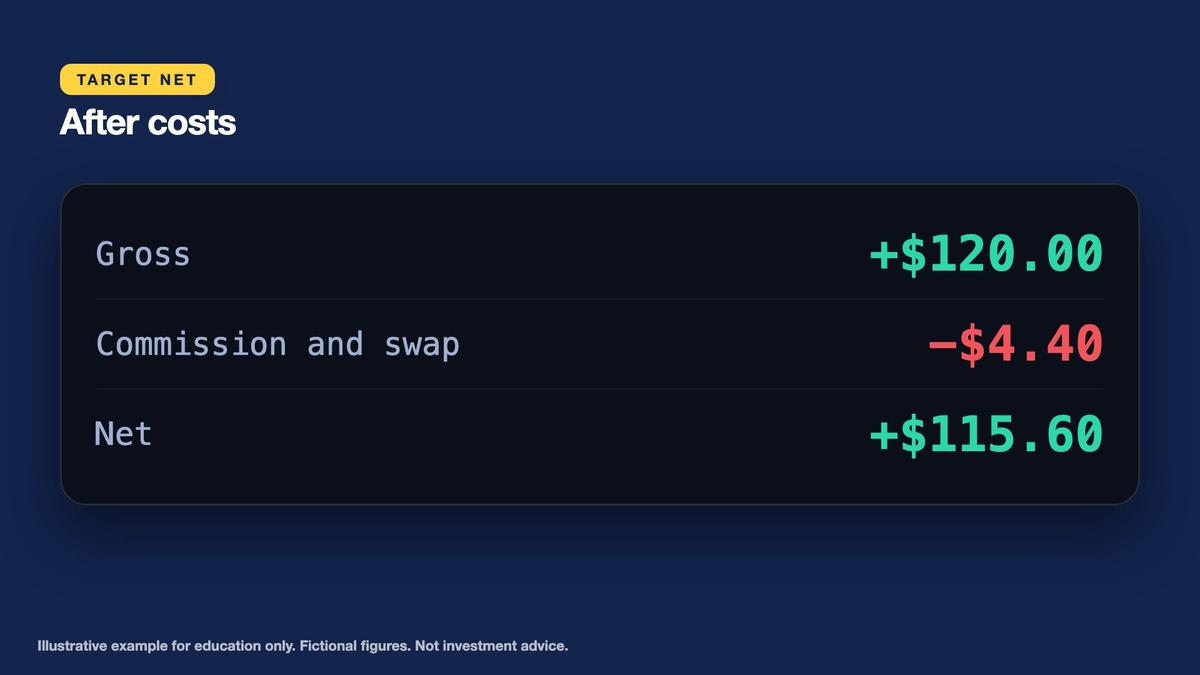
The completed trade incurs $0.40 round-trip commission and $4.00 of five-night long swap. Subtract both amounts once: $120.00 minus $0.40 minus $4.00 equals $115.60 net profit. Relative to the $5,000 starting account equity, this is $115.60 divided by $5,000 multiplied by 100, or positive 2.312%. The gross $120 outcome is not the same as the net $115.60 outcome. Financing reduces the result even though the favorable price movement was unchanged. The journal should retain the exact holding period, commission basis, assumed constant swap rate and executed exit bid.
Key points
- Scenario A, target hit after 5 nights: gross 4 x 30 = $120.00.
- Net = 120.00 - 0.40 - 4.00 = $115.60, which is 2.312% of equity.
- Do not subtract the spread again: gross already uses the ask and the bid.
Compare this result with the original trade plan. The $30 target distance and $10 stop distance suggested a 3:1 gross reward-to-price-risk ratio before financial costs. However, the actual net reward-to-loss ratio requires an exact-stop comparison using the same five-night financing assumption, which the next scenario supplies. Do not describe the trade as risk-free because a target outcome can be calculated. Real price paths, execution gaps, financing changes and broker actions could prevent or alter the result. The educational goal is a transparent transition from hypothetical gross profit to hypothetical net account profit.
Scenarios B and C: Stop Loss, Financing and Slippage
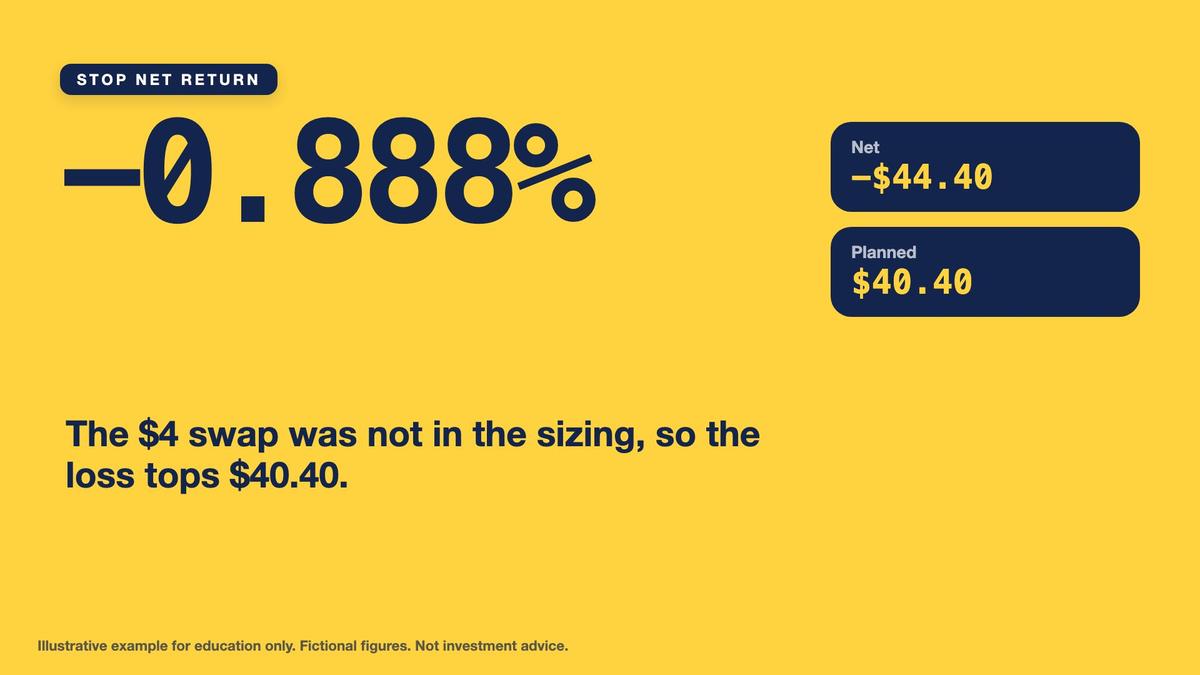
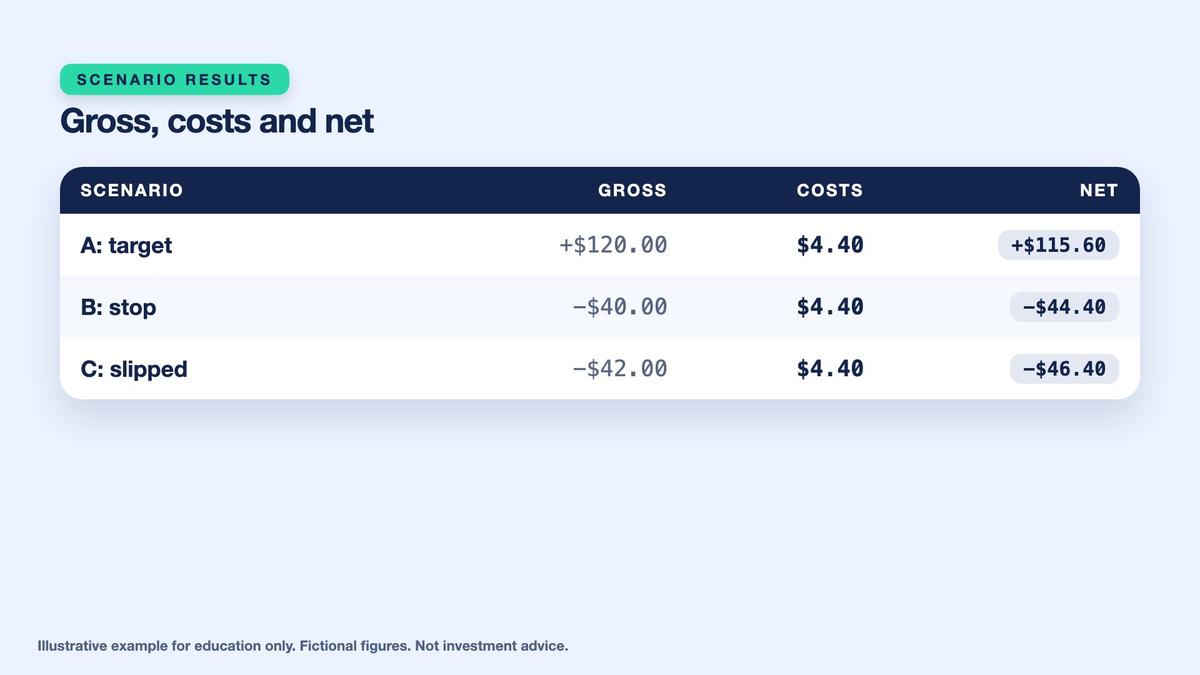
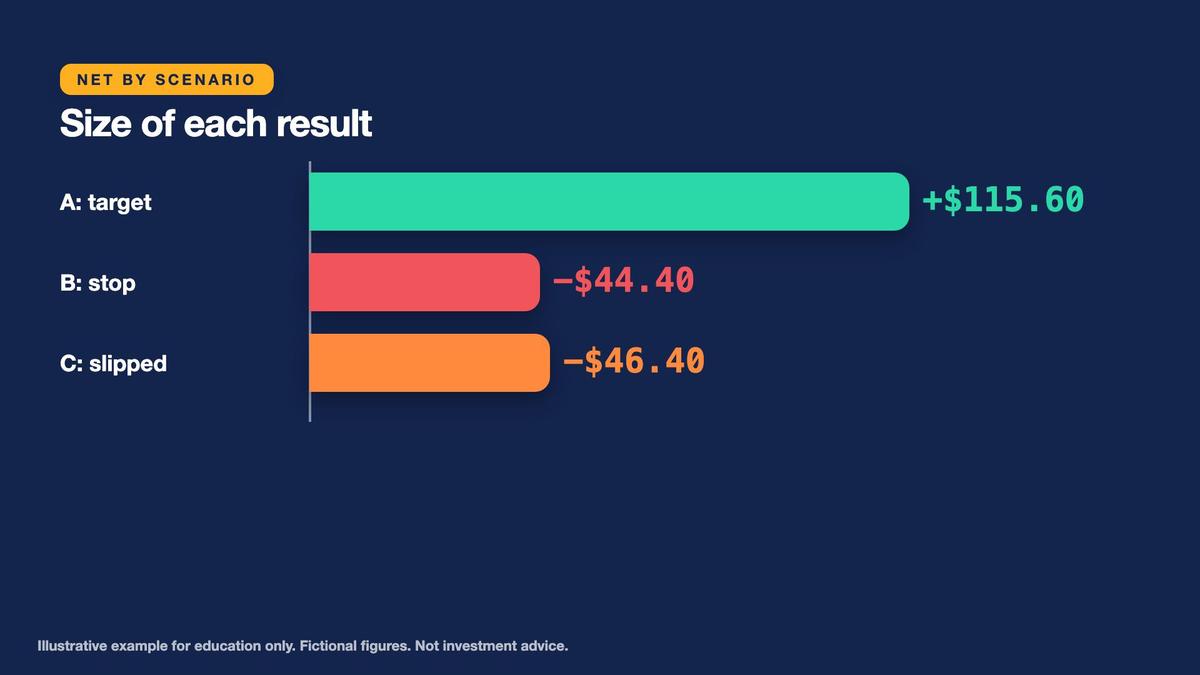
Scenario B assumes the stop executes at the intended $1,990.20 bid after five nights. Relative to the $2,000.20 entry ask, the adverse movement is $10.00 per ounce. Four ounces create a $40.00 gross loss. Subtract the same $0.40 round-trip commission and $4.00 overnight financing, producing a $44.40 net loss. Divide by the original $5,000 equity to obtain negative 0.888%. This exceeds the initial planned loss of $40.40 by exactly $4.00, because the position-sizing calculation included commission but did not reserve for five nights of swap. The final net loss remains below the invented $50 budget under this exact-fill scenario.
Scenario C assumes the intended stop was $1,990.20, but the actual exit fills $0.50 lower at $1,989.70. The adverse price difference from the entry is now $10.50 per ounce. Across four ounces, gross loss becomes $42.00. Deducting $0.40 commission and $4.00 swap yields $46.40 net loss, or negative 0.928% of starting equity. The extra $0.50 slippage across four ounces adds $2.00 compared with scenario B. Stop orders can execute at a different price from the planned level, particularly when markets gap, liquidity becomes thin or broker execution conditions change.
Key points
- Scenario B, stop hit: gross -$40.00; net -$44.40 (-0.888%), more than the planned $40.40 because swap was not in the sizing.
- Scenario C, $0.50 slippage (fill 1,989.70): gross -$42.00; net -$46.40.
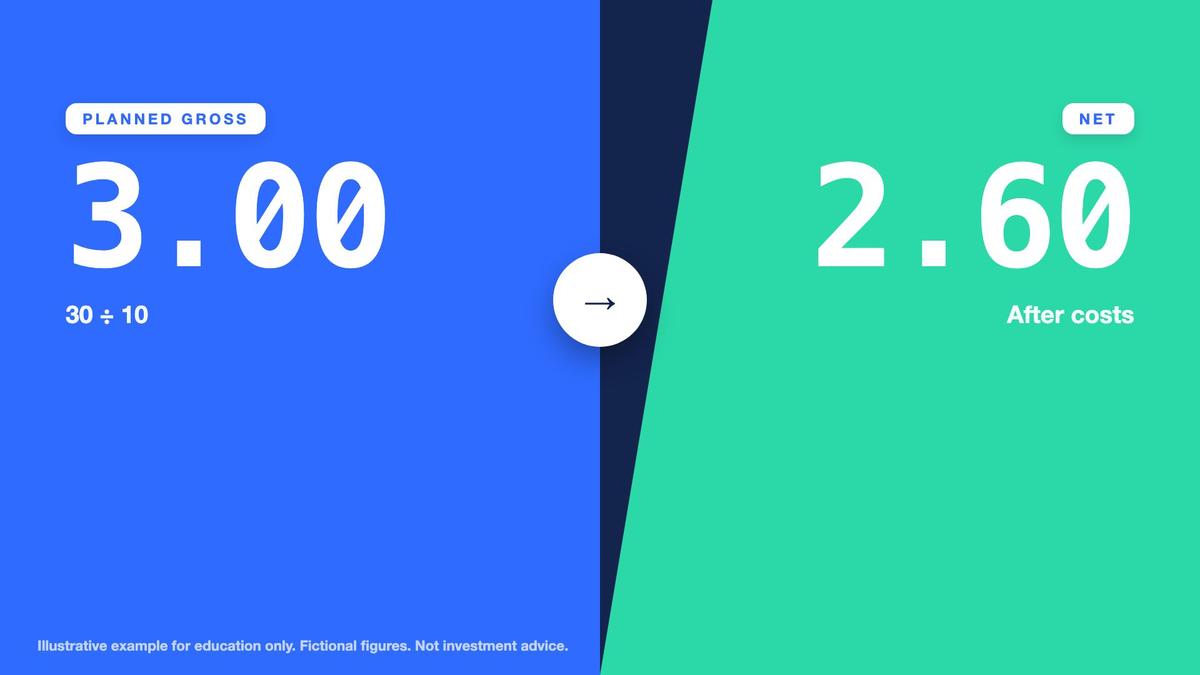
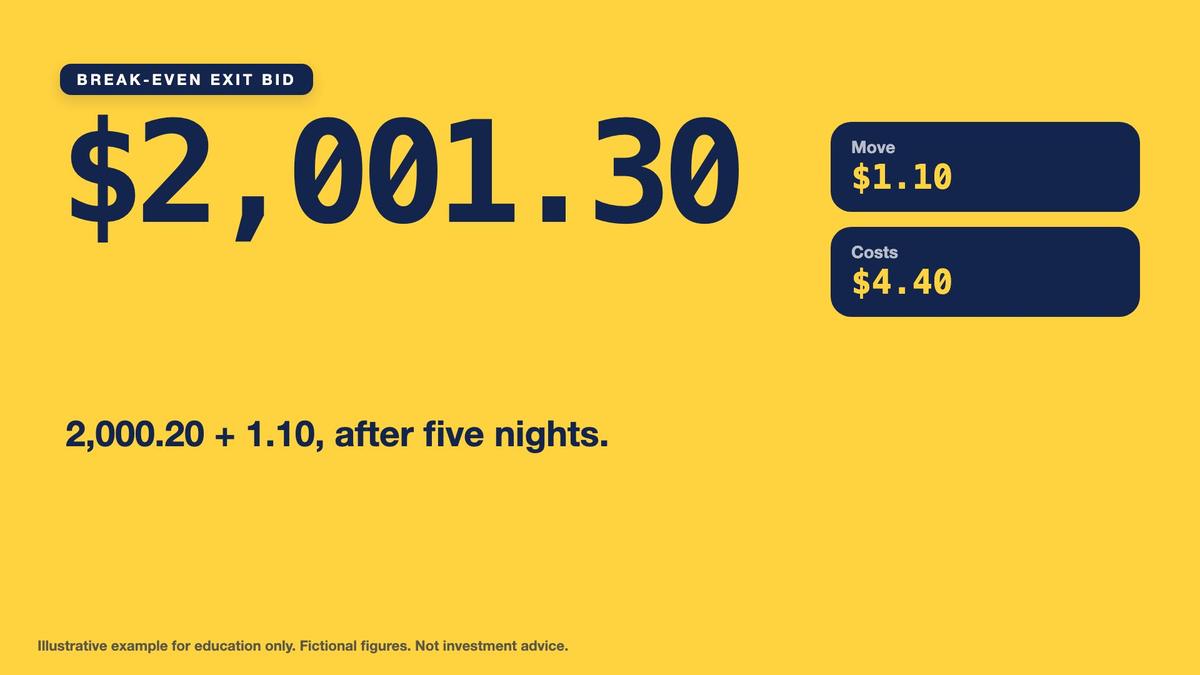
- Net reward to net loss = 115.60 / 44.40 = 2.60, below the planned 3.0 gross; break-even exit bid = 2,000.20 + 4.40 / 4 = $2,001.30.
The net reward-to-net-loss ratio for the exact-stop case compares $115.60 target profit with $44.40 stop loss. Dividing produces approximately 2.6036, displayed as 2.60, lower than the original gross 3.00. Next calculate the fee-adjusted break-even exit after five nights. Commission and swap total $4.40; dividing by four ounces gives a required favorable movement of $1.10 per ounce. Add that to the $2,000.20 entry ask, producing an exact break-even exit bid of $2,001.30 under the stated assumptions. No additional spread charge is deducted because the bid and ask are already embedded in the fill-based gross result.
Scenario D: Oversizing, Margin Utilization and Stop-Out
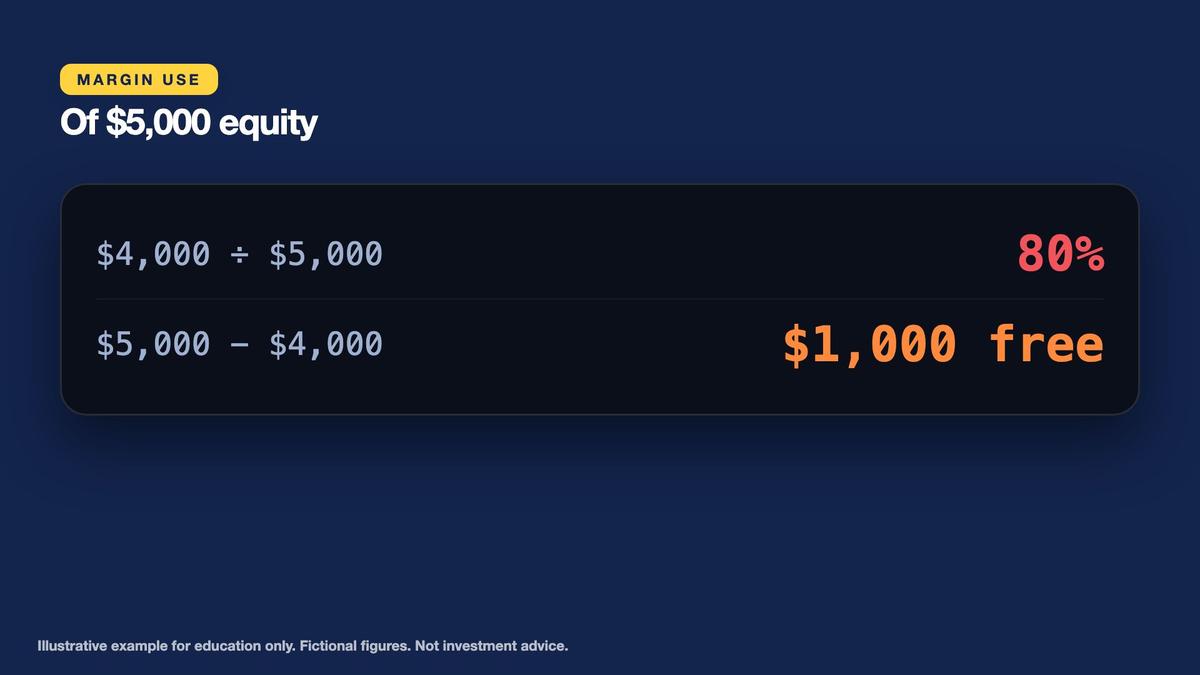
Consider an erroneous position of 0.40 lot instead of 0.04 lot. The oversized trade controls forty troy ounces rather than four. At the fictional $2,000 reference, its notional exposure is $80,000, requiring $4,000 margin at 20:1 leverage. That consumes 80% of the $5,000 account equity and leaves only $1,000 free margin before costs. With the same $10 planned stop distance, forty ounces lose $400 in gross price movement. This is 8% of starting equity, eight times the dollar amount permitted by the 1% risk rule even before adding commission or financing.
The oversized trade also incurs greater proportional costs. Round-trip commission is 0.40 multiplied by $10, or $4.00. Long swap is 0.40 multiplied by $20, or $8.00 each night. After five nights, swap totals $40.00. An exact stop at the original planned level therefore produces negative $400 gross price P&L minus $4 commission minus $40 financing, or negative $444 net P&L. That is negative 8.88% of $5,000 equity. The trade does not become acceptable simply because the account has enough margin to open it. Margin eligibility is not equivalent to compliance with the planned loss budget.
Key points
- Scenario D, 0.40 lot (40 oz): notional $80,000, margin $4,000 (80% of equity), free margin $1,000.
- The $10 stop loses $400 (8% of equity); with $4 commission and $40 swap the net is -$444 (-8.88%).
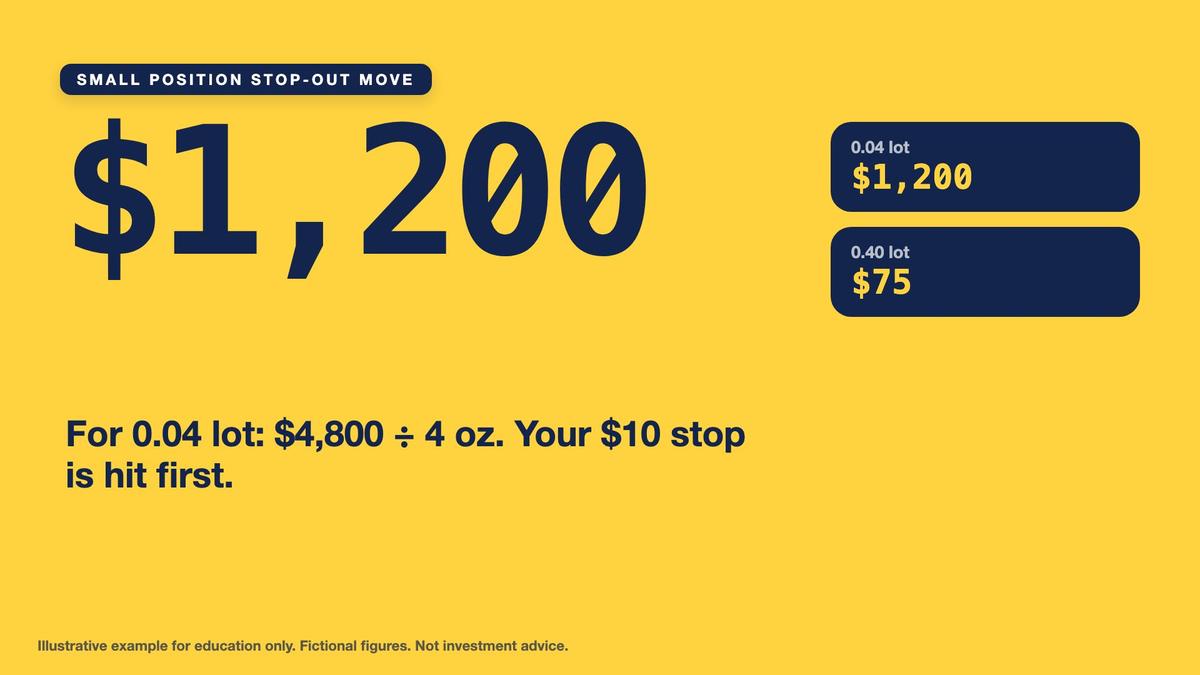
- Stop-out equity $2,000 means a $75 move (about 1,925.20); for 0.04 lot it would need $1,200, so size sets the stop-out distance.
Under the fictional 50% stop-out rule, the oversized position's $4,000 used margin sets a $2,000 equity threshold. Starting from $5,000 equity, a $3,000 loss reaches that threshold. At $40 gross P&L per $1 gold move, the adverse movement is $3,000 divided by forty, or $75 per ounce. From the $2,000.20 entry, the illustrative closing-price boundary is $1,925.20, a 3.75% decline relative to the $2,000 reference. For comparison, the properly sized four-ounce position uses $400 margin, giving a $200 threshold and requiring $4,800 price loss, equivalent to a $1,200 per-ounce decline. These simplified boundaries exclude fees, swap, dynamic margin and slippage and are not guaranteed liquidation prices.
Minimum-Size Trap and the Preflight Checklist
The same broker specification can make an otherwise reasonable risk rule impossible for a smaller account. Suppose the simulated account equity is only $500. Its 1% trade risk budget is $5.00. However, the broker's minimum valid position is 0.01 lot, representing one ounce. The original $10 stop distance creates $10 of price loss at that minimum size. Round-trip commission adds $0.10, making initial planned loss $10.10 before swap and slippage. Relative to $500 equity, that equals 2.02%, more than twice the 1% budget. The minimum lot is executable under the contract rules but fails the learner's stated risk constraint.
The correct classroom response is to skip the stated setup rather than round a theoretical lot below the permitted minimum or silently exceed the loss budget. A different hypothetical plan could be evaluated with a genuinely justified stop distance, appropriate contract specification, or another instrument, but changing the stop solely to force a trade into the account risks undermining the original thesis. The learner should document that no compliant position exists under the current setup. This is an important distinction between the ability to place an order and the ability to place an order within a written policy.
Key points
- On a $500 account the 1% budget is $5, but the minimum 0.01 lot risks 0.01 x 1,010 = $10.10 (2.02%).
- The setup breaks the rule at the minimum size, so skip it or tighten the stop and recalculate.
- Preflight: spec dated, size rounded down, commission and swap added, risk within the rule.
Before marking the laboratory complete, apply a practical preflight checklist. Record the specification date and account currency; verify contract multiplier, minimum lot, lot step, tick value and quote convention; confirm margin reference and stop-out rules; calculate the risk budget; include round-trip commission in sizing; round down to a valid quantity; estimate holding-period financing; and test target, stop and slippage outcomes. Record the risk percentage, used margin and free margin, and compare planned loss against both the written risk rule and severe execution possibilities. These checks are educational and do not guarantee that a real stop or broker will perform as modeled.
Final Lab: Reconcile the Specification and Simulated Trade Log
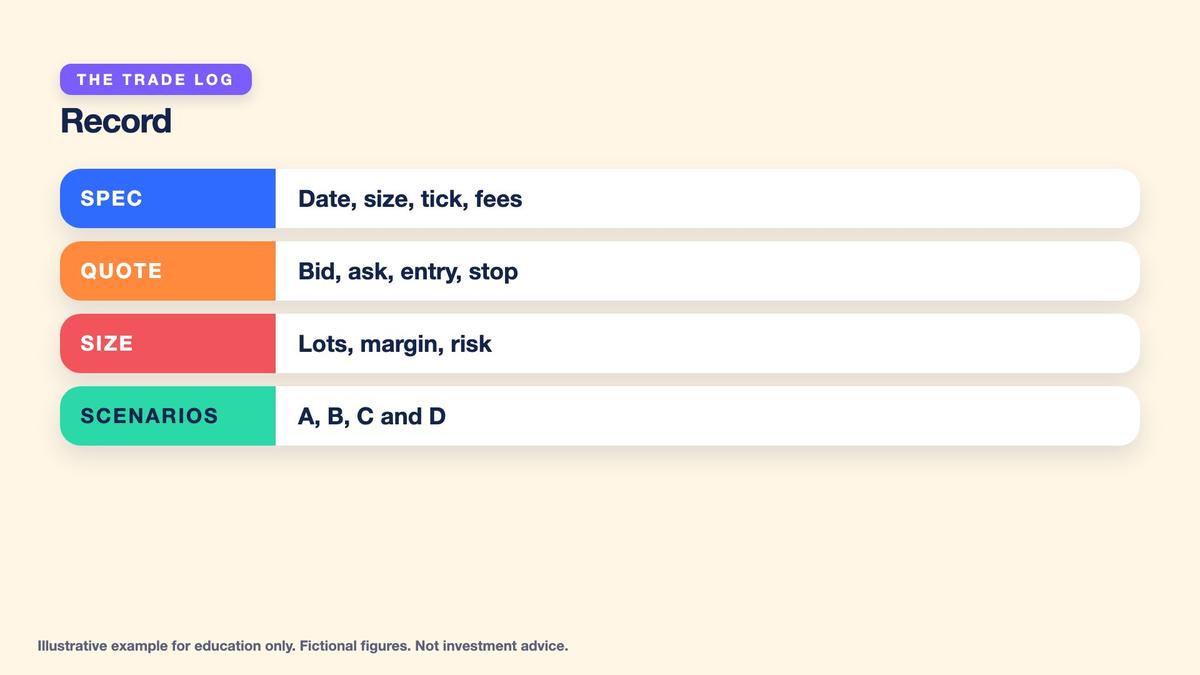
Build a one-page trade log beginning with the fictional Sample Broker specification version dated March 2, 2026. Include USD account currency, 100-ounce lot size, 0.01 minimum and step, $0.01 price tick, $1 tick value per full lot, 20:1 leverage, $5 per lot per-side commission, $20 per lot nightly long swap, and 50% used-margin stop-out. Record the $1,999.80 bid, $2,000.20 ask, $2,000 reference midpoint and $0.40 spread. Then write the $5,000 account equity, 1% risk rule, $50 budget, $2,000.20 entry, $1,990.20 stop and $2,030.20 target. Keep this dated specification separate from any later updates.
Hands-On Lab: Read a Fictional XAUUSD Specification, Size a Trade and Reconcile Costs
Use only the fictional Sample Broker XAUUSD specification dated 2026-03-02 and a simulated USD account. Start by copying the 100-ounce standard lot, 0.01 minimum size and step, $0.01 price tick, 20:1 leverage, $5 per lot per-side commission, $20 per lot nightly long swap and 50% used-margin stop-out rule into a dated worksheet. Use $2,000.00 as the specified margin reference, $1,999.80 bid and $2,000.20 ask. The primary account has $5,000 equity and a written 1% risk budget. Simulate a long entry at the ask, stop at the $1,990.20 bid, and target at the $2,030.20 bid. Size from stop distance plus round-trip commission, round DOWN to the 0.01-lot increment, and calculate position exposure, margin and tick value. Evaluate target, exact-stop and slipped-stop exits after five nights, deducting commission and swap exactly once. Compare an oversized 0.40-lot trade and a separate $500-account minimum-lot case. Preserve full calculation precision and record all assumptions. Never use an actual broker, order, price feed or financial asset.
- Decision 1: The fictional Sample Broker specification dated 2026-03-02 defines 100 ounces per lot, minimum and step 0.01 lot, price tick $0.01, commission $5 per lot per side, and account currency USD. — Calculate tick value per full lot, minimum position ounces, and round-trip commission per full lot; identify which specification fields must be recorded before trading calculations.
- Decision 2: The primary account contains $5,000 equity. A long enters at $2,000.20 with an intended stop exit at $1,990.20. Risk budget is 1% of equity and commission is $10 round trip per full lot. — Calculate theoretical lot size, valid rounded-down lot size, planned dollar risk, risk percentage, underlying ounces, reference notional and margin.
- Decision 3: A correctly sized 0.04-lot long enters at $2,000.20 and has a target at $2,030.20 and stop at $1,990.20. Each scenario closes after five nights at $0.80 swap per night, with $0.40 total commission. — Calculate gross and net P&L at the target and exact stop, compare net reward to net loss, and find the five-night break-even exit bid.
- Decision 4: The intended stop bid is $1,990.20, but one simulation slips to $1,989.70. Separately, an oversized 0.40-lot position uses the same entry, stop and five-night holding period. — Calculate net P&L for the slipped 0.04-lot stop and the oversized exact stop, then determine the oversized position's used margin, free margin and stop-out boundary.
- Decision 5: A separate $500 simulated account uses the same one-percent risk rule, $10 stop distance, $10 full-lot round-trip commission and minimum broker size of 0.01 lot. — Calculate the minimum permissible trade's planned loss, express it as a percentage of equity, and decide whether the existing plan qualifies under the rule.
Answer key
Verify that the initial risk per full lot is $1,010 including commission, yielding approximately 0.04950495 theoretical lot and a permissible rounded-down 0.04 lot. Confirm four ounces, $40.40 planned risk, 0.808% planned equity risk, $8,000 notional, $400 margin, $0.04 tick value and $4 sensitivity per $1 gold price movement. Reconcile the three five-night outcomes separately: target gross +$120 and net +$115.60; exact-stop gross -$40 and net -$44.40; slipped-stop gross -$42 and net -$46.40. Record that the spread is already included in fill-based P&L and that commission and swap are separate deductions.
Key points
- Log the spec date, quote, entry, stop, target, quantity, tick value, margin, commission and swap.
- Reconcile: $1,010 per lot, 0.0495 lot, 0.04 lot, $40.40, $400, $115.60, -$44.40, -$46.40, 2.60 and $2,001.30.
- Keep slippage as its own line and never count the spread twice.
Finish with the 2.60 net reward-to-loss ratio, $2,001.30 break-even exit bid, and the oversized 0.40-lot warning: $80,000 notional, $4,000 margin, $444 net stop loss and approximate $1,925.20 margin stop-out boundary. Add the $500-account minimum-size trap, where the smallest permissible 0.01 lot produces $10.10 initial planned risk versus a $5 budget. The journal conclusion should explain how the dated specification determines quantity, execution sensitivity, cost and margin risk. This lesson builds on the earlier gold exposure map, risk-per-trade rule, order execution lab and margin-and-leverage lessons. Every trade remains fictional, and no live broker interaction or real-money trading is required.
Worked example at a glance
Key terms
- Contract size: the quantity of gold one lot represents, here 100 oz.
- Lot step: the smallest allowed change in position size, here 0.01 lot.
- Tick value: the profit or loss for one price tick at your position size.
- Margin: collateral that supports a leveraged position; here notional divided by 20.
- Commission: a fee charged per lot on each side of a trade.
- Swap: the overnight financing charge on a held position.
- Stop-out: the equity level at which a broker closes positions.
- Slippage: the difference between the intended and the actual fill price.
- Break-even: the exit price where net P&L is zero after all costs.
- Risk budget: the most you allow one trade to lose, here 1% of equity.
- Spec sheet: the contract specification, with a version date.
- Net reward to net loss: target net profit divided by stop net loss, here 2.60.
Multi Asset Trading Lab provides educational information only and does not constitute personalized investment, trading, financial, accounting, tax, legal, brokerage, commodities or risk-management advice. The Sample Broker XAUUSD contract specification dated March 2, 2026, is an entirely fictional classroom document; it is not a real provider's terms, an official contract specification, or a representation of actual gold market conditions on that date. All quotations, prices, lot sizes, trading rules, commission rates, financing charges, leverage limits, account balances, execution fills, stop-out levels, scenarios, profits and losses in this lesson are invented. No real broker, account, ticker, market price, financial product or trading venue is identified or recommended. XAUUSD is used only as a conventional description of gold quoted in US dollars per troy ounce, while the specific example represents a fictional CFD-style contractual instrument and does not convey ownership of physical gold. Every calculation and exercise uses simulated money and paper or isolated mock trading records. No live brokerage connection, transaction, leveraged position, margin borrowing, real-money activity or actual order is required or encouraged. The fictional specification defines a full lot as 100 troy ounces, minimum size as 0.01 lot, lot step as 0.01 lot, price tick as $0.01 per ounce, full-lot tick value as $1.00, leverage as 20:1, account currency as USD, commission as $5.00 per lot per side, long overnight swap as $20.00 per lot per night, and stop-out at 50% of used margin. These values are not universal and can differ substantially among actual brokers and instruments. A valid risk calculation must use the applicable provider's current official specification, account conditions, contract multiplier, minimum quantity, tick value, leverage rules, stop-out policy, margin reference, trading hours, commission currency and financing schedule. The dated classroom specification must not be used for live trading decisions. The fictional quote is $1,999.80 bid and $2,000.20 ask, with midpoint $2,000.00 and spread $0.40 per ounce. The simulated account has $5,000 starting equity and a written one-percent planned loss budget of $50. The hypothetical long enters at the $2,000.20 ask, places an intended stop exit at the $1,990.20 bid, and records a target exit at the $2,030.20 bid. These entry, stop and target levels are pedagogical inputs, not trading recommendations, signals or predicted price movements. The stop distance is $10 per ounce and target distance is $30 per ounce, yielding a planned gross reward-to-price-risk ratio of 3:1 before costs. For a full 100-ounce lot, the stop-price difference creates $1,000 gross loss. Adding $10 round-trip commission produces $1,010 initial planned risk per full lot, excluding overnight financing and slippage. Dividing the $50 budget by $1,010 produces approximately 0.0495049505 lot, which must be rounded DOWN to 0.04 lot under the fictional broker's 0.01-lot increment. Rounding to 0.05 lot would create $50.50 commission-inclusive planned loss and breach the written budget. The selected 0.04-lot position represents four ounces and has $40.00 stop-price loss plus $0.40 round-trip commission, or $40.40 initial planned risk equal to 0.808% of the $5,000 starting equity. This planned risk does not include financing, exit slippage, gaps, broker adjustments or extraordinary losses and therefore is not a guaranteed realized-loss ceiling. The position's reference notional is $8,000 at the fictional $2,000 margin reference, and used margin is $400 at 20:1 leverage, representing 8% of starting equity. Each $0.01 tick changes the position's gross P&L by $0.04, and each $1.00 gold price movement changes gross P&L by $4.00. Margin is collateral supporting larger contractual exposure, not a purchase payment for physical gold, a statement of maximum loss, or assurance that the account can withstand all adverse price movements. The fictional contract's $0.40 quoted spread amounts to $1.60 across four ounces for an illustrative complete round trip. The entry ask lies $0.20 above the midpoint, giving $0.80 midpoint-referenced entry friction. The round-trip spread is already incorporated when gross profit and loss are calculated from the stipulated executed entry ask and exit bid. It must not be subtracted again as a separately billed fee. Explicit round-trip commission is $0.40 for 0.04 lot. Long swap is assumed constant at $0.80 per night for that position and equals $4.00 over five nights. Real overnight swap can change, may include special calendar adjustments, may vary with position direction and broker policy, and may be charged or credited in different currencies or amounts. The five-night scenarios assume the position remains unchanged, the specified commissions and swap apply, and no other fees, taxes or conversion costs occur. Scenario A assumes a complete target fill at $2,030.20 after five nights, yielding $120.00 gross profit and $115.60 net profit after $0.40 commission and $4.00 swap, or 2.312% of original equity. Scenario B assumes a complete exact-stop fill at $1,990.20 after five nights, yielding a $40.00 gross loss and $44.40 net loss after the same charges, or 0.888% of starting equity. That net loss is $4.00 greater than the initial $40.40 planned loss because swap was excluded from sizing. Scenario C assumes adverse stop slippage of $0.50 per ounce, moving the execution bid to $1,989.70, causing $42.00 gross loss and $46.40 net loss after commission and swap, or 0.928% of equity. A stop-loss instruction is not a guarantee that the broker will fill at the requested price. Actual gaps, poor liquidity, volatility, platform disruptions, delayed execution, wider spreads, insufficient available counterparties or changed contract rules can cause materially worse fills or losses larger than the illustrated risk budget. The ratio of net target profit to exact-stop net loss is $115.60 divided by $44.40, approximately 2.60, lower than the planned 3.00 gross ratio. The five-night fee-adjusted break-even bid is $2,001.30, calculated by adding $4.40 total commission and swap divided by four ounces, or $1.10, to the $2,000.20 executed entry ask. This is a mathematical break-even under fictional fixed costs and not a forecast or promise of execution. The oversized scenario uses 0.40 lot, equivalent to forty ounces. Reference notional is $80,000, margin is $4,000, margin utilization is 80% of starting equity, and free margin before costs is $1,000. The original $10 stop distance creates $400 gross price loss, equal to 8% of the $5,000 account and eight times the original $50 risk budget in dollar terms. Round-trip commission is $4.00 and five-night swap is $40.00, increasing the modeled exact-stop net loss to $444.00, or 8.88% of original equity. A broker allowing an order to open because margin is available does not establish that the order complies with a separate planned-loss budget. For the oversized position, the fictional stop-out equity boundary is 50% of $4,000 used margin, or $2,000. From $5,000 starting equity, a $3,000 modeled loss reaches that boundary. With forty ounces of exposure, this corresponds to a $75 per-ounce adverse move and an illustrative closing-price boundary of $1,925.20 from the $2,000.20 entry ask, equivalent to a 3.75% decline relative to the $2,000 reference. The properly sized four-ounce position has $400 used margin, giving a $200 stop-out equity threshold. A $4,800 loss would be needed to reach that simplified threshold, corresponding to a $1,200 adverse move per ounce and a mathematical price boundary of $800.20. These boundary calculations ignore changing margin requirements, actual broker mark prices, spread widening, financing, commission, partial liquidation, other positions, account liabilities, slippage, gap risk and platform-specific rules. They are not guaranteed liquidation prices or maximum-loss estimates. Actual forced position closure can happen earlier or at worse prices, and financial obligations or losses may exceed a simplified collateral estimate under some circumstances. The separate small-account illustration assumes $500 starting equity and the same one-percent risk policy, giving a $5 permitted initial planned loss. The broker's minimum valid size of 0.01 lot already loses $10 from a $10 stop-price movement and incurs $0.10 round-trip commission, totaling $10.10 initial planned risk or 2.02% of account equity, excluding financing and slippage. The specified trade therefore cannot satisfy the written rule at the broker's minimum quantity. The educational decision is to skip the setup unless a genuinely justified alternative meets all constraints. Tightening a stop solely to force an unsuitable trade into a small account can invalidate the trade thesis and does not eliminate execution or gap risk. Throughout the lab, the dated trade log should preserve specification inputs, quote values, intended and actual exits, position size, reference notional, margin, tick value, spread, commission, swap, slippage, gross P&L, net P&L, equity denominators, review notes and any reasons to reject the setup. The previous gold exposure map, risk-per-trade rule, order-type and fee labs, and margin-and-leverage lessons are educational foundations rather than guarantees of capital preservation or reliable execution. No hypothetical gain, stop-loss calculation, margin threshold, cost estimate, reward-to-risk ratio or simulated journal result predicts future gold prices or real trading performance. This lesson teaches how to read a dated specification and reconcile a simulated contract's risk and costs; it does not recommend using leverage, trading XAUUSD, opening a broker account, selecting a contract size, or undertaking any real financial transaction.
Lesson Checkpoint
Review what you learned and get feedback on your work.