



In this twelve-minute beginner lesson, learners prepare a one-page investment research memo for the entirely fictional Capped Coin using a $20,000 simulated portfolio. They distinguish verified facts from assumptions and opinions, summarize token supply and demand, identify failure conditions, calculate three hypothetical return scenarios, and compare expected returns under two invented probability sets. Learners apply a predefined inclusion rule requiring positive conservative expected return, a stress-case loss within a 1% portfolio risk budget, and a documented custody and recovery plan. They calculate a $250 risk-constrained position, compare it with a $1,000 crypto allocation cap, and establish measurable review triggers. The worked memo demonstrates why optimistic assumptions can support a conditional inclusion while conservative assumptions require exclusion or continued observation. The outcome is a dated, reproducible investment memo documenting downside risk, position sizing, evidence quality, custody responsibilities, and an inclusion, exclusion, or watch decision. All values, scenarios, probabilities, prices, and portfolio balances are fictional and educational only; no real trading or price prediction is involved.
Why Write an Investment Memo Before Deciding?
An investment memo is a dated research document explaining why an asset might deserve consideration, what evidence supports that view, what could go wrong, and which conditions would change the conclusion. Writing it before an outcome occurs makes the decision reproducible. Without a memo, investors may remember their initial confidence more favorably after a gain or claim they anticipated a loss only after it happens. The purpose is not to produce a persuasive advertisement for an asset. It is to test a hypothesis against risks, competing explanations, and a written policy. Our single worked example uses fictional Capped Coin in a $20,000 simulated portfolio.



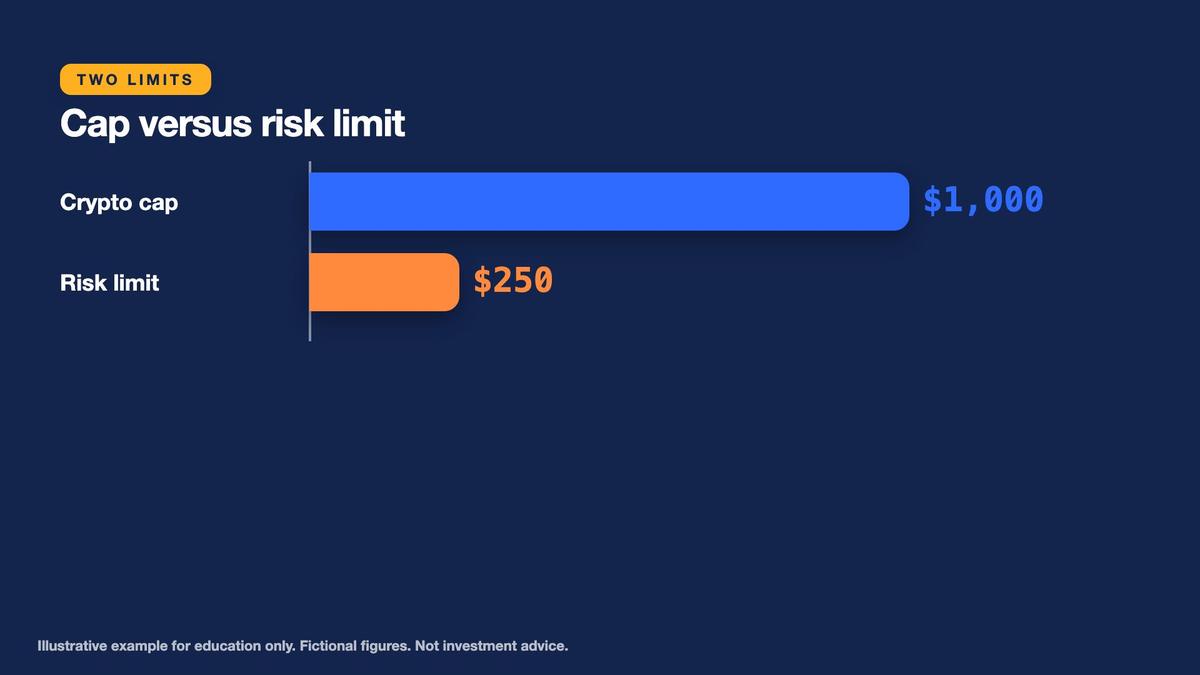
The portfolio's written policy establishes two independent limits. Cryptocurrency exposure cannot exceed 5% of the $20,000 portfolio, creating a $1,000 sleeve cap. Additionally, any individual position must have a modeled stress-case loss no greater than 1% of the portfolio, or $200. The portfolio cap controls the amount allocated, while the risk budget controls the loss under an explicitly severe scenario. These constraints were chosen before studying Capped Coin. They are classroom assumptions, not recommended allocation percentages or appropriate limits for any real investor.
Key points
- A memo is a dated document written before the decision, to test assumptions.
- Policy: crypto sleeve capped at 5% of $20,000 = $1,000; stress loss budget 1% = $200.
- Write the decision rule first: positive conservative expected return, stress loss within budget, custody plan documented.
Before performing the calculations, write the decision rule. The candidate can be included in the simulated portfolio only if three conditions pass: expected return under the conservative probability set must be strictly positive, the chosen position's stress-case loss must fit within the $200 budget, and a custody and recovery plan must be documented. The memo also requires eight completeness items before inclusion. Setting these conditions in advance limits the temptation to relax a failing test simply because the candidate's story sounds appealing. Exclusion and continued observation are valid research outcomes.
Write the Thesis and Separate Facts From Assumptions
The one-sentence thesis for this fictional case is: Capped Coin might attract lasting demand through its predictable issuance schedule, provided network security and adoption remain credible. This is a conditional hypothesis rather than a factual conclusion or a price forecast. The memo should immediately distinguish stipulated facts, assumptions, and opinions. Facts within the invented case include the maximum supply, circulating supply, reference price, and issuance schedule. Assumptions include future demand strength, security resilience, market liquidity, and the probabilities assigned to possible outcomes. Opinions describe the learner's interpretation of that evidence.
Capped Coin has a fictional maximum supply of 21,000,000, with 19,000,000 circulating and 2,000,000 remaining under the stated cap. The hypothetical price is $50 per coin. Multiplying $50 by 19 million gives circulating market capitalization of $950 million. The current-year supply growth assumption from the previous token economics lesson is approximately 2.11%. These quantities describe the teaching case but do not establish whether Capped Coin is attractive. Market capitalization is a price multiplied by circulating units, not a cash reserve or a measure of how much money investors collectively paid into the asset.
Key points
- Thesis in one sentence: predictable issuance may attract demand if security and adoption stay credible.
- Facts: maximum 21,000,000, circulating 19,000,000, price $50, market cap $950 million, supply growth 2.11%.
- Assumptions and opinions are labeled separately from facts.
Demand analysis should consider actual network usage, monetary beliefs, the role of scarcity, available market liquidity, adoption trends, and speculative participation. The strongest failure assumptions include weakening network security, stalled adoption, concentration among holders, restricted exchange access, disruptions to liquidity, and the disappearance of speculative interest. A supply cap can limit future issuance without guaranteeing willing buyers. The memo should also explain what evidence would contradict the thesis. For example, deteriorating network security or persistent declines in verifiable usage could weaken confidence even when the stated supply schedule remains unchanged.
Build Three Scenarios and Calculate Expected Returns
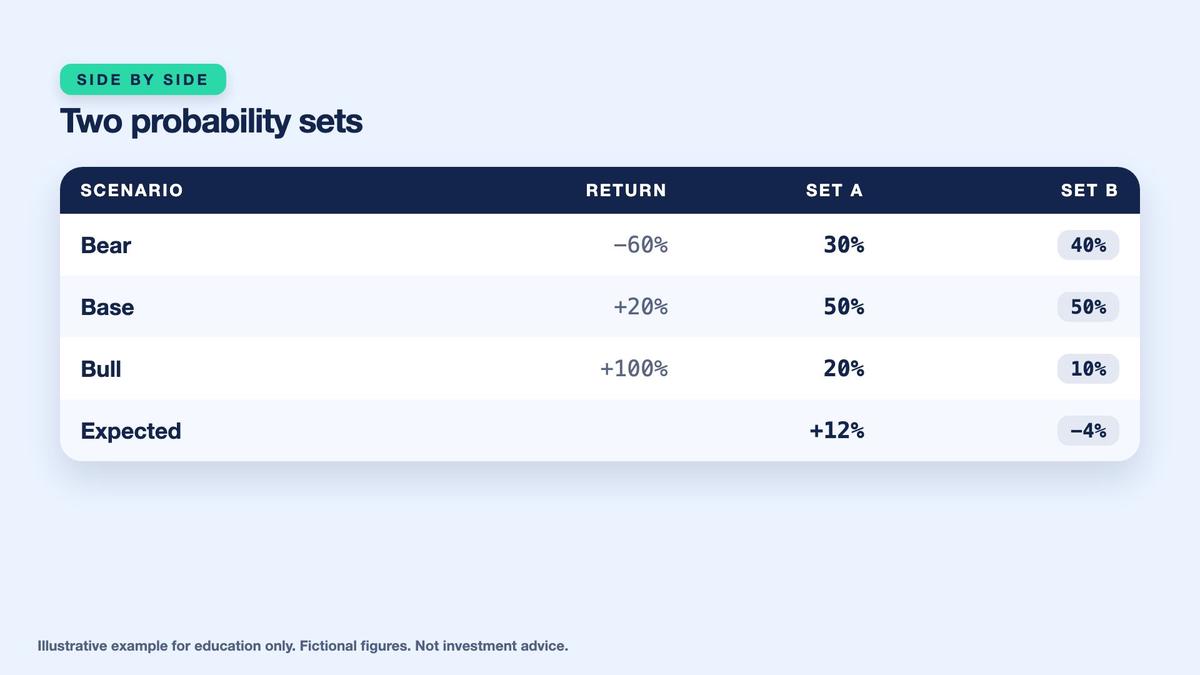
Use three illustrative one-year scenarios for Capped Coin. The bear scenario assumes a negative 60% return, the base scenario assumes a positive 20% return, and the bull scenario assumes a positive 100% return. At the fictional $50 reference price, those returns correspond to hypothetical ending values of $20, $60, and $100 per coin respectively. These are deliberately chosen educational outcomes, not estimated future prices. Scenario analysis does not require believing that any single result will occur. Its value comes from making the consequences of different assumptions visible.

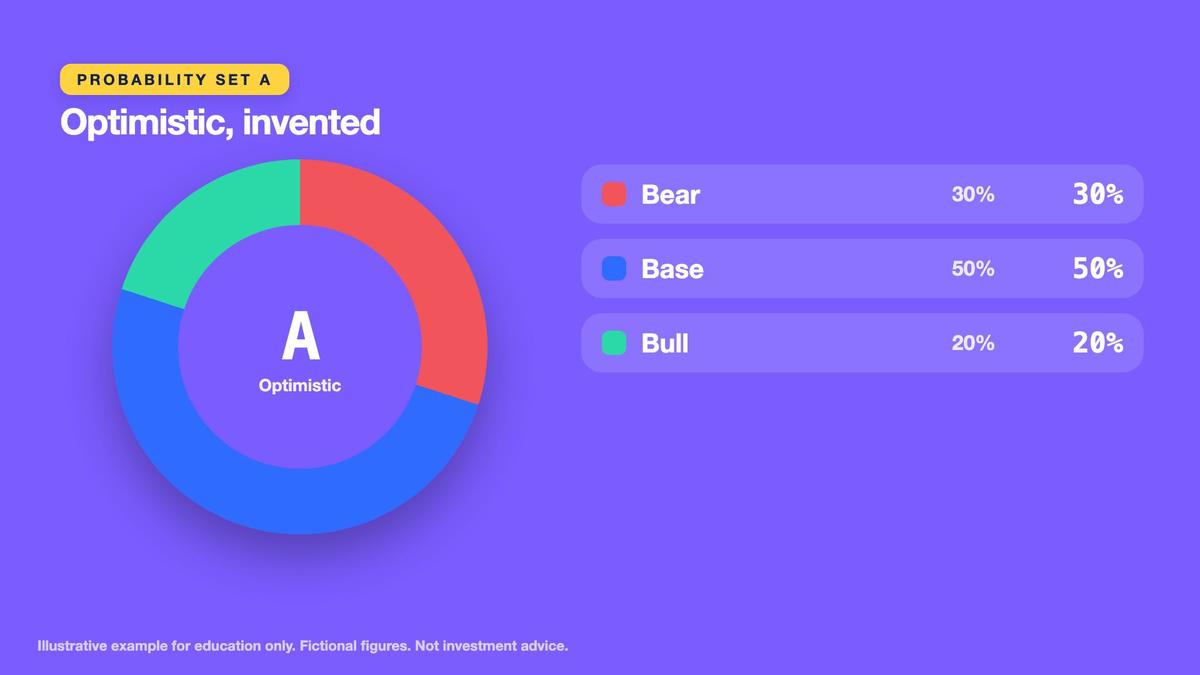
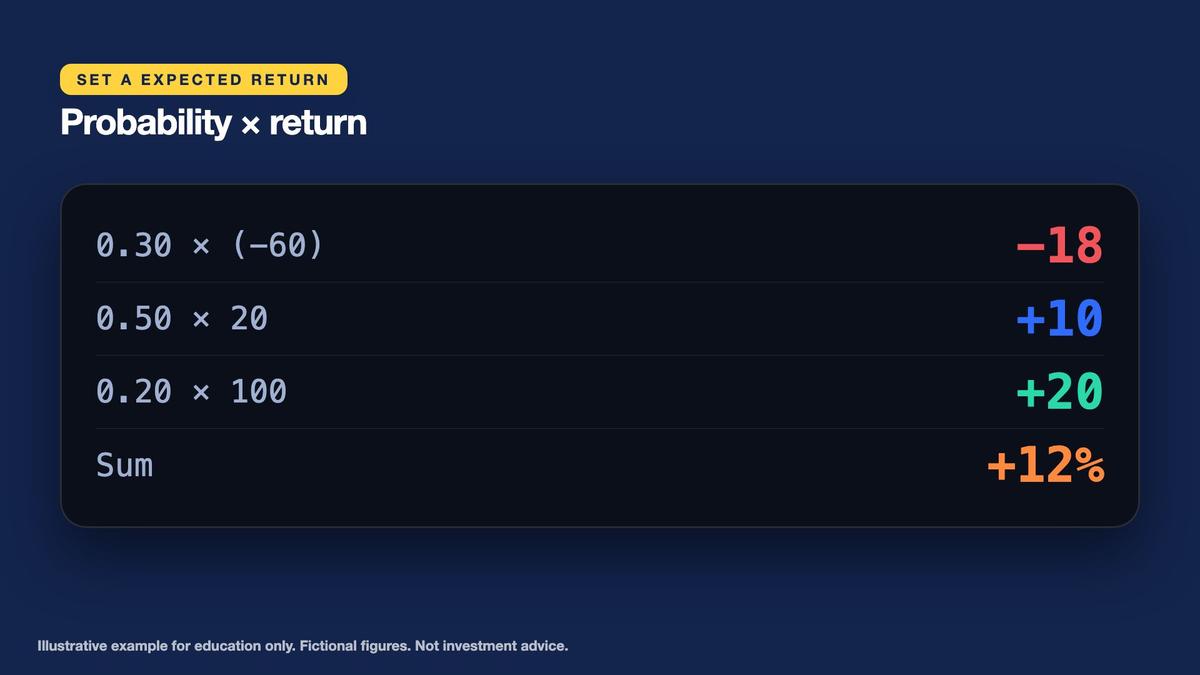
The optimistic probability set A assigns 30% probability to the bear scenario, 50% to the base scenario, and 20% to the bull scenario. The probabilities sum to 100%. Calculate expected return by multiplying each hypothetical return by its assigned probability and adding the contributions. The bear contributes negative 18 percentage points, the base contributes positive 10, and the bull contributes positive 20. Their sum is positive 12%. For a hypothetical $250 position, that corresponds to positive $30 of probability-weighted expected profit before costs. The result depends entirely on the invented probabilities and scenario outcomes.
Key points
- Scenarios: bear -60%, base +20%, bull +100% (illustrative, not forecasts).
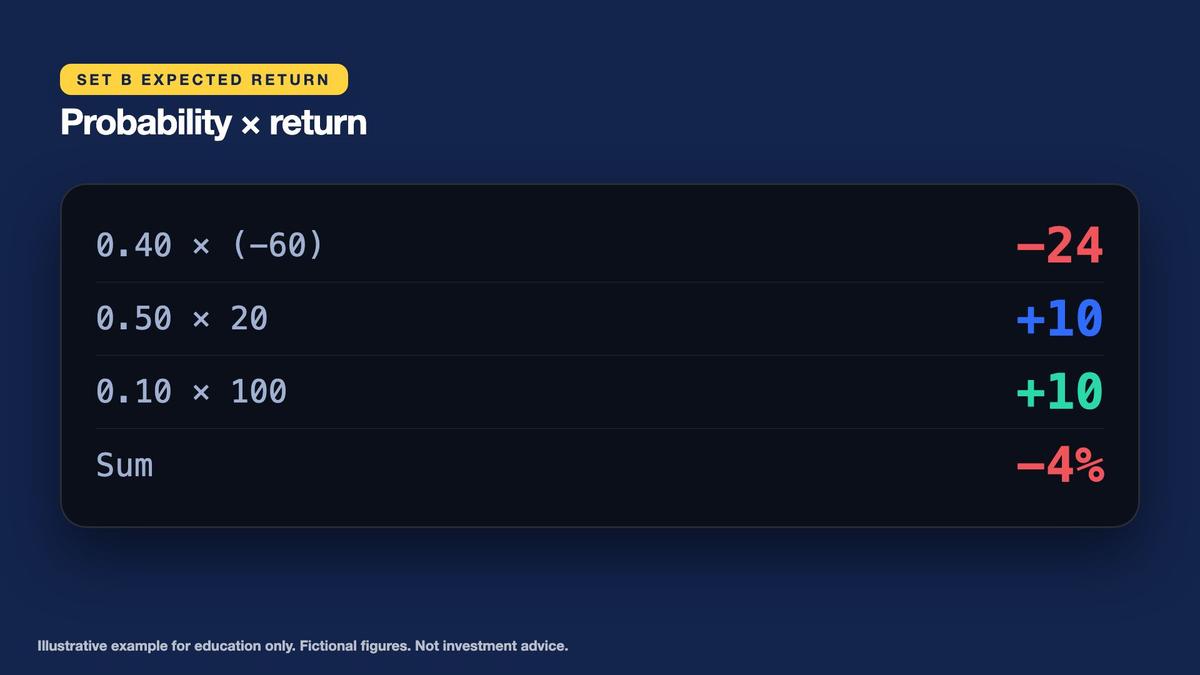
- Set A 30/50/20: -18 + 10 + 20 = +12%. Set B 40/50/10: -24 + 10 + 10 = -4%.
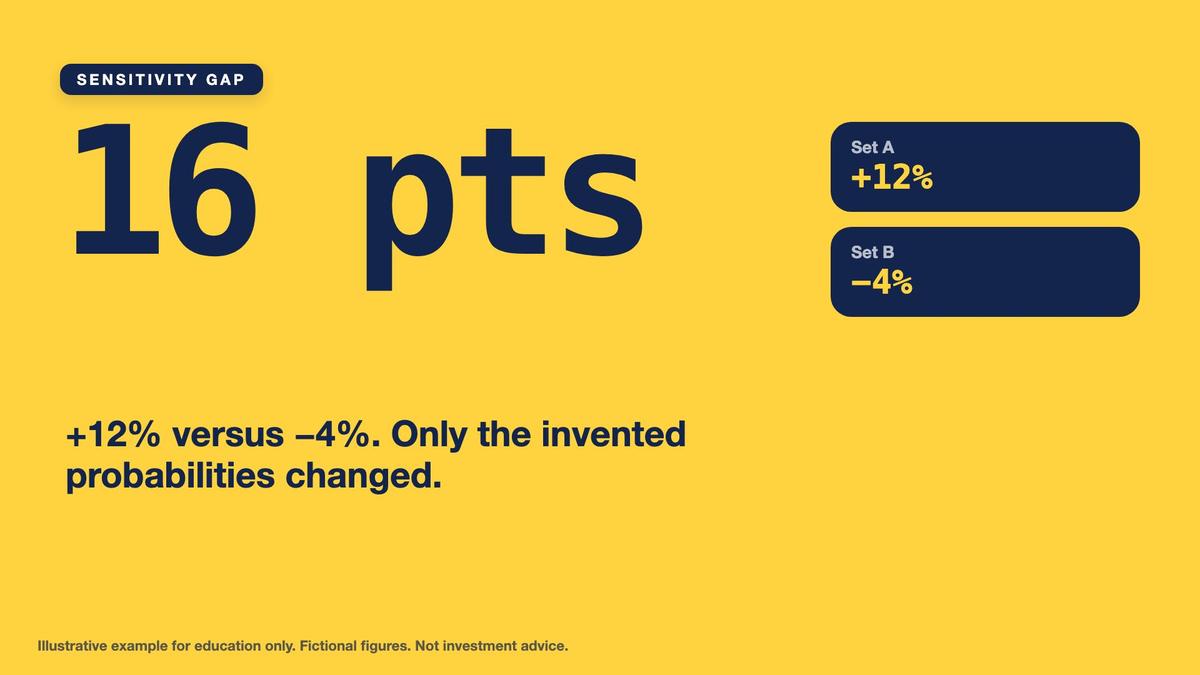
- The 16-point gap comes only from invented probabilities; keep both sets in the memo.
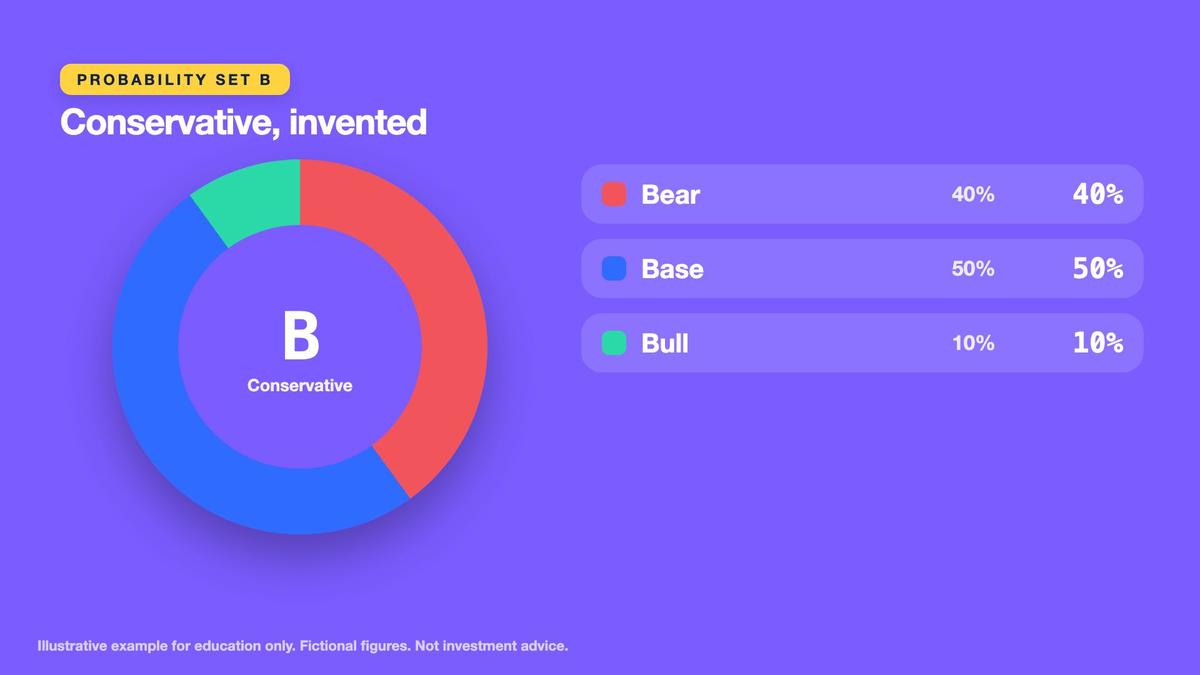
The more conservative probability set B raises the bear probability to 40%, retains a 50% base probability, and reduces the bull probability to 10%. These probabilities also sum to 100%. The weighted bear contribution is negative 24 points, the base contribution positive 10, and the bull contribution positive 10, resulting in negative 4% expected return. For a $250 position, that corresponds to negative $10 of modeled expected profit or loss. The difference between positive 12% and negative 4% is sixteen percentage points, despite unchanged scenario returns. This sensitivity is a central finding: invented probability assumptions can reverse the apparent attractiveness of the same hypothetical asset.
Separate the Downside Scenario From the Stress Case
The bear scenario and the stress case serve different purposes. The bear scenario, negative 60%, is one of the three outcomes used for probability-weighted expected return. The separate stress case assumes an even more severe negative 80% movement. This stress assumption is used to size the simulated position against the predefined $200 risk budget. It is not assigned a separate probability in the three-scenario expected-return calculation, and it is not a forecast of the largest possible loss. A real asset can experience losses greater than an assumed stress level, including complete loss under extreme circumstances.
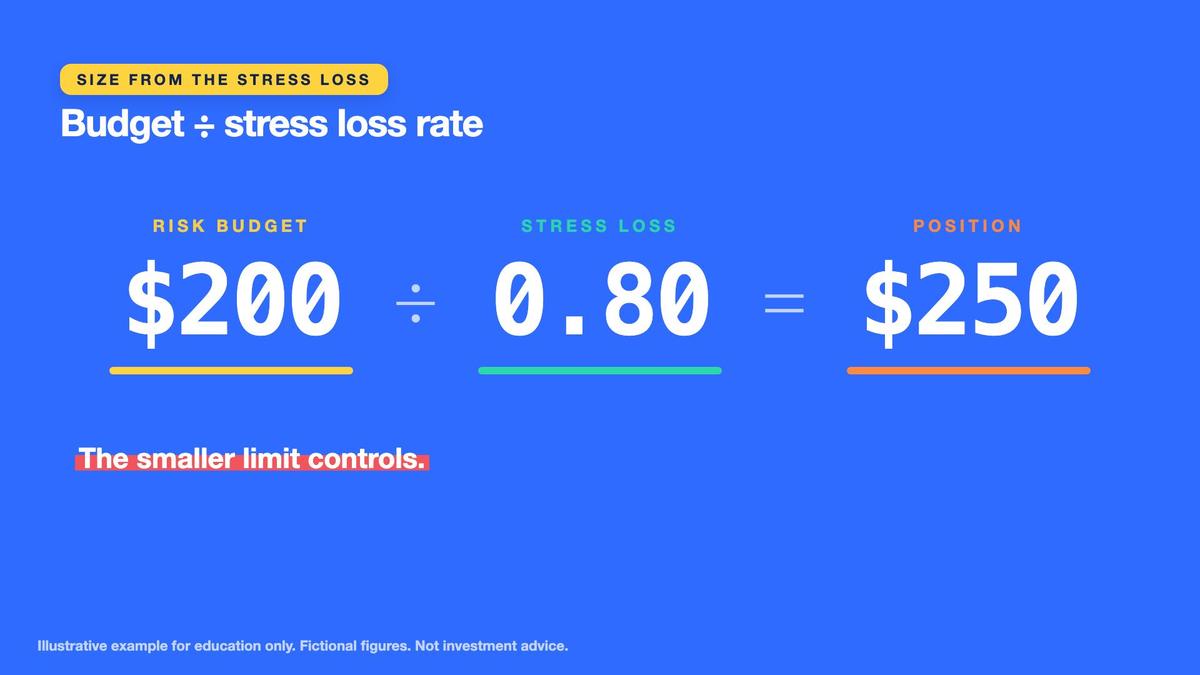
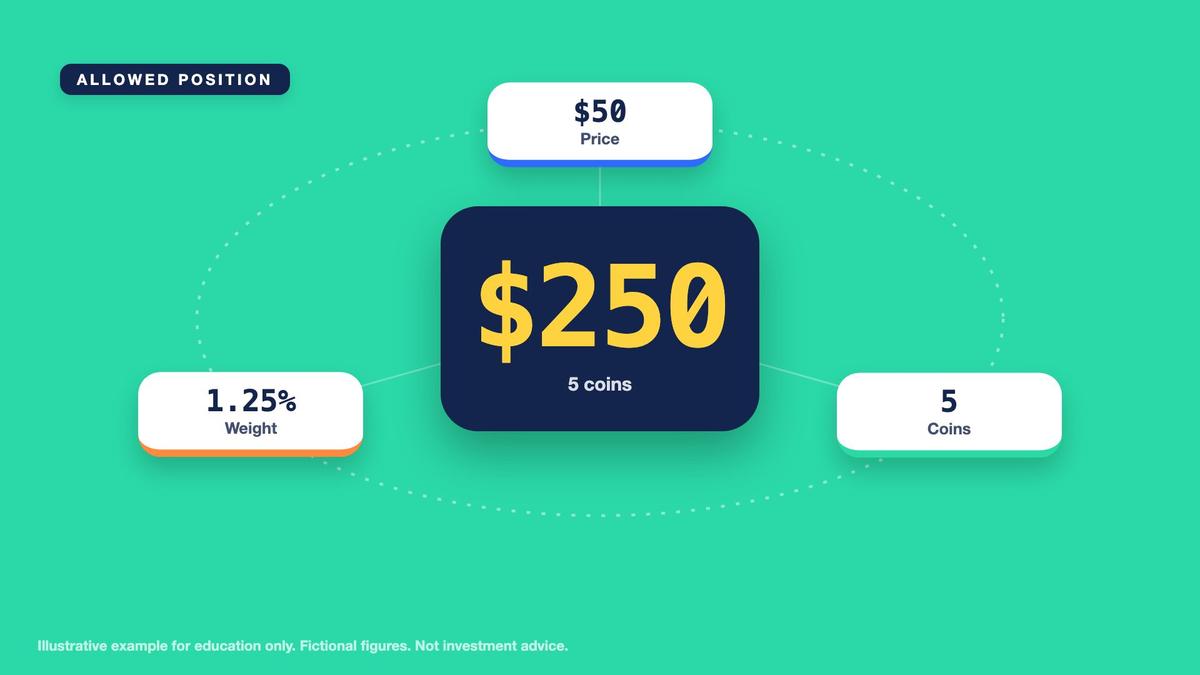
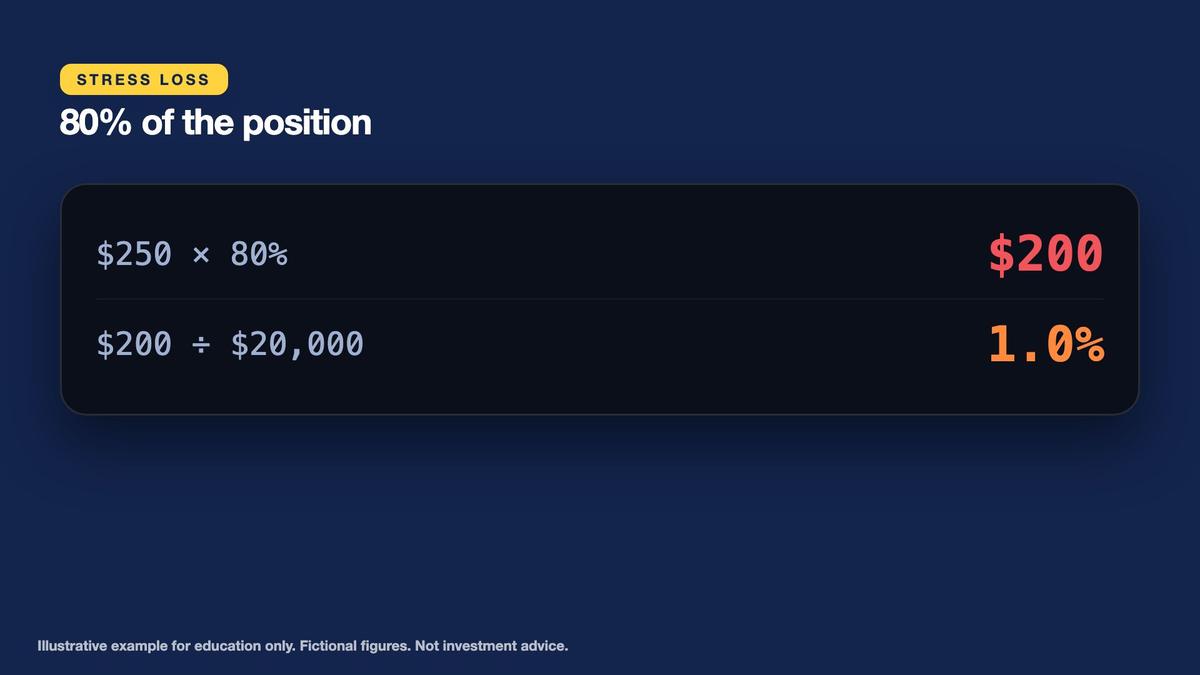
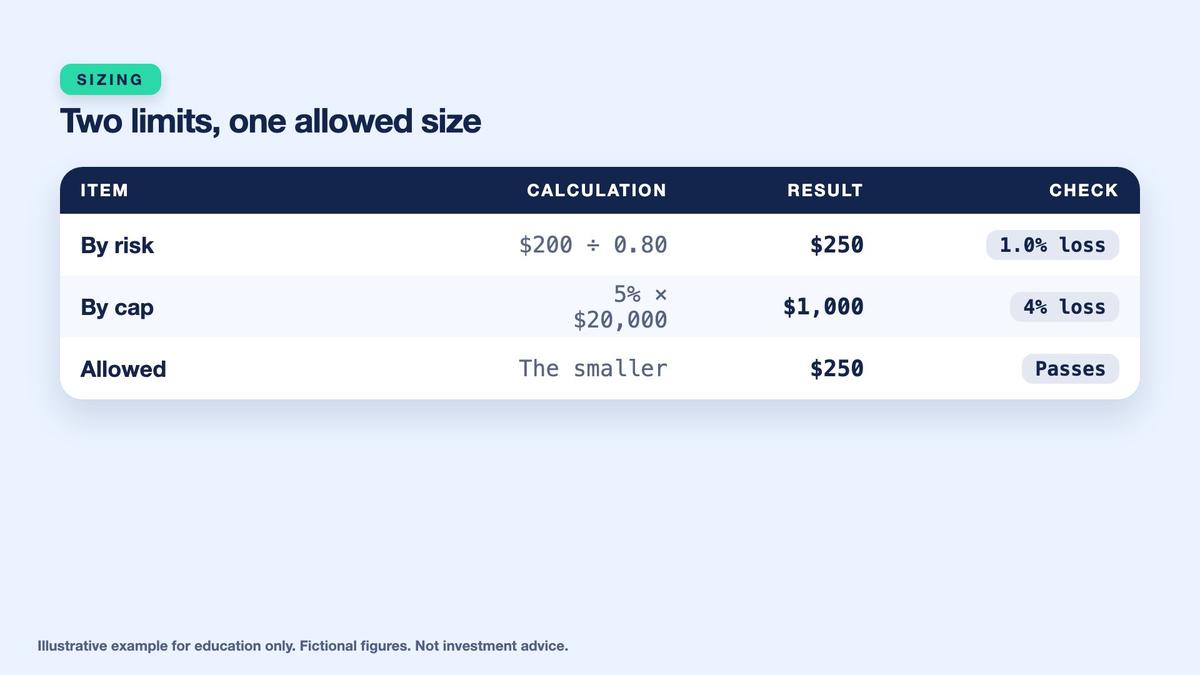
The risk-constrained position value is the $200 budget divided by the 0.80 stress-loss fraction, giving $250. The separate crypto sleeve cap permits up to $1,000, so the applicable maximum is the smaller of $250 and $1,000. At the fictional $50 reference price, a $250 position contains exactly five coins. Its allocation weight is $250 divided by the $20,000 portfolio, or 1.25%. An 80% loss on that position equals $200, exactly 1% of the total portfolio. After the stress loss, the position would have $50 of remaining value before costs or other effects.
Key points
- Stress case -80% is separate from the -60% bear scenario.
- Position = $200 / 0.80 = $250 = 1.25% of $20,000 = 5 coins at $50; the cap alone would allow $1,000.
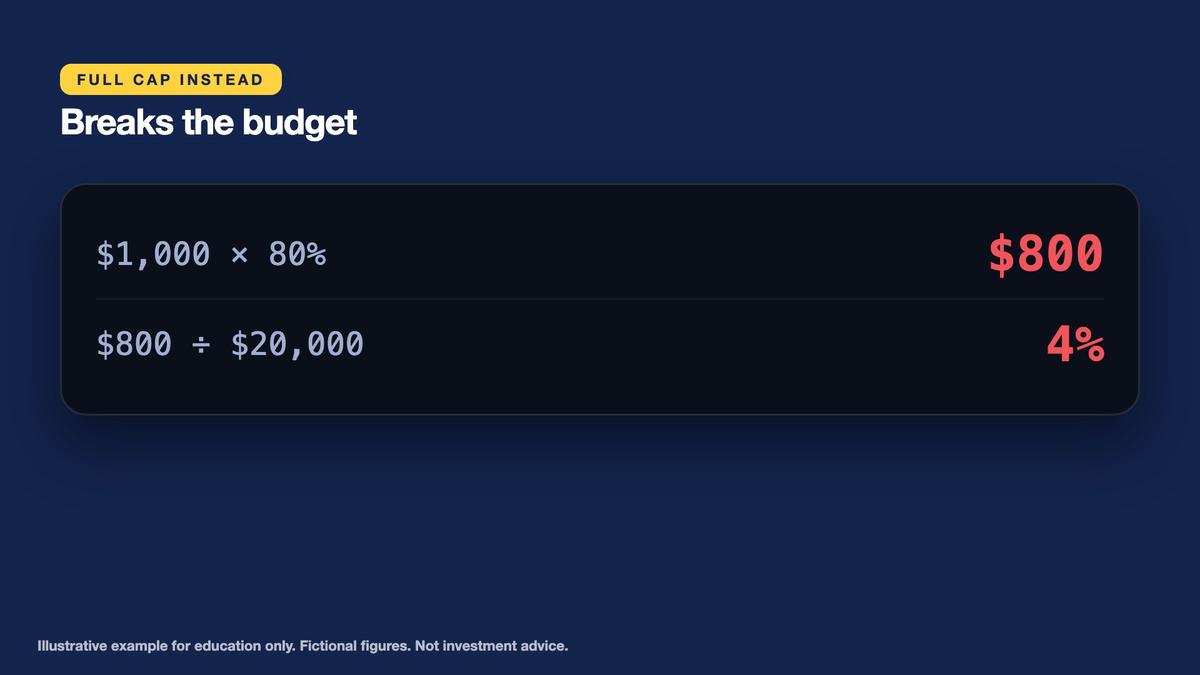
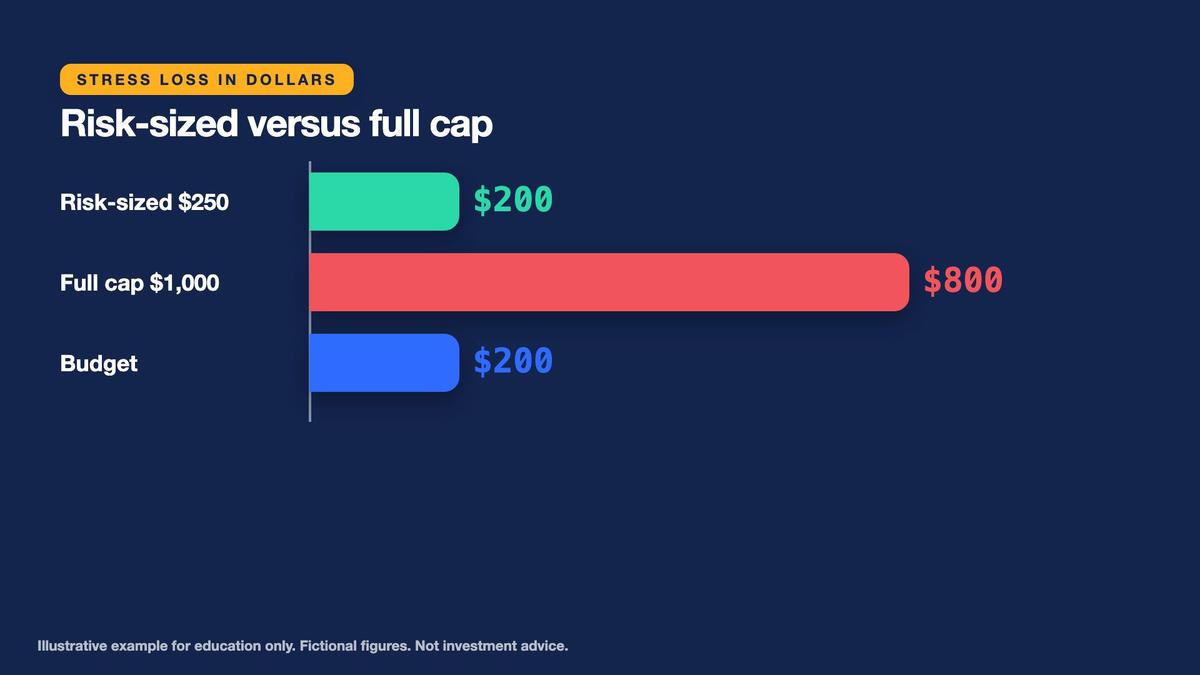
- Stress loss: $250 x 80% = $200 (1.0%); the full cap would lose $800 (4%).
If the full $1,000 crypto sleeve were allocated to Capped Coin, the same 80% stress decline would produce an $800 loss. Relative to the $20,000 portfolio, that equals 4%, exceeding the written 1% risk budget by $600. Therefore, passing the allocation-cap test does not automatically satisfy the stress-loss test. On the chosen $250 position, the negative 60% bear scenario produces a $150 loss, the positive 20% base scenario produces a $50 gain, and the positive 100% bull scenario produces a $250 gain. All calculations remain hypothetical and exclude execution costs, custody incidents, and other forms of loss.
Document Custody, Counterparties and Recovery Responsibilities
An investment memo for a digital asset must address operational exposure as well as market outcomes. Earlier lessons examined stablecoin reserve quality, derivatives and liquidation, exchange counterparty failure, self-custody responsibilities, and wallet safety. The lessons showed that financial loss can occur without a decline in the quoted asset price. An exchange may restrict withdrawals or fail financially. A self-custody owner may lose access through destroyed recovery materials, malicious authorization, malware, or mistaken transfer details. These risks cannot be fully represented by the simple negative 80% market stress assumption.
The fictional Capped Coin memo should document the intended custody arrangement without naming or accessing any real provider. It should identify who controls transaction-signing keys, whether the position would represent a direct asset holding or custodial claim, and how access could be restored after a device loss or account lockout. It should also describe withdrawal dependencies, key backup procedures, transaction verification, emergency responsibilities, and any reliance on third parties. A recovery plan must be specific enough to evaluate but must never contain actual private keys, recovery phrases, passwords, or usable account credentials.
Key points
- Document key control, backups, withdrawal dependencies and a failure plan.
- Operational losses can occur without any adverse price move.
- Custody and recovery is the third inclusion test.
Completing a custody checklist is the third required inclusion condition. Even if an optimistic expected-return estimate is positive and the position is properly sized, missing recovery documentation prevents the memo from passing every test. The plan should identify which events require immediate review, such as exchange withdrawal freezes, unexpected permission changes, compromised security devices, or loss of backup availability. The previous wallet safety lab provides the verification principles, while the earlier counterparty lesson explains why legal claims and provider solvency matter. Neither self-custody nor custodial storage guarantees recoverability.
Apply the Prewritten Inclusion, Exclusion and Watch Rule
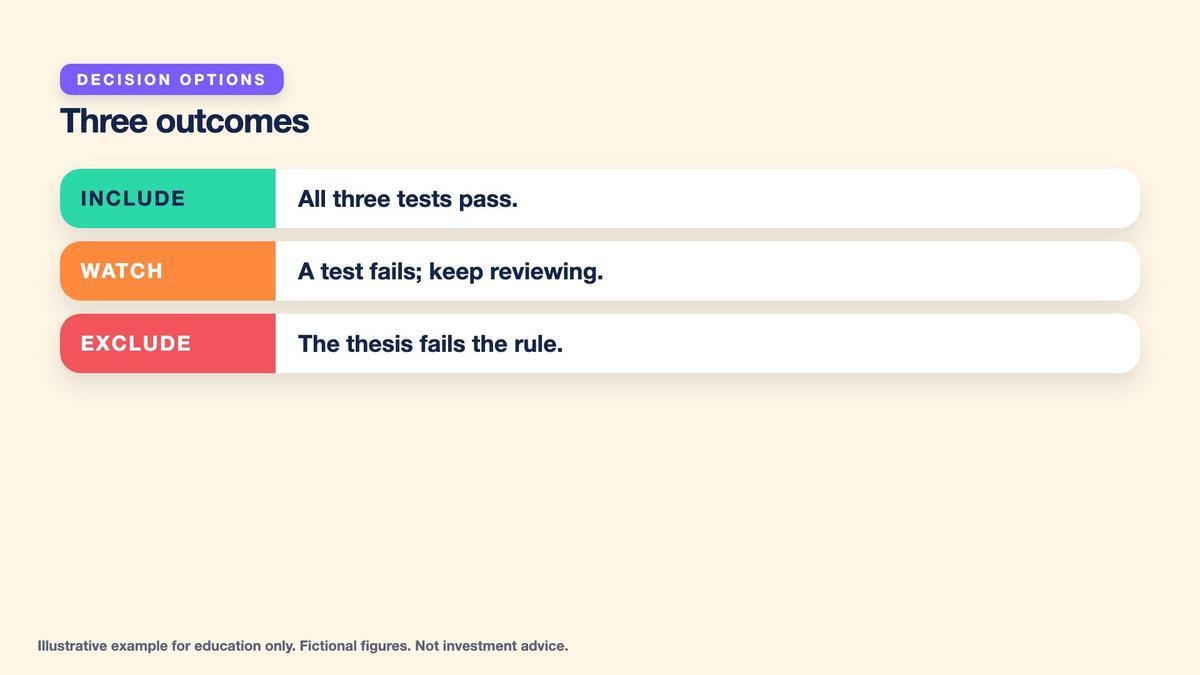
Return to the three-part decision rule. Test one requires positive expected return under the conservative probability set, not merely under the optimistic set. Test two requires the position's modeled 80% stress loss to stay within $200. Test three requires a documented custody and recovery plan. All three are mandatory. Using set A alone, the positive 12% expected return passes an illustrative positive-return test, and the proposed $250 position passes the stress constraint. A conditional inclusion could be considered under that alternative approach only if custody documentation were complete. However, set A is not the conservative set specified by the actual written policy.
Under conservative set B, expected return is negative 4%. Because the rule requires a result strictly above zero, the first condition fails. The $250 position still passes the stress test, and the custody plan could be completed, but those successes cannot override a failed mandatory condition. The memo conclusion is therefore exclude or watch. Exclude means the candidate does not qualify under the current simulated policy assumptions. Watch means continuing research without adding the asset to the hypothetical portfolio. Both are valid outcomes, and neither implies a prediction about future price movements.
Key points
- Set A passes the return and size tests; the custody plan must still be documented.
- Set B fails the return test (-4%), so the conclusion is exclude or watch.
- Record that the decision flips when assumptions change.
The memo must explicitly record that the decision flips when probability assumptions change. Under optimistic set A, the modeled return is positive 12%; under conservative set B, it is negative 4%. This is not a small rounding difference but a sixteen-percentage-point change driven entirely by assumed probability weights. A disciplined learner should preserve both calculations and explain why the conservative rule governs. Selecting only the favorable result would be confirmation bias, while claiming afterward that a particular future price had been anticipated would risk hindsight bias. The memo records what was known, assumed, and decided at the time.
Define Numeric Triggers and a Ninety-Day Review
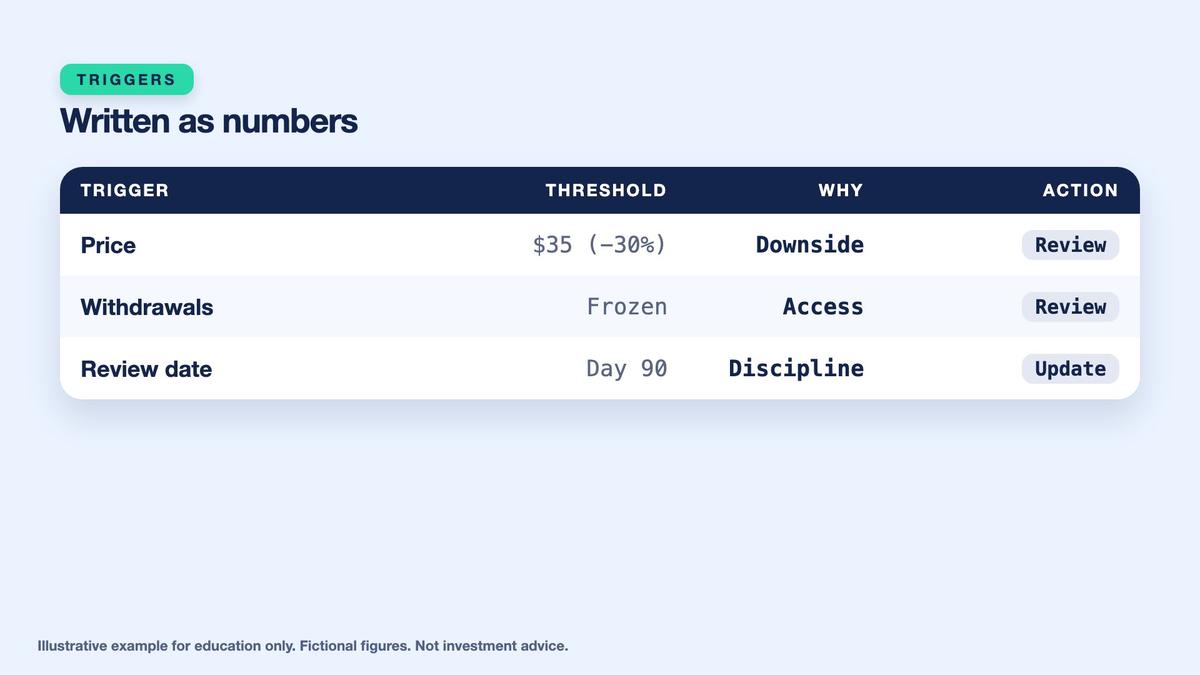
A useful research memo does not end with a static decision. It defines evidence that will prompt reconsideration and records when the research should be reviewed. For this fictional case, one trigger is a price decline of 30% below the $50 reference, equivalent to $35 per coin. This is a review threshold, not an instruction to buy or sell and not a guaranteed execution level. Another trigger is an exchange withdrawal freeze, which requires immediate investigation of access and counterparty exposure. The scheduled review occurs ninety days after the memo preparation date, with earlier review permitted if material events occur.
The third numeric trigger is circulating float increasing by more than 25% from the stated 19 million coins. A 25% increase would bring circulation to 23.75 million, so a strictly greater-than-25% increase would require more than 23.75 million circulating coins. However, this exceeds Capped Coin's stipulated maximum supply of 21 million. Under unchanged supply rules and consistent data definitions, the condition cannot occur through ordinary issuance. Therefore, observing such a figure should trigger investigation of data accuracy, changing definitions, or a material protocol-rule change rather than a routine interpretation of token unlocking.
Key points
- Price trigger: $50 x (1 - 30%) = $35, a review trigger and not a guaranteed stop.
- Float trigger: +25% on 19 million = 23.75 million, above the 21 million cap, so investigate the data.
- Review after 90 days, earlier on a security or market-access event.
Write each trigger with its starting reference and action. The price trigger calls for reviewing the thesis and downside assumptions. The circulating-supply trigger calls for checking the source data and whether the maximum supply rule remains valid. A withdrawal freeze calls for evaluating custody access and operational risk immediately. The ninety-day review should revisit demand evidence, network security, issuance, concentration, custody arrangements, and the scenario probabilities. Review dates should be concrete in a completed real-world record, but this fictional course uses a relative ninety-day interval because no actual portfolio or investment date is provided.
Final Lab: Complete the One-Page Memo and Journal
The memo completeness scorecard contains eight items, each worth one point: a one-sentence thesis, supply facts, demand drivers, failure assumptions, a downside number in dollars, a custody and recovery plan, position size with a risk check, and numeric review triggers with a review date. A complete hypothetical inclusion requires all eight. The scorecard measures documentation completeness, not investment quality, forecast accuracy, or safety. A memo can be fully documented and still conclude that the candidate should be excluded. Missing evidence must be labeled as missing rather than replaced by unsupported confidence or promotional claims.



Practice Lab: Build a One-Page Capped Coin Investment Memo
Use only fictional Capped Coin and a $20,000 simulated portfolio. The written crypto allocation cap is 5%, while the single-position stress-loss budget is 1% of the entire portfolio. Record the candidate's fictional $50 reference price, 21-million maximum supply, 19-million circulating supply, approximately 2.11% annual growth and $950-million market capitalization. Evaluate the three hypothetical one-year returns using both invented probability sets, calculate the position permitted by an independent 80% stress-loss assumption, and apply the prewritten three-part inclusion rule. Prepare a custody and recovery plan without actual credentials or providers. Complete the eight-item memo scorecard, define review triggers and a ninety-day review interval, and preserve the original decision in a dated simulated journal. No actual investment, exchange connection or transaction is permitted.
- Decision 1: Capped Coin has a fictional $50 reference price, 19 million circulating units, a 21-million maximum supply, and stated annual supply growth of approximately 2.11%. — Write a one-sentence investment hypothesis, identify the supply facts and demand assumptions, calculate capitalization, and state at least three plausible failure conditions.
- Decision 2: Capped Coin has illustrative one-year returns of -60%, +20%, and +100%. Optimistic set A assigns probabilities of 30%, 50%, and 20%, while conservative set B assigns 40%, 50%, and 10%. — Calculate both expected returns, their difference, and the modeled expected dollar result for a hypothetical $250 position.
- Decision 3: The simulated portfolio is $20,000. The policy permits at most $1,000 in cryptocurrency and no more than $200 stress-case loss per position. The independent sizing stress assumes an 80% decline. — Calculate the maximum permitted position, fictional coin quantity, portfolio weight, stress loss, and consequence of using the entire crypto sleeve.
- Decision 4: The prewritten inclusion rule requires conservative expected return above zero, stress-case loss within $200, and documented custody and recovery. Set A has +12% expected return, while set B has -4%. — Apply the decision rule under both assumption sets, explain the final conservative conclusion, and identify why a completed custody plan cannot override a failed return test.
- Decision 5: The memo requires eight completeness items, a ninety-day review, a 30% decline trigger from $50, a more-than-25% circulating-float increase from 19 million, and immediate review if exchange withdrawals freeze. — Calculate the numeric trigger values, identify the supply-cap inconsistency, and describe what the learner should preserve in the research journal.
Answer key
For Capped Coin, the completed worksheet states $20,000 simulated portfolio value, $1,000 crypto allocation cap, and $200 stress-loss budget. It records maximum supply of 21 million, circulation of 19 million, $50 reference price, $950 million market capitalization, and approximately 2.11% current supply growth. The three one-year scenario returns are negative 60%, positive 20%, and positive 100%. Their invented probabilities produce positive 12% under set A and negative 4% under set B. The negative 80% stress assumption limits the illustrative position to $250 or five coins, with modeled stress loss of $200. A full $1,000 position would violate the stress budget.
Key points
- Eight items, one point each; all eight before any inclusion.
- Verify +12%, -4%, $250, $200, $35 and the 5 coins.
- Keep the original memo unchanged to avoid hindsight bias.
The final decision is exclude or watch because conservative expected return is negative. The journal should preserve that conclusion alongside the positive optimistic estimate, the completed custody checklist, the $35 price review trigger, the impossible-under-unchanged-rules float threshold, the withdrawal-freeze trigger, and the ninety-day review interval. Later research updates should be dated separately rather than silently rewriting the original memo. This lab demonstrates how to justify inclusion or exclusion through a prewritten rule, an explicit downside calculation, and documented failure assumptions. No actual asset, exchange, transaction, price prediction, or financial recommendation is involved.
Worked example at a glance
Key terms
- Investment memo: a dated document that records a thesis, numbers and a decision before acting.
- Thesis: the reason an asset might deserve consideration, in one sentence.
- Scenario: an illustrative outcome used to explore a decision; not a forecast.
- Expected return: probability-weighted average of scenario returns.
- Probability set: invented weights attached to scenarios.
- Stress case: a severe loss used to size a position.
- Risk budget: the most you accept to lose on a position.
- Position sizing: choosing a position so a stress loss fits the budget.
- Inclusion rule: written tests an asset must pass before it is included.
- Trigger: a numeric condition that starts a review.
- Confirmation bias: favoring evidence that supports what you already believe.
- Hindsight bias: believing an outcome was obvious after it happened.
Multi Asset Trading Lab provides educational information only and does not constitute personalized investment, trading, financial, legal, tax, cybersecurity, or custody advice. Capped Coin is an entirely fictional educational asset. Every price, market capitalization, issuance figure, scenario return, probability, portfolio balance, position size, custody assumption, stress outcome, expected return and research decision in this lesson is hypothetical. No real cryptocurrency, token, exchange, ticker, wallet provider, financial product, or real-money transaction is recommended, used or required. The simulated portfolio balance of $20,000, 5% crypto sleeve cap and 1% single-position stress-loss budget are invented classroom policy constraints rather than allocation advice or appropriate limits for any actual person. The fictional $50 Capped Coin reference, maximum supply of 21 million, circulating supply of 19 million, approximately 2.11% annual supply growth and $950 million circulating capitalization are arithmetic inputs for the case study. A capped supply does not guarantee demand, economic utility, liquidity, adoption, network security, or future price appreciation. Circulating market capitalization is calculated as price multiplied by circulating supply and must not be mistaken for invested cash, available liquidity or realizable recovery value. The three illustrative one-year scenario returns of -60%, +20% and +100% are not forecasts, research estimates, historical data or predictions. The optimistic probabilities of 30%, 50% and 20% and conservative probabilities of 40%, 50% and 10% are invented solely for demonstrating expected-value sensitivity. Their weighted results of +12% and -4% respectively are mathematical outcomes under those artificial assumptions, not valid predictions of future average returns. The $30 optimistic and -$10 conservative expected dollar outcomes for a $250 hypothetical position represent probability-weighted models, not payments, guarantees or realized profits and losses. The sixteen-percentage-point difference demonstrates that expected results can change substantially with assumptions even when possible scenario outcomes remain the same. The separate -80% stress scenario is deliberately more severe than the -60% bear scenario and is used only to size the simulated exposure. It is not a maximum possible decline or a guaranteed stop-loss boundary. Complete loss, liquidity gaps, adverse execution, custody failures, market-access disruptions and other risks may create outcomes worse than the modeled scenario. The risk-constrained position of $250 is calculated as the $200 budget divided by 0.80 and is smaller than the $1,000 crypto sleeve cap. At the invented $50 price it corresponds to five coins, or 1.25% of the portfolio. Its modeled stress loss is $200 or 1% of the $20,000 portfolio. Allocating the entire $1,000 sleeve would produce an $800 loss, or 4% of the portfolio, under the same hypothetical stress, violating the stated $200 budget. These calculations ignore trading costs, spreads, slippage, financing, tax consequences, liquidity limitations, operational failures and changing market conditions. A position-allocation cap and risk budget are separate constraints and neither guarantees that actual realized losses remain within the planned amount. The prewritten fictional decision rule requires all three conditions: expected return under conservative set B strictly greater than zero, position stress loss no greater than $200, and documented custody and recovery arrangements. The negative 4% conservative expected return fails the first requirement, so the final simulated decision is EXCLUDE or WATCH regardless of the positive optimistic result. This is a conditional classroom classification, not an instruction to avoid, buy, sell or monitor any real asset. The rule's result depends on invented probabilities and is not proof of investment quality. The eight-item memo scorecard measures research completeness, including thesis, supply facts, demand drivers, failure assumptions, quantified downside, custody and recovery, sizing and risk check, and dated numeric triggers. Completing all eight does not establish that evidence is correct, that the asset is safe or that positive future returns are likely. The fictional price review trigger of $35 is calculated as 30% below $50 and is a research reassessment condition, not a guaranteed execution price, trading stop or prediction. The circulating-float review condition is an increase greater than 25% from the 19-million starting circulation, meaning more than 23.75 million coins. This threshold exceeds the stipulated 21-million maximum supply and is therefore inconsistent with ordinary issuance under unchanged rules and consistent definitions. Observing such a number would require checking data quality, supply methodology, token definitions, protocol changes or violations of the fictional case assumptions rather than treating it as a plausible routine unlock. Exchange withdrawal freezes and other material security incidents can trigger immediate research review, while the scheduled review is ninety days after the fictional memo's preparation date. Review triggers cannot guarantee timely access to assets or prevention of loss. Earlier lessons on token economics, stablecoin and derivatives risk, counterparty exposure, exchange versus self-custody, and wallet safety describe additional risks not captured by the simple return model. These include network security failures, software vulnerabilities, malicious contracts, irreversible transfers, lost signing keys, recovery phrase compromise, exchange insolvency, withdrawal restrictions, fraud, concentrated holders, collateral failures, liquidity stress, leverage contagion and legal or regulatory changes. A custody and recovery plan should identify key control, access dependencies, backup verification and emergency responsibilities without including usable keys, recovery phrases, account credentials or wallet addresses. Custodial and self-custody approaches each have distinct and potentially severe failure modes, and neither guarantees safe recovery. Learners must distinguish stipulated facts from opinions, model assumptions and uncertain forecasts, use dated records, preserve original probability sets and decision criteria, and record subsequent information as separate updates rather than rewriting prior research. Confirmation bias, hindsight bias and selectively choosing favorable assumptions can undermine the purpose of an investment memo. No numerical model, expected return, stress calculation, review threshold, policy constraint or journal checklist can establish future cryptocurrency prices or ensure capital preservation. All research and examples remain simulated educational activities only. Nothing in this lesson constitutes a recommendation to acquire, hold, transfer, custody, lend, stake, borrow against, or trade any actual digital asset, and no real-money activity is required or encouraged.
Lesson Checkpoint
Review what you learned and get feedback on your work.