



In this sixteen-minute beginner hands-on lab, learners practice wallet security using only fictional addresses, mock networks, invented messages, simulated tokens, and dummy recovery materials. They compare visually similar destination strings, verify network compatibility, calculate test-transfer fees, identify phishing through a weighted red-flag scorecard, assess limited versus unlimited token approvals, and calculate recovery transcription error probabilities. Learners also rehearse a recovery test on a fresh mock wallet, inspect signing permissions, review device hygiene, and apply a ten-item preflight checklist before hypothetical transfers. Six practical activities reinforce the distinction between technical controls and human mistakes. The outcome is a reproducible wallet safety procedure and journal documenting destination verification, network compatibility, transaction costs, permission exposure, recovery readiness, and suspicious-message responses. All inputs, probabilities, messages, transactions, accounts, and balances are fictional. No real wallets, private keys, recovery phrases, addresses, financial prices, or transactions are used.
Why Wallet Safety Begins With Human Verification
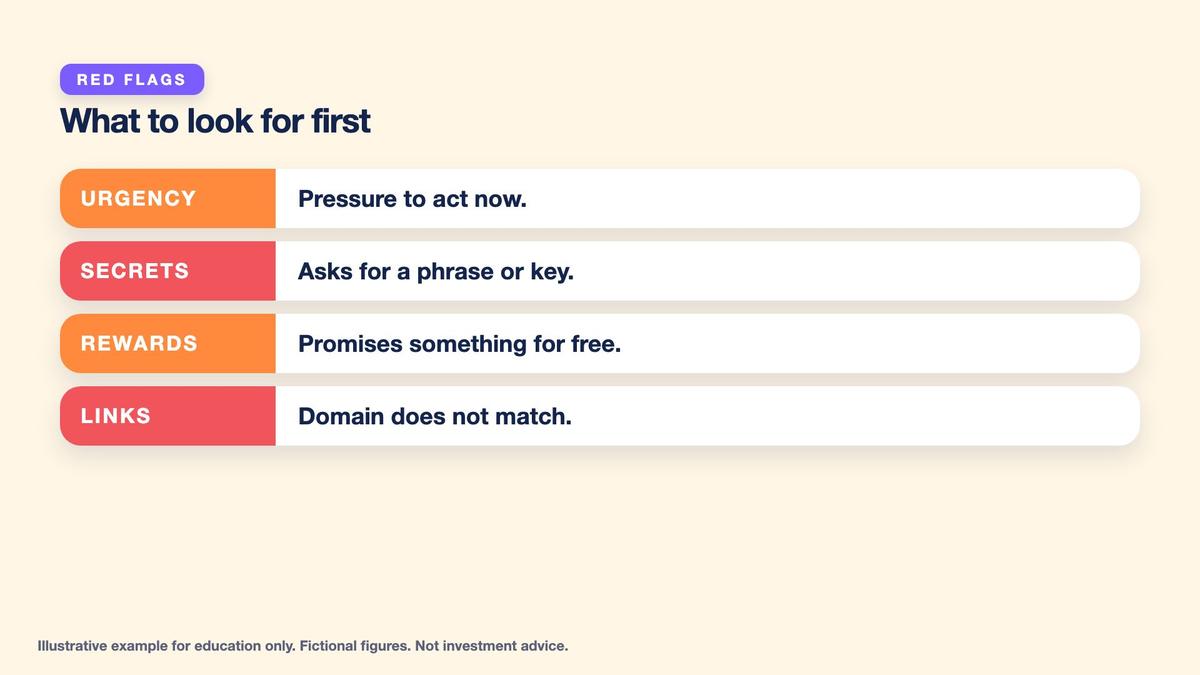
Digital wallet systems can use strong cryptographic signing while remaining vulnerable to human mistakes and social engineering. Attackers may not need to break the underlying blockchain. Instead, they can persuade someone to reveal a recovery secret, approve an unwanted contract permission, transfer funds to an impostor, or use an incompatible network. They often exploit urgency, fear, authority, financial rewards, and seemingly professional support messages. Effective wallet safety therefore combines technical protections with careful decision procedures. This lesson uses only fictional account information, invented warning messages, dummy recovery placeholders, and simulated tokens to rehearse those procedures without exposing real assets.



The previous custody lesson distinguished exchange accounts from self-custody. A custodial provider normally controls transaction-signing keys and may offer account recovery through authentication and support. A self-custody user controls signing authority and assumes responsibility for protecting keys, verifying transactions, and maintaining usable backups. Neither arrangement eliminates phishing, malware, financial loss, or operational mistakes. In a self-custody setting, an incorrect destination or harmful signing authorization may be difficult or impossible to reverse. The learner's first responsibility is to determine exactly what action is being requested before approving anything.
Key points
- Strong cryptography does not protect against a person approving a dangerous action.
- Attackers use urgency, fear, rewards and apparent authority.
- Everything in this lab uses mock inputs: no real phrase, key, address or credential.
Six practical exercises structure this lab: address comparison, network and test-transfer checks, phishing classification, token allowance review, dummy recovery testing, and a ten-item preflight checklist. Every address is deliberately fictitious, every website-like domain ends with .test, and every recovery placeholder is unusable as a genuine secret. The fictional asset is Sample Coin, abbreviated SMP. No real wallet application, exchange, address, key, recovery phrase, market price, or transaction is required. The objective is to demonstrate a repeatable verification workflow, not to practice transferring actual funds.
Lab One: Detect Lookalike Addresses and Clipboard Substitution
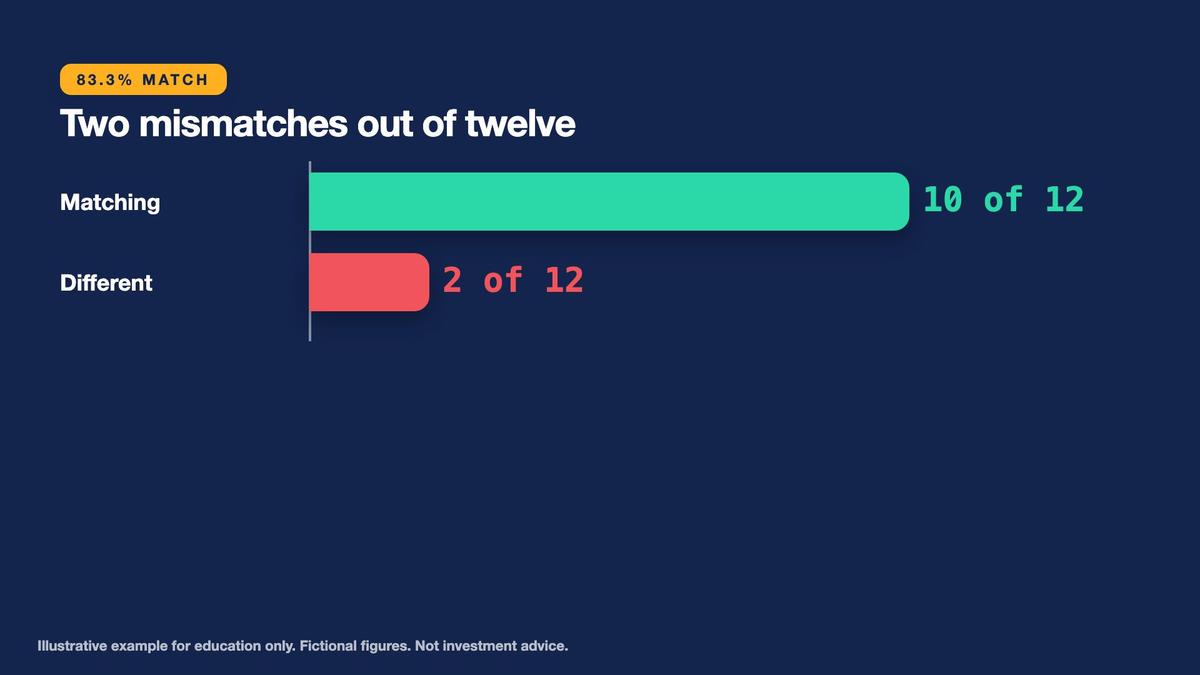
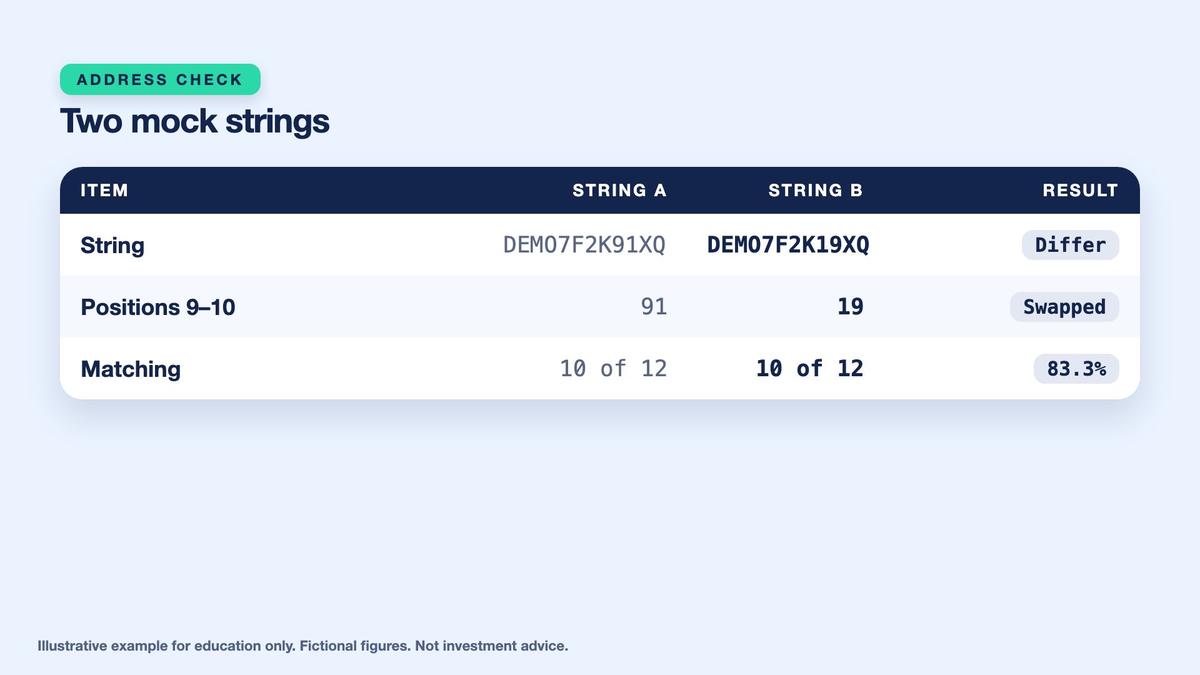
A destination comparison can fail when a person checks only the beginning and end of a long-looking identifier. For our fictional exercise, the legitimate mock destination is DEMO7F2K91XQ, while the lookalike destination is DEMO7F2K19XQ. Each string contains exactly twelve characters. Positions one through eight match, positions nine and ten differ, and positions eleven and twelve match. Specifically, the two adjacent characters 91 in the legitimate destination become 19 in the lookalike. Ten of the twelve positions therefore match, producing a positional similarity of ten divided by twelve, or approximately 83.3%.
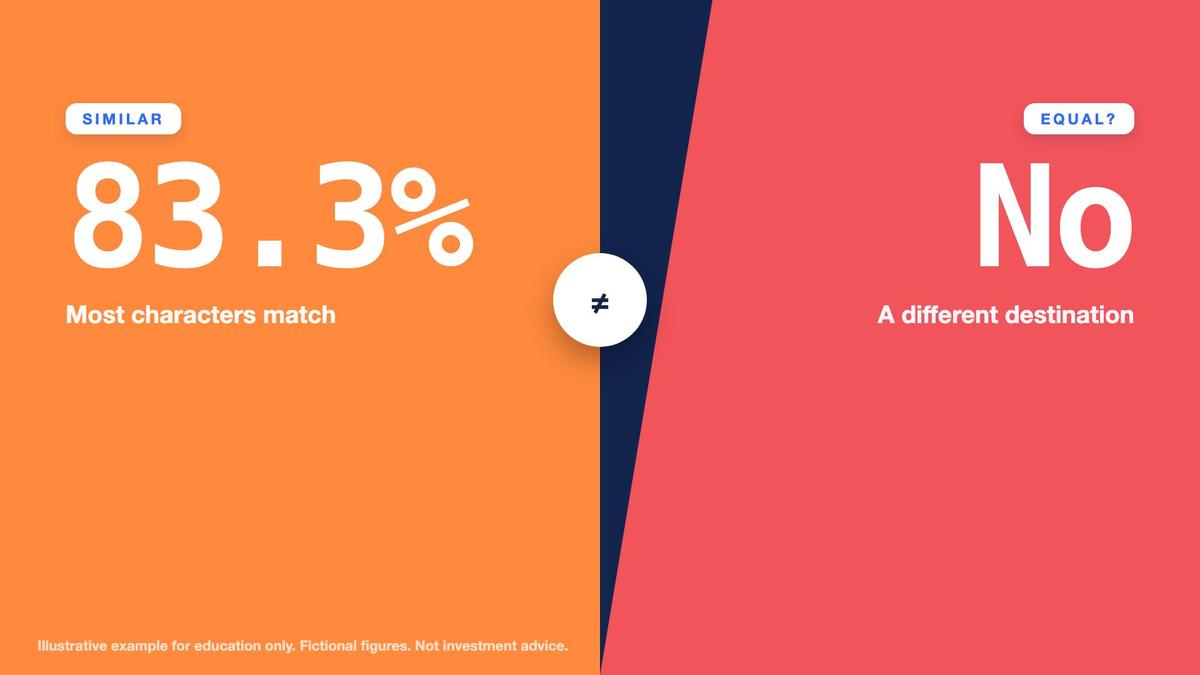
Despite the high similarity, the strings are not equal and represent different fictional destinations. This exercise demonstrates why checking only a prefix or suffix is insufficient. An attacker might exploit address poisoning by placing lookalike identifiers in activity records or might use clipboard malware to substitute a destination after the user copies it. Copying and pasting reduces some transcription mistakes, but it does not prove that the clipboard contains the intended destination. A verification process should compare the complete string against a trusted source after pasting and before authorizing the transaction.
Key points
- Mock strings DEMO7F2K91XQ and DEMO7F2K19XQ differ at positions 9 and 10 (91 became 19).
- 10 of 12 positions match = 83.3%, yet they are different destinations.
- Compare the whole string, verify after pasting, and beware clipboard swaps and address poisoning.
For this lab, place both mock strings side by side, mark positions nine and ten, and record the exact mismatch. Do not convert either mock identifier into a real blockchain address or send anything to it. In a safe transfer workflow, confirm the intended recipient through a trustworthy channel, verify the full destination, check the chosen network, and consider a small test transfer before a larger amount. Even a successful test cannot guarantee that later authorization details remain unchanged, so every transaction requires its own final review.
Lab Two: Verify Networks, Test Transfers and Fees
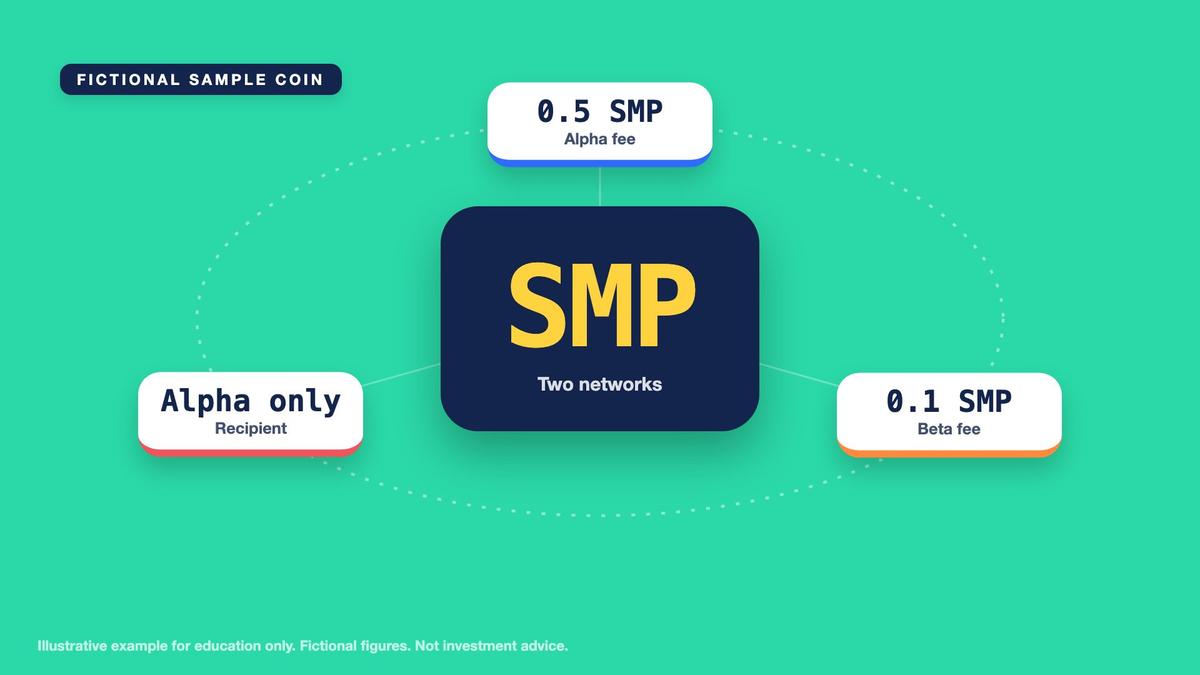
The fictional asset Sample Coin can move through two incompatible classroom networks, Network Alpha and Network Beta. Alpha charges a fee of 0.5 SMP per transfer, while Beta charges 0.1 SMP. However, the intended recipient accepts SMP only through Network Alpha. The lower fee on Beta is irrelevant if the recipient cannot access assets sent through that network. Wrong-network transfers may be unrecoverable, depending on actual systems and available recovery mechanisms. The essential verification question is whether the recipient, asset representation, destination and selected network are compatible before any transfer is authorized.
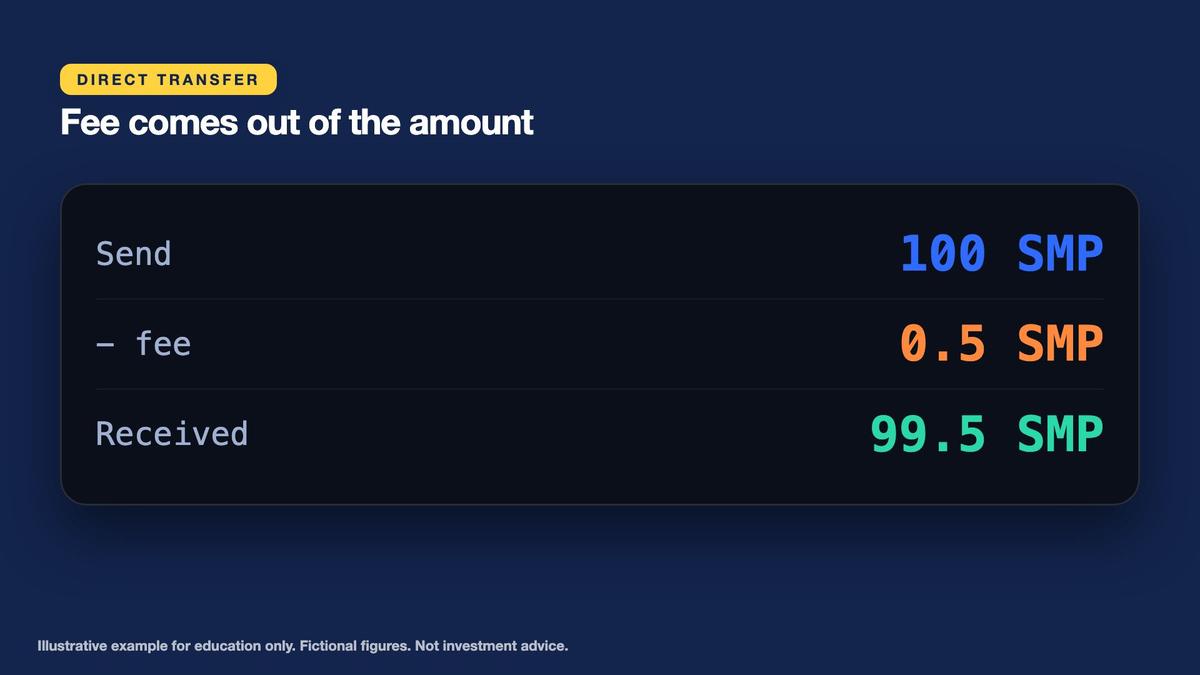
Assume that the stated transfer amount includes the network fee, which is deducted before the recipient receives the tokens. A direct transfer of 100 SMP over Network Alpha costs 0.5 SMP, equal to 0.5% of the original amount, and delivers 99.5 SMP. Now consider a two-step plan. First, send a 1 SMP test transfer. After the 0.5 SMP Alpha fee, the recipient receives 0.5 SMP. Confirm that the mock transaction reaches the intended fictional destination on Network Alpha before preparing the remaining transfer. This confirmation is a verification checkpoint rather than a guarantee of future success.
Key points
- Sample Coin: Network Alpha fee 0.5 SMP, Network Beta fee 0.1 SMP; the recipient accepts Alpha only.
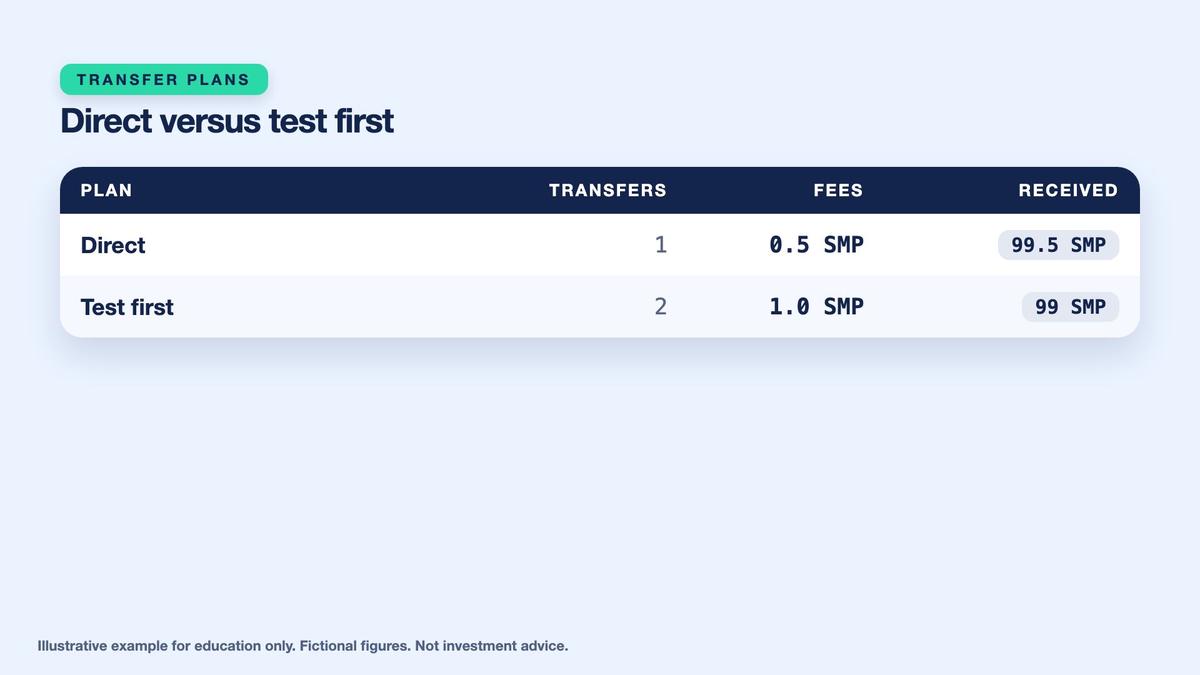
- Direct: send 100, fee 0.5 (0.5%), received 99.5. Test first: send 1 (receives 0.5), then 99 (receives 98.5).
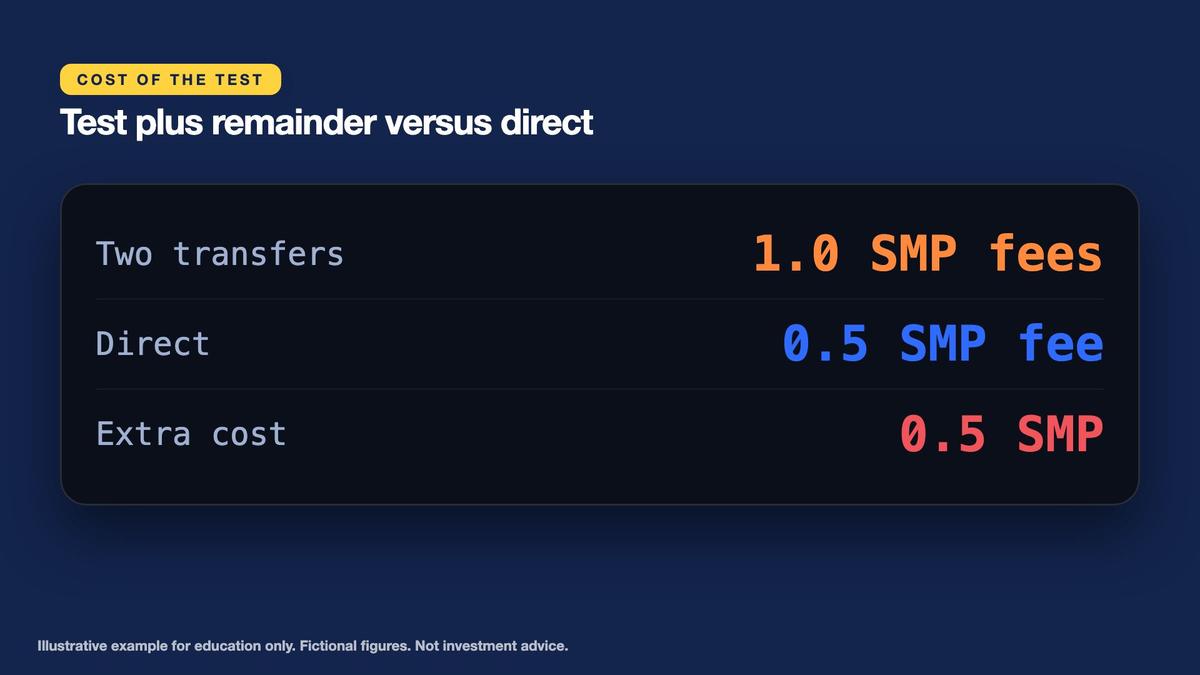
- Test first costs 1.0 SMP in fees versus 0.5 SMP: an extra 0.5 SMP, and it is not a guarantee.
Next send the remaining 99 SMP over Alpha, paying another 0.5 SMP fee. The recipient receives 98.5 SMP in the second transfer. Combined receipts equal 0.5 plus 98.5, or 99 SMP. Total network fees equal 1.0 SMP, which is 1.0% of the original 100 SMP. Compared with the direct-transfer fee of 0.5 SMP, the test-first plan costs an additional 0.5 SMP, or 0.5% of the original amount. This is an explicit trade-off between additional verification and higher transaction friction. The entire example is fictional and uses no real network or address.
Lab Three: Recognize Phishing With a Weighted Scorecard
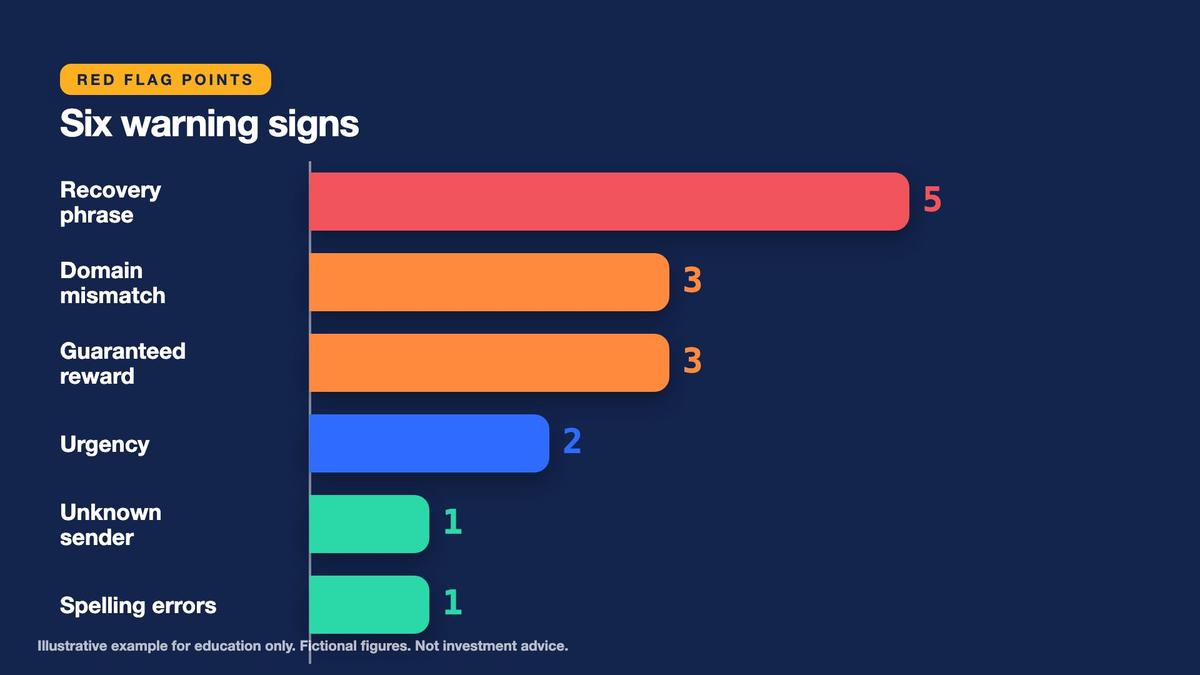
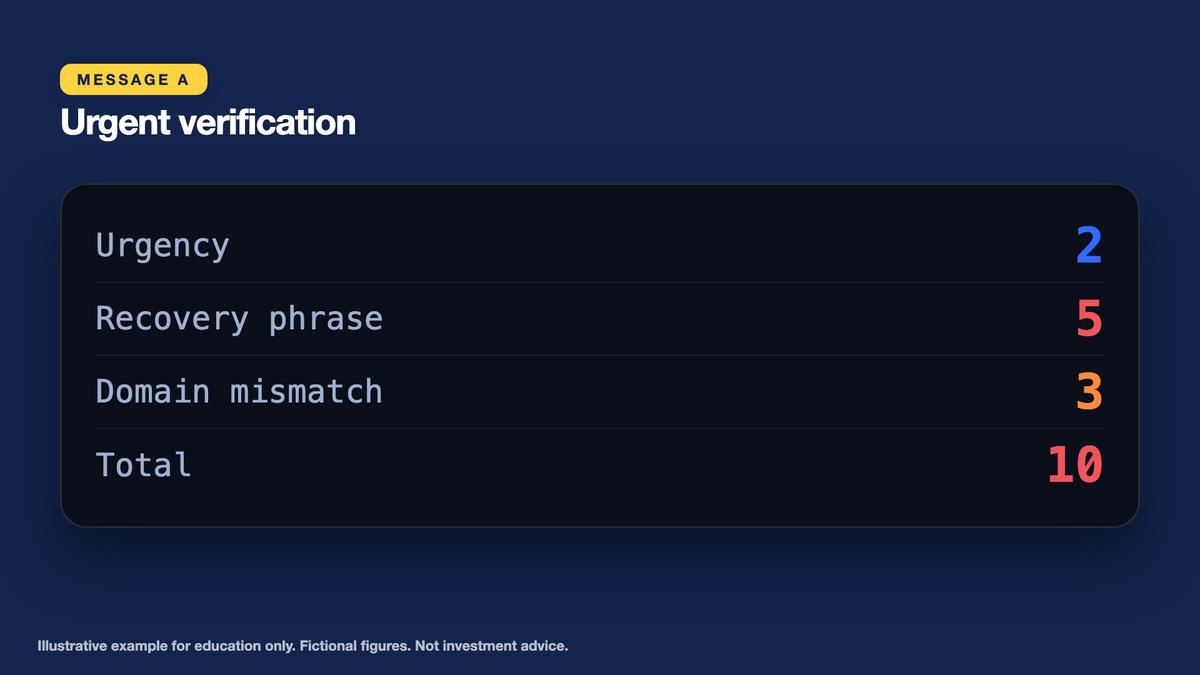
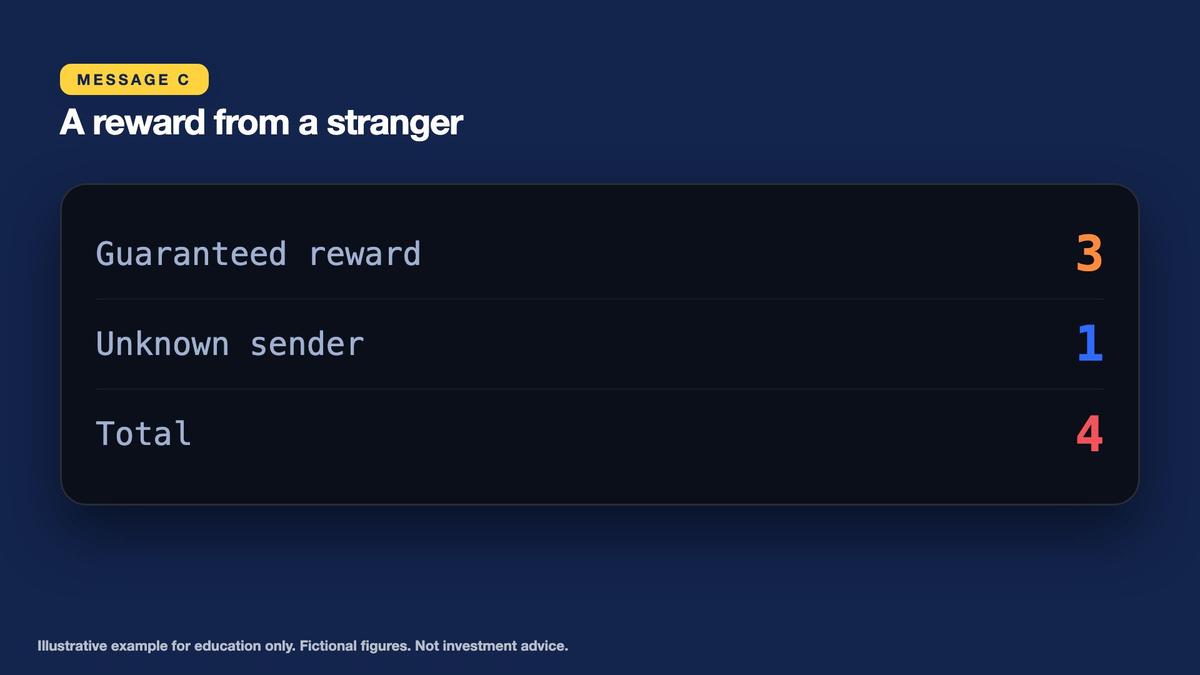
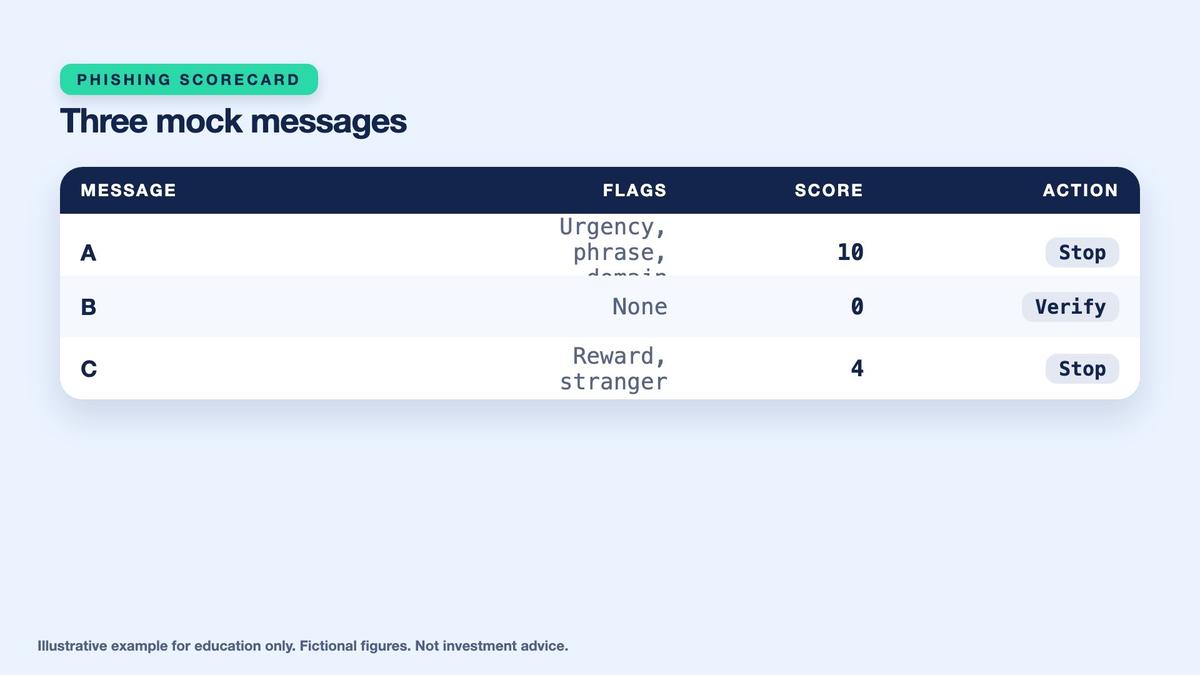
Phishing often depends on persuasion rather than sophisticated technical exploitation. We use a fictional six-factor scorecard to practice recognizing warning signs: urgency or threat receives two points, requesting a recovery phrase receives five, a domain mismatch receives three, a guaranteed reward or return receives three, an unknown sender receives one, and spelling errors receive one. Under the written classroom rule, a score of four or more means stop and do not act on the message. The weights and threshold are invented for education, not a validated model of real phishing probability. A message scoring below four can still be malicious.
Message A states: 'URGENT: verify your wallet within 24 hours at examp1e-wallet-support.test and enter your 12 words'. Assume the mock official domain for comparison is example-wallet.test. The phishing address differs, and the message combines urgency, a request for recovery information, and a mismatched domain. Its score is two plus five plus three, totaling ten. The correct response is to stop, avoid the link, never provide recovery information, and independently access the known official application through a trusted method. The .test addresses in this exercise are reserved fictional examples and are not services to visit.
Key points
- Points: recovery phrase 5, domain mismatch 3, guaranteed reward 3, urgency 2, unknown sender 1, spelling errors 1.
- Rule: 4 or more means stop. Message A = 10, Message B = 0, Message C = 4.
- A score of 0 is not proof of safety: verify in the official app, never through a link.
Message B states: 'You requested a withdrawal of 50 SMP at 10:05; if this was not you, open the official app yourself and review activity'. It scores zero under the specified categories, but zero does not establish authenticity or prove that the withdrawal occurred. The learner should still inspect activity independently inside the official application. Message C states: 'Support desk: send 1 SMP to unlock your 500 SMP reward'. Assign three points for the promised reward and one for the unknown sender, totaling four. The written rule therefore says stop. Never pay a supposed support representative to unlock an unexpected reward.
Lab Four: Inspect Token Approvals and Signing Prompts
Some token systems allow wallet owners to grant a contract permission to spend specified quantities of their tokens. Such approvals may remain active after the immediate interaction, depending on the contract and token design. A wallet can therefore face exposure even if it is not currently initiating a conventional transfer. Before approving a request, determine which token is involved, which contract receives authorization, whether the request is a one-time transfer or a continuing spending allowance, and what the maximum permitted amount is. An attractive interface or familiar-looking application is not proof that the underlying authorization is safe.
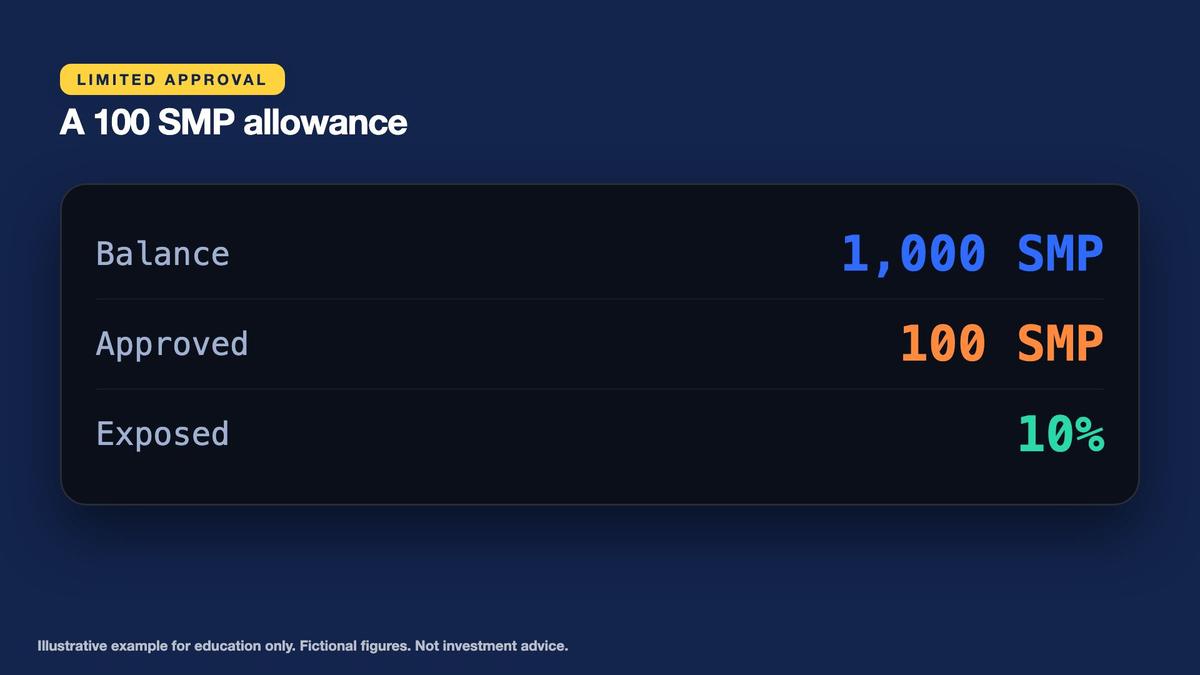
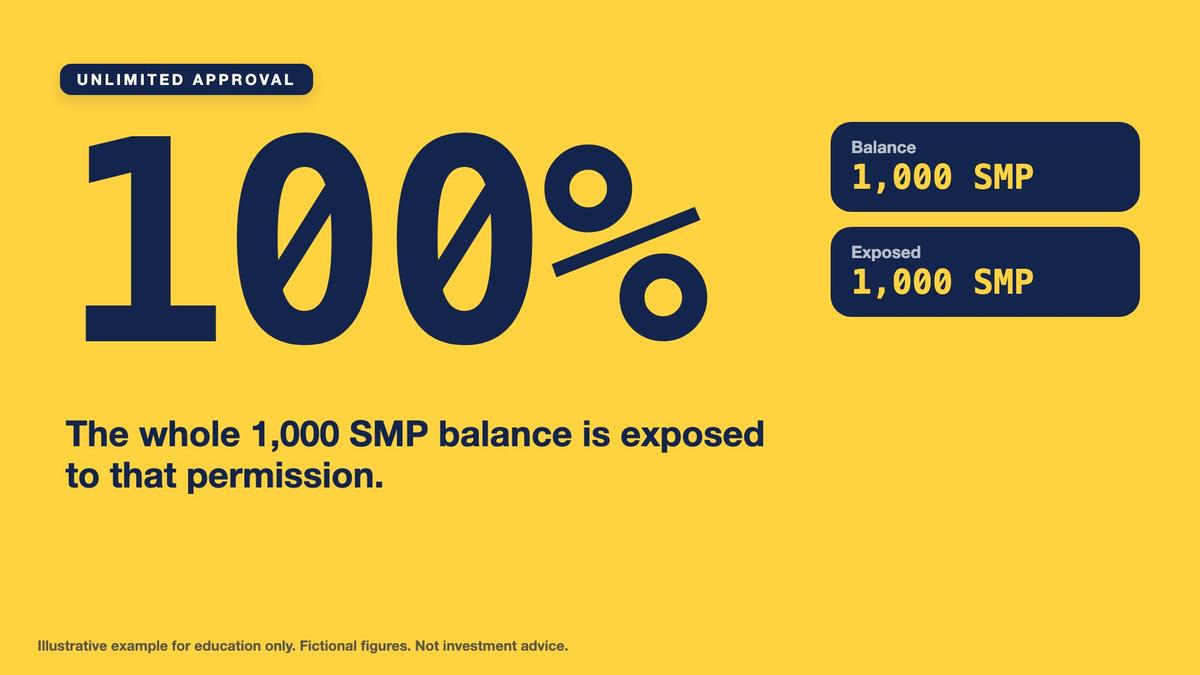
Our simulated wallet contains 1,000 SMP. A limited allowance of 100 SMP represents 100 divided by 1,000, or 10% of the balance. Under the exercise assumptions, that approval exposes at most 100 SMP through that particular allowance. An unlimited approval is modeled as permitting access to the entire current 1,000 SMP, representing 100% of the balance. These values describe potential permission exposure, not guaranteed losses. Actual contracts and balances may impose additional limits or behave differently, and future token deposits could change the amount exposed by an effectively unrestricted permission.
Key points
- A limited 100 SMP approval on 1,000 SMP exposes 10%; an unlimited approval exposes 100%.
- Read the contract, action, asset, allowance and consequences before signing.
- Review and revoke approvals you no longer need; revoking may cost a fee.
The learner should compare the two fictional permissions and identify the more tightly bounded authorization. Before signing, review the contract identity, function, asset, amount, allowance, network and expected consequence. If using a dedicated signing device, verify the information shown on the device itself rather than trusting only the computer screen. Periodically review and revoke allowances that are no longer required through verified procedures. Revocation may involve a separate transaction, may carry costs and may not undo prior transfers. This lab remains a mock permission analysis rather than a real contract interaction.
Lab Five: Dummy Recovery Phrase Transcription and Restore
Recovery materials can restore access only when they are accurate, complete and compatible with the wallet arrangement. For this lab, create a fictional sequence containing twelve placeholders named demo-1 through demo-12. These are ordinary exercise labels, not a valid cryptographic recovery phrase. Never replace them with actual recovery words. Assume each placeholder has an invented 1% probability of being copied incorrectly, independently of the other eleven placeholders. Therefore, each placeholder has a 99%, or 0.99, probability of being copied correctly. The probabilities are teaching assumptions, not measured rates of human transcription mistakes.
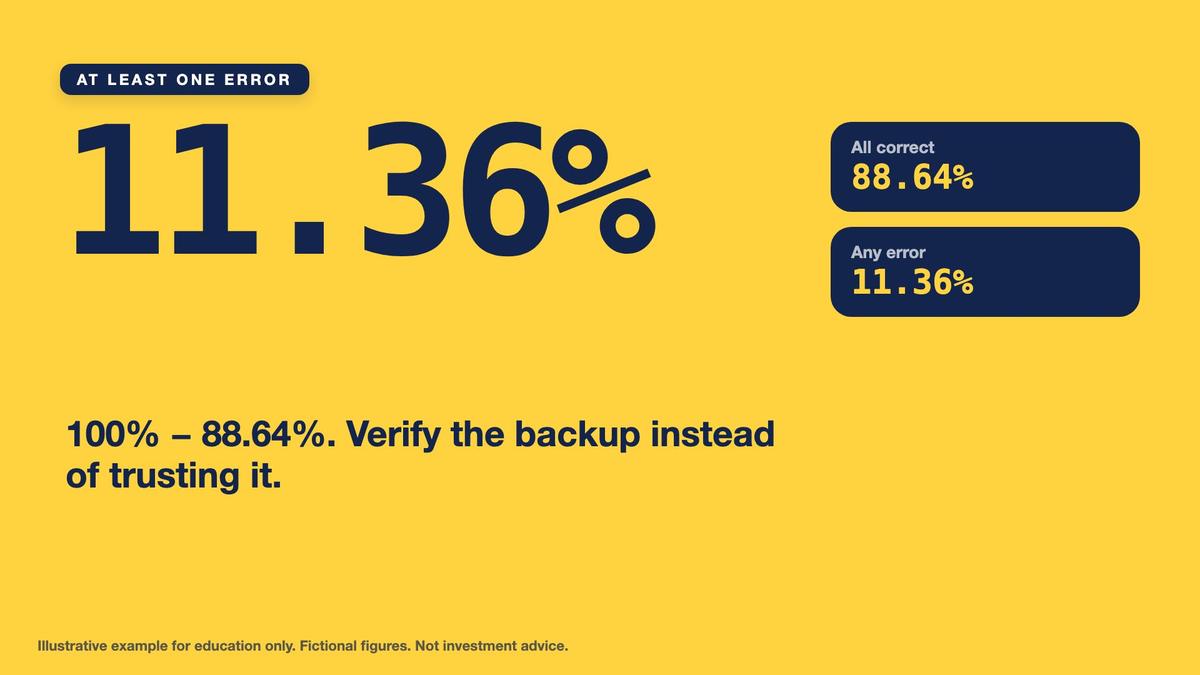
The probability that all twelve placeholders are copied correctly equals 0.99 multiplied by itself twelve times, or 0.99 raised to the twelfth power. This equals approximately 0.8863848717, or 88.64%. The probability of at least one transcription error is the complement: one minus 0.99 raised to the twelfth power, approximately 0.1136151283, or 11.36%. These calculations require the independence assumption. Real transcription errors may be correlated, and some wallet recovery procedures have additional validation mechanisms. The lesson is that a backup should be verified, not that these invented percentages describe real wallet reliability.
Key points
- Mock phrase: demo-1 to demo-12 only; never a real phrase.
- All 12 correct = 0.99^12 = 88.64%; at least one error = 11.36% (invented 1% per word).
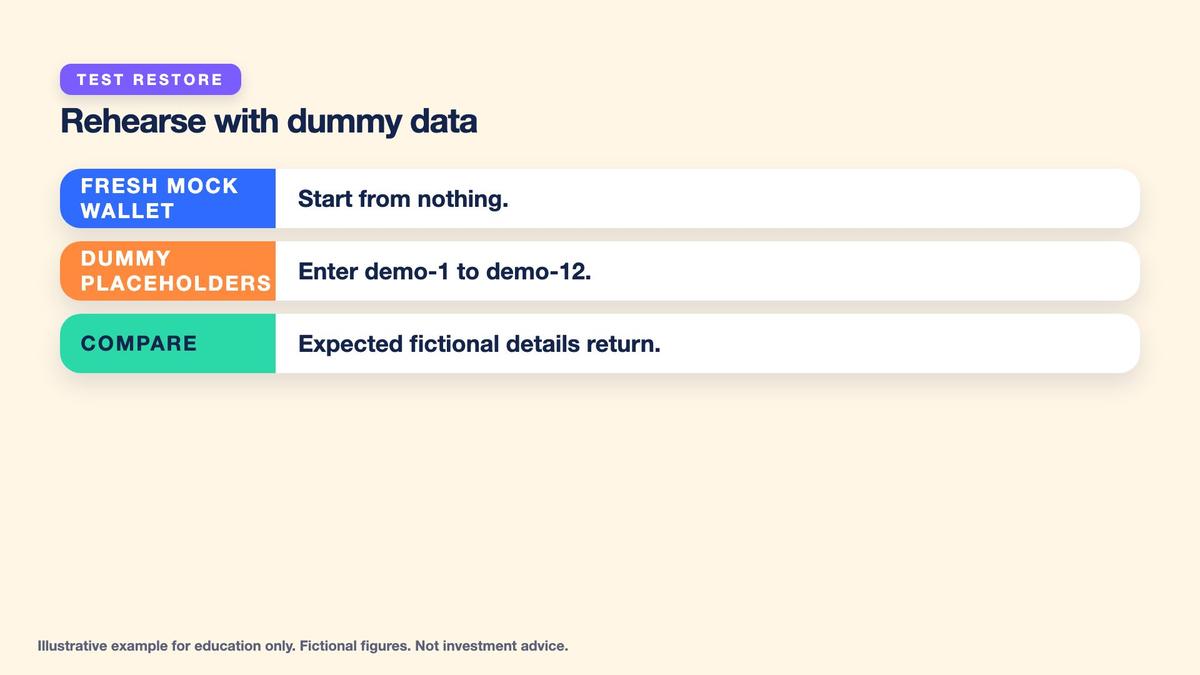
- Verify the backup with a test restore on a fresh mock wallet.
Rehearse recovery using a fresh, isolated mock wallet and the dummy placeholders only. Record the invented sequence, intentionally introduce and correct a practice transcription mistake if useful, and verify that the expected fictional wallet information is restored. Mark the backup tested only after the mock process succeeds. Real recovery phrases must never be typed into websites, photographed, uploaded into cloud notes, shared in support chats or copied into course submissions. In actual custody arrangements, compatible software, additional passphrases, configuration files or multiple keyholders may also be necessary, so a backup plan must account for all required components.
Lab Six: The Ten-Item Preflight and Device Hygiene
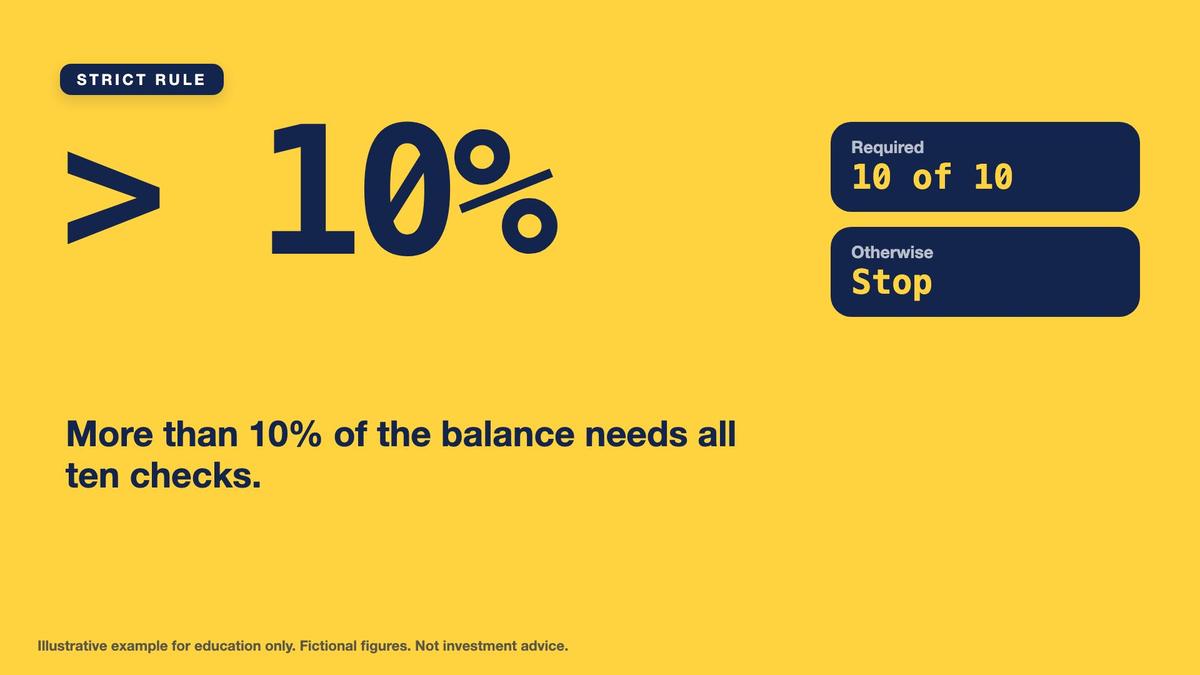
Our hypothetical transaction policy requires a ten-item preflight checklist before sending more than 10% of a simulated wallet balance. Each completed check earns one point, and the required score is ten out of ten. The checklist verifies the correct network, complete destination comparison, successful test amount, checked amount and fee, independently opened official application, no suspicious link navigation, no recovery phrase entered, reviewed approvals, tested dummy backup and updated device. The policy is stricter for larger transfers but does not imply that smaller transfers are safe without checks. A failed or uncertain item should be resolved before proceeding.
For a fictional 1,000 SMP wallet, sending 150 SMP equals 150 divided by 1,000, or 15% of the balance. Because 15% exceeds the stated 10% threshold, all ten checks are mandatory before the simulated transfer. A separate 50 SMP transfer represents 5%, so the special ten-of-ten rule is not triggered, although core transaction safety remains necessary. The threshold is an invented educational rule, not a universal risk-management standard or proof that an approved transaction will succeed. As with the earlier risk-budget lesson, the goal is to define risk controls before an action rather than after an unwanted outcome.
Key points
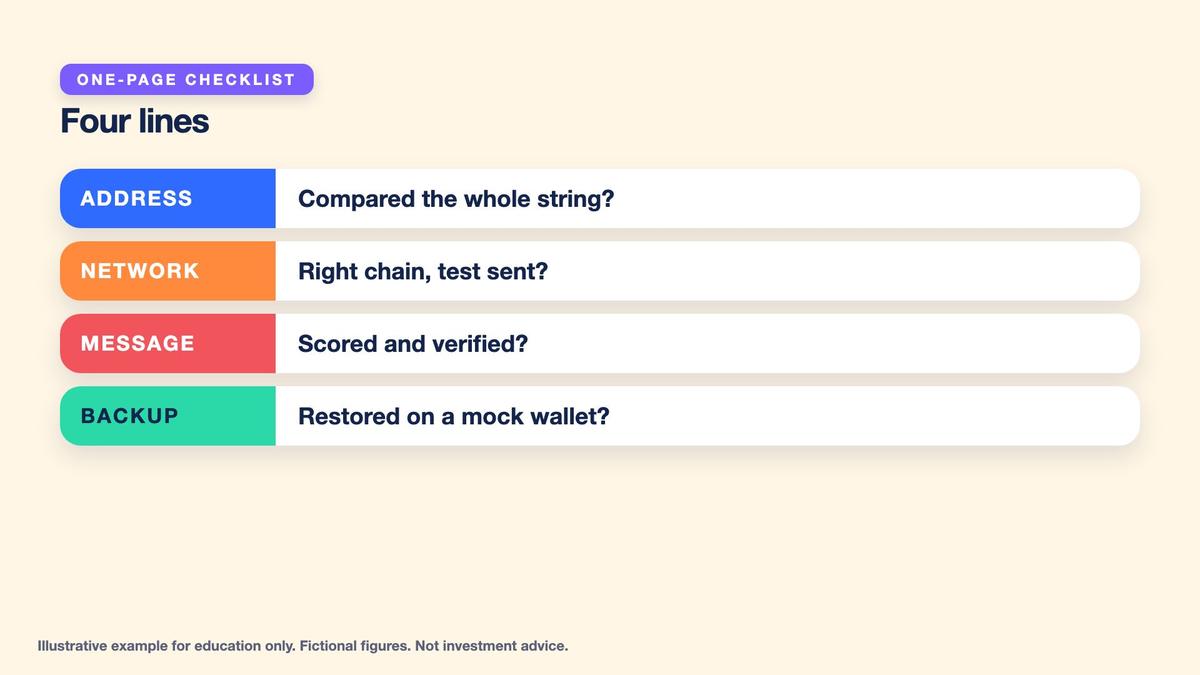
- Ten checks: network, full address, test amount, amount and fee, official app, no link, no phrase typed, approvals reviewed, backup tested, device updated.
- More than 10% of the balance needs 10 of 10: 150 of 1,000 SMP is 15%; 50 SMP is 5%.
- Keep devices updated, avoid unknown software and check the hardware device screen.
Device hygiene supports these checks. Keep operating systems and wallet-related software updated, avoid unknown applications or extensions, and consider separating sensitive financial activity from everyday browsing. If using a hardware signing device, independently verify relevant details on its trusted display. Be cautious with unusual prompts and unexpected permissions even when the interface looks familiar. Updates, separate browser profiles and hardware devices can reduce some exposure but cannot eliminate phishing, compromised credentials, faulty decisions or all malware. The learner should document device status, checklist completion, hypothetical transfer amount and any reason for stopping.
Suspected Compromise, Journaling and Final Checkpoint
When compromise is suspected, stop interacting with the suspicious message, website, wallet interface or signing request. Do not provide recovery materials to anyone promising emergency assistance. Preserve relevant observations without copying secrets, and inspect account or wallet activity using independently verified methods from a trusted, clean environment. Depending on the situation, safe containment may involve reviewing and revoking permissions, securing remaining access, or evaluating whether assets can be moved safely using verified steps. Such actions can be complicated by malicious contracts, compromised devices, pending transactions or missing keys, so do not assume that one generic response will work in every case.
Hands-On Lab: Verify, Score, Restore and Journal Mock Wallet Activity
Complete six exercises using fictional Sample Coin (SMP), Network Alpha, Network Beta, deliberately fake twelve-character destinations, reserved .test domains, mock phishing messages, fictional token permissions, and dummy recovery placeholders demo-1 through demo-12. Never use real addresses, private keys, seed phrases, wallet products, exchanges, websites, or actual transfers. Apply the specified fee convention: each network fee is deducted from the stated send amount. Treat all probabilities, phishing weights, thresholds and balances as invented teaching assumptions. For the final checklist, award one point per completed item and require ten out of ten before any simulated transfer exceeding 10% of the wallet balance. Record all calculations, verification steps, observations, status decisions and limitations in a dated mock execution journal.
- Decision 1: A legitimate fictional destination is DEMO7F2K91XQ, while the suggested destination is DEMO7F2K19XQ. Both have twelve characters, and the learner notices that their beginnings and endings look similar. — Compare the complete identifiers, calculate their positional similarity, identify mismatched positions, and decide whether to proceed.
- Decision 2: A fictional recipient accepts SMP only through Network Alpha. Alpha charges 0.5 SMP per transfer, Beta charges 0.1 SMP, and the learner intends to send 100 SMP with fees deducted from each stated amount. — Compare direct versus test-first transfers using Network Alpha, calculate recipient receipts and total fees, and explain why Network Beta is inappropriate.
- Decision 3: The phishing scorecard assigns urgency 2 points, recovery phrase requests 5, domain mismatch 3, guaranteed rewards 3, unknown senders 1, and spelling errors 1. Scores of four or more require stopping. — Evaluate mock messages A, B and C, then explain why a zero-point message still requires checking through the independently opened official app.
- Decision 4: A fictional wallet contains 1,000 SMP. One contract requests a limited allowance of 100 SMP, and another requests unrestricted token spending. Separately, twelve dummy recovery placeholders each have an invented independent 1% transcription-error probability. — Calculate the approval exposure percentages and the probability of an entirely correct dummy recovery transcription, then describe the safer verification procedure.
- Decision 5: A simulated wallet holds 1,000 SMP and uses a ten-item preflight checklist. Every completed item earns one point, and the policy requires 10/10 before sending more than 10% of the balance. — Determine whether transfers of 150 SMP and 50 SMP trigger the full checklist, and outline what to journal after a suspected compromise.
Answer key
A useful incident journal records the date, suspicious message features, mock destination, chosen network, attempted authorization, observed status, affected permissions, and actions taken. It should also document any reports made through independently verified channels, without including a real private key, recovery phrase or usable address. The journal separates evidence from assumptions and notes whether the device, account, contract or recovery process remains trustworthy. Learners should retain the original observations rather than rewriting them to make the outcome appear predictable. The previous custody lesson provides the broader context: key control determines who has recovery responsibilities, while counterparty and operational risks can remain under either model.
Key points
- If compromise is suspected: stop, use a clean device, review approvals, report through verified channels.
- Record a dated incident journal without exposing secrets.
- Verify 10 of 12, 83.3%, 1.0 versus 0.5 SMP, 10/0/4, 10% versus 100%, 11.36% and 15%.
The final checkpoint combines all six exercises. Identify the two mismatched positions in the twelve-character destination strings and calculate 83.3% positional similarity. Verify that the Alpha network test-first plan delivers 99 SMP after 1.0 SMP total fees, compared with 99.5 SMP directly. Score mock phishing messages A, B and C as ten, zero and four, while independently reviewing B. Calculate 10% limited approval versus 100% unlimited approval, and 88.64% error-free dummy transcription versus 11.36% chance of at least one error. Finally, show that a 150 SMP transfer from a 1,000 SMP balance is 15% and requires all ten preflight checks. Save the completed fictional safety journal.
Worked example at a glance
Key terms
- Social engineering: manipulating a person, rather than code, to gain access or action.
- Lookalike address: a destination that closely resembles a trusted one.
- Address poisoning: planting a similar-looking address so you copy the wrong one.
- Network: the blockchain a transfer moves over; it must match the recipient.
- Test transaction: a small transfer sent first to confirm the route.
- Phishing: deceptive messages that trick you into acting or revealing secrets.
- Token approval: permission for a contract to spend your tokens.
- Allowance: the amount a contract may spend under an approval.
- Recovery phrase: secret words that can regenerate wallet keys; never share them.
- Test restore: rehearsing recovery on a fresh wallet with dummy data.
- Preflight checklist: checks completed before sending a transfer.
- Hardware wallet: a dedicated device that signs transactions on its own screen.
Multi Asset Trading Lab provides educational information only and does not constitute personalized investment, trading, financial, cybersecurity, legal, tax, custody, or operational security advice. Every instrument, domain, identifier, network, address-like string, wallet balance, message, permission, transaction, probability, risk score and outcome in this lesson is entirely fictional and exists only for simulation and classroom calculations. No real assets, exchanges, wallet products, recovery phrases, private keys, seed phrases, addresses, websites, or prices are used. The deliberately fake identifiers DEMO7F2K91XQ and DEMO7F2K19XQ are twelve-character classroom strings, not usable blockchain destinations. The example domains example-wallet.test and examp1e-wallet-support.test use the reserved .test suffix and are fictional labels; they must not be opened or treated as actual services. The placeholders demo-1 through demo-12 are not a genuine recovery phrase and must never be replaced with real recovery words in a training system. No learner should enter, upload, photograph, share, or transmit actual recovery phrases, private keys, signing credentials, account passwords, or real wallet addresses as part of any exercise. Cryptocurrency transfers and smart-contract signatures may be irreversible, and incorrect destinations, network choices, malicious permissions, malware, phishing, or compromised signing devices can result in substantial permanent losses. Copy-and-paste is not sufficient to establish recipient authenticity because clipboard manipulation, address poisoning and compromised interfaces can substitute misleading information. Comparing the full destination reduces some avoidable mistakes but does not guarantee that the trusted source itself is authentic. The mock address similarity calculation identifies exactly two mismatched positions among twelve, giving approximately 83.3% similarity; a high character-match percentage is not evidence that two destinations are interchangeable. Network Alpha, Network Beta and Sample Coin (SMP) are fictional. The Alpha fee of 0.5 SMP and Beta fee of 0.1 SMP are invented and do not describe any actual network. The classroom assumes that each fee is deducted from the stated amount sent, so a direct 100 SMP transfer delivers 99.5 SMP, while a 1 SMP test followed by 99 SMP delivers 0.5 SMP and 98.5 SMP respectively, totaling 99 SMP after 1.0 SMP of fees. The test-first approach incurs an additional 0.5 SMP cost relative to the direct approach. Real transfer fees, token quantities, fee currencies, minimum amounts and settlement mechanics can differ substantially. A successful test transfer can identify some errors but does not guarantee subsequent transaction safety or recovery. The phishing scorecard is an invented heuristic for educational practice and is not a validated security classifier or a probability model. Its point allocations are urgency or threat 2, recovery phrase request 5, domain mismatch 3, guaranteed reward or return 3, unknown sender 1, and spelling errors 1. The four-point stopping rule is a classroom threshold only. Mock messages A, B and C score 10, 0 and 4 respectively under the stipulated classification assumptions. A score of zero never proves authenticity, and a high score does not establish the identity of a sender; all sensitive events must be independently verified through trusted channels. No reward, support request, urgent message, or apparent account alert should be used as a reason to share recovery materials or make unverified payments. Token approval calculations assume a fictional wallet holding 1,000 SMP, where a limited 100 SMP allowance represents 10% of the balance and an unrestricted allowance is modeled as exposing the full 1,000 SMP or 100%. Actual allowance mechanics depend on contract logic, token balances, delegated authority, signature types, prior approvals, and possible future deposits. A limited approval can reduce potential exposure but does not guarantee that the approved contract is safe. Revoking permissions may require a separate transaction and may not reverse already completed transfers or remedy every type of compromise. Wallet signing requests must be evaluated for contract identity, destination, network, requested function, amount, allowance and other meaningful consequences. Dedicated signing devices and isolated browser profiles may reduce some risks but cannot prevent all malicious approvals, device compromise, supply-chain attacks, or user mistakes. The recovery transcription example uses twelve dummy placeholders and an invented independent one-percent error probability for each placeholder. The modeled probability that all twelve are transcribed correctly is 0.99^12, approximately 88.64%, and the probability of at least one transcription error is approximately 11.36%. These values are teaching assumptions, not measured human-error rates, real wallet restoration failure probabilities, or predictions of backup success. The independence assumption may not hold in practice, and genuine recovery systems can include checksums, additional credentials, passphrases, multiple keys or other requirements. Test restoration in this course must use dummy credentials and a fresh isolated mock wallet only. Real recovery secrets should never be exposed to training platforms, online forms, customer support agents, shared documents, screenshots or ordinary cloud notes. The ten-item preflight is an invented educational procedure. It awards one point for each of the following: correct network, complete address comparison, confirmed test transaction, checked amount and fee, independently opened official app, no suspicious link navigation, no recovery phrase entered, reviewed token permissions, tested mock backup and updated device. Its stated rule requires all ten items before a simulated transaction greater than ten percent of the 1,000 SMP balance. The 150 SMP example equals 15% and triggers the ten-of-ten requirement, whereas the 50 SMP example equals 5% and does not trigger that additional threshold. Neither completing ten checks nor making a smaller transfer guarantees safety, correctness, settlement or recoverability. Device security, software integrity, trusted application access, user authorization, legal control and operational circumstances may create risks beyond the listed checks. If compromise is suspected, stopping interaction with suspicious software or contacts and preserving observations can reduce additional exposure, but response actions depend on what has been compromised. Transferring remaining real assets or revoking permissions may expose a user to additional risks if the signing environment remains compromised or the proposed transaction is malicious. The course does not instruct learners to perform real emergency transfers. In a real incident, independently verified professional assistance and appropriate reporting channels may be necessary; never provide usable recovery secrets to anyone claiming that disclosure is required for rescue. The previous lessons' custody responsibilities and risk-budget rules remain conceptual planning frameworks, not guarantees against theft, mistaken transfers, counterparty failure or financial loss. Every exercise uses simulated money and mock information only. No real purchase, sale, wallet connection, contract approval, network transaction, exchange account, or financial commitment is required or encouraged. Nothing in this lesson recommends a particular wallet product, security provider, blockchain network, financial instrument, investment strategy or real transaction.
Lesson Checkpoint
Review what you learned and get feedback on your work.