



In this twelve-minute beginner lesson, learners compare custodial exchange accounts with self-custody wallets by examining who controls private keys, who can authorize transactions, and who is responsible when access is lost. Using entirely fictional custody arrangements and invented teaching probabilities, learners calculate expected losses for exchange custody, unverified self-custody backups, tested backups, and a mixed custody arrangement. They also study hot and cold storage, hardware and software wallets, recovery phrases, multisignature authorization, backup redundancy, phishing risks, and emergency planning. A 2-of-3 multisignature example demonstrates how shared authorization can reduce single-key failure risk, while a separate ten-year backup illustration shows the trade-off between preventing total backup loss and increasing potential theft exposure. The lesson distinguishes expected loss from worst-case outcomes, explains why account recovery differs from private-key recovery, and culminates in a one-page custody decision checklist and simulated security journal. Every probability is an invented teaching assumption rather than an estimate of real-world risk. No actual wallets, keys, addresses, seed phrases, transactions, or investments are used.
Custody Means Control of Private Keys
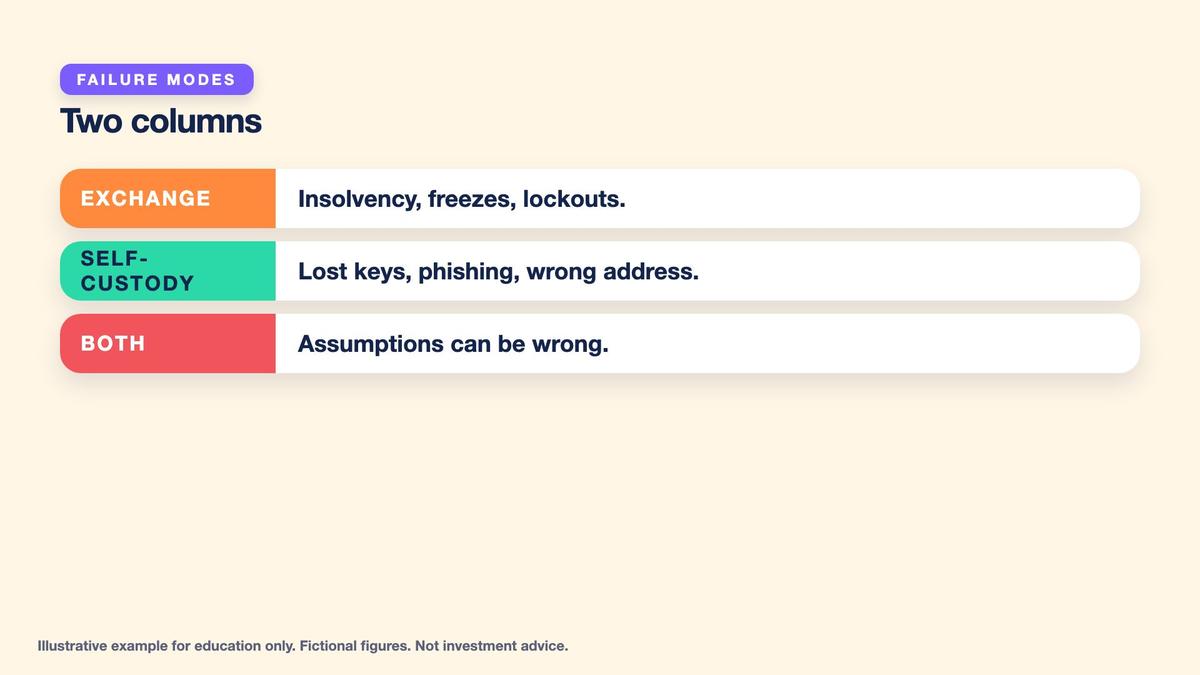
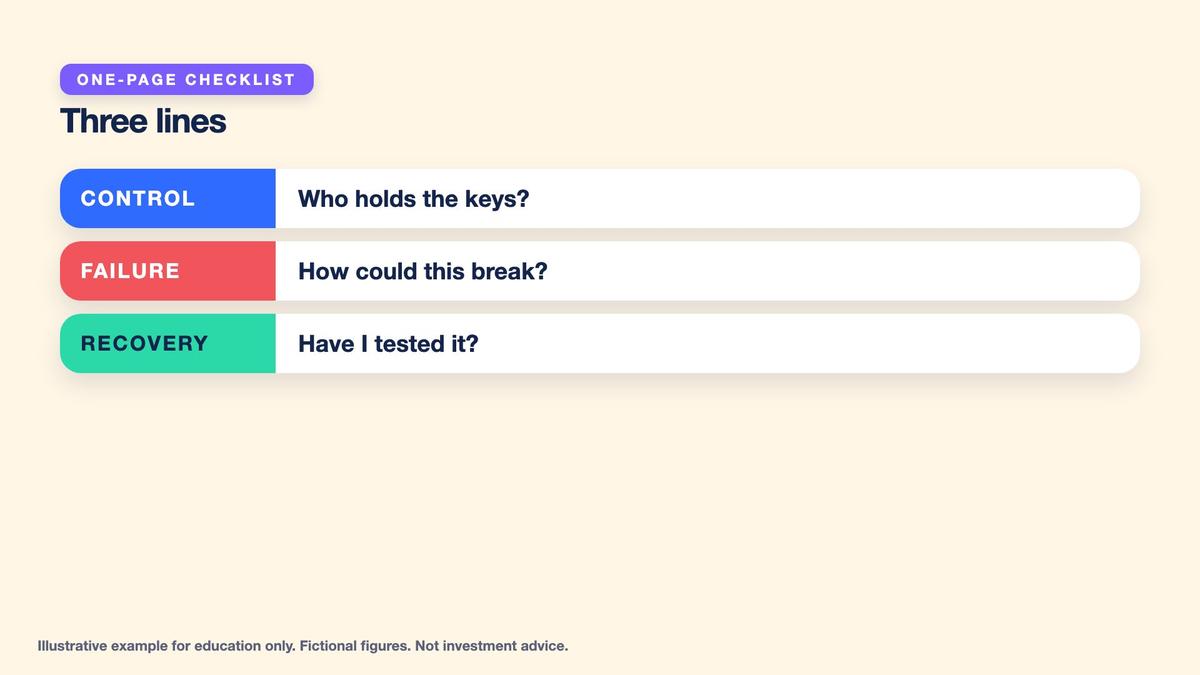
Digital asset custody begins with a simple question: who controls the private keys used to authorize transactions? On a custodial exchange, the provider ordinarily controls the signing infrastructure and records customer balances internally. The customer may have a contractual claim to assets, withdrawal rights, or other entitlements depending on the platform's terms and applicable arrangements. On a self-custody wallet, the user controls the keys or key shares needed to authorize spending. These arrangements can display similar balances but place security duties and recovery responsibilities in different hands. The difference becomes especially important when an exchange fails, an account is locked, or a wallet backup disappears.

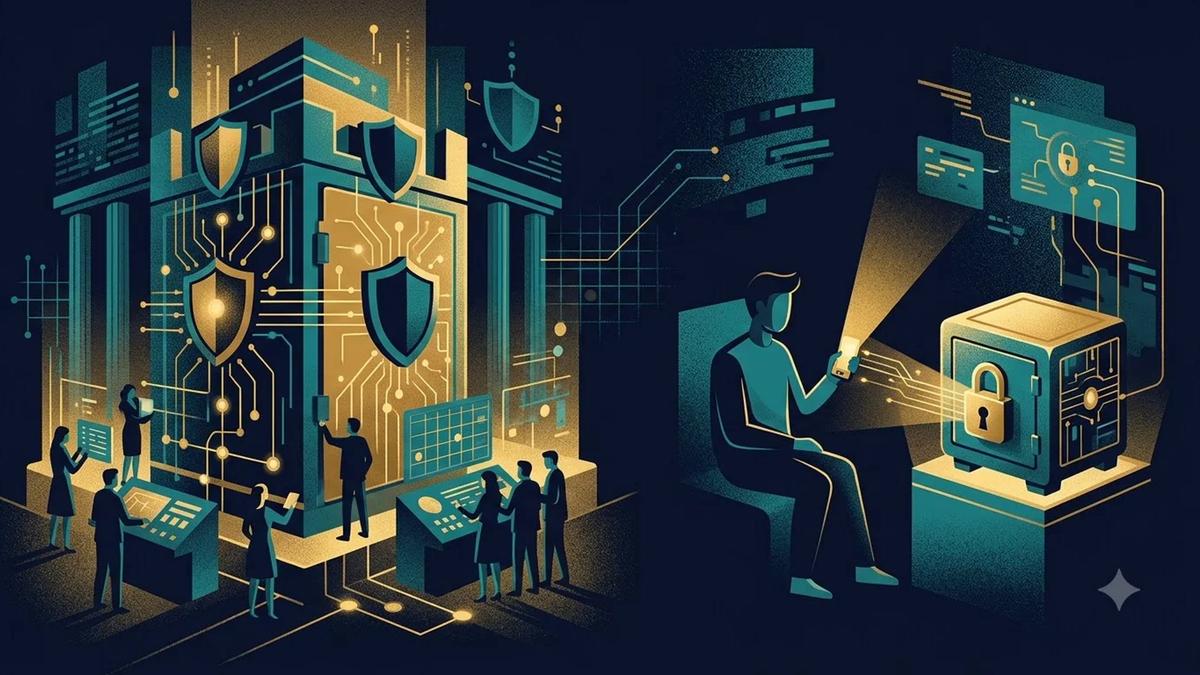

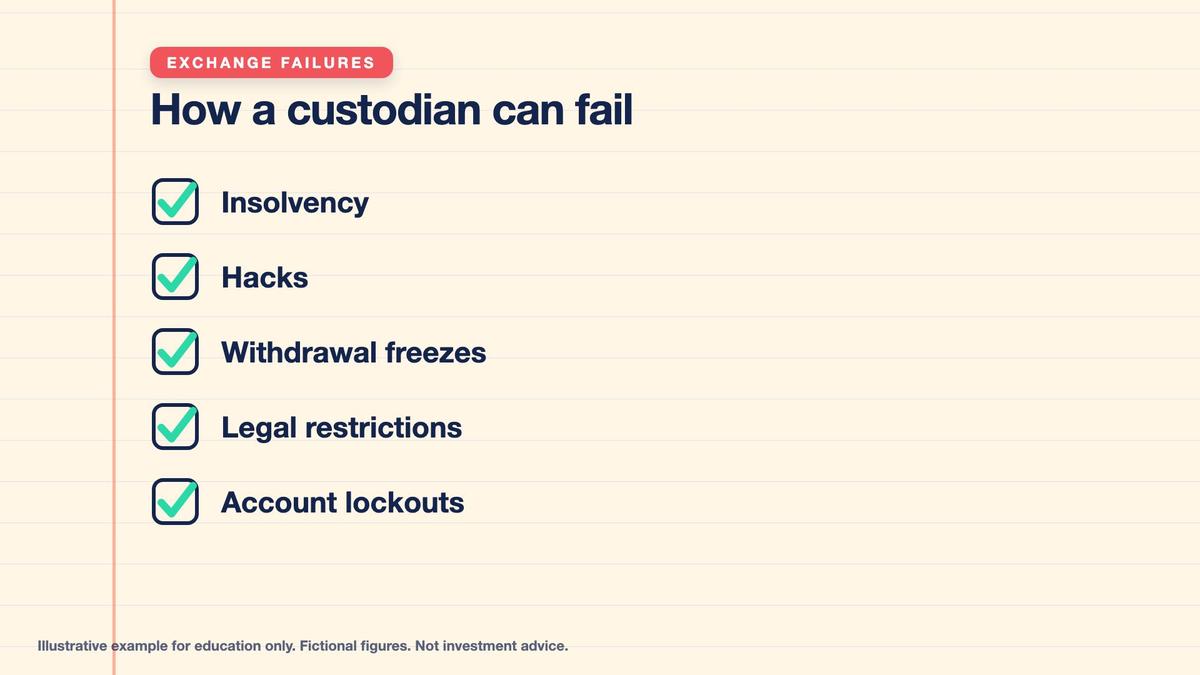
Custodial platforms can provide familiar account features such as passwords, authentication, identity verification, customer support, trading interfaces, and account recovery procedures. These conveniences can reduce some personal key-management burdens. However, account recovery does not guarantee that the platform remains solvent or that customer assets will be available for withdrawal. An exchange may suffer insolvency, theft, internal control failures, legal restrictions, withdrawal freezes, or prolonged service outages. A learner should understand the distinction between recovering access to an account interface and recovering the underlying assets represented by the account balance.
Key points
- Custody means controlling the private keys that authorize transactions.
- On a custodial exchange the provider holds the keys; in self-custody you do.
- A balance on a screen does not show who controls the keys.
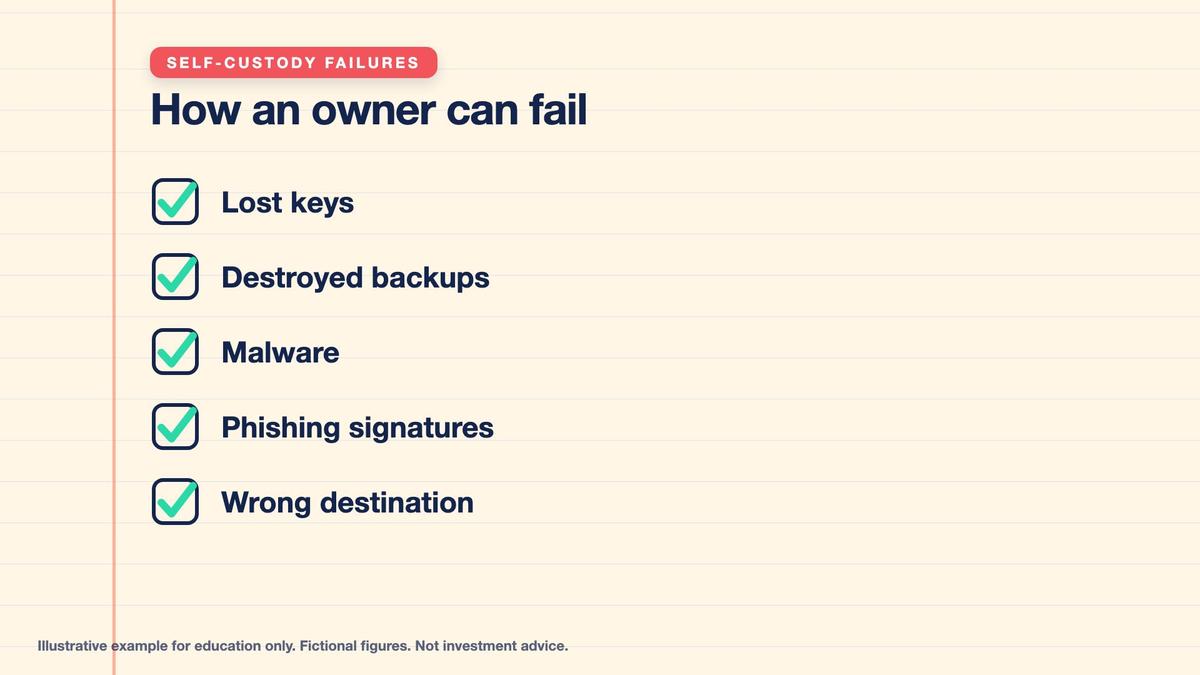
Self-custody moves signing authority to the individual or to a user-selected shared authorization arrangement. This can reduce dependence on a single exchange's withdrawal permissions, but it transfers substantial responsibilities to the keyholder. Lost keys, destroyed backups, malicious software, phishing signatures, irreversible transfers, and inheritance difficulties may create permanent losses. The phrase not your keys, not your coins emphasizes the limitations of custodial claims, but it leaves out an equally important fact: controlling keys is not itself proof that they are securely stored, recoverable, or protected from mistaken authorization.
Hot, Cold, Software and Hardware Storage
Wallet arrangements can be compared by how signing keys are stored and used. Hot storage involves keys or signing environments connected to online systems. This can make frequent transactions convenient but creates exposure to internet-connected software, devices, and operational processes. Cold storage generally keeps signing secrets offline and may reduce certain remote attack opportunities. However, offline storage does not prevent physical theft, damage, incorrect backups, social engineering, or mistakes when a user eventually authorizes a transaction. The terminology describes operational arrangements rather than an absolute safety ranking.
A software wallet is an application used to manage blockchain account information, prepare transactions, and interact with signing keys. A hardware wallet uses a dedicated device intended to protect signing secrets while authorizing transactions. Hardware devices can reduce some forms of key exposure, but they do not automatically protect users who approve malicious transactions, trust incorrect destinations, expose backup materials, or obtain compromised devices. The security of either arrangement depends on implementation, authentic software, device integrity, backups, and the learner's ability to understand transaction requests.
Key points
- Hot storage is online and convenient; cold storage keeps keys offline.
- Software wallets sign in an app; hardware wallets sign inside a dedicated device.
- A recovery phrase can regenerate keys: never type, photograph, cloud-store or share it.
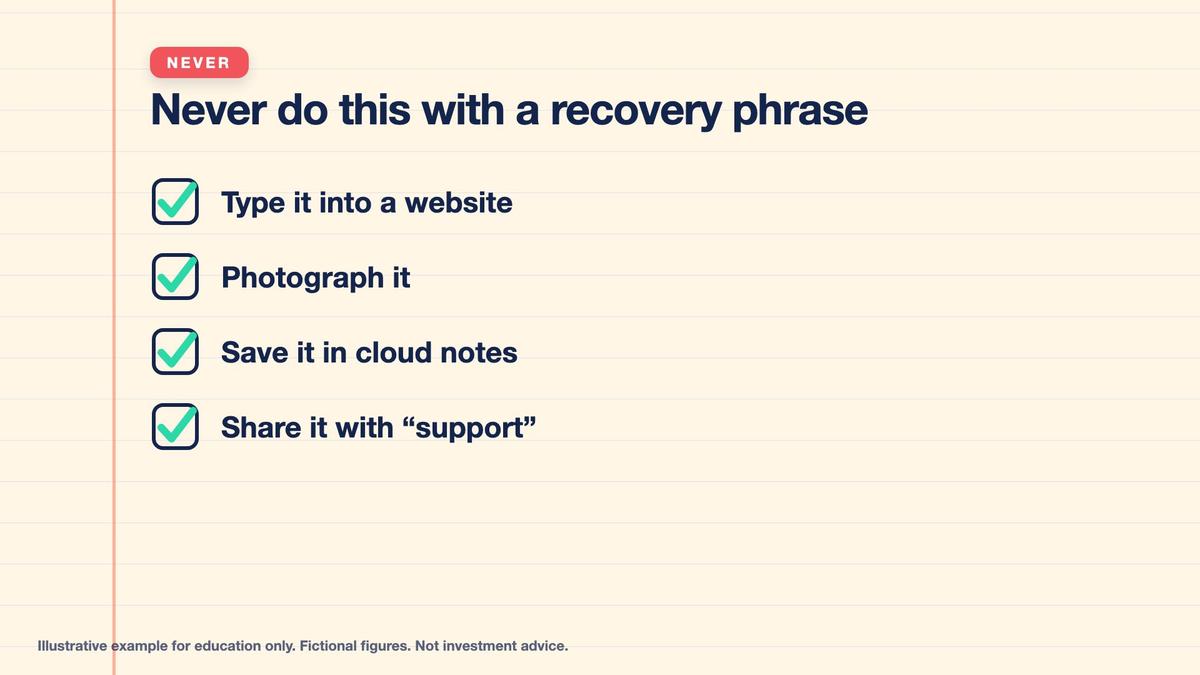
Recovery phrases are particularly sensitive because they can regenerate signing keys in compatible wallet designs. Never type a real recovery phrase into a website, share it with customer support, photograph it, place it in ordinary cloud notes, or submit it to a training exercise. A genuine recovery process should not require giving an unrelated person control of the recovery secret. Some wallet arrangements also use additional passphrases, multiple keys, or other information beyond a recovery phrase. Therefore, recovery planning must identify all required components without recording usable secrets in a publicly accessible journal.
Expected Loss: Exchange Versus Self-Custody
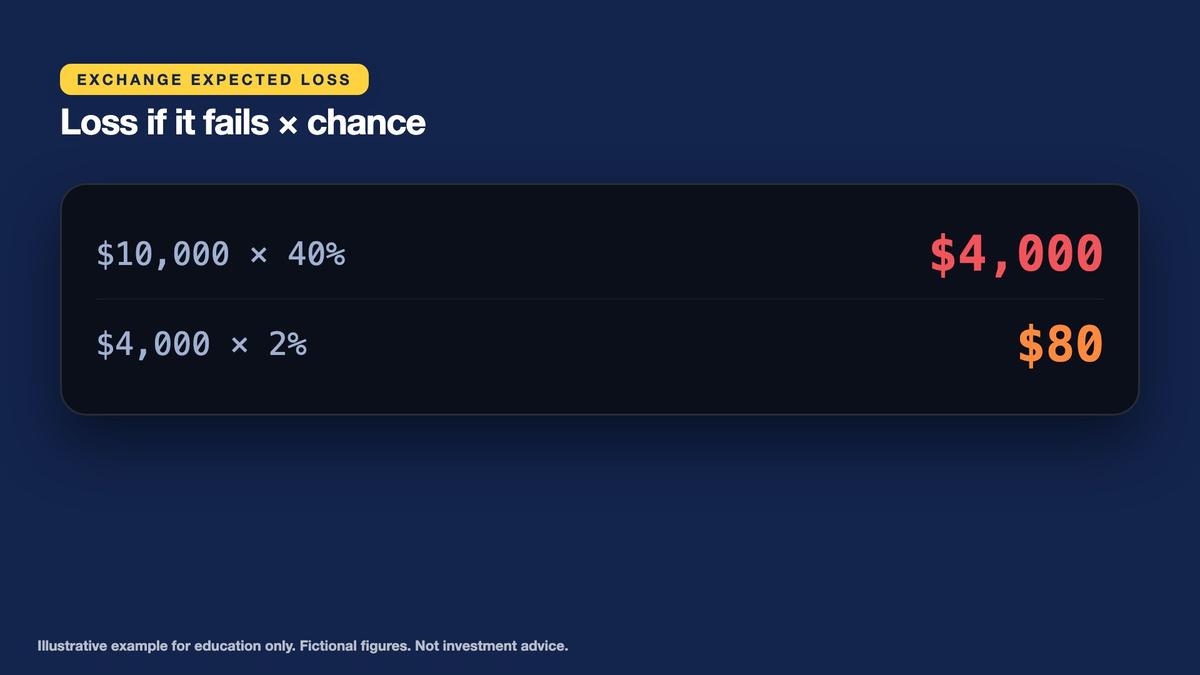
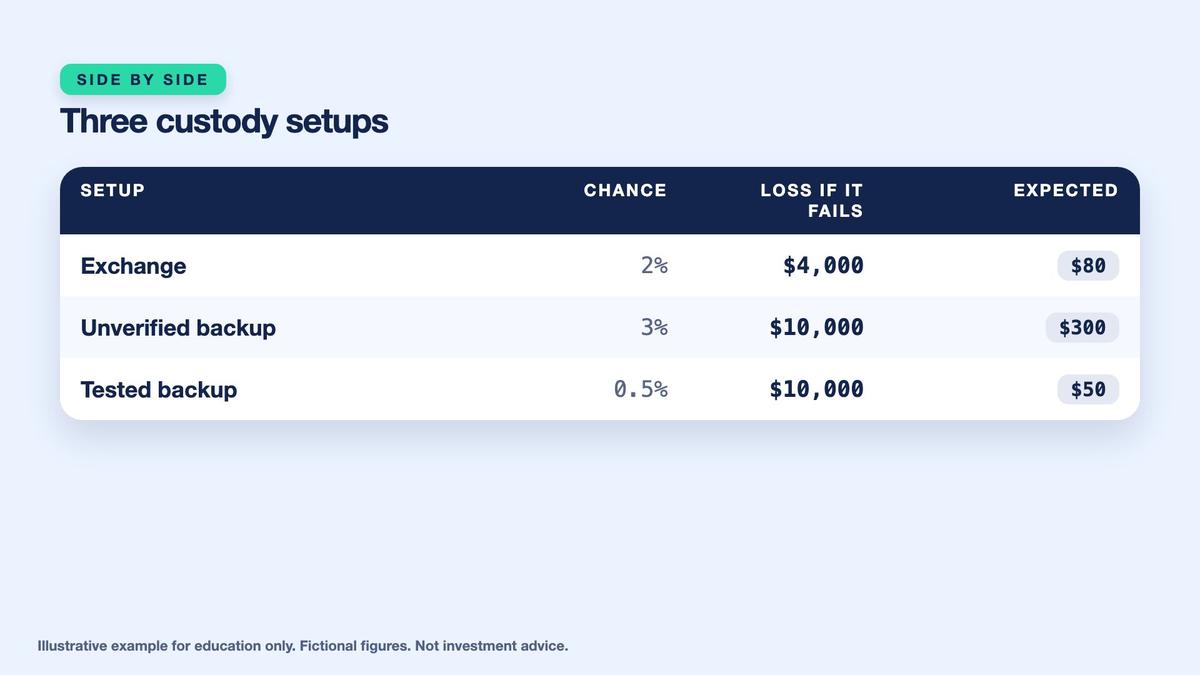
Our first mathematical comparison uses a simulated $10,000 balance and entirely invented annual failure probabilities. These probabilities are classroom assumptions, not estimates of actual custody risk. Suppose a fictional custodial exchange has a 2% chance of failure over one year. If failure occurs, customers recover 60% of their claims, leaving a 40% loss. The loss on a $10,000 balance is $4,000. Multiplying the assumed failure probability by that loss gives 0.02 multiplied by $4,000, or $80 of modeled expected annual loss. The result represents an average across hypothetical outcomes, not a charge deducted from every account.
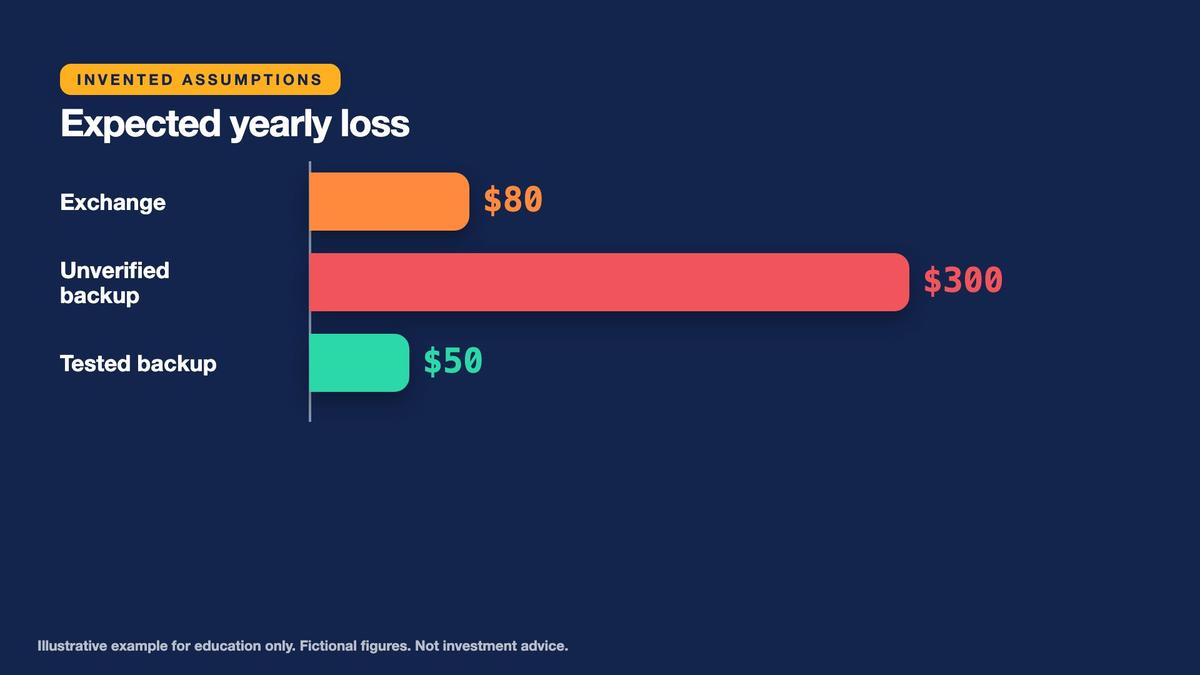
Next consider self-custody with a single unverified recovery backup. Assume an invented 3% annual probability of irrecoverably losing access and a 100% loss when that event occurs. Expected loss is 0.03 multiplied by $10,000, or $300. Now assume the owner has a tested recovery backup, and assign a lower invented access-loss probability of 0.5%. Expected loss becomes 0.005 multiplied by $10,000, or $50. These figures demonstrate how modeled outcomes depend on assumptions about recovery quality. They do not establish that tested self-custody is always safer than a custodial provider in actual circumstances.
Key points
- Invented assumptions on $10,000: exchange 2% failure, 60% recovery, so loss if it fails $4,000 and expected loss $80.
- Unverified backup 3% x $10,000 = $300; tested backup 0.5% x $10,000 = $50.
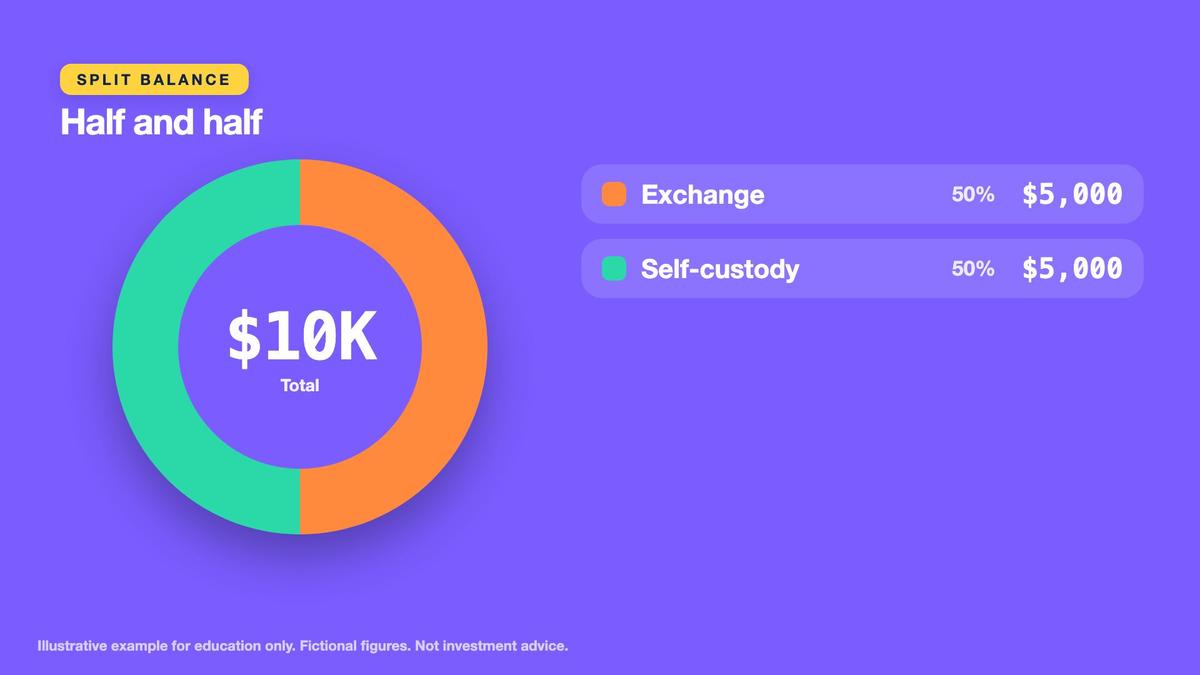
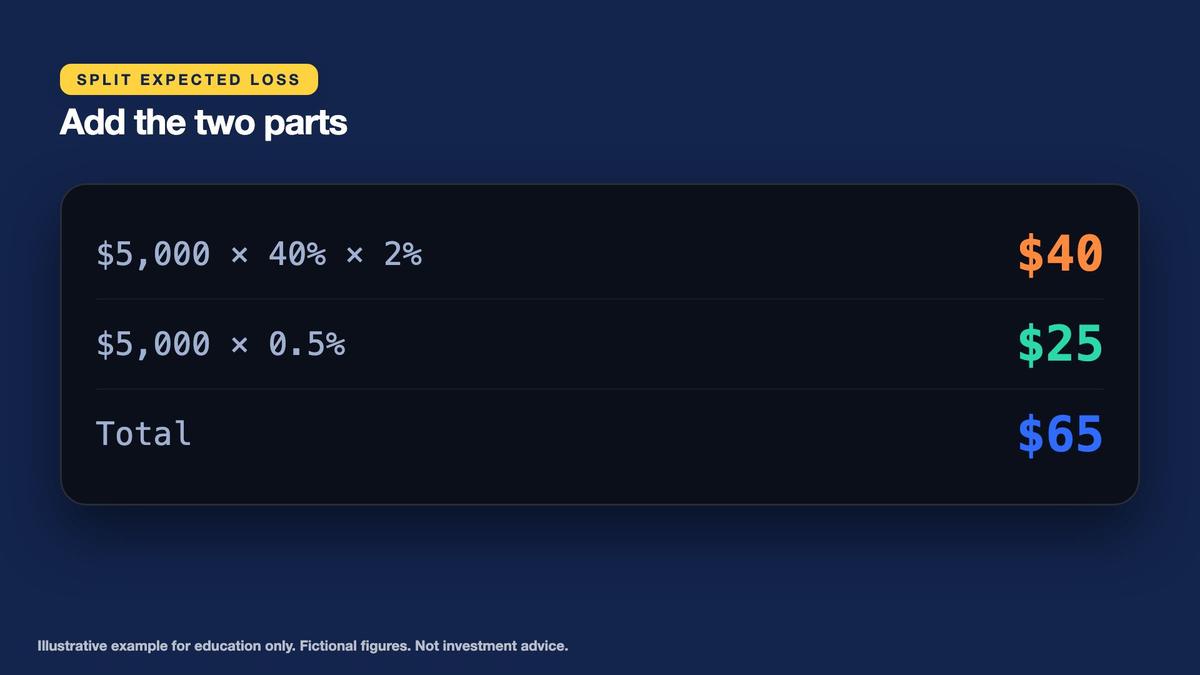
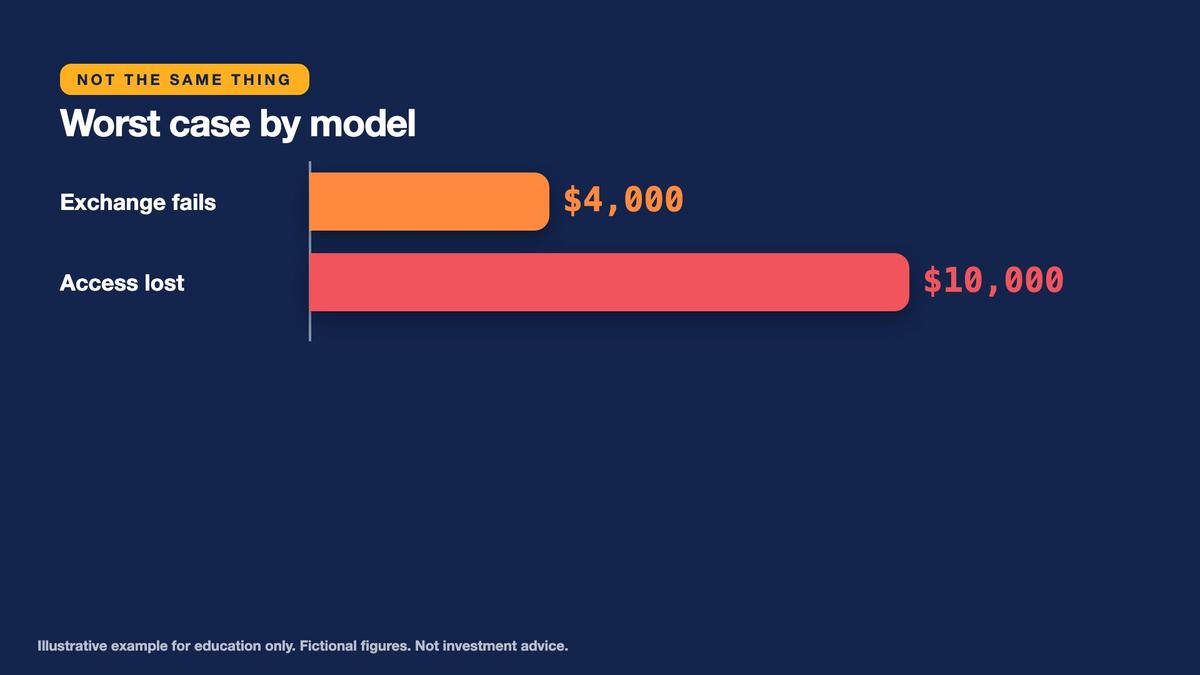
- Split $5,000 and $5,000: $40 + $25 = $65. Worst cases: $4,000 on the exchange, $10,000 in self-custody.
For a mixed arrangement, divide the simulated $10,000 evenly: $5,000 on the fictional exchange and $5,000 in tested self-custody. The exchange portion has expected loss of 0.02 multiplied by 40% multiplied by $5,000, giving $40. The self-custody portion has expected loss of 0.005 multiplied by $5,000, giving $25. Total modeled expected loss is $65. Expected loss should not be confused with worst-case loss: the exchange's modeled failure event loses $4,000 on a full $10,000 balance, while complete unrecoverable self-custody access loss destroys the entire $10,000. Correlated failures may also affect more than one custody arrangement at once.
Multisignature Authorization and Shared Responsibility
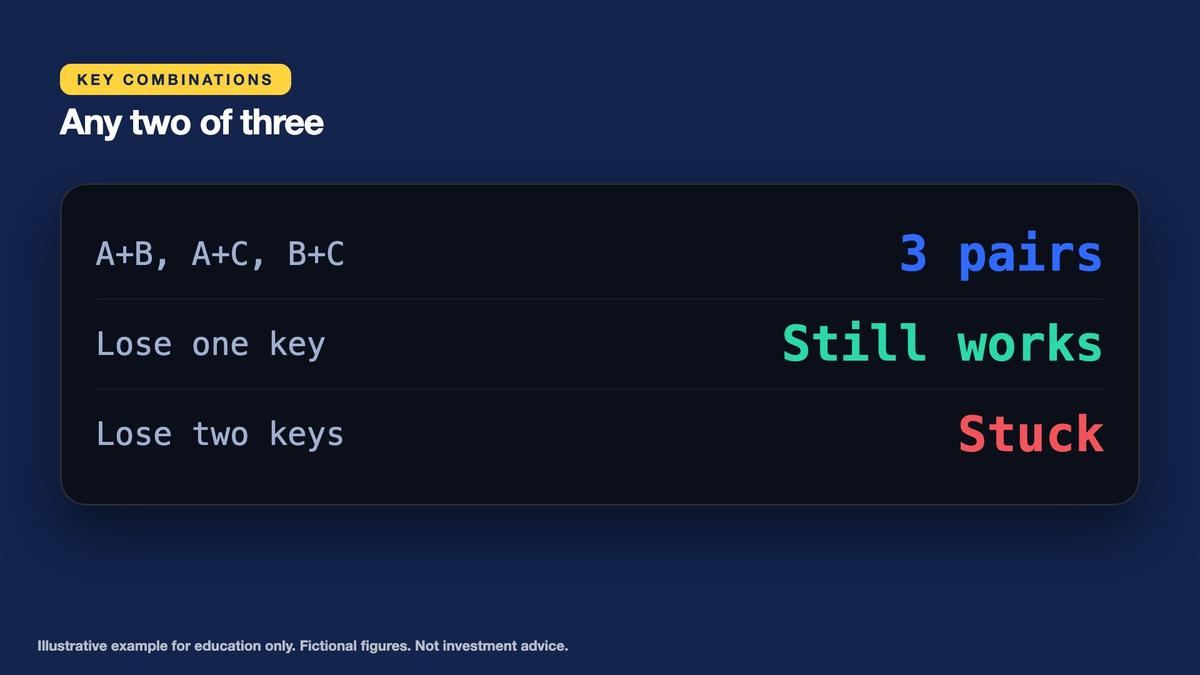
Multisignature authorization changes how many keys are required to approve spending. In our fictional 2-of-3 wallet, three separate signing keys exist and any two can jointly authorize a valid transaction. The number of distinct two-key combinations is three: the first and second keys, the first and third keys, or the second and third keys. Mathematically, the number of combinations is three factorial divided by two factorial multiplied by one factorial, which equals three. This simple example illustrates a threshold authorization system rather than a particular wallet product.
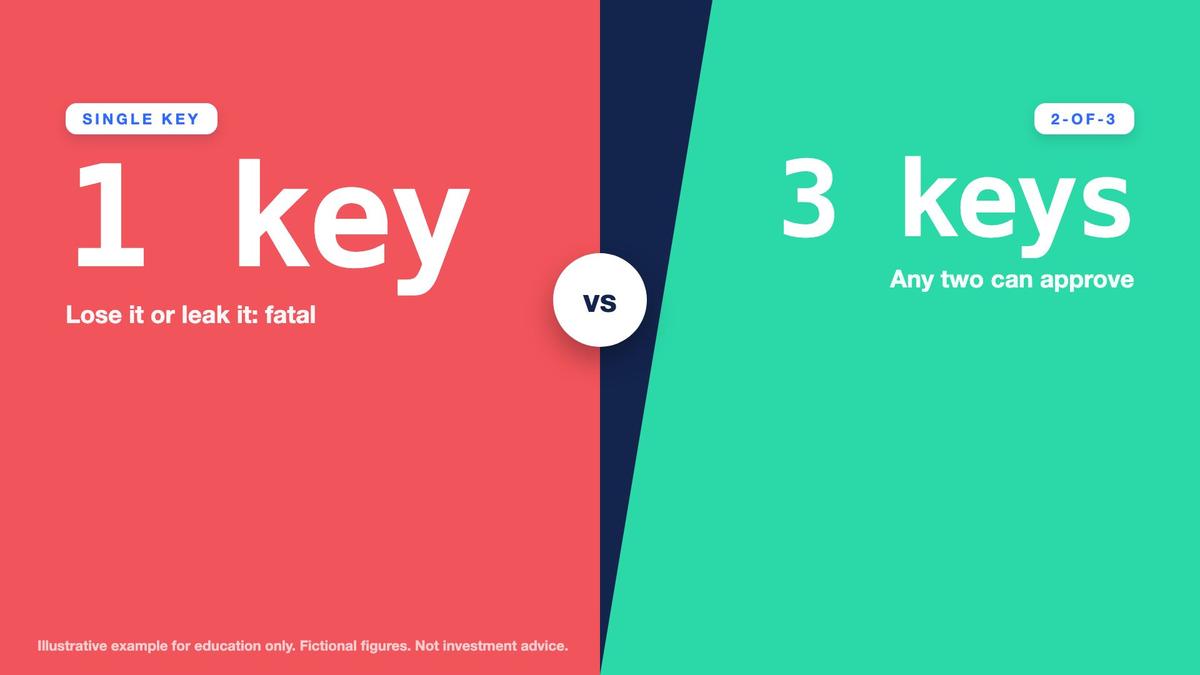
If one key in the 2-of-3 arrangement becomes unavailable, the two remaining keys can still authorize a transaction. If two keys are permanently lost and there is no alternative recovery mechanism, only one remains, so the authorization threshold cannot be satisfied. Theft of one key alone does not permit spending under the stated rules because a second valid signature is required. In contrast, a basic single-key wallet depends on one signing key: losing that sole usable key may eliminate access, while theft of that key may allow unauthorized transactions.
Key points
- A 2-of-3 wallet has three keys and any two can approve a spend: 3 possible pairs.
- Losing one key still leaves access; losing two keys means the funds cannot be spent.
- One stolen key cannot spend alone, but keys and workflows must be kept independent.
Multisignature security is not automatic. The keys must be generated, distributed, stored, and operated independently for the resilience benefits to hold. If every key is kept in one location, a single disaster or theft may compromise the entire arrangement. If one person controls all devices, the practical separation may be weaker than the mathematical threshold suggests. Coordination mistakes, inaccessible cosigners, lost configuration information, compromised signing interfaces, and inheritance problems also matter. A multisignature plan should describe authorized responsibilities and recovery procedures without exposing private keys or signing materials.
Recovery Backup Redundancy and Theft Exposure
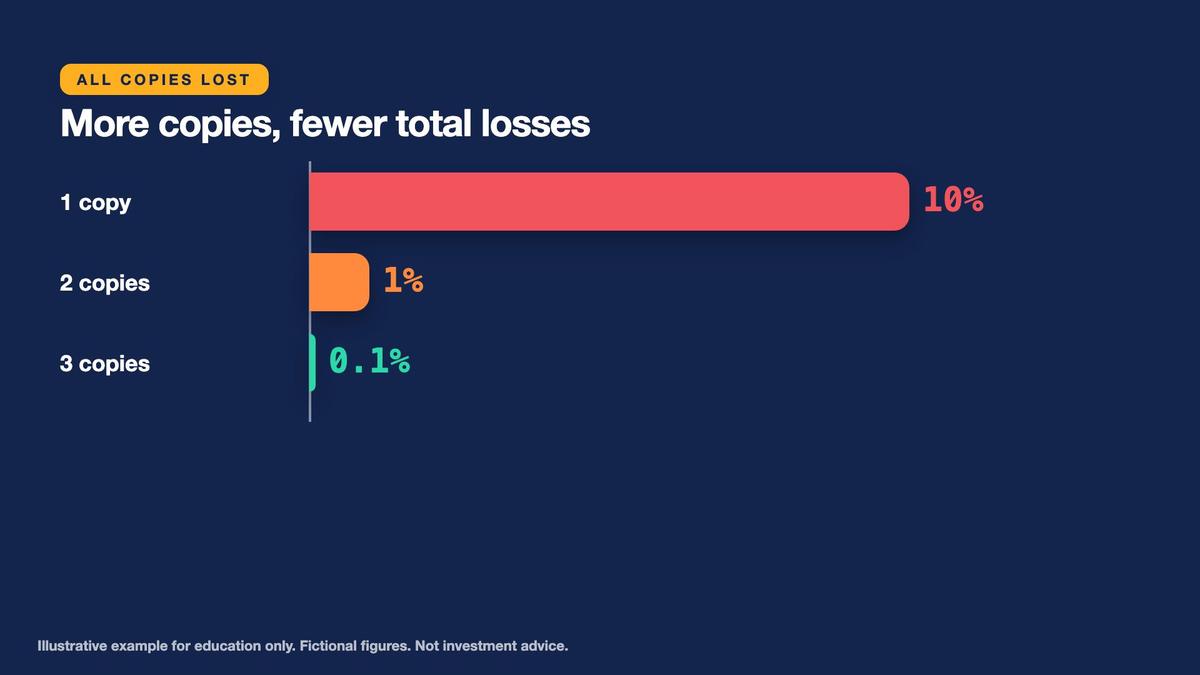
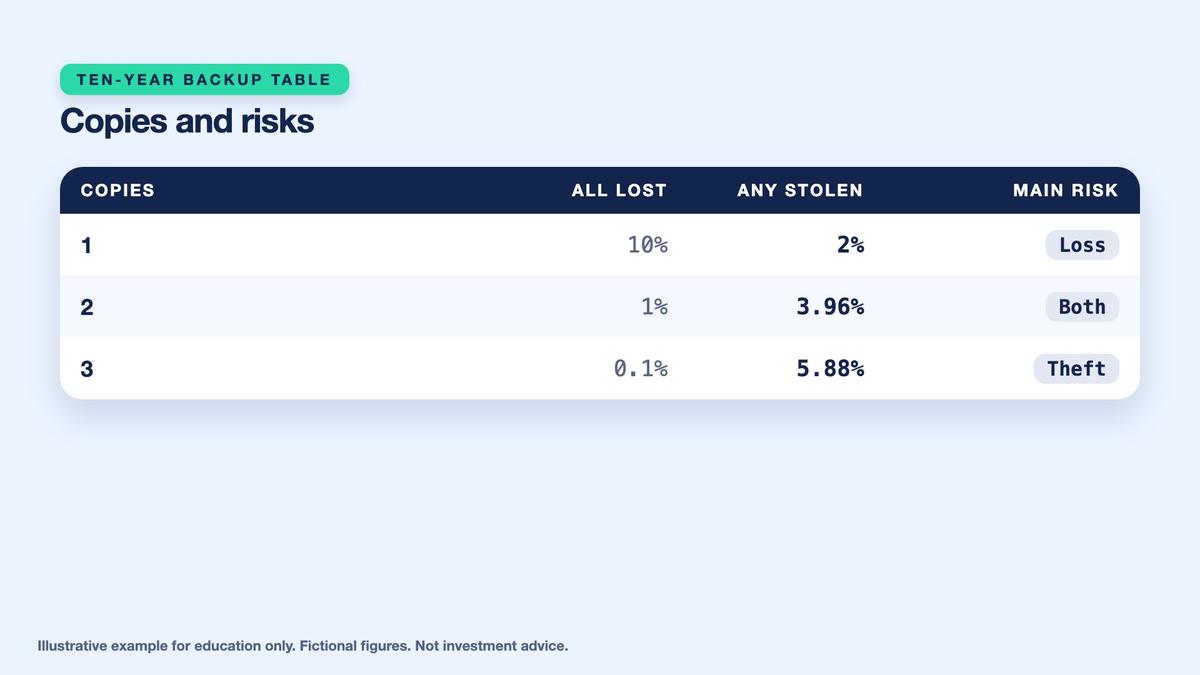
Backup redundancy can reduce the probability that all recovery materials are lost, but additional copies also create more opportunities for theft or unauthorized discovery. Consider an invented ten-year illustration in which each independent backup copy has a 10% probability of being lost or destroyed. With one copy, the probability of complete backup loss is 10%. With two independent copies, both must be lost, so the probability is 0.10 multiplied by 0.10, or 1%. With three independent copies, the probability becomes 0.10 multiplied by 0.10 multiplied by 0.10, or 0.1%. These are model outputs, not observed failure rates.
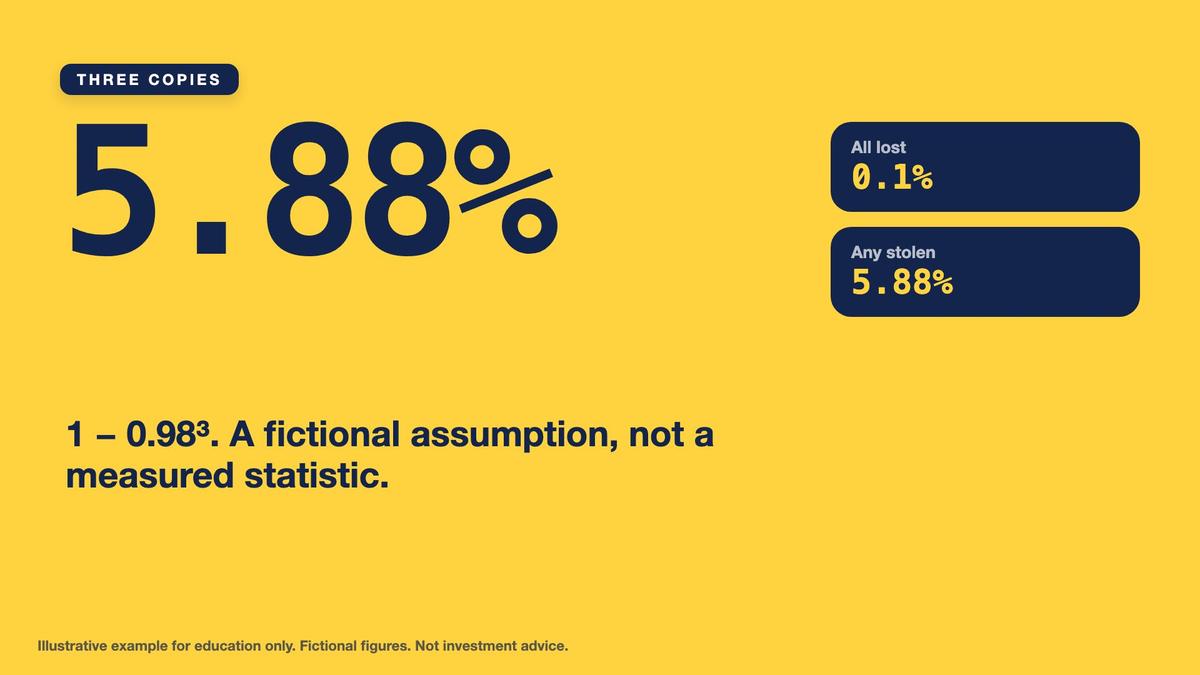
Now assume each copy has a separate invented 2% chance of being discovered or stolen during the same ten-year period. To calculate the chance that at least one copy is stolen, subtract the probability that no copy is stolen from one. For one copy, the result is 2%. For two independent copies, it is one minus 0.98 squared, or 3.96%. For three independent copies, it is one minus 0.98 cubed, or 5.8808%, rounded to 5.88%. This illustrates why increasing the number of complete backup copies can expand the number of secrets an attacker might discover.
Key points
- Each copy: 10% chance of loss and 2% chance of theft over ten years (invented).
- All copies lost: 10%, 1%, 0.1% for 1, 2, 3 copies.
- At least one stolen: 2%, 3.96%, 5.88% (1 - 0.98^n); independence is only an assumption.
The calculations assume copies fail independently. Real storage locations may share physical hazards, family access, service providers, or environmental risks, so independence may be unrealistic. Theft of one complete recovery phrase can be especially serious in a single-key wallet, while a multisignature design can change the consequences of discovering one key share. A practical backup plan balances recovery reliability against unauthorized access. Copies should be protected, documented without exposing their contents, periodically checked for physical integrity, and incorporated into a secure emergency plan. For this course, no real recovery phrase or usable secret is ever created or displayed.
Phishing, Transaction Errors and Recovery Testing
Self-custody users must evaluate more than whether their backup exists. Phishing messages can impersonate wallet support, exchanges, applications, or trusted contacts. Malicious websites may ask for a recovery phrase or request signatures granting unintended transaction permissions. Malware can alter copied destination information or compromise the device used to prepare transactions. A hardware signing device may protect a private key from direct extraction while still allowing a user to approve a harmful transaction. It is therefore necessary to understand what an authorization request actually permits before confirming it.
Digital asset transactions can be difficult or impossible to reverse after settlement. An incorrect destination, unsupported network, mistaken quantity, or malicious approval can result in permanent loss. One cautious educational principle is to verify the intended destination, network, amount, and transaction effect, and to use a tiny test transaction before a larger transfer when appropriate. A successful small test can detect some errors but does not guarantee later safety, especially if instructions, destinations, or permissions change. In this course, testing is performed through fictional demonstrations or paper simulation rather than actual asset transfers.
Key points
- Phishing can drain a wallet without a stolen phrase if you sign a malicious request.
- Verify the destination, network, effects and permissions before signing.
- Test with a tiny amount first, and never use real credentials in training.
Recovery testing should also avoid exposing real secrets. The learner can use dummy credentials in a controlled environment to rehearse the sequence: locate recovery instructions, identify compatible software, verify required information, restore access, and confirm that the intended simulated balance is visible. For actual keyholders, a secure test requires careful procedures that do not reveal backup information to a website, a support agent, a camera, or an untrusted device. Document the outcome, date, and process status, but never copy a real seed phrase, private key, or signing secret into the journal.
Inheritance, Emergency Access and Choosing a Custody Model
Custody planning must consider situations where the owner becomes unavailable through illness, incapacity, death, or other emergencies. A custodial account may have formal procedures for authorized successors, but access depends on provider policies, identity checks, legal requirements, and continued operations. A self-custody wallet has no universal support department capable of resetting the keys. Authorized successors may need secure knowledge of where recovery materials are stored, which wallet arrangement was used, and how to obtain any additional required credentials. Preparing this information without exposing the keys during ordinary life is a central planning challenge.
A useful emergency plan identifies authorized people, the existence and location of instructions, storage responsibilities, backup verification procedures, and ways to obtain suitable professional help without disclosing secrets casually. The plan should account for physical disasters, loss of devices, forgotten passwords, unavailable cosigners, and changing technology. For multisignature arrangements, successors may need to coordinate multiple authorized keyholders. In every model, the goal is to preserve legitimate access while preventing unauthorized parties from acquiring enough information to spend funds. The course does not give jurisdiction-specific inheritance or legal instructions.
Key points
- Plan for emergencies: where instructions are, what depends on what, who may lawfully access.
- Never put secrets in the plan itself.
- Match the custody model to amount, purpose, access needs and recovery ability.
Different custody arrangements can be compared by purpose, frequency of access, balance size, operational competence, and recoverability. Frequently accessed assets may have different practical requirements from longer-term storage. A mixed arrangement can distribute exposure across institutional and personal failure modes, although shared dependencies and correlated disruptions can undermine that benefit. The earlier counterparty lesson taught learners to ask who owes them what; this lesson adds who controls the signing keys and who can restore access after failure. The Week One risk-budget principle also remains relevant: custody exposure should be considered part of total risk rather than ignored because no market trade is occurring.
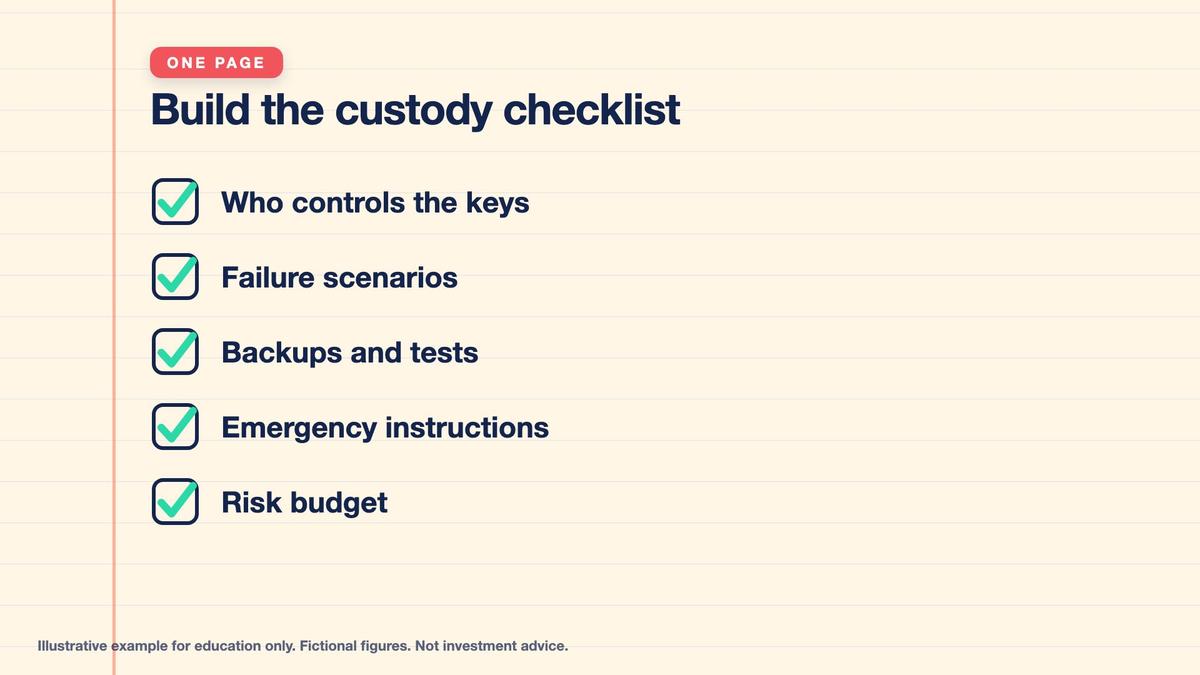
Final Checkpoint: Calculate Losses and Write the Recovery Matrix
Your final worksheet begins with the invented expected-loss comparison. A fictional $10,000 custodial exchange claim has a 2% annual failure probability and 60% modeled recovery, producing a $4,000 failure-case loss and $80 expected loss. Unverified self-custody with a 3% annual probability of complete access loss produces $300 expected loss. Tested self-custody with a 0.5% probability produces $50. A split of $5,000 exchange custody and $5,000 tested self-custody produces $40 plus $25, or $65 expected loss. Explain why these numbers are assumptions rather than measured probabilities and why they do not define maximum possible losses.

Practice Lab: Compare Custody Failure and Recovery Responsibilities
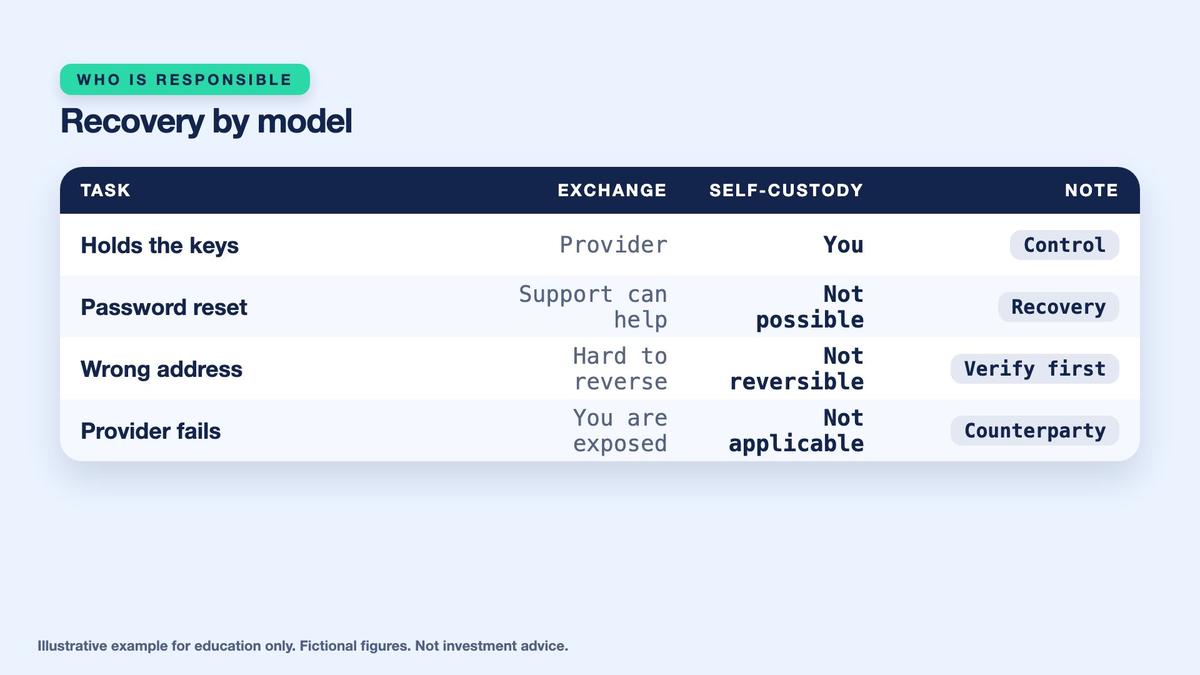
Use only hypothetical custody arrangements, an invented custodial exchange, fictional self-custody wallets, dummy recovery procedures, and simulated money. No real wallet, private key, recovery phrase, blockchain address, or exchange account may be used. First calculate annual expected loss for a $10,000 exchange claim, self-custody with an unverified backup, self-custody with a tested backup, and a $5,000/$5,000 mixed arrangement. Every probability is an invented teaching assumption, not an estimate of real risk. Then evaluate a 2-of-3 multisignature configuration and calculate ten-year loss and theft probabilities for one, two, and three independent recovery backups. Finally, complete a responsibility matrix identifying who controls keys, what can fail, who can restore access, which failures are irreversible, and how a fictional emergency plan would be tested. Keep expected loss, failure-case severity, and real-world uncertainty separate.
- Decision 1: A fictional exchange holds a $10,000 customer claim. Assume an invented annual failure probability of 2%, with customers recovering 60% of their claims if failure occurs. — Calculate the failure-case loss in dollars, the percentage loss, and expected annual loss, explaining why expected loss differs from a maximum loss.
- Decision 2: A self-custody wallet contains $10,000. The invented annual probability of complete access loss is 3% with an unverified backup or 0.5% with a tested backup. — Calculate expected annual losses for both backup arrangements and for a split containing $5,000 exchange custody and $5,000 tested self-custody.
- Decision 3: A hypothetical wallet uses two-of-three multisignature authorization, with three independently controlled keys and any two needed to approve a transaction. — Calculate the number of qualifying key pairs and explain what happens when one key is lost, two keys are lost, or one key is stolen.
- Decision 4: Over ten years, each fictional recovery backup has an invented independent 10% chance of loss and independent 2% chance of theft, with one, two, or three full copies. — Calculate the probability that every copy is lost and that at least one copy is stolen for each backup count.
- Decision 5: A fictional learner compares a custodial account, a personally controlled single-key wallet, and a two-of-three multisignature wallet. The learner must plan for phishing, lost access, exchange failure, and emergencies. — Create a recovery responsibility matrix and describe a safe simulation-based test without using real credentials or transactions.
Answer key
Next verify the 2-of-3 multisignature example. Three keys create exactly three distinct qualifying pairs. One lost key leaves sufficient authorization capacity, while two lost keys prevent spending under the stated arrangement. One stolen key cannot spend alone. Then calculate the ten-year backup probabilities. Complete loss falls from 10% with one copy to 1% with two and 0.1% with three, assuming independence. The chance at least one copy is stolen rises from 2% to 3.96% and approximately 5.88%. Explain why correlated failures and poor physical protection can invalidate the apparent benefits of redundancy.
Key points
- Verify $80, $300, $50 and $65, and the 3 key pairs.
- Verify 10%, 1%, 0.1% and 2%, 3.96%, 5.88%.
- Write the recovery responsibility matrix and a dated recovery review.
Finish with a one-page recovery responsibility matrix. For custodial exchange accounts, record provider key control, login and identity-based account recovery, and dependence on solvency, support, legal claims, and withdrawal availability. For self-custody, record personally controlled signing keys, tested offline recovery requirements, lack of universal password-reset authority, and risks from theft, phishing, mistaken transfers, and unavailable successors. Add hot-versus-cold storage, software-versus-hardware signing, possible multisignature arrangements, fictional test procedures, and an emergency plan. The outcome is a transparent comparison of failure modes and recovery duties, not a recommendation to use any particular custody provider or wallet.
Worked example at a glance
Key terms
- Custody: control of the private keys that authorize transactions.
- Private key: a secret that authorizes transactions from a wallet.
- Custodial exchange: a platform that holds the keys for its customers.
- Self-custody: holding the keys yourself, with sole responsibility for recovery.
- Hot storage: keys or signing kept in an online environment.
- Cold storage: keys kept offline.
- Hardware wallet: a dedicated device that signs transactions.
- Recovery phrase: secret words that can regenerate wallet keys; never share them.
- Expected loss: probability times loss; not the same as the worst case.
- Multisignature: a wallet that needs several keys to approve a spend.
- Phishing: deception that tricks you into signing or revealing secrets.
- Counterparty risk: the risk that an institution fails to meet its obligation.
Multi Asset Trading Lab provides educational information only and does not constitute personalized investment, trading, financial, accounting, legal, tax, cybersecurity, or custody advice. All exchanges, wallets, accounts, digital assets, balances, failure events, recovery rates, probabilities, and security configurations in this lesson are fictional teaching examples. No real exchange, wallet product, seed phrase, recovery phrase, private key, blockchain address, account credential, or transaction is used or provided. Every probability in this lesson is an invented assumption created solely for classroom mathematics and must never be interpreted as a measured or estimated real-world annual failure, theft, loss, or recovery rate. The hypothetical 2% annual exchange failure probability, 60% recovery fraction, 3% unverified self-custody loss probability, and 0.5% tested self-custody loss probability have no empirical basis in this course. Expected loss represents probability multiplied by modeled loss severity, not an annual charge, a predicted realized loss, a guarantee, or a maximum amount at risk. On the fictional $10,000 balance, the exchange's modeled failure-case loss is $4,000 and expected annual loss is $80. Unverified self-custody expected loss is $300, tested self-custody expected loss is $50, and the $5,000/$5,000 split has expected loss of $65. These comparisons are conditional upon the invented assumptions and do not establish that any custody arrangement is universally safer, more suitable, or more reliable. The simplified loss models exclude many actual risks, including correlated failures, malicious insiders, undisclosed liabilities, private-key compromise, hardware failures, software vulnerabilities, legal restrictions, unpredictable recoveries, and changing asset values. In the split arrangement, modeled simultaneous exchange failure and complete self-custody loss could produce $7,000 loss under the stated event severities, while more extreme scenarios could differ. Custodial exchanges may control customer signing keys, provide account access procedures, and offer support, but account access recovery does not guarantee asset recovery, withdrawal availability, solvency, legal entitlement, or full customer compensation. Exchange failure modes can include insolvency, hacks, fraud, withdrawal suspensions, account freezes, operational disruption, and legal action. Self-custody grants control over transaction authorization but introduces responsibility for maintaining usable keys, secure backup materials, device integrity, compatible recovery tools, and safe signing procedures. Losing all usable signing and recovery materials may permanently prevent access, while theft of usable keys or recovery materials may permit unauthorized transactions. Recovery phrases and private keys are highly sensitive and must never be shared with websites, support representatives, unauthorized individuals, screenshots, ordinary cloud notes, or classroom materials. A software wallet, hardware wallet, hot-storage arrangement, or cold-storage setup does not eliminate every operational or security risk. Hardware signing devices may reduce certain key-exposure risks but cannot guarantee protection when the user approves malicious instructions or uses compromised recovery materials. Multisignature authorization changes the number of required keys but does not guarantee safety. The hypothetical 2-of-3 arrangement permits three distinct two-key combinations, tolerates one lost key, cannot authorize spending after two keys are lost without another recovery method, and prevents a single stolen key from authorizing spending alone. Real multisignature arrangements may depend on software configuration, independent signers, device integrity, key coordination, recovery metadata, and other operational factors. The ten-year backup probabilities are entirely fictional: each copy is assumed independently to have a 10% loss probability and 2% theft probability, producing all-copy-loss probabilities of 10%, 1%, and 0.1%, and at-least-one-stolen probabilities of 2%, 3.96%, and approximately 5.88% for one, two, and three copies. These calculations require the stated independence assumption, which can fail when backups share locations, people, infrastructure, security practices, or environmental hazards. Loss and theft assumptions should not be treated as mutually exclusive unless explicitly specified, and the examples do not provide a complete joint probability model. Additional backup copies may improve resilience against independent loss while creating more opportunities for unauthorized access, so the appropriate design depends on security and recovery arrangements not established here. Wallet transactions and approvals can be irreversible or difficult to reverse; phishing signatures, malicious permissions, malware, wrong destinations, unsupported networks, incorrect amounts, and compromised devices can cause permanent losses. A tiny test transaction may detect some mistakes but does not guarantee that later transfers are correct or safe. All test procedures in this course must use fictional accounts, dummy credentials, or paper simulations rather than real assets or secrets. Inheritance and emergency access can involve personal security, privacy, legal succession, and authorization requirements that differ by circumstance, and this lesson provides no jurisdiction-specific legal guidance. Learners should document responsibilities, safeguards, recovery testing status, and authorized emergency procedures without revealing private credentials. The phrase not your keys, not your coins highlights dependence on custodial intermediaries but does not establish that self-custody is risk-free or appropriate for every person or purpose. References to earlier counterparty analysis, risk budgets, and position limits are educational frameworks rather than protections against all custody failure modes. No simulated calculation predicts future asset prices, actual failure probabilities, real theft rates, recovery results, or financial performance. Nothing in this lesson constitutes a recommendation to acquire, transfer, hold, trade, or store any real digital asset through a particular custody model, and no real-money activity is required or encouraged.
Lesson Checkpoint
Review what you learned and get feedback on your work.