



In this twelve-minute beginner lesson, learners compare spot ownership, leveraged perpetual futures, defined-risk purchased options, stablecoin reserves, and financial counterparty exposure using fictional instruments and simulated money. Through Sample Coin, a hypothetical perpetual contract, a fictional call option, and Peg Dollar (PGD), learners calculate spot losses, leverage, liquidation thresholds, funding costs, option payoffs, stablecoin redemption coverage, reserve haircuts, depeg losses, and counterparty failure recoveries. The lesson explains why holding an asset is different from holding a contractual claim, why leverage amplifies losses, why stablecoin reserves and redemption rights matter, and why proof-of-reserves disclosures cannot establish complete solvency. Learners finish by building a one-page risk map identifying who owes them what, which failure conditions matter, and which evidence would require reconsideration. All examples are hypothetical, involve simulated money only, and provide no investment advice or price predictions.
Spot Ownership, Custody and Derivative Contracts
Spot trading generally involves buying or selling an underlying asset for settlement rather than obtaining contractual exposure through a derivative. However, buying an asset through a custodial platform does not necessarily mean the learner directly controls it. An exchange may hold the underlying digital units and show a balance representing a claim against the platform. The legal and practical protections depend on the platform's custody arrangement, segregation policies, withdrawal rights, and financial condition. A wallet controlled by the owner presents a different set of risks, including private-key loss and transaction mistakes. The first question should therefore be: what is actually owned, controlled, or owed?


A derivative is a contract whose value depends on an underlying asset, price, rate, or event. Futures commonly create obligations linked to future settlement or contract specifications. Perpetual futures maintain price exposure without a fixed scheduled expiration, often relying on margin, liquidation mechanisms, and recurring funding payments. Options grant contractual rights and sometimes obligations, depending on whether the participant buys or writes the contract. These products create different exposure profiles from ordinary spot ownership. A derivative position does not necessarily give the holder ownership of the underlying asset.

Key points
- Spot means the asset itself; check whether you hold coins or a claim on a platform.
- A derivative is a contract on an asset price: futures, perpetual futures, options.
- Every instrument here is fictional and every number is simulated.
This lesson uses only fictional Sample Coin, a hypothetical perpetual future, a purchased call option, and fictional Peg Dollar stablecoin. The simulations intentionally simplify real execution, margin, and contract mechanics. Earlier trading labs emphasized defining an order, documenting the instrument, and identifying stop and size constraints before acting. Here, the objective is not to choose a product but to distinguish contractual claims, leverage, collateral, settlement, and counterparty exposure. Understanding these distinctions is a prerequisite for accurately identifying where financial losses might originate.
Spot Versus Perpetual Futures: Leverage and Liquidation
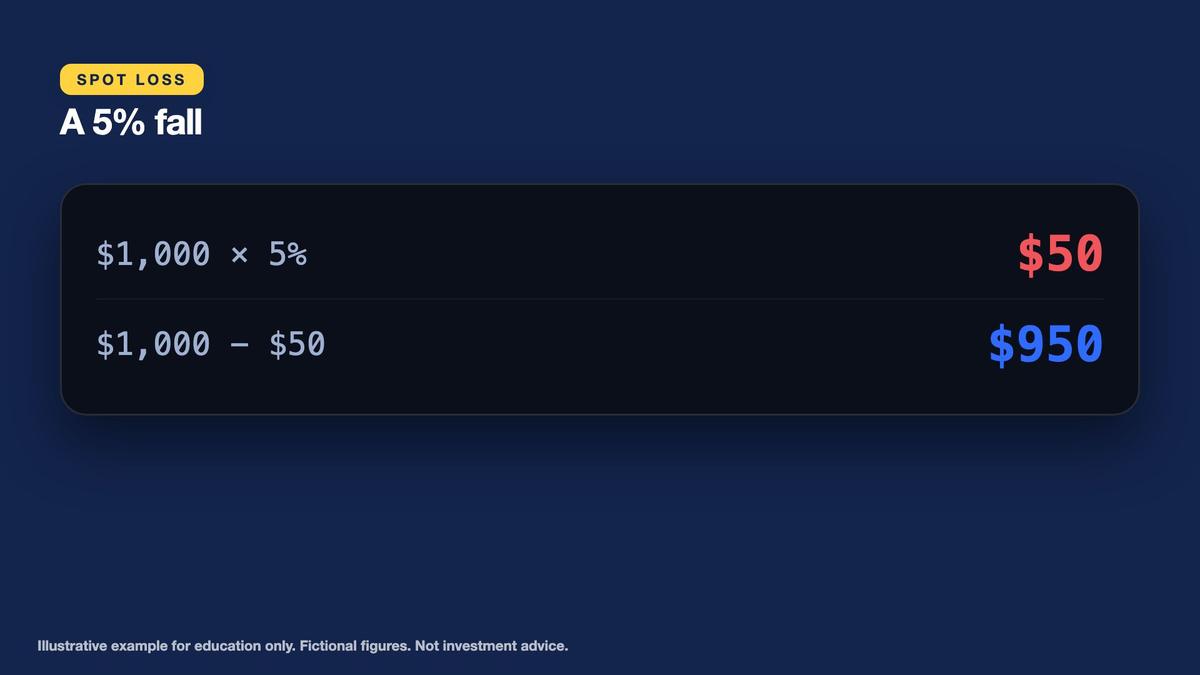
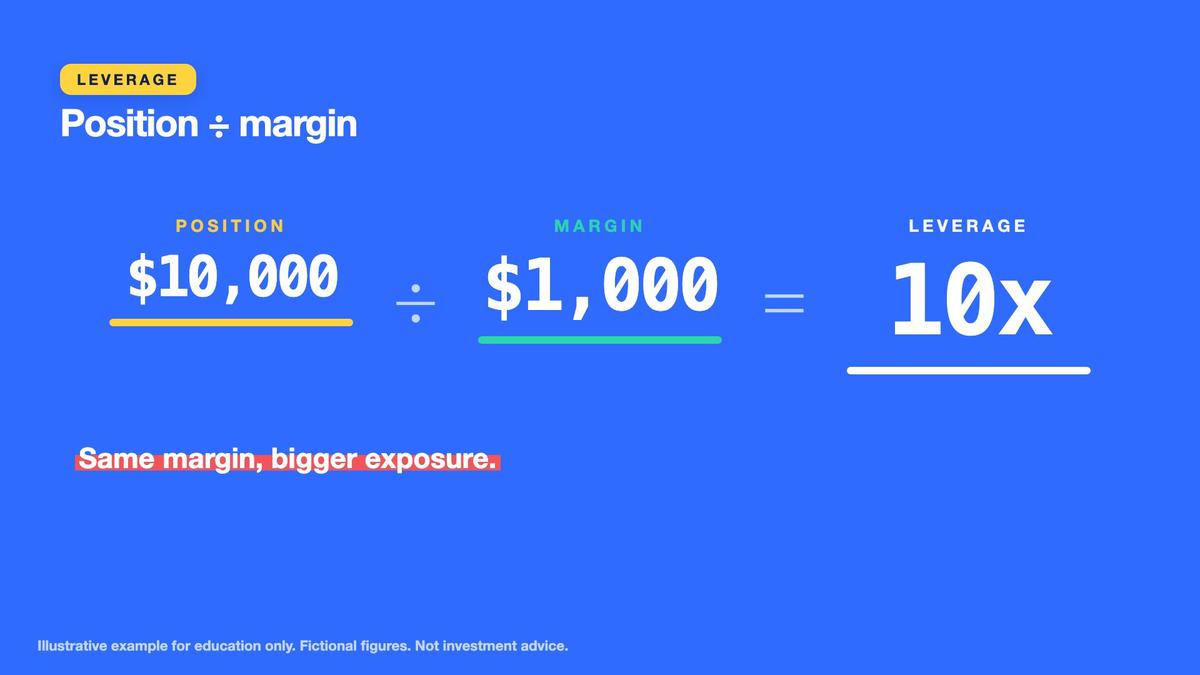
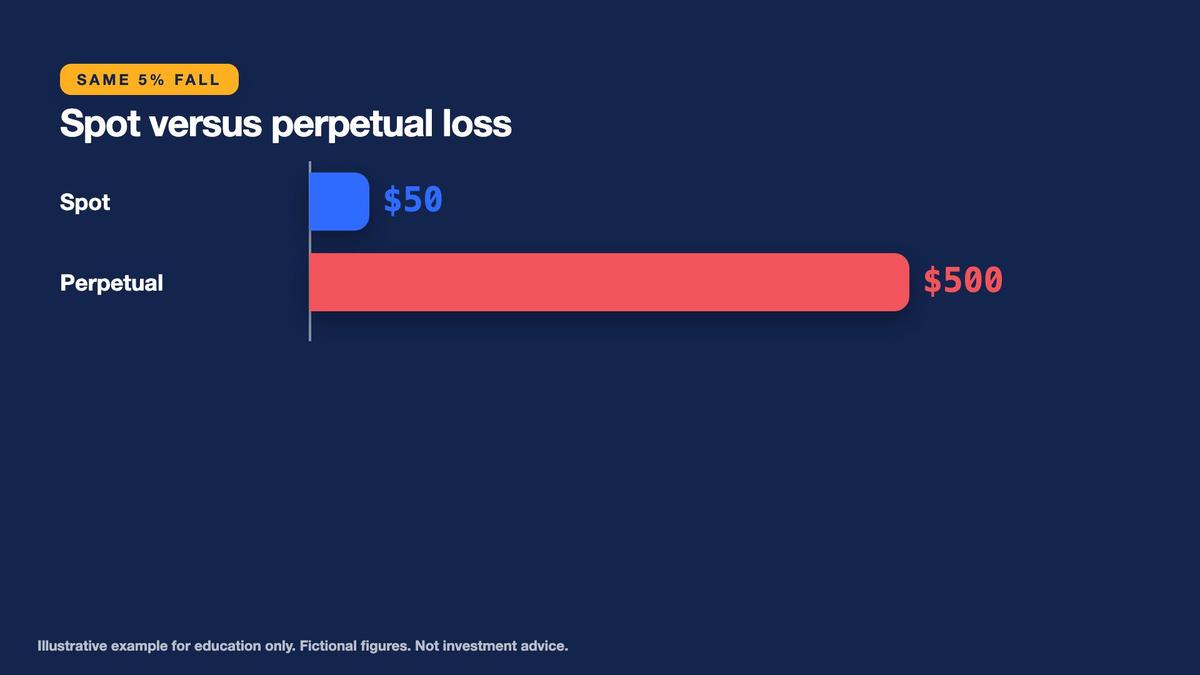
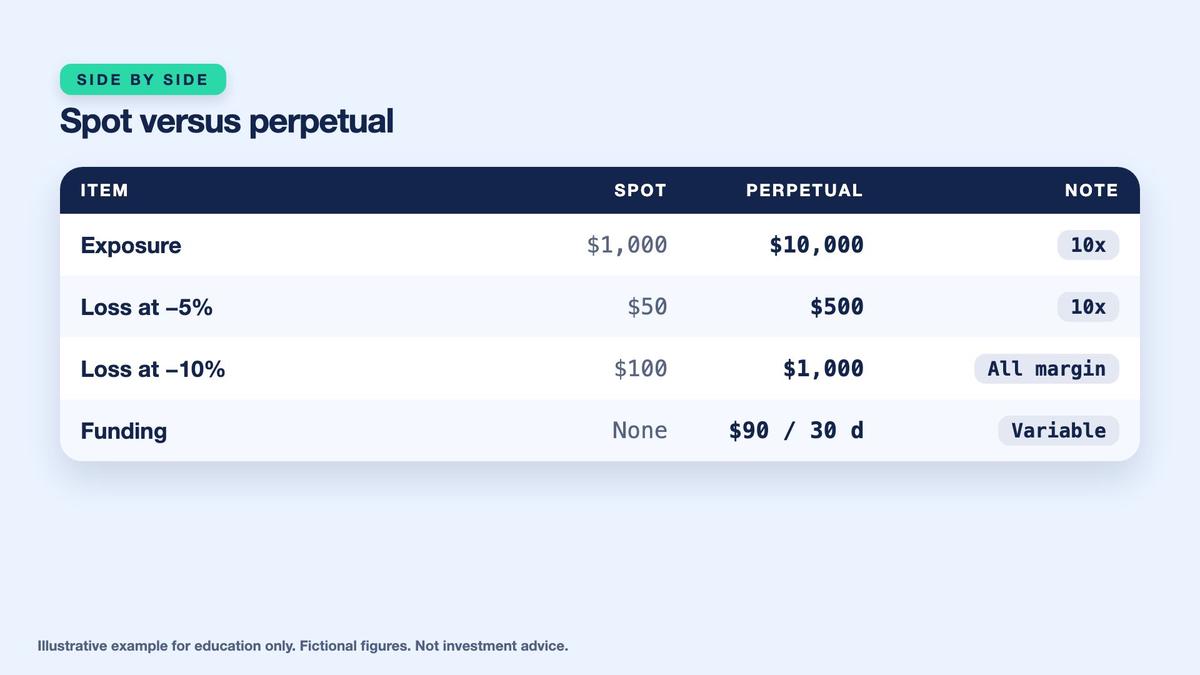
Begin with a fictional $1,000 spot purchase of Sample Coin. If the asset's price falls 5%, the simplified spot position loses $1,000 multiplied by 0.05, or $50, leaving $950 in market value before costs. Now compare a perpetual futures position using $1,000 of initial margin to control $10,000 of notional exposure. Leverage is notional value divided by initial margin, which equals 10x. A 5% adverse price movement on the $10,000 notional creates a $500 loss, assuming a simple linear contract and unchanged position size. This consumes half the original margin.
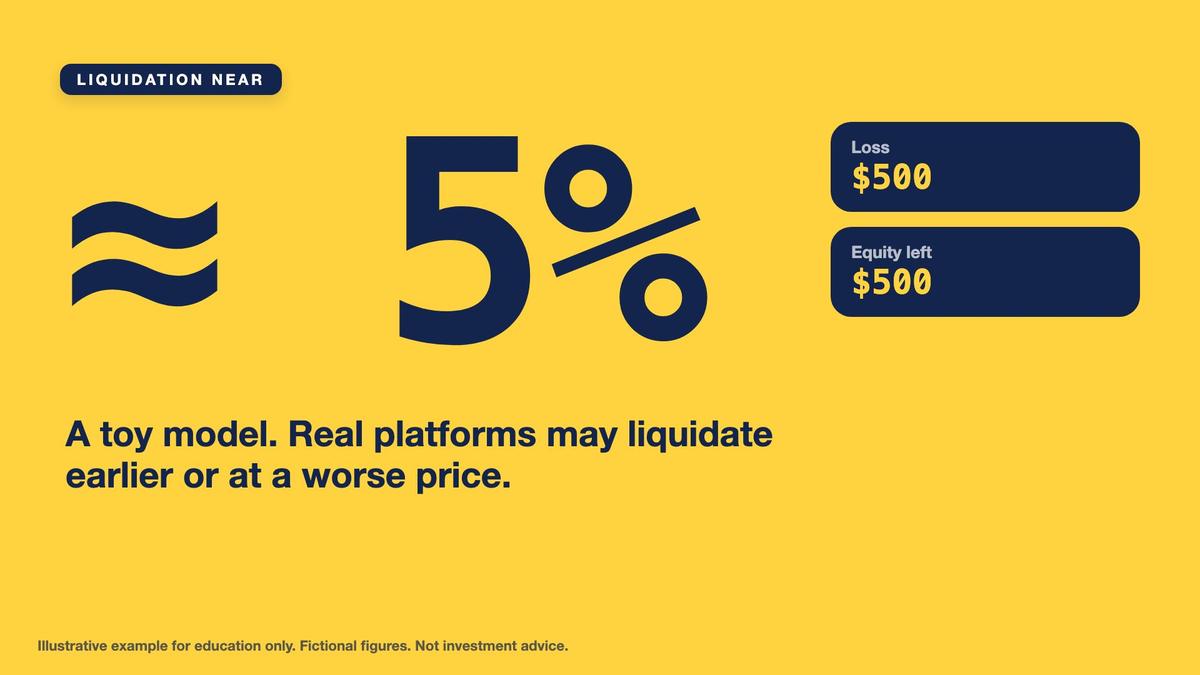
Our exercise sets the maintenance requirement at 5% of the original $10,000 notional, or $500. After the $500 mark-to-market loss, margin equity equals $1,000 minus $500, leaving exactly $500. In this intentionally simplified model, liquidation becomes possible at approximately a 5% adverse price move because equity reaches the maintenance threshold. Real platforms may use maintenance tiers, mark prices, changing position value, funding adjustments, buffers, and liquidation fees. Consequently, real liquidation may begin sooner or result in worse execution than the toy calculation suggests.
Key points
- Spot: $1,000 falls 5%, loss $50. Perpetual: $1,000 margin controls $10,000 (10x), loss $500.
- Maintenance margin 5% of $10,000 = $500: equity $1,000 - $500 = $500, so liquidation near a 5% fall.
- A 10% fall loses $1,000, which is 100% of the margin; real platforms may liquidate earlier.
A hypothetical 10% adverse move on the same $10,000 notional would create a $1,000 loss, equivalent to 100% of the initial margin, if the position were allowed to remain open without intervention. The simplified liquidation threshold would normally be reached before that point. This demonstrates why leveraged derivatives can produce much larger percentage changes in account equity than the underlying asset's spot price movement. Even a relatively modest adverse move can threaten the collateral supporting the position. The example is educational and is not an instruction to use leverage.
Perpetual Funding and the Defined-Risk Purchased Call
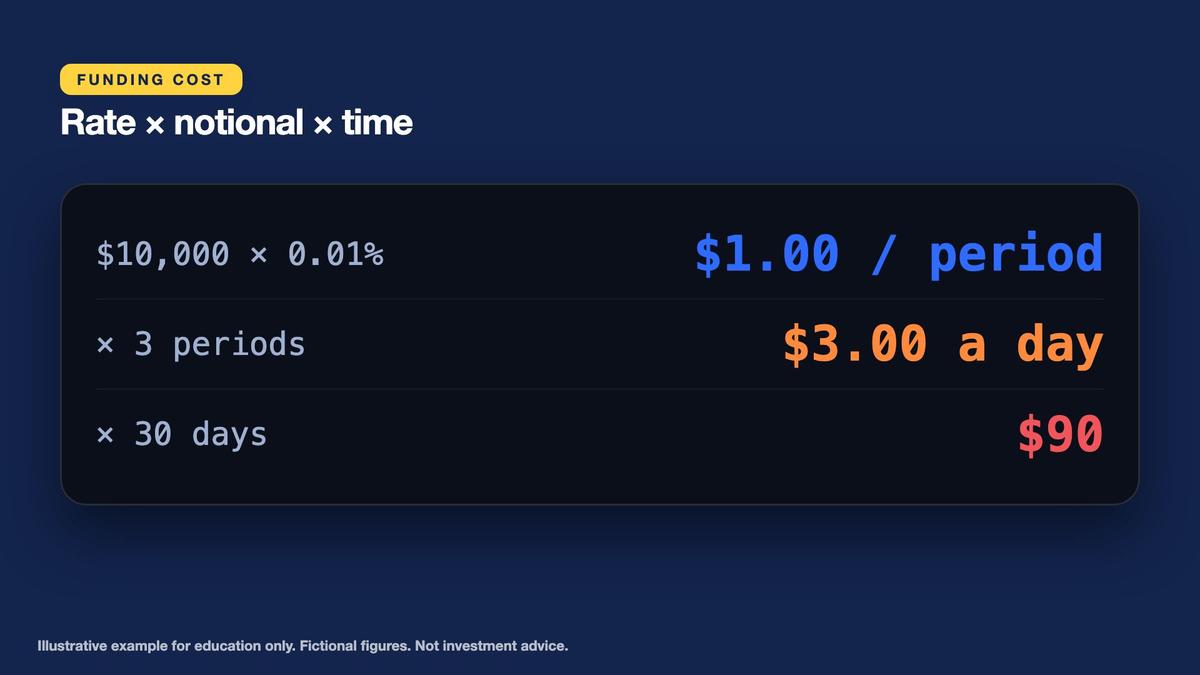
Perpetual futures may include periodic funding transfers between long and short participants. Funding is designed around the relationship between perpetual contract prices and their reference markets, but actual methodologies vary by platform. In our illustration, a hypothetical long position pays a constant positive funding rate of 0.01% every eight hours on $10,000 notional. The payment is $10,000 multiplied by 0.0001, giving exactly $1 per funding period. With three eight-hour periods per day, this equals $3 daily. Over 30 days, the cumulative funding expense is $90, or 9% of the original $1,000 margin.
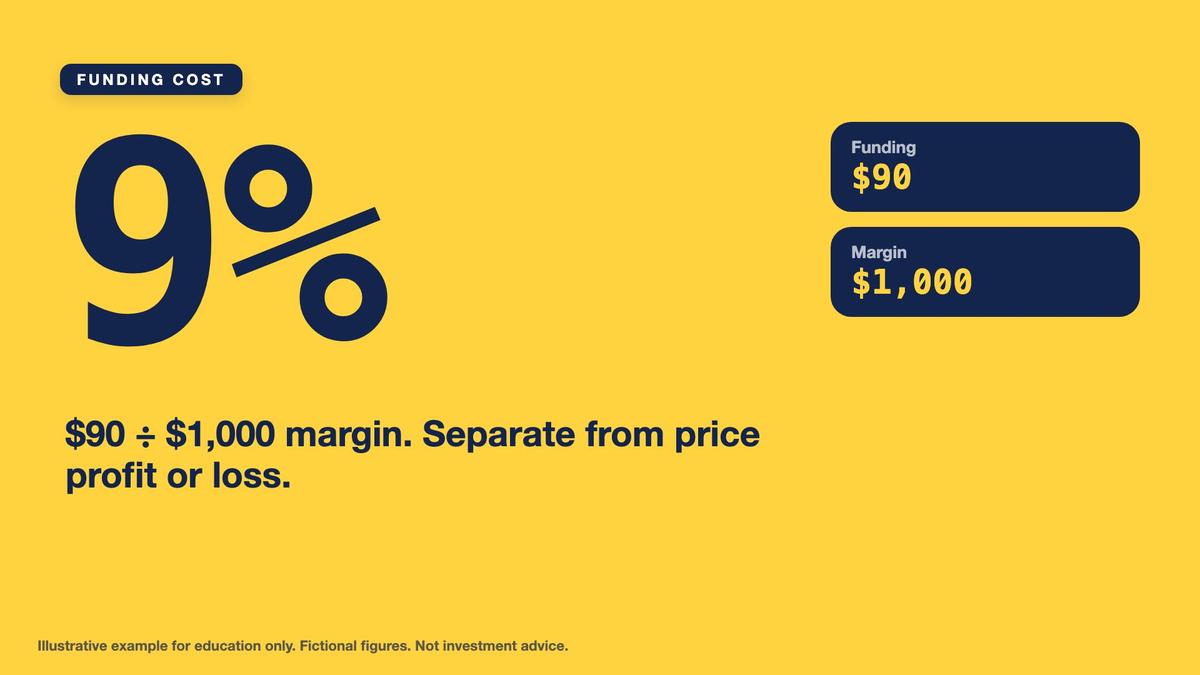
Funding is separate from trading profit or loss and can become material relative to posted margin. The calculation assumes unchanged notional value, funding rate, position direction, and number of periods. Real funding rates can vary sharply and may reverse sign, meaning the long receives rather than pays funding under some conditions. Fees, changes in position size, and liquidation may prevent a position from remaining open for the full illustrative period. Learners should therefore examine funding history, calculation methodology, timing, and sensitivity without assuming that any fixed daily charge or payment persists.
Key points
- Funding: 0.01% x $10,000 = $1.00 per 8 hours, $3.00 a day, $90 in 30 days = 9% of margin.
- Funding is separate from price profit or loss and can change sign.
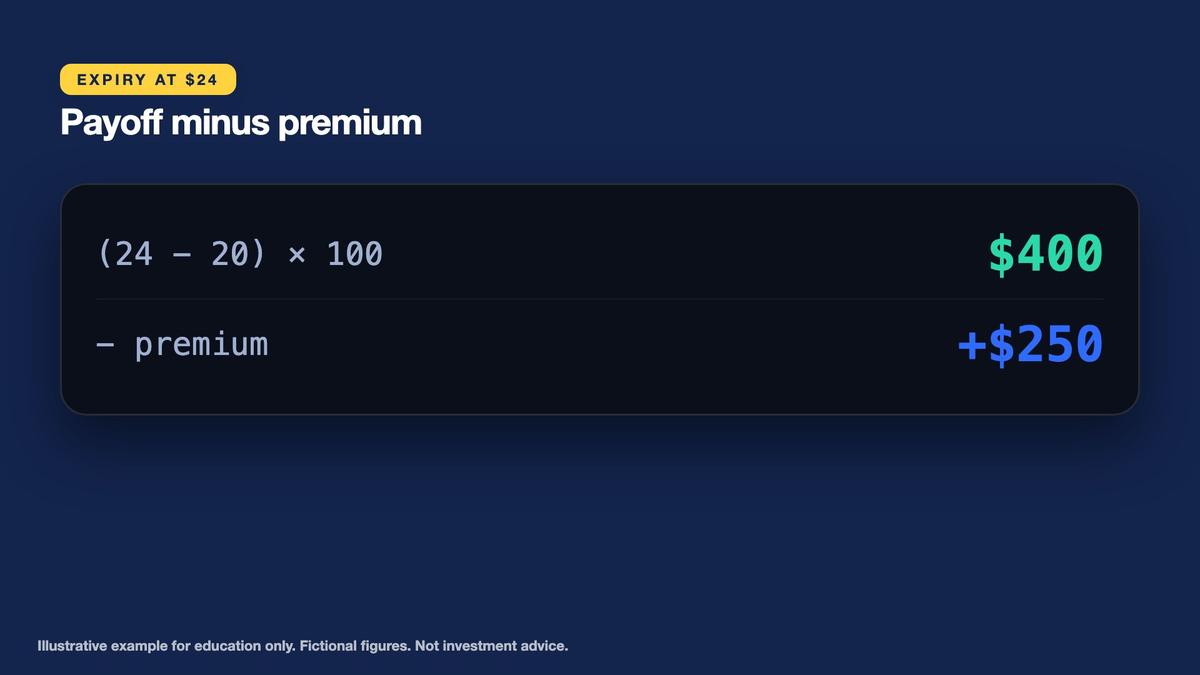
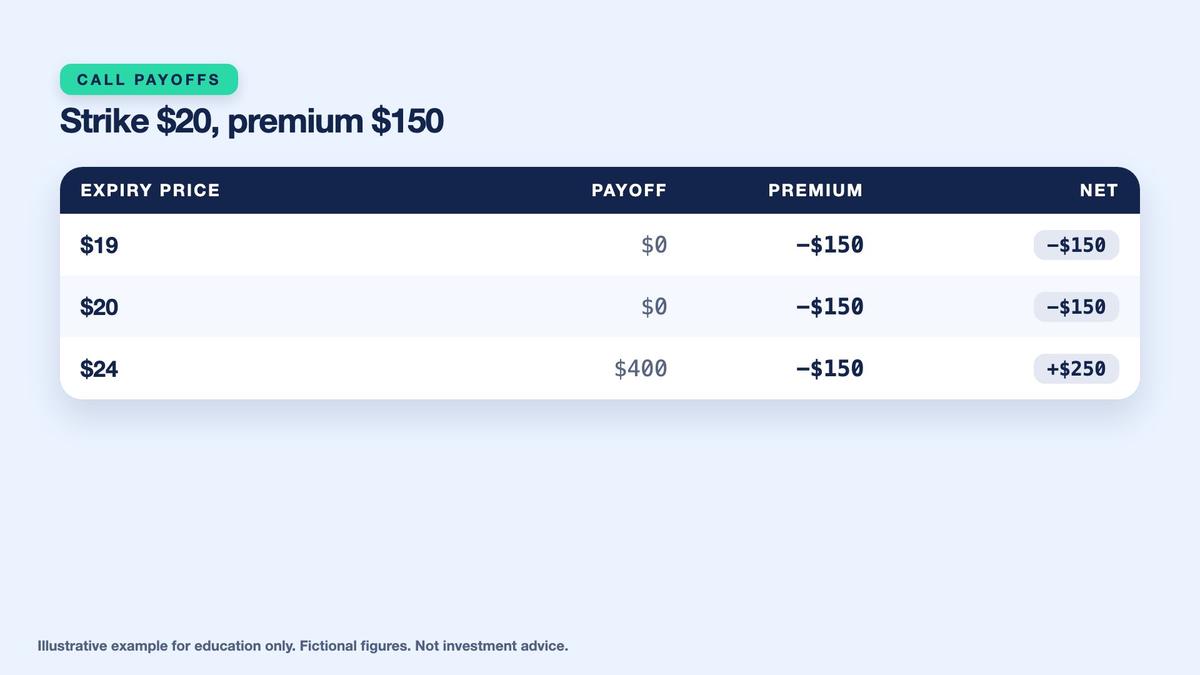
- Call: 100 units, strike $20, premium $150 = maximum loss; at $24 net +$250, at $19 loss $150.
For contrast, consider a fictional purchased call option granting the right to buy 100 underlying units at a $20 strike. The buyer pays $1.50 per unit, or $150 in total. At expiry, if the underlying price is $24, intrinsic payoff equals ($24 minus $20) multiplied by 100, or $400; subtracting the $150 premium leaves $250 net profit before costs. If expiry price is $19, the call expires worthless and the buyer loses the $150 premium. For an ordinary fully paid purchased call, the buyer's maximum contractual loss is the premium, unlike an uncapped exposure to a leveraged perpetual position; option sellers and other option structures can carry substantially different risks.
Stablecoin Designs, Reserves and Redemption Rights
A stablecoin is a digital token designed to maintain a relatively stable value against a reference asset or unit. Some stablecoins rely on reserves of cash and financial instruments, while others use crypto collateral or algorithmic mechanisms intended to adjust supply and incentives. These models expose holders to different risks. A fiat-backed structure depends on reserve quality, the legal rights of token holders, and the ability to convert assets into redemption cash. Crypto-collateralized designs can experience collateral volatility, liquidation pressure, and smart-contract risk. Algorithmic mechanisms without robust external backing can be particularly vulnerable to self-reinforcing loss of confidence and collapse.
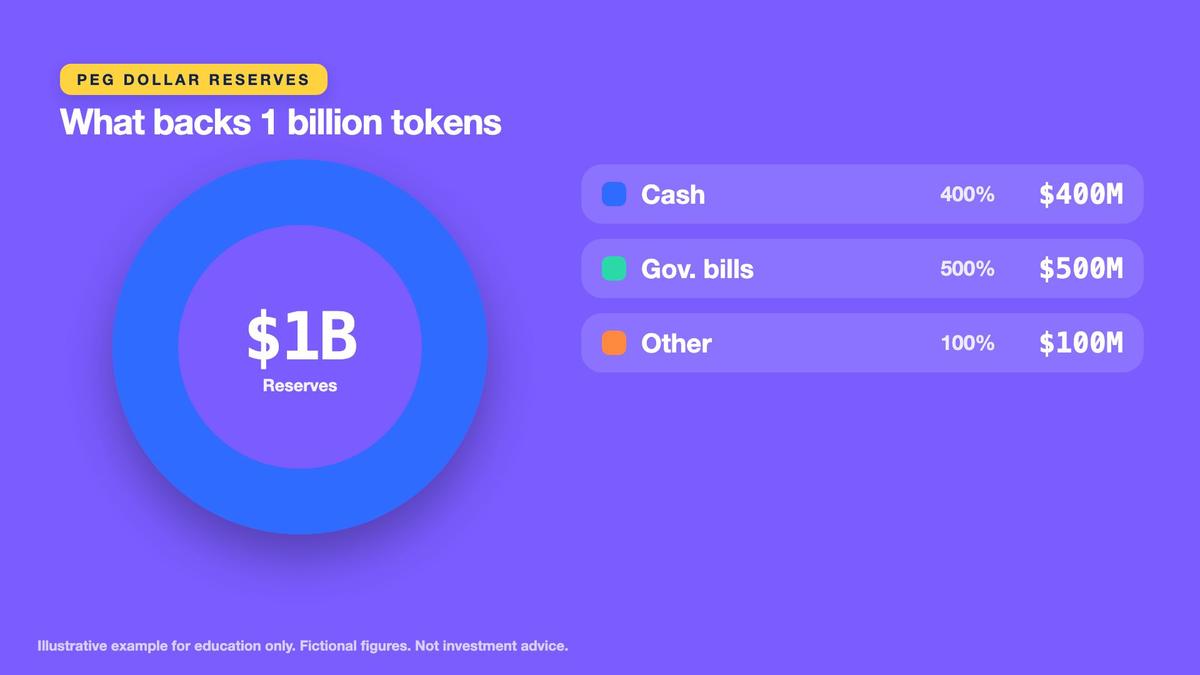
Our fictional Peg Dollar, abbreviated PGD, targets $1.00 per token and has 1,000,000,000 tokens issued. The fictional reserve statement lists $400 million of cash, $500 million of short-term government bills, and $100 million of other less-liquid assets. At stated face values, reserves total $1 billion, equivalent to $1.00 for each issued token. This is nominal 100% backing under the exercise assumptions. However, asset values, access restrictions, redemption timing, and legal ownership determine whether apparent backing can actually satisfy claims when many holders request repayment.
Key points
- Peg Dollar: 1,000,000,000 tokens, reserves $400M cash, $500M bills, $100M other.
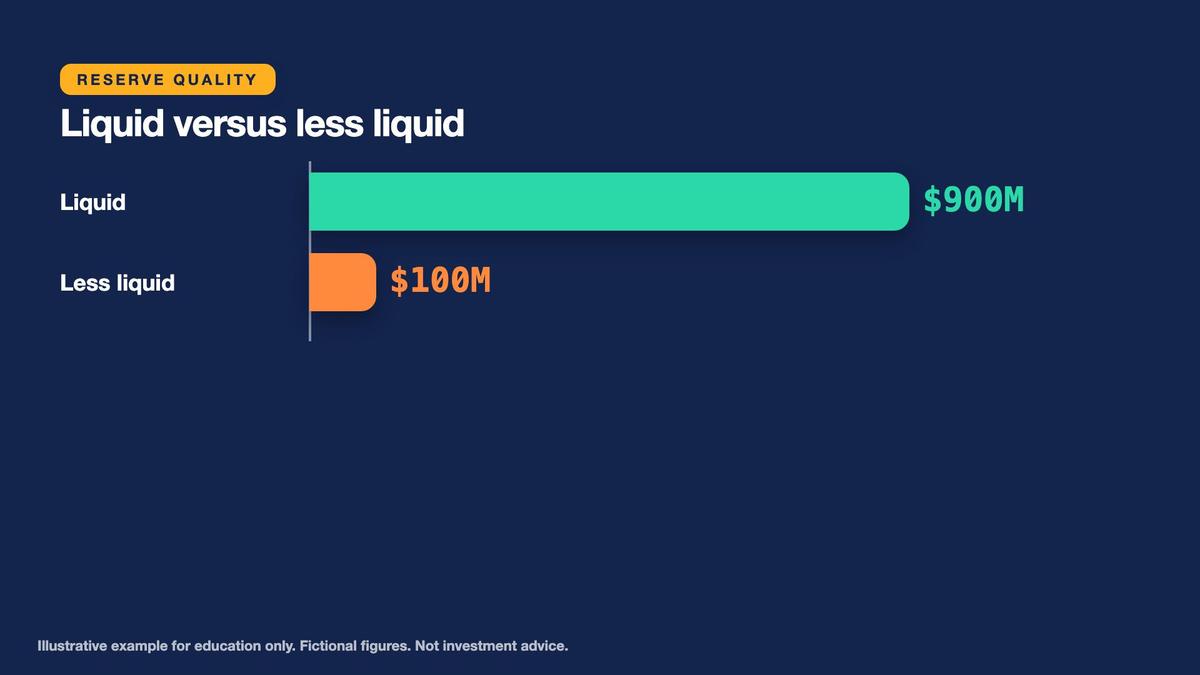
- Face-value backing is 100%, but liquid reserves are $900M (90%).
- Algorithmic designs fail more often; redemption rights and reserve quality matter.
The readily liquid portion of the reserve consists of $400 million cash plus $500 million short-term bills, totaling $900 million or 90% of the face-value reserves. Less-liquid assets account for the remaining $100 million. The classification is simplified: even short-term government bills may require sale, settlement, or financing before cash is immediately available. In actual research, verify who may redeem directly, whether minimum redemption sizes apply, what fees or delays exist, where reserves are held, and how independently reported figures are verified. A stablecoin's intended peg does not itself guarantee instant redemption at par.
Stress-Test Peg Dollar: Redemptions, Haircuts and Depegs
First consider a redemption request covering 60% of all PGD tokens. That requires $600 million if each token is redeemed at the intended $1.00 value. The $900 million liquid reserve pool covers the amount, leaving $300 million of those reserves before considering other liabilities or operational restrictions. Next increase redemption demand to 95% of issued tokens, or $950 million. This exceeds the stated liquid reserves by $50 million. The issuer would need to obtain additional liquidity, potentially by selling less-liquid assets, borrowing against them where permitted, or using another valid funding source. The existence of total nominal assets does not guarantee immediate cash availability.
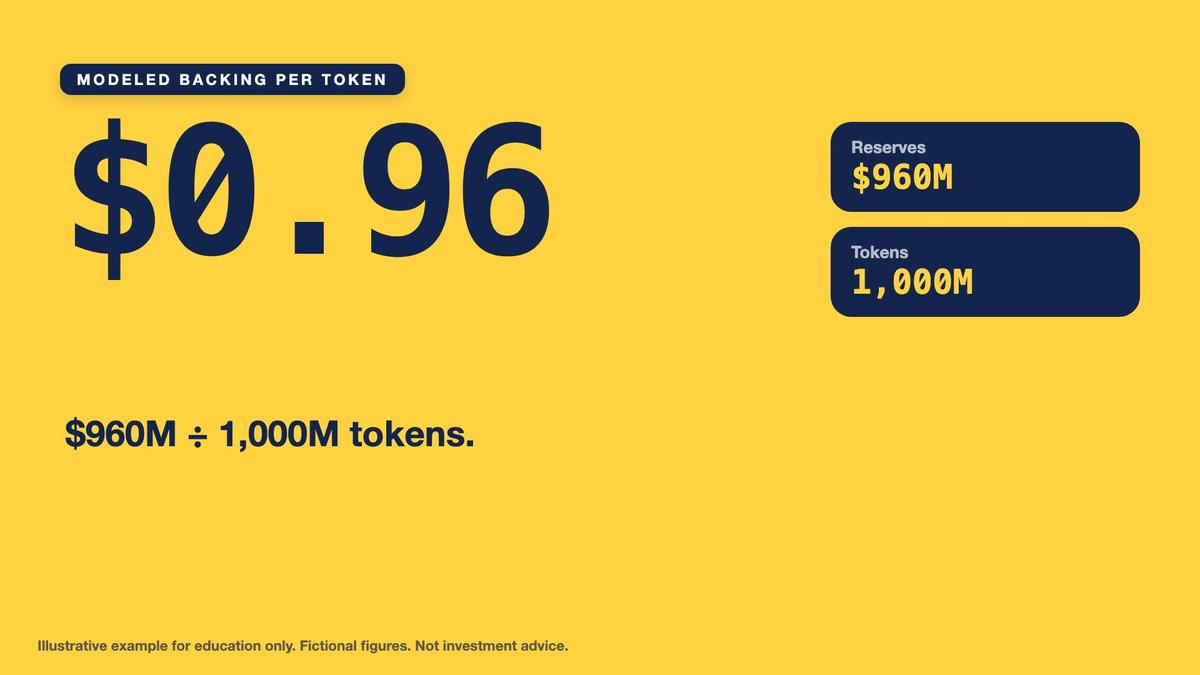
Now assume the $100 million of less-liquid reserve assets can only be sold at a 40% haircut. They realize $60 million rather than their $100 million face value. Total reserves available under that simplified liquidation assumption become $400 million plus $500 million plus $60 million, or $960 million. Dividing by 1 billion issued PGD tokens gives a modeled full-redemption backing value of $0.96 per token. This is a hypothetical asset-realization calculation, not an actual redemption guarantee, since contractual seniority, custody, expenses, timing, legal claims, and asset availability may change recoveries.
Key points
- A 60% redemption ($600M) is covered; a 95% redemption ($950M) leaves a $50M shortfall.
- A 40% haircut turns $100M into $60M, so modeled backing is $960M = $0.96 per token.
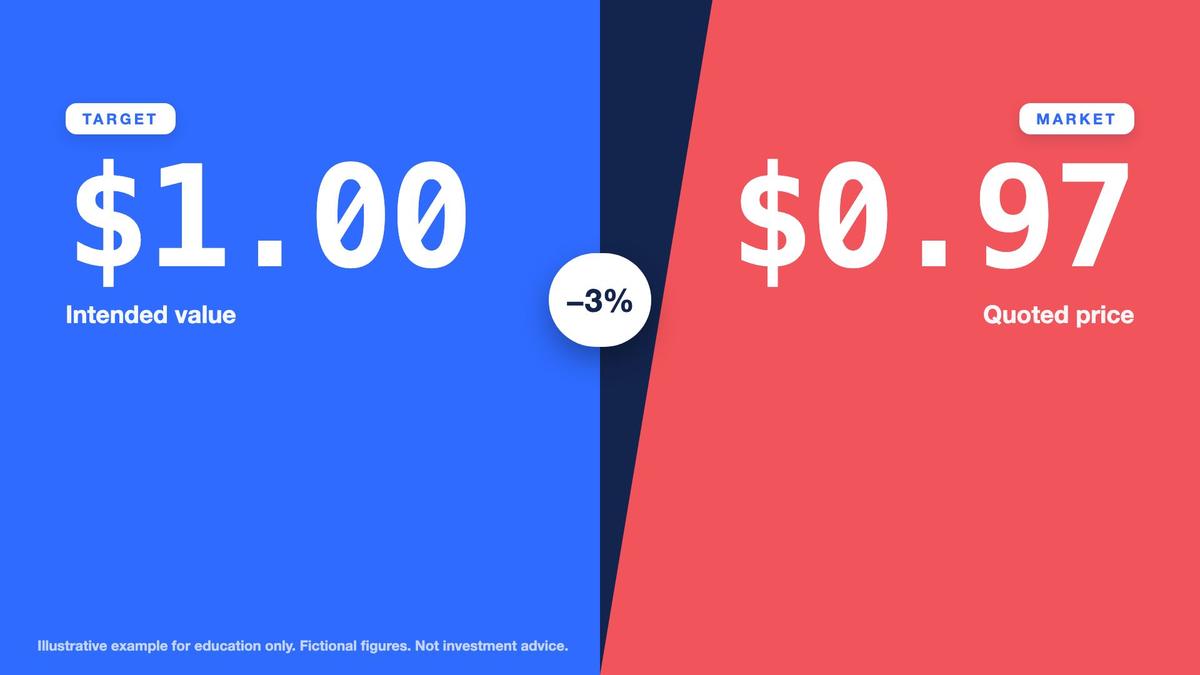
- At $0.97 the depeg is -3.0%; 10,000 tokens are worth $9,700, down $300.
Suppose PGD separately trades at $0.97 on a fictional secondary market. Relative to its $1.00 intended value, the depeg is ($0.97 divided by $1.00 minus one) multiplied by 100, or negative 3.0%. A holder of 10,000 PGD has a market value of $9,700 at that quote, an unrealized $300 decline from the intended $10,000 parity value. The $0.97 secondary-market price and $0.96 modeled full-reserve liquidation value answer different questions. Neither assures that all holders can redeem promptly, and both can change with liquidity, confidence, reserve values, and contractual conditions.
Counterparty Risk, Custody and Proof-of-Reserves Limits
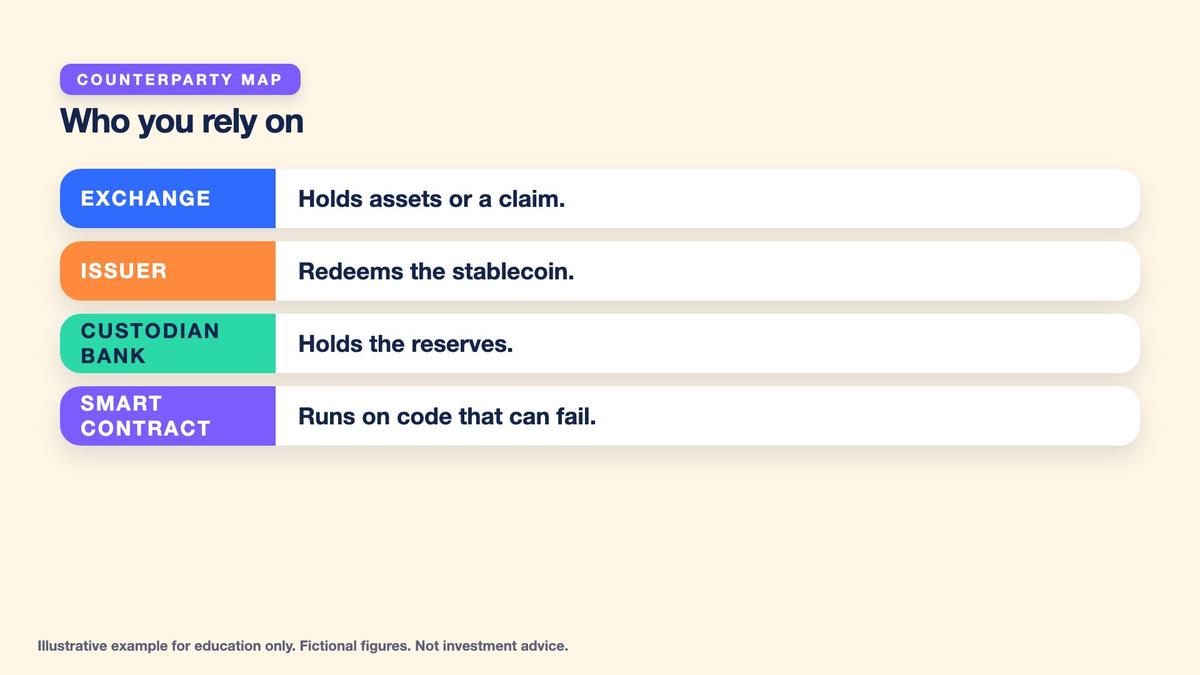
Counterparty risk concerns the possibility that an institution or contractual participant fails to meet an obligation. In digital asset markets, that counterparty could be an exchange holding customer assets, a stablecoin issuer promising redemption, a custodian bank holding reserves, a lender owing repayment, or another legal or technical intermediary. Smart contracts and bridges introduce additional software and operational dependencies even where no traditional firm directly controls every transaction. A useful risk map asks who owes the learner what, which assets support that obligation, where those assets are held, who can control them, and what happens if the relevant system fails.
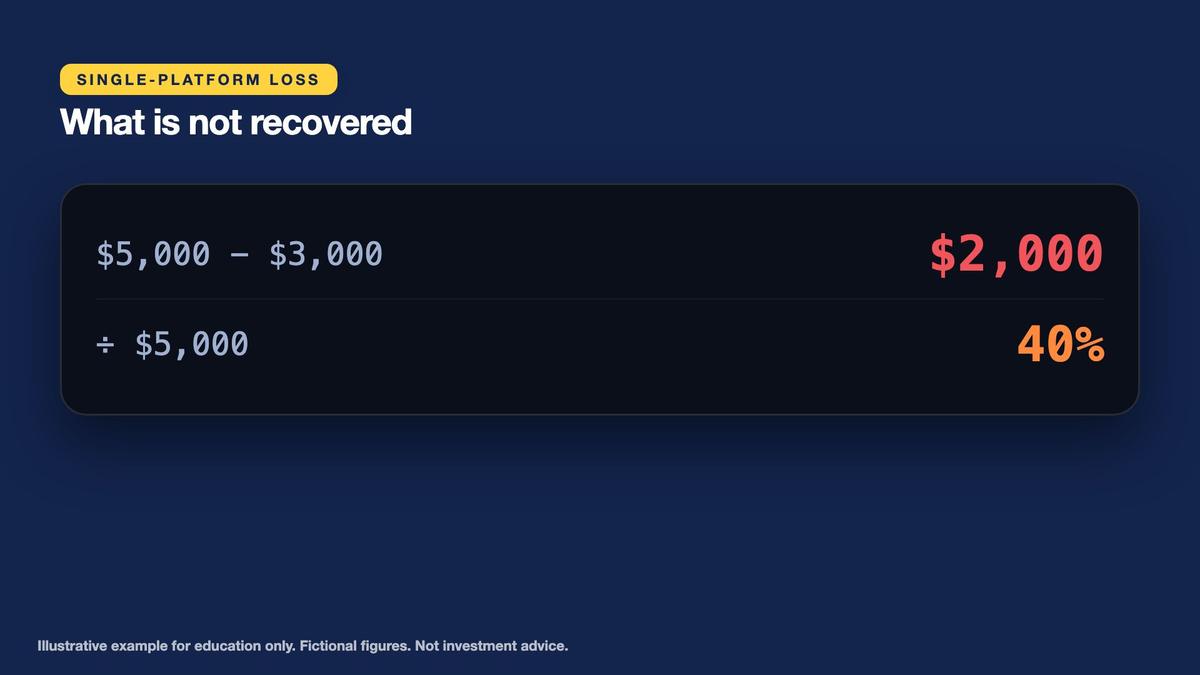
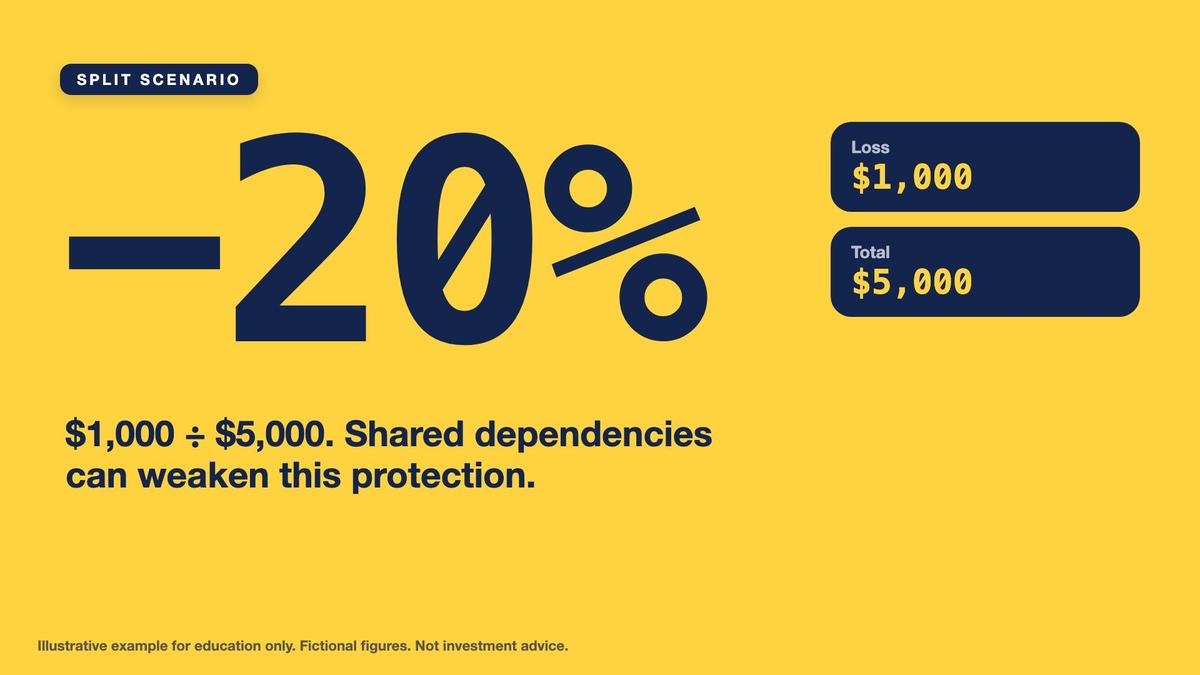
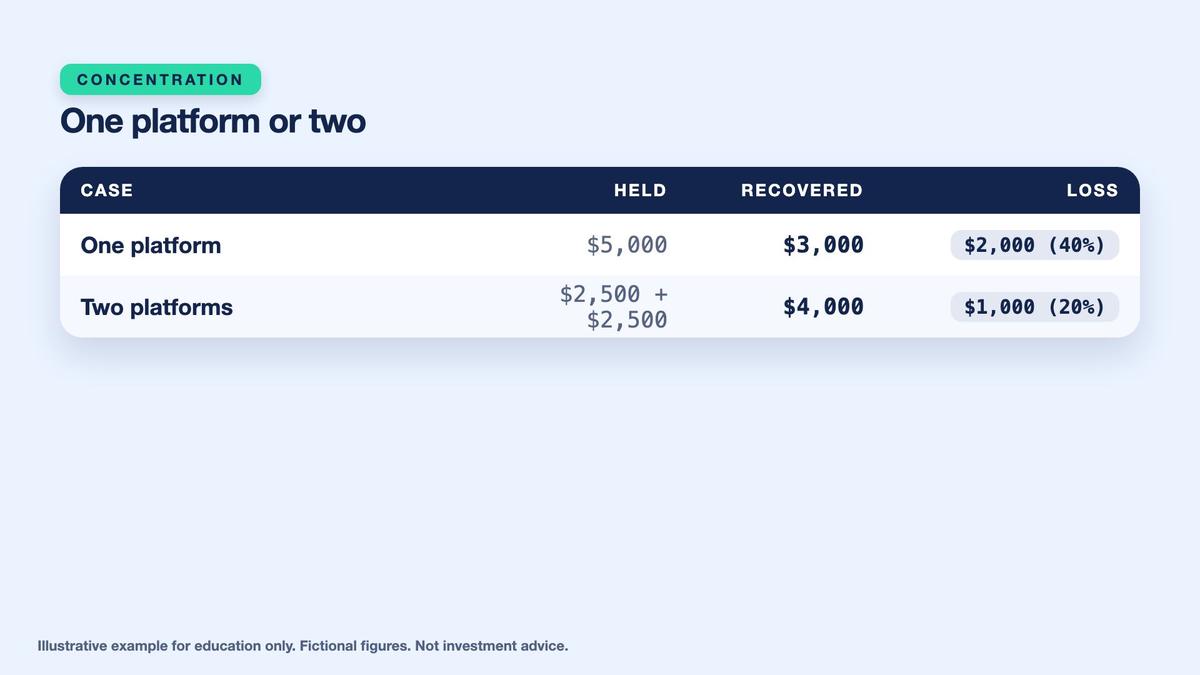
Consider $5,000 of fictional customer value held on one exchange. If that platform fails and customers ultimately recover 60%, the recovered amount is $5,000 multiplied by 0.60, or $3,000. The unrecovered loss is $2,000, equal to 40% of the starting claim. Now divide the same $5,000 equally between two genuinely independent platforms, with $2,500 on each. If one fails and pays 60% recovery, its customer receives $1,500 from that platform while losing $1,000 there. Assuming the other $2,500 remains fully available, the combined remaining value is $4,000 and the total loss is 20%.
Key points
- One exchange: $5,000 with 60% recovery returns $3,000, a $2,000 loss (40%).
- Two platforms at $2,500 each, one fails: $1,000 loss (20%).
- Diversification helps only if the platforms do not share a dependency; proof of reserves is not proof of solvency.
Diversifying across counterparties can reduce the amount exposed to a single failure, but only when the exposures are genuinely independent. Two platforms may rely on the same custodian, reserve issuer, lender, bridge, or infrastructure. Proof-of-reserves disclosures can demonstrate control of certain assets at a particular time, but they may omit liabilities, borrowed assets, off-balance-sheet obligations, or relevant legal restrictions. An attestation provides assurance over specifically defined information under its engagement scope, while an audit may examine broader financial statements; neither is a blanket guarantee of solvency or protection against future failure. Independent verification and legal claim analysis remain important.
Risk Controls and the One-Page Counterparty Checklist
The earlier risk-per-trade lesson introduced a planned loss budget, stop distance, and position-allocation cap. Those ideas help learners express exposure limits before outcomes are known, but leveraged products add liquidation thresholds, funding, collateral eligibility, and execution uncertainty. Even a precise stop cannot guarantee a maximum realized loss when prices gap or market liquidity disappears. For beginners, this course emphasizes understanding derivatives without using leverage in real accounts. A simulated position should be small enough to analyze clearly, and a separate research worksheet can demonstrate every calculation without placing any transaction.
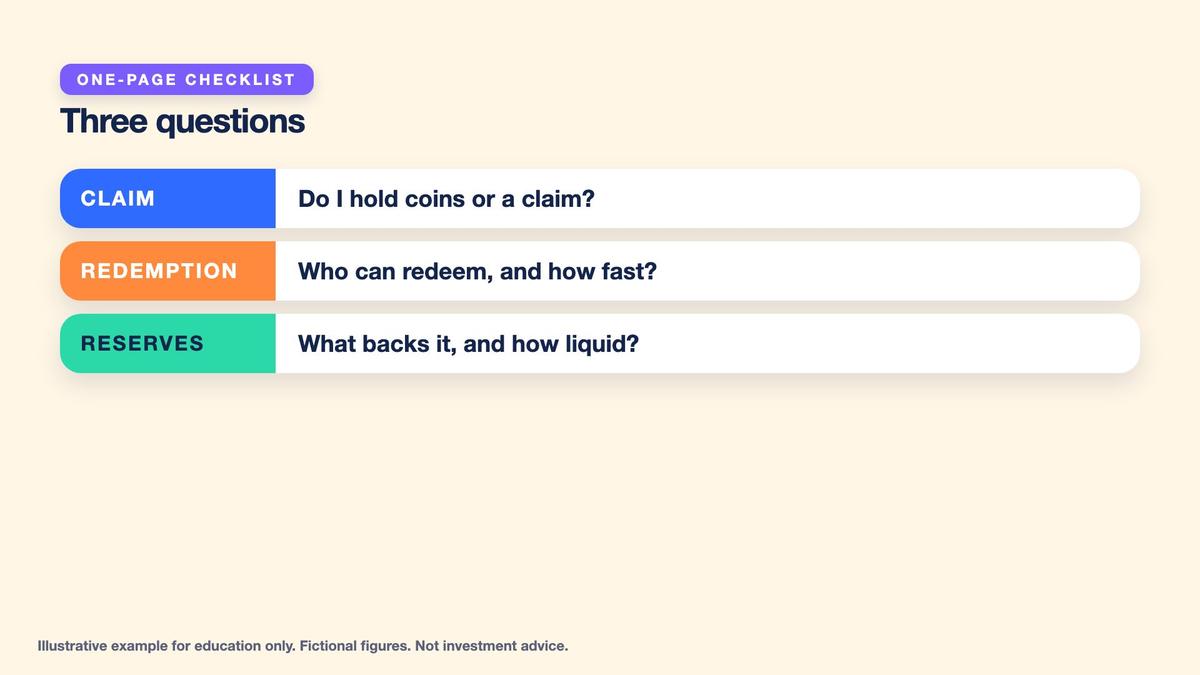
A one-page counterparty and depeg checklist begins by naming the instrument and identifying whether it represents an underlying asset, custodial claim, redemption claim, or derivative contract. Next record the relevant issuer, exchange, custodian, lender, contract administrator, or bridge. For stablecoins, list reserve composition, liquid assets, independent disclosures, direct redemption eligibility, minimum amounts, delays, and depeg mechanisms. For derivatives, list notional exposure, posted margin, maintenance requirements, funding method, possible liquidation triggers, and execution slippage. Distinguish recorded facts from assumptions and unanswered questions.
Key points
- Use the risk-per-trade rule and keep leverage at zero while you learn.
- A checklist: claim, redemption, reserves, liquidation level, what changes my mind.
- Stops are not guarantees: gaps and thin liquidity can make losses larger.
The checklist should conclude with plausible failure conditions and specific reasons to revisit the thesis. Examples include a reserve shortfall, unexpected redemption restrictions, a material depeg, an exchange withdrawal suspension, reduced independent verification, a change in margin requirements, or a security incident. Write these conditions before any imagined outcome occurs and preserve dated journal updates. Each metric should retain its denominator and assumptions: margin percentage is not the same as price movement, backing is not identical to immediate liquidity, and a secondary-market stablecoin quote is not necessarily the redemption amount the holder can legally claim.
Final Checkpoint: Compare Claims, Depegs and Failure Losses
Complete the first part of the worksheet by comparing a $1,000 Sample Coin spot holding with a $10,000 perpetual position supported by $1,000 margin. A 5% decline produces a $50 spot loss and a $500 derivative loss. Under the simplified fixed $500 maintenance threshold, the perpetual's remaining equity reaches maintenance after that decline. Calculate funding of $1 per eight-hour period, $3 per day, and $90 over 30 days, equal to 9% of initial margin. For the separate purchased call, verify $150 premium, $400 payoff and $250 net gain at a $24 expiry, and $150 loss at a $19 expiry.

Practice Lab: Map Spot, Derivative, Stablecoin and Counterparty Risks
Use only fictional Sample Coin, Peg Dollar (PGD), a hypothetical perpetual future, a hypothetical purchased call option, and simulated custodial platforms. Work through four separate scenarios using the specified prices, positions, margins, reserve assets, redemption requests, and recovery rates. Assume simplified linear perpetual exposure, a fixed $500 maintenance requirement based on original notional, zero trading fees and slippage unless expressly stated, constant funding for the stated thirty-day period, and fixed option contract terms. Treat stablecoin asset realization and secondary-market pricing as separate illustrations. Record calculations, counterparties, legal or contractual claims, failure assumptions, and reasons for review in a dated paper journal. Do not use a real exchange or place any leveraged order.
- Decision 1: A fictional Sample Coin spot holding is worth $1,000. Separately, a perpetual futures position uses $1,000 margin to control $10,000 notional, with a fixed maintenance requirement equal to 5% of the original notional. — Calculate leverage, the loss after a 5% adverse price move for each position, remaining derivative equity, and the simplified liquidation implication.
- Decision 2: The fictional perpetual has $10,000 constant notional and a positive funding rate of 0.01% every eight hours, paid by the hypothetical long. A separate purchased call covers 100 units at strike $20 with $1.50 premium per unit. — Calculate funding over 30 days and the call buyer's payoff, net result and maximum contractual loss at expiry prices of $24 and $19.
- Decision 3: Peg Dollar has one billion tokens and reserves of $400 million cash, $500 million short-term bills, and $100 million less-liquid assets. Redemption demand is alternatively 60% or 95% of tokens. — Calculate total nominal backing, readily liquid reserves, redemption demands, the immediate 95% liquidity shortfall, and recovery backing after a 40% haircut on less-liquid assets.
- Decision 4: PGD is intended to maintain $1.00 but trades at $0.97. A hypothetical learner holds 10,000 tokens and separately considers an exchange claim of $5,000 with a 60% recovery if the exchange fails. — Calculate the stablecoin depeg and market-value decline, then compare the single-exchange failure loss with a split allocation where only one independent platform fails.
- Decision 5: A simulated learner compares spot custody, a leveraged perpetual, a purchased call, Peg Dollar, and balances on two fictional financial platforms. The objective is identifying contractual and counterparty risks. — Prepare a one-page map of who owes the learner what, identify failure points, and specify evidence that would require reconsidering each exposure.
Answer key
Next calculate Peg Dollar's reserve position and redemption risks. Total reserves are $1 billion, with $900 million classified as liquid. A $600 million redemption request can be covered by the assumed liquid reserves, while a $950 million request creates a $50 million immediate liquidity gap. A 40% haircut on the $100 million less-liquid assets reduces their value to $60 million and total modeled reserves to $960 million, or $0.96 per issued token. At a separate $0.97 market quote, 10,000 PGD are worth $9,700, an unrealized $300 loss from par. Explain why the market price and theoretical reserve recovery differ.
Key points
- Record leverage, depeg gap and the recovery rate you assume.
- Verify $500, $90, $250, $50M, $0.96, -3.0%, $2,000 and $1,000.
- Write the risk map before any simulated decision.
Finally compare counterparty failure scenarios. A $5,000 claim on one fictional failed exchange with 60% recovery loses $2,000. Dividing the same $5,000 into two independent $2,500 claims, with only one platform failing at the same recovery rate, reduces the assumed loss to $1,000. Explain why shared infrastructure can make the two exposures less independent than they appear. Save a one-page counterparty map recording legal claims, collateral, reserve liquidity, margin, redemption rights, failure conditions, and evidence requiring further research. The outcome is identifying counterparty and depeg risks, not choosing an asset or predicting prices.
Worked example at a glance
Key terms
- Spot: buying or selling the underlying asset itself.
- Derivative: a contract whose value depends on an underlying asset.
- Perpetual future: a futures-style contract with no fixed expiry, usually with funding.
- Margin: collateral posted to support a position.
- Leverage: position size divided by margin.
- Liquidation: a forced close when equity falls to the maintenance level.
- Funding: periodic payments between long and short holders of a perpetual.
- Option premium: the price paid for an option; the buyer's maximum loss.
- Stablecoin: a token that targets a stable value, such as $1.00.
- Depeg: a market price that moves away from the intended value.
- Haircut: a discount applied when assets are sold or valued under stress.
- Counterparty risk: the risk that an institution or contract fails to meet an obligation.
Multi Asset Trading Lab is an educational course and does not provide personalized investment, trading, financial, accounting, legal, or tax advice. Sample Coin, Peg Dollar (PGD), the hypothetical perpetual futures contract, the hypothetical purchased call option, all exchanges and financial platforms, and every price, position, reserve, funding rate, recovery assumption, and transaction in this lesson are fictional. No real stablecoin, exchange, ticker, or instrument is recommended or identified for purchase. All activities involve simulated money or written classroom calculations only; no actual asset purchase, leveraged transaction, options trade, stablecoin redemption, or brokerage connection is required or encouraged. Spot ownership differs from holding a claim against a custodian, and direct control of digital assets can introduce private-key loss, transaction error, software, and custody risks. Derivatives are contracts whose performance and settlement depend on product terms, market conditions, margin arrangements, and counterparties. The fictional $1,000 spot exposure loses $50 after a 5% price decline, while the separate $10,000 perpetual exposure supported by $1,000 margin loses $500 under the same move. The 10x leverage comparison is arithmetic, not a recommendation to use leverage. The simplified liquidation illustration fixes maintenance margin at 5% of the original $10,000 notional, or $500, and ignores changing notional value, mark-price methodology, maintenance tiers, additional margin, fees, funding adjustments, slippage, liquidation buffers, and platform-specific rules. Actual liquidation may occur earlier or result in worse losses. A hypothetical 10% adverse move represents a $1,000 mark-to-market loss on $10,000 notional before intervention, but a platform may close the position before such a loss occurs. Under unusual circumstances, losses or liabilities can exceed deposited margin depending on contract terms and available protections. The illustrated positive 0.01% funding charge per eight hours assumes constant $10,000 notional, three funding periods per day, and 30 days without interruption, resulting in $90 total or 9% of initial margin. Real funding rates vary, can reverse direction, and may not apply at identical intervals across products. Purchased-call calculations assume a fully paid long call covering 100 units, a $20 strike, and a $1.50 premium per unit. The $150 premium is the buyer's maximum contractual loss before transaction costs under those assumptions. At a $24 expiry price the intrinsic payoff is $400 and net result is $250; at $19 the call expires worthless and the loss is $150. Option sellers, uncovered positions, different settlement arrangements, and more complex options strategies can have substantially greater risks. Stablecoins can lose their intended reference value because of reserve losses, redemption restrictions, counterparty failures, liquidity shortages, changes in market confidence, unstable collateral, software problems, or algorithmic design failures. Fiat-backed, crypto-collateralized, and algorithmic designs differ materially, and no stablecoin mechanism guarantees par redemption or protection from loss. The fictional PGD reserve exercise assumes one billion issued tokens backed by $400 million cash, $500 million short-term government bills, and $100 million less-liquid assets stated at face value. The $900 million liquid-reserve classification is an educational assumption, not a guarantee of instant cash settlement. A 60% redemption request requires $600 million at par, while a 95% request requires $950 million and exceeds assumed liquid reserves by $50 million. A 40% forced-sale haircut reduces the $100 million less-liquid allocation to $60 million, yielding $960 million total modeled realizable reserves, or $0.96 per token if all one billion tokens are considered. This modeled value excludes legal priorities, liabilities not specified, reserve encumbrances, settlement delays, asset sale costs, operational failures, and other possible claims, and it is not a guaranteed redemption or recovery amount. The separate fictional $0.97 secondary-market quote is a 3.0% depeg from the $1.00 reference; 10,000 PGD would have a $9,700 market value, an unrealized $300 decline from par before transaction costs. A market quote and a modeled reserve realization value are distinct and need not converge. A stablecoin holder's actual redemption rights depend on issuer terms, eligibility, minimum sizes, jurisdiction, custody, and enforceable contractual arrangements. Reserve attestations may provide scoped assurance about specific disclosed information, while audits may examine broader financial statements, but neither automatically proves complete liabilities, unrestricted reserve availability, or continuing solvency. Proof-of-reserves evidence can be incomplete, outdated, or affected by off-balance-sheet obligations and shared custody arrangements. Counterparty concentration calculations are fictional. A $5,000 claim with 60% recovery loses $2,000, while splitting $5,000 equally between two independent platforms and assuming only one fails with 60% recovery produces a $1,000 total loss, or 20%. The split-platform result requires the second platform to remain unaffected and the two exposures to be sufficiently independent; common custodians, reserves, lenders, infrastructure, or correlated failures can undermine diversification. Recovery rates, access restrictions, and legal outcomes are uncertain and are not guaranteed by any account balance. Exchanges, issuers, custodian banks, lenders, smart contracts, bridges, and other intermediaries may each create distinct or overlapping failure dependencies. The earlier planned risk-per-trade and position-cap rules remain educational frameworks and do not guarantee that execution stops, liquidation, custody protections, or financial recoveries will work as expected. Beginners should study leverage and derivatives through simulation rather than using borrowed exposure or real-money leverage. Learners should document exact instruments, contractual rights, reserve backing, liquidity, margin, funding, redemption eligibility, counterparty dependencies, and measurable revisit conditions in dated research notes. No hypothetical result, modeled reserve value, simulated recovery, or educational risk control predicts future outcomes or constitutes a recommendation to buy, sell, hold, borrow, stake, lend, redeem, or trade any real financial asset.
Lesson Checkpoint
Review what you learned and get feedback on your work.