



In this sixteen-minute beginner lesson, learners build a spreadsheet to apply a predefined portfolio rebalancing rule using fictional Global Stock ETF, Bond ETF, and Cash holdings in a simulated account. Starting with a 60% stock, 30% bond, and 10% cash policy, learners calculate current weights, percentage-point drift, target dollar values, proposed trades, trading spreads, hypothetical taxes, whole-share quantities, and remaining cash. They practice applying a five-percentage-point threshold consistently, distinguishing a rebalancing trigger from a performance forecast, and documenting execution costs and rounding differences. The outcome is a reproducible spreadsheet and journal entry showing whether the written rule requires rebalancing or holding.
Why Rebalance and Why Write the Rule First
Portfolio rebalancing is the process of adjusting asset allocations toward predefined target weights. It is primarily a tool for maintaining a chosen risk exposure rather than maximizing returns. Assets change in value at different rates, causing their percentage weights to drift away from the original plan. Without a rule, learners may allow recent performance or emotion to determine whether to make adjustments. A written policy creates a consistent reference that can be applied before and after market changes. This lesson uses fictional Global Stock ETF, Bond ETF, and Cash in a simulated account.

Our written policy specifies a target allocation of 60% Global Stock ETF, 30% Bond ETF, and 10% Cash. It also specifies that rebalancing occurs when any asset's current weight differs from its target by more than five percentage points. If all differences are five percentage points or less, the policy requires holding the existing allocation. The word more is important: a deviation of exactly five percentage points does not trigger the rule. The threshold should be stated before the market moves so it cannot be redefined to justify a preferred outcome.


Key points
- Rebalancing returns a portfolio to the risk mix you chose; it is not a forecast or a way to boost returns.
- Write the rule before the market moves: targets 60/30/10 and rebalance when any drift is more than 5 points.
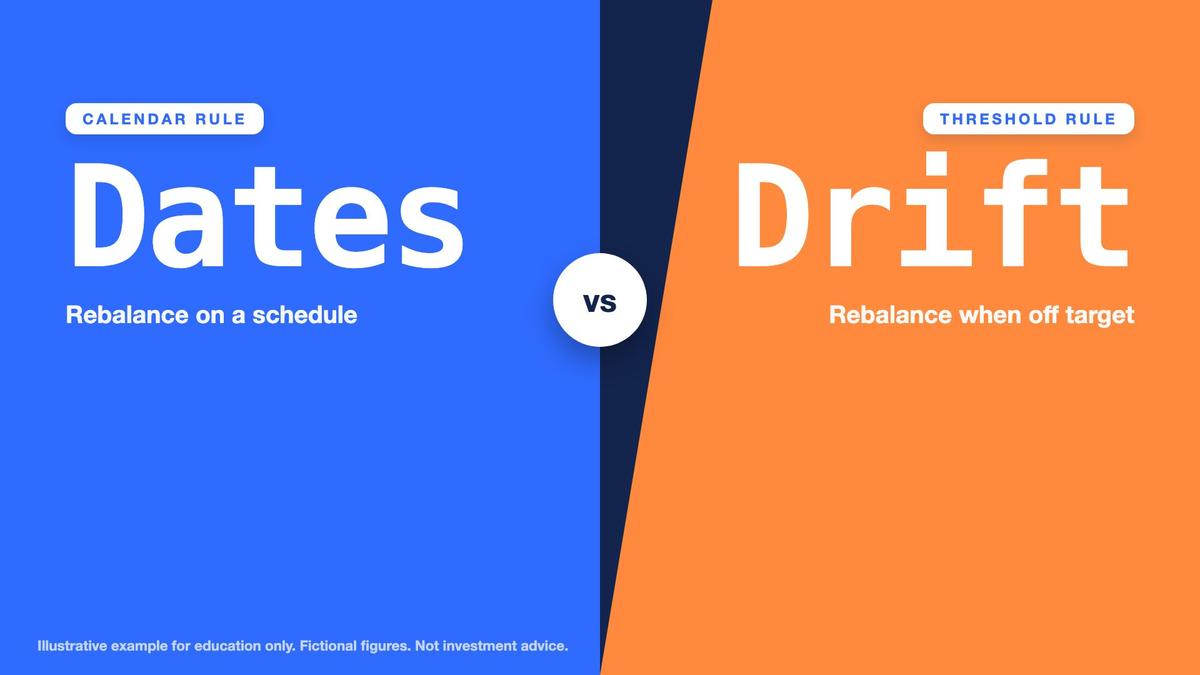
- Calendar rules act on dates; threshold rules act on drift.
Different policies can use different approaches. A calendar rule triggers rebalancing at predefined intervals, such as a scheduled annual review. A threshold rule triggers when weight drift exceeds a specified tolerance. Some policies combine both methods. None guarantees higher returns or lower realized costs. For this educational exercise, we use the stated five-percentage-point threshold rule, and the scenario provides a hypothetical year-end observation. Rebalancing is not a forecast that an overweight asset will decline or an underweight asset will rise.
Calculate Current Weights and Identify the Threshold Trigger
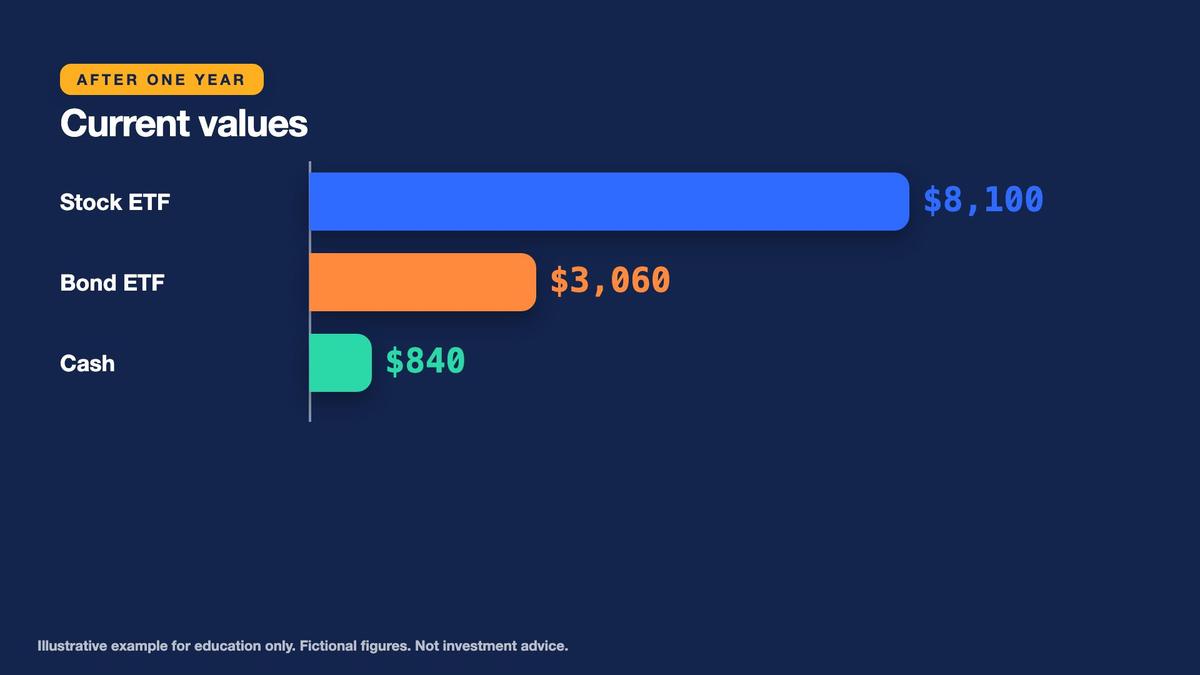
Begin with the simulated $10,000 portfolio. At its starting point, Global Stock ETF holds $6,000, Bond ETF holds $3,000, and Cash holds $1,000. These values match the written targets of 60%, 30%, and 10%. After one hypothetical year, market movements and account activity leave Global Stock ETF valued at $8,100, Bond ETF at $3,060, and Cash at $840. The sum is exactly $12,000. Current weight is calculated by dividing each asset's value by the current total portfolio value, not by the original $10,000 balance.
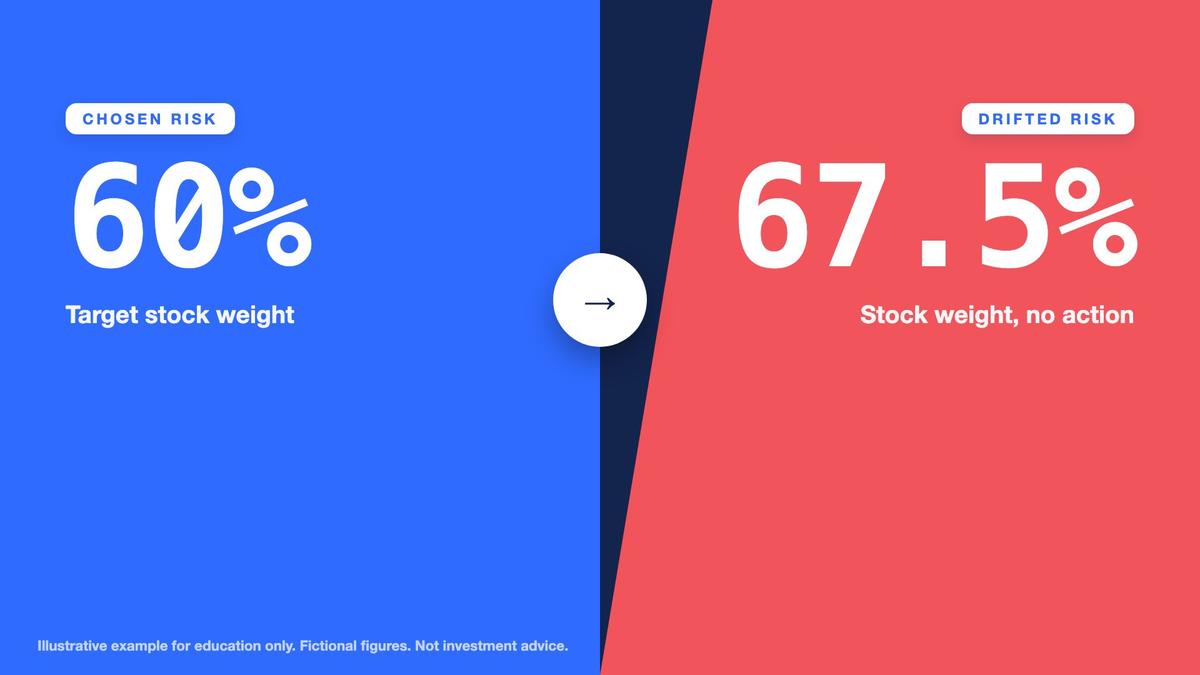
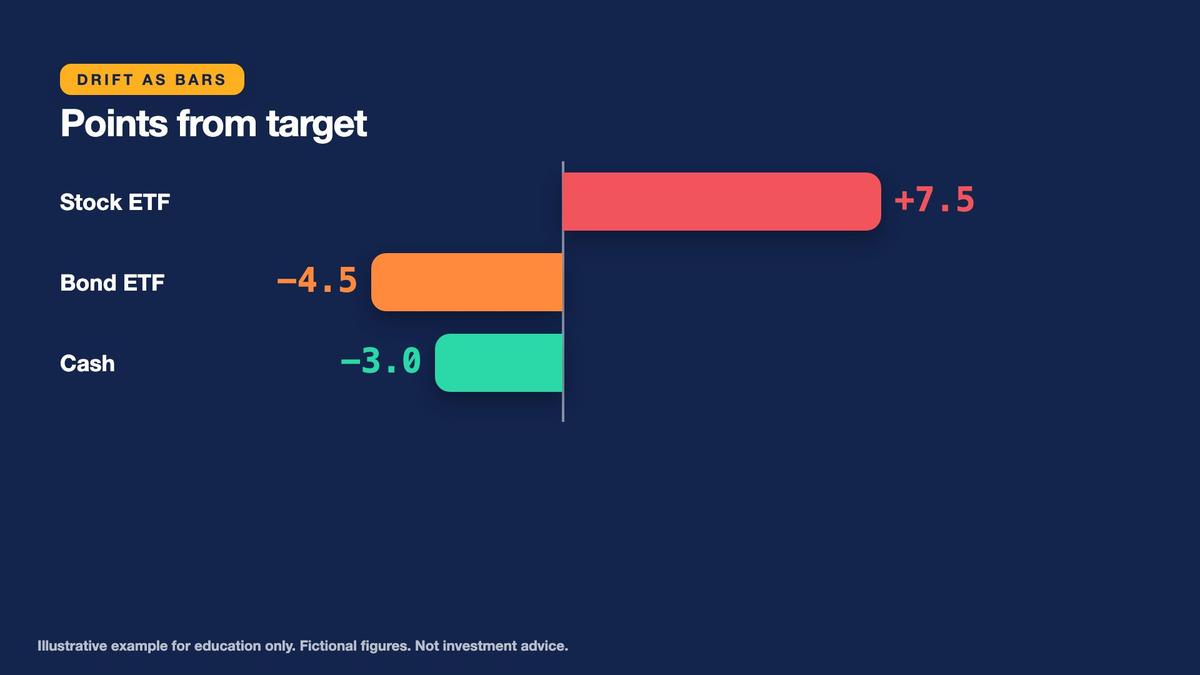
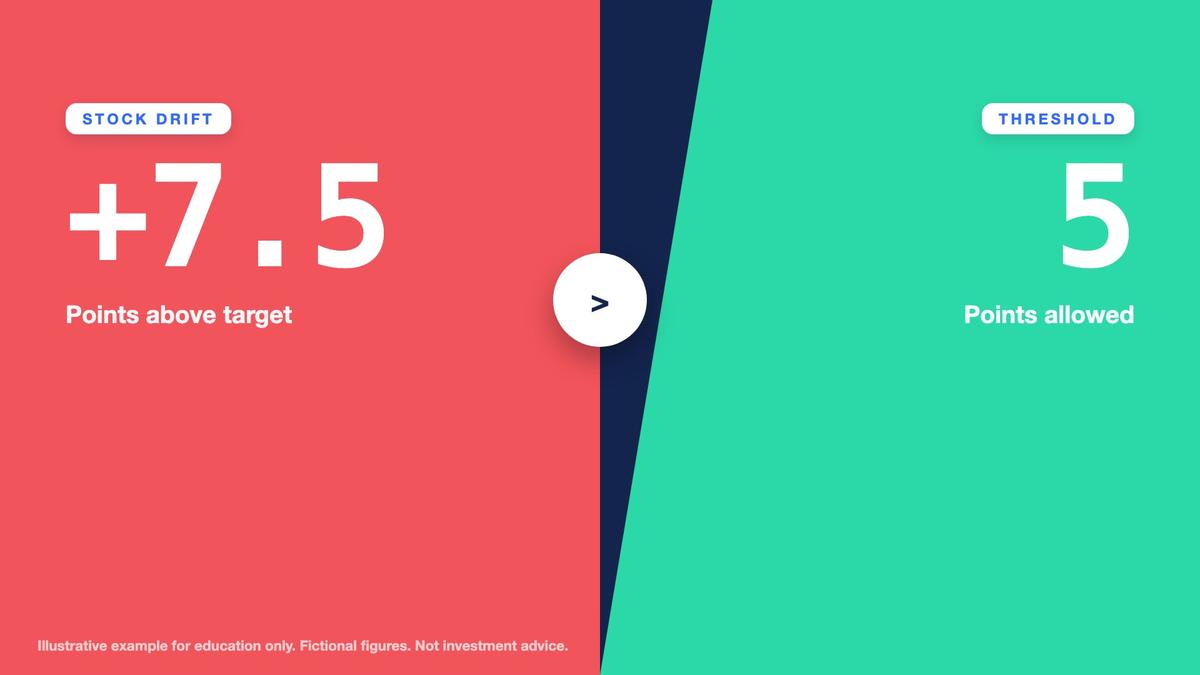
The current weights are $8,100 divided by $12,000, or 67.5% stocks; $3,060 divided by $12,000, or 25.5% bonds; and $840 divided by $12,000, or 7.0% cash. These percentages sum to exactly 100%. Calculate drift by subtracting each target weight from its corresponding current weight. Stock drift is positive 7.5 percentage points, bond drift is negative 4.5 points, and cash drift is negative 3.0 points. Positive drift means overweight relative to the policy, while negative drift means underweight.
Key points
- Current weight = value / total: 8,100 / 12,000 = 67.5%, 3,060 / 12,000 = 25.5%, 840 / 12,000 = 7.0%.
- Drift = current weight - target weight: +7.5, -4.5, -3.0 points.
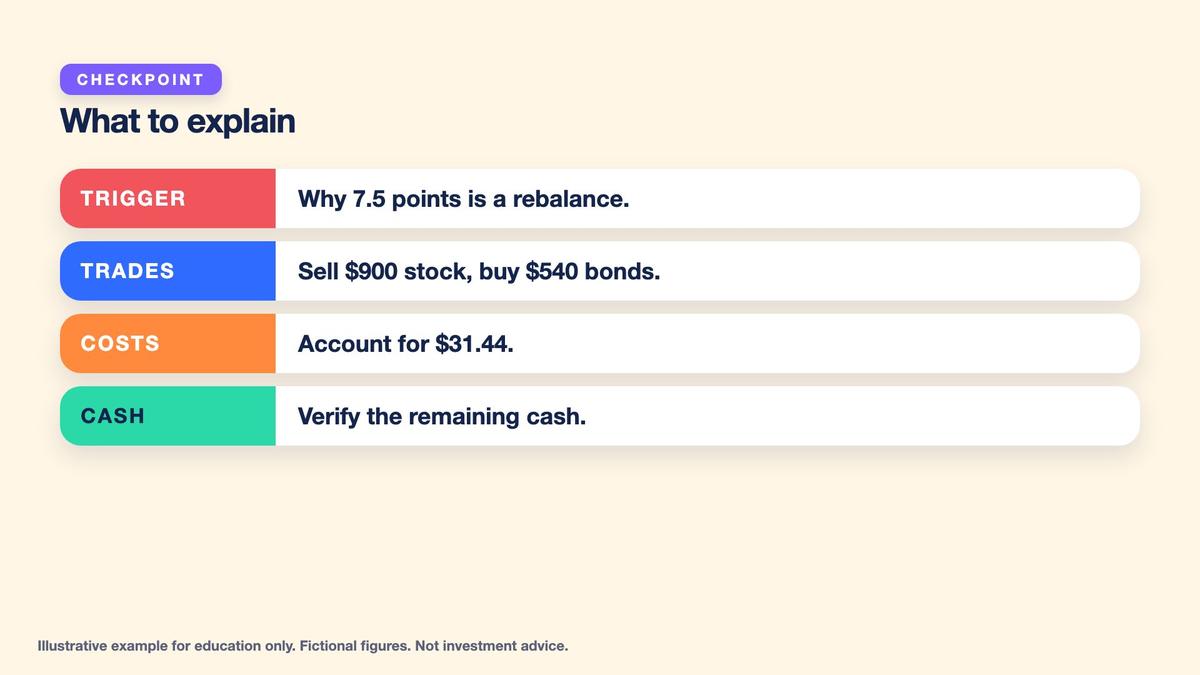
- Stock drift 7.5 is more than 5, so the rule says rebalance. Exactly 5 would not trigger it.
The rule uses the absolute size of each deviation. Stocks have a 7.5-percentage-point absolute drift, bonds 4.5, and cash 3.0. Because stocks exceed the five-percentage-point threshold, the entire portfolio is scheduled for rebalancing. The other two assets do not individually breach the tolerance, but they still participate in restoring the overall target allocation. This is an important distinction: the threshold identifies when the portfolio-wide action is required, while the target weights determine the desired allocation after that action.
Calculate Target Values and Ideal Dollar Trades
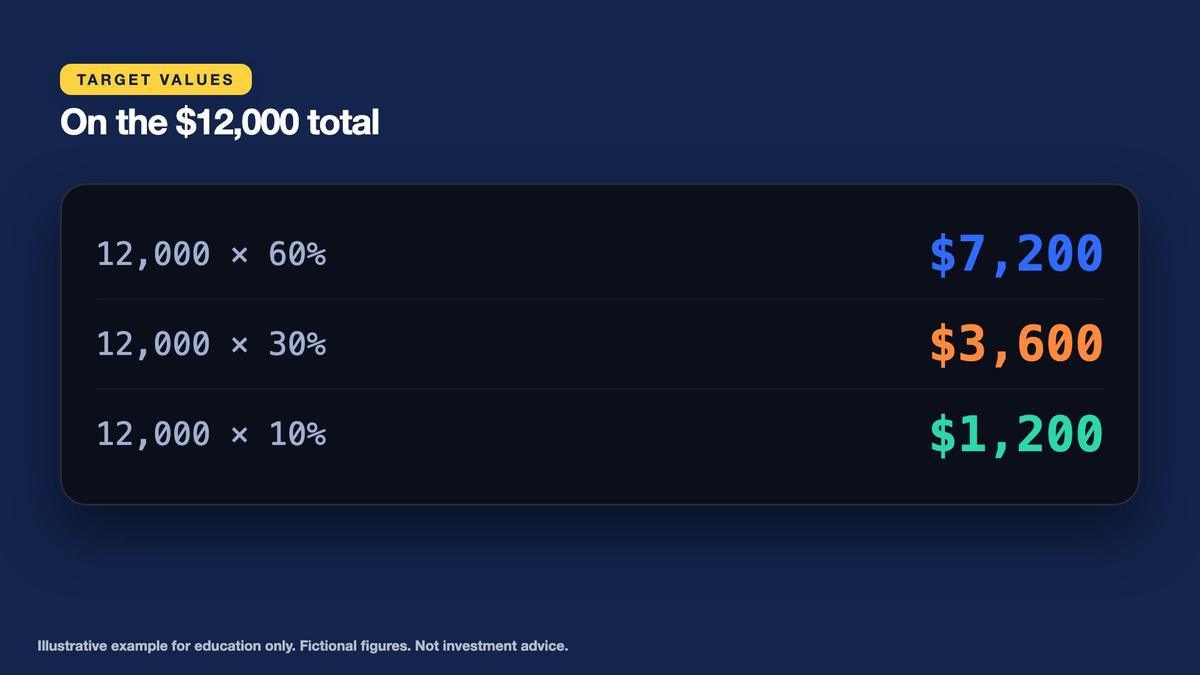
Once the rule indicates rebalancing, calculate target dollar values using the current $12,000 portfolio total. Global Stock ETF's target is 60% multiplied by $12,000, equal to $7,200. Bond ETF's target is 30% multiplied by $12,000, equal to $3,600. Cash's target is 10% multiplied by $12,000, equal to $1,200. These three desired dollar amounts add to exactly $12,000. The calculations are based on the pre-trade, pre-cost total so the initial ideal adjustments can be inspected consistently.
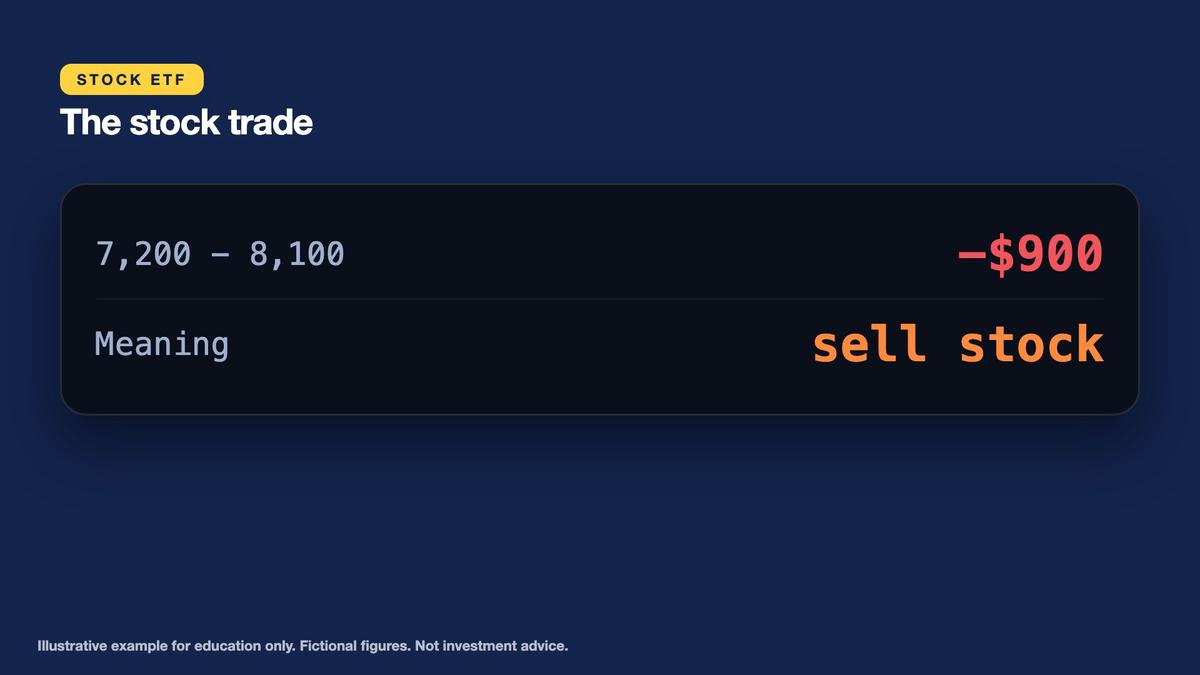
The signed trade amount equals target value minus current value. For Global Stock ETF, $7,200 minus $8,100 equals negative $900, indicating a proposed sale of $900. For Bond ETF, $3,600 minus $3,060 equals positive $540, indicating a proposed purchase of $540. Cash requires an additional $360 to reach its target, because $1,200 minus $840 equals positive $360. Selling $900 of stocks and buying $540 of bonds leaves $360 to increase cash before accounting for any costs.
Key points
- Target value = total x target weight: $7,200, $3,600, $1,200.
- Trade = target - current: stock -$900 (sell), bonds +$540 (buy), cash +$360.
- Sanity check: -900 + 540 + 360 = 0.
A useful sanity check is that the frictionless target adjustments sum to zero. The adjustments are negative $900 for stocks, positive $540 for bonds, and positive $360 for cash. Their sum is exactly zero. This confirms that the planned allocation changes are internally balanced before taxes and trading frictions. However, the ideal target amounts are not guaranteed execution amounts. Share prices, whole-share restrictions, fees, and taxes can prevent the final portfolio from matching the original target dollar values exactly.
Account for Trading Spreads and Hypothetical Taxes
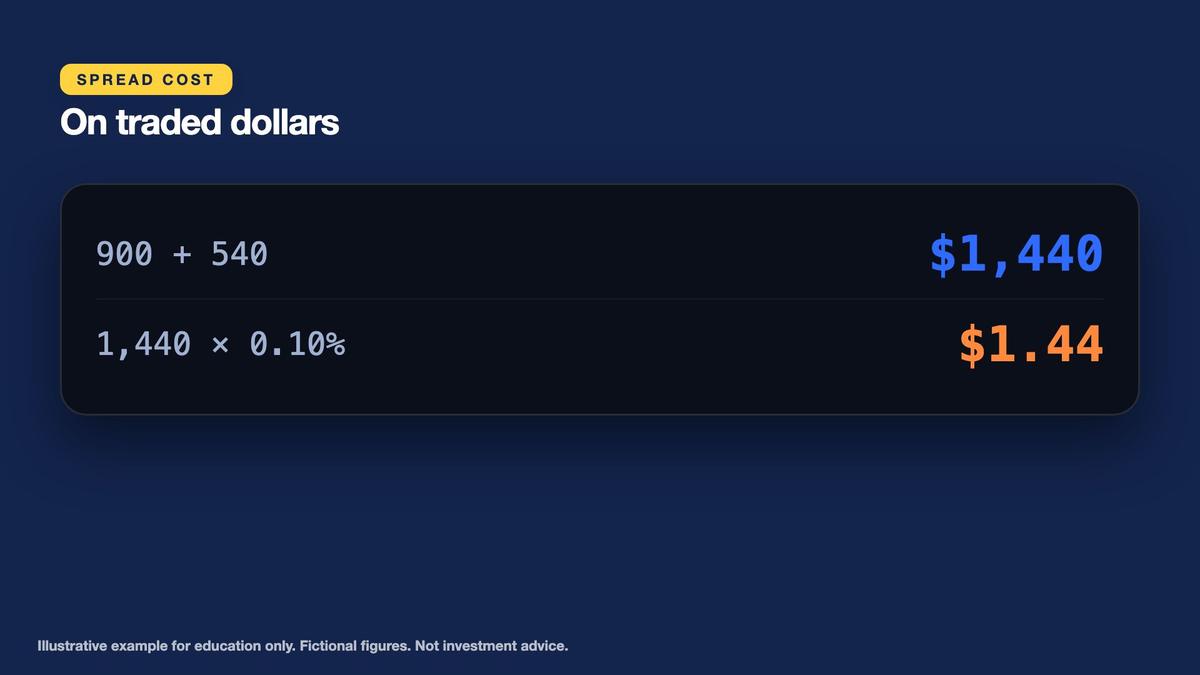
The exercise introduces a fictional trading spread cost of 0.10% of every traded dollar amount. The ideal rebalancing plan sells $900 of Global Stock ETF and buys $540 of Bond ETF. Their combined gross traded amount is $1,440. Multiplying $1,440 by 0.001 gives exactly $1.44 in spread costs. This amount is an invented arithmetic assumption rather than an actual broker quote. In real transactions, spreads can vary by asset, market conditions, order size, and execution timing.
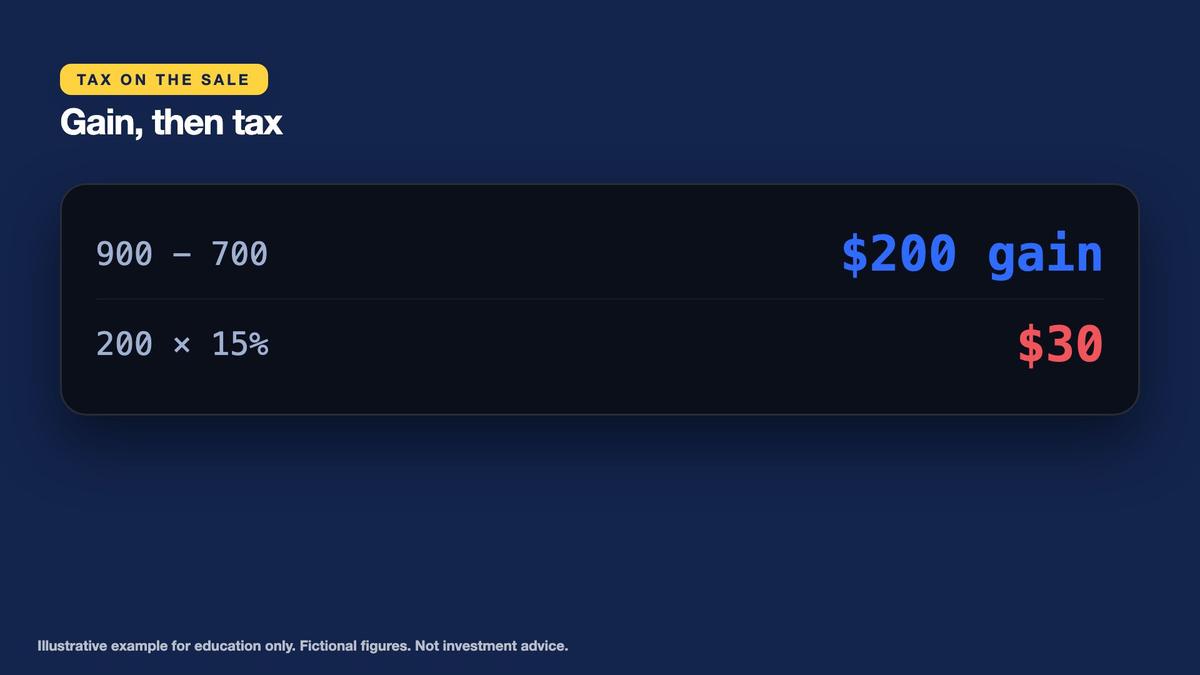
The example also assumes an invented 15% tax on realized capital gains. The $900 stock sale is assigned a hypothetical cost basis of $700, so its realized gain is $200. Fifteen percent of $200 equals $30 of fictional tax. Adding the prescribed $1.44 spread cost produces $31.44 in total illustrated costs. These calculations are independent of actual taxation in any jurisdiction and exclude other possible fees. They demonstrate why an otherwise balanced set of proposed trades can reduce the account's total value.
Key points
- Spread: (900 + 540) x 0.10% = $1.44.
- Invented tax: gain 900 - 700 = $200, 15% = $30.
- Total illustrative cost: $31.44. Tax is most of it.
There is an important implementation distinction. The required $1.44 spread is calculated on the ideal $900 sale and $540 bond purchase before whole-share rounding. Later, the actual bond purchase will be only $520. If the stated 0.10% spread were recalculated strictly on executed traded amounts, the spread would instead be $1.42, and total cost would be $31.42. To preserve the exercise's specified $31.44 cost budget, the main worked reconciliation deducts that illustrative amount. A real spreadsheet should explicitly identify which trade amounts generate each cost and recompute costs after final execution quantities are known.
Round Trades to Whole Shares and Reconcile Cash
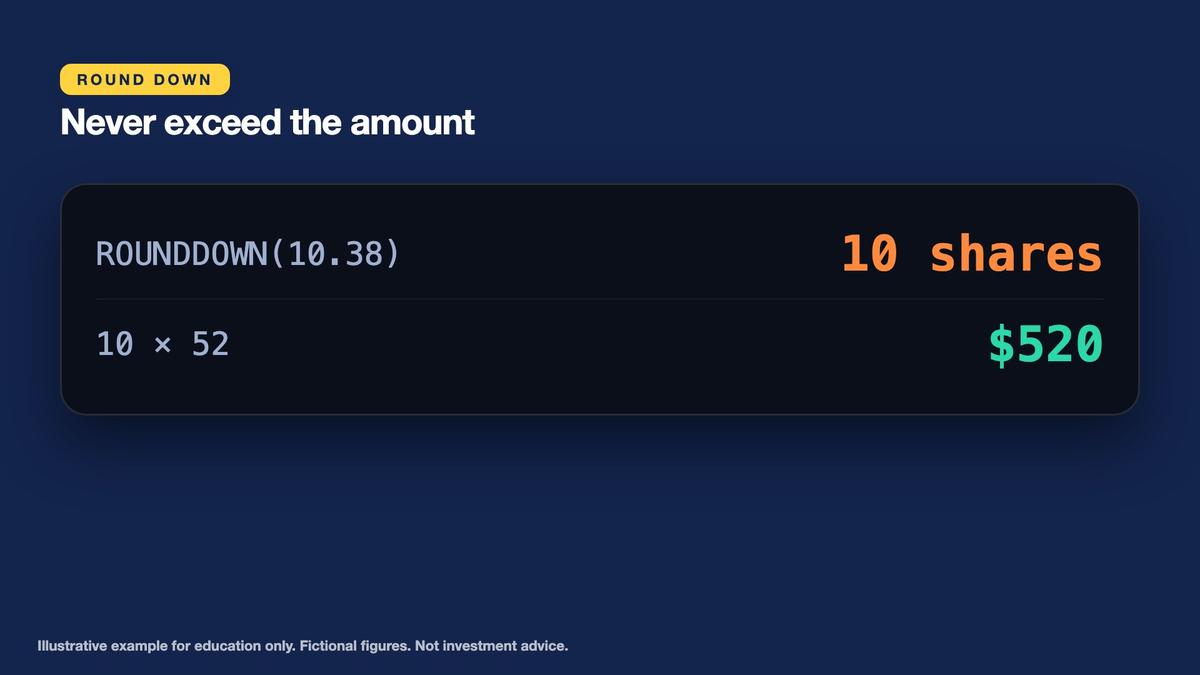
Convert the ideal dollar trades into share quantities using the fictional prices supplied for this lesson. Global Stock ETF has a price of $45. Selling $900 therefore means selling exactly 20 shares. Bond ETF has a price of $52. The desired $540 purchase corresponds to approximately 10.384615 shares, but the exercise assumes only whole shares may be traded. Round the purchase quantity down to 10 shares, costing exactly $520. The bond purchase is therefore $20 smaller than the ideal dollar adjustment.
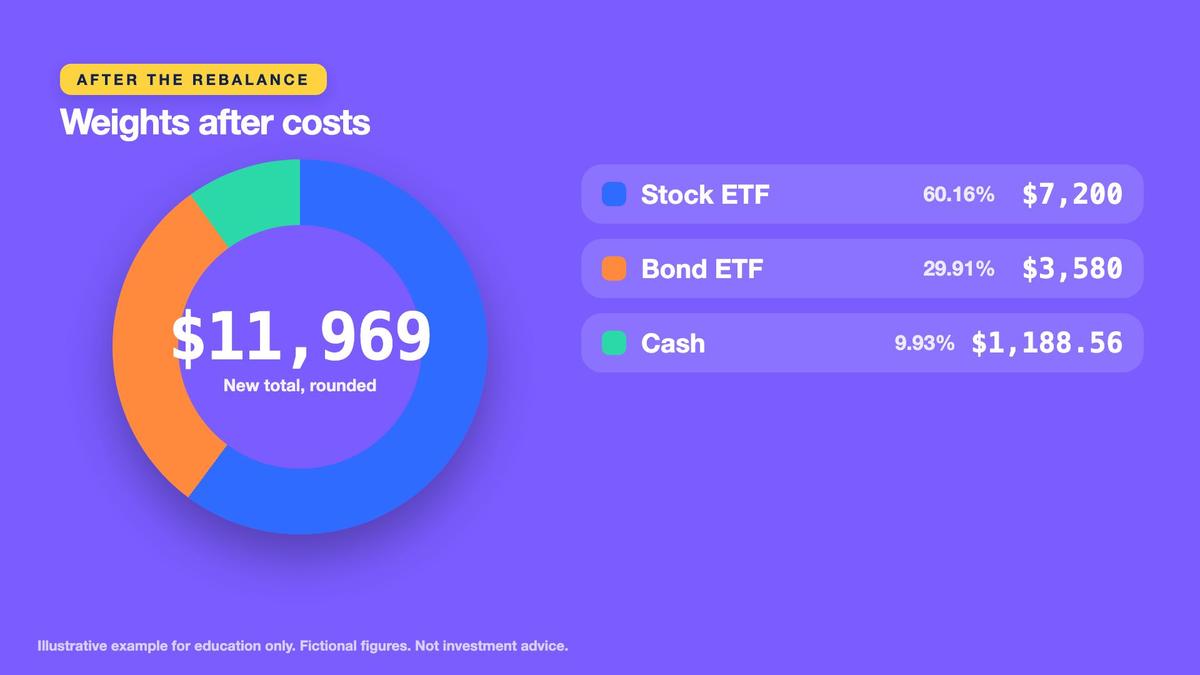
After these whole-share trades, the stock allocation is $8,100 minus $900, or $7,200. The bond allocation is $3,060 plus $520, or $3,580. Cash becomes $840 plus $900 sale proceeds minus $520 bond purchase, or $1,220 before costs. The original desired cash target was $1,200, so the whole-share rounding leaves $20 more cash than the frictionless target. This is not an arithmetic error; it is a consequence of being unable to purchase a fractional bond ETF share under the exercise's rules.
Key points
- Stock: 900 / 45 = 20 shares. Bonds: 540 / 52 = 10.38, round down to 10 shares = $520.
- Cash before costs: 840 + 900 - 520 = $1,220. After costs: $1,188.56.
- New total $11,968.56: exactly $31.44 below $12,000.
Using the prescribed illustrative total cost of $31.44, deduct that amount from the $1,220 cash balance, leaving exactly $1,188.56. The resulting portfolio consists of $7,200 stocks, $3,580 bonds, and $1,188.56 cash, totaling $11,968.56. The reduction from the starting $12,000 equals the $31.44 cost budget. If the spreadsheet instead recomputes the spread on executed $900 and $520 trades, final cash is $1,188.58 and the total is $11,968.58. Both reconciliations are mathematically consistent when their respective cost assumptions are clearly labeled.
Build Spreadsheet Columns, Formulas, and Validation Checks
Create a spreadsheet with assets in column A, current dollar values in B, current weights in C, target weights in D, and signed percentage-point drift in E. Add a helper action column F, target dollar values in G, signed target trades in H, market prices in I, and signed whole-share quantities in J. Place Global Stock ETF in row 2, Bond ETF in row 3, Cash in row 4, and the portfolio total in B5. The helper action column allows the formulas to remain consistent while distinguishing a row-level threshold result from target and trade calculations.
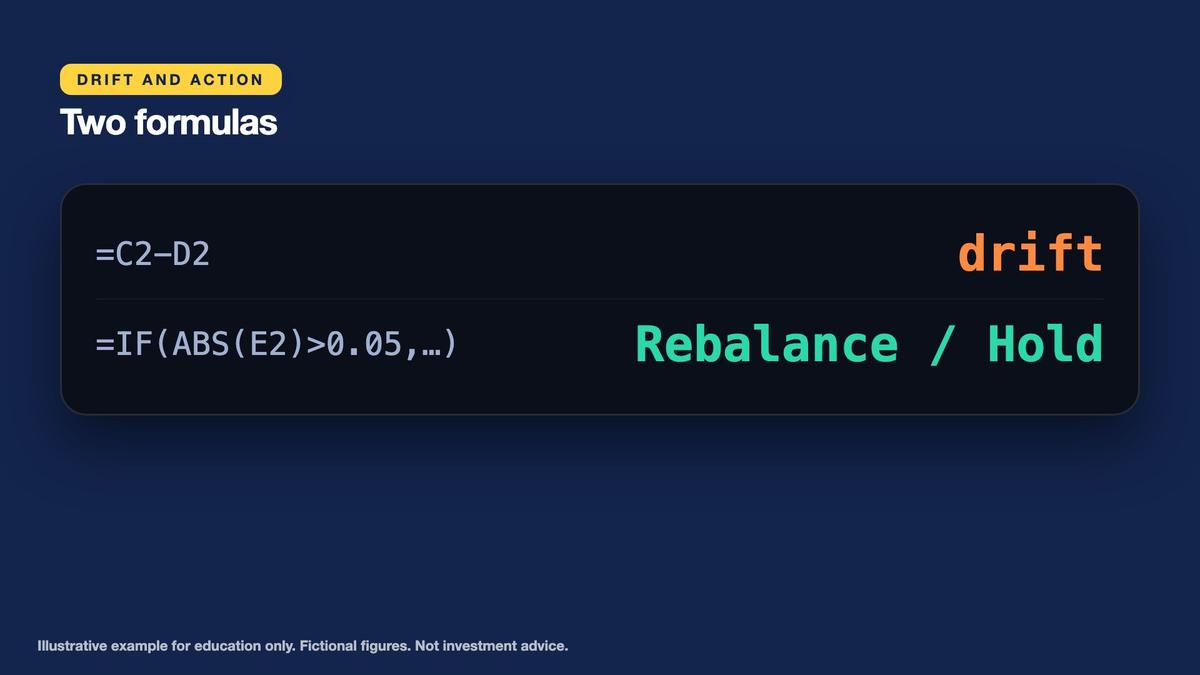
In C2, use =B2/B$5 to calculate the current stock weight, assuming B5 contains =SUM(B2:B4). In E2, use =C2-D2 for signed drift. In F2, use =IF(ABS(E2)>0.05,"Rebalance","Hold") to identify whether that asset breaches the threshold. In G2, use =D2*B$5 to calculate target value, and in H2 use =G2-B2 for the signed ideal trade amount. In J2, use =ROUNDDOWN(H2/I2,0) for signed whole-share quantity. Copy appropriate formulas down to the bond row, and calculate cash as the residual rather than trying to divide cash by an ETF share price.
Key points
- Columns: Asset, Value, Weight, Target weight, Drift, Target value, Trade, Price, Shares.
- Formulas: =B2/B$5, =C2-D2, =IF(ABS(E2)>0.05,"Rebalance","Hold"), =D2*B$5, =G2-B2, =ROUNDDOWN(H2/I2,0).
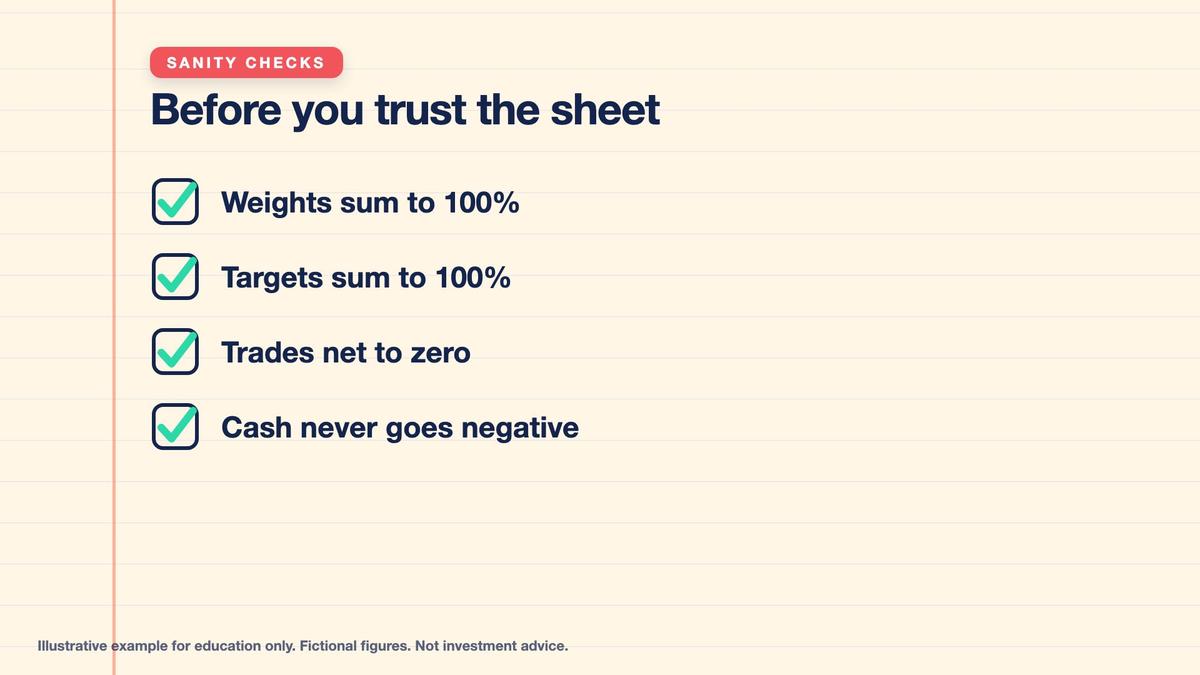
- Check that weights sum to 100% and trades net to zero.
For the portfolio-wide decision, evaluate whether the largest absolute drift among the three rows exceeds 0.05. Verify that current weights sum to 100%, target weights sum to 100%, and frictionless target-dollar adjustments sum to zero. The signed share quantities should show a 20-share stock sale and a 10-share bond purchase. Add separate actual-trade, fee, tax, and ending-cash fields or a supporting execution table to reconcile the final $11,968.56 value using the prescribed cost budget. Do not overwrite the original target calculations with executed amounts.
Compare Hold Decisions and New-Money Rebalancing
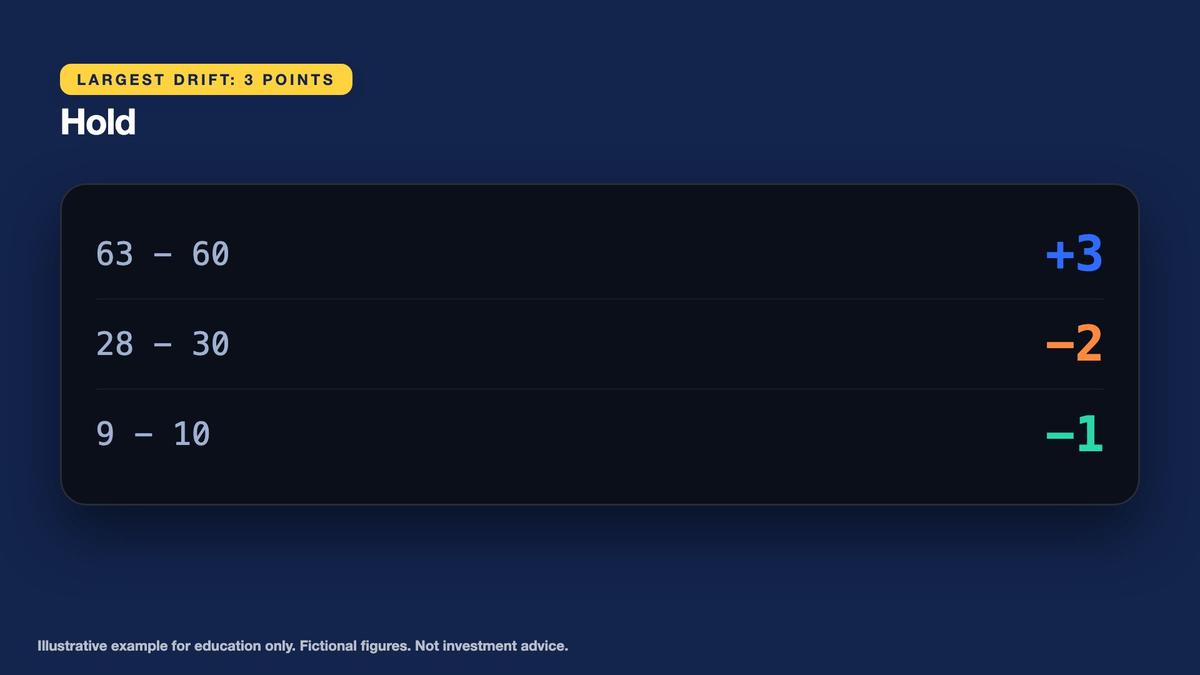
A rebalancing rule must also define when not to act. Consider a separate hypothetical observation using the same policy targets of 60%, 30%, and 10%. Suppose current weights are 63% stocks, 28% bonds, and 9% cash. Their drifts are positive 3, negative 2, and negative 1 percentage points, respectively. The largest absolute drift is 3 percentage points, which does not exceed the five-percentage-point threshold. Therefore, the written rule says hold rather than rebalance. A small drift is not automatically a reason to trade.
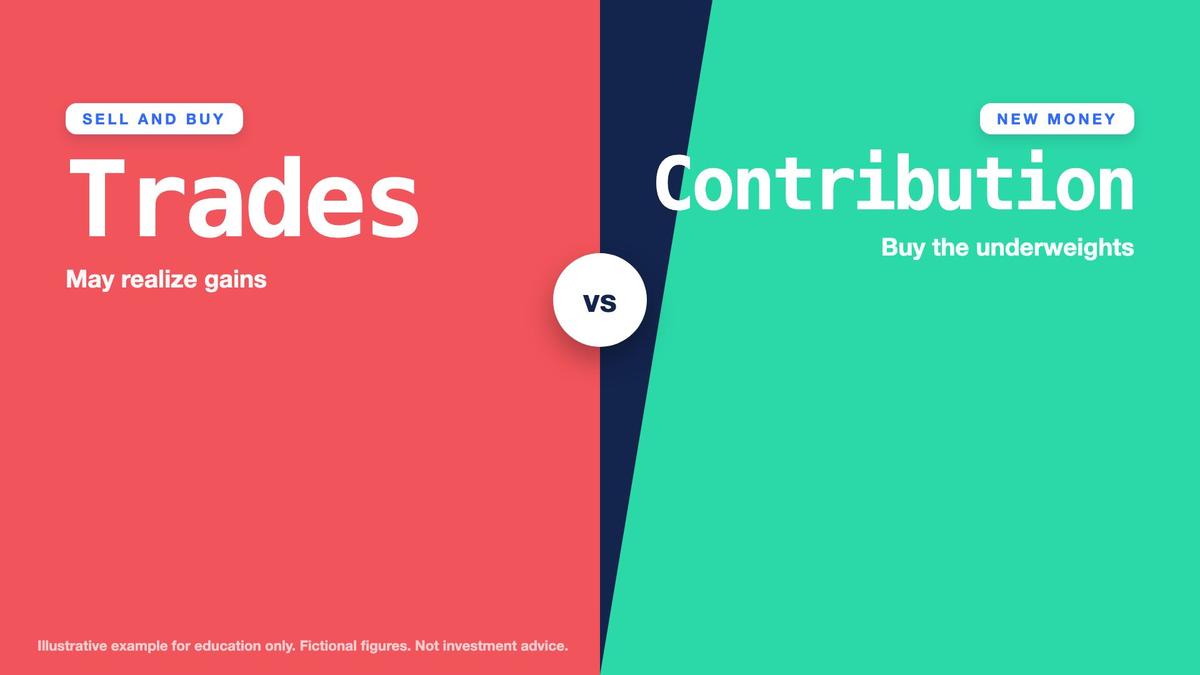
New-money rebalancing is another educational technique. Instead of selling an overweight holding, new contributions can be directed toward underweight assets. This may reduce transaction costs or avoid realizing gains, depending on the circumstances. However, contributions increase the portfolio's total value and change its target dollar amounts, so the effect must be recalculated rather than assumed. If contributions are insufficient to restore the target weights, some drift may remain. The exact approach should follow a policy written in advance, including any instructions about contribution timing and cost considerations.
Key points
- Hold example: 63%, 28%, 9% gives drifts +3, -2, -1. The largest is 3, which is not more than 5, so hold.
- New money can rebalance without selling, but it changes the total, so recompute targets and re-test.
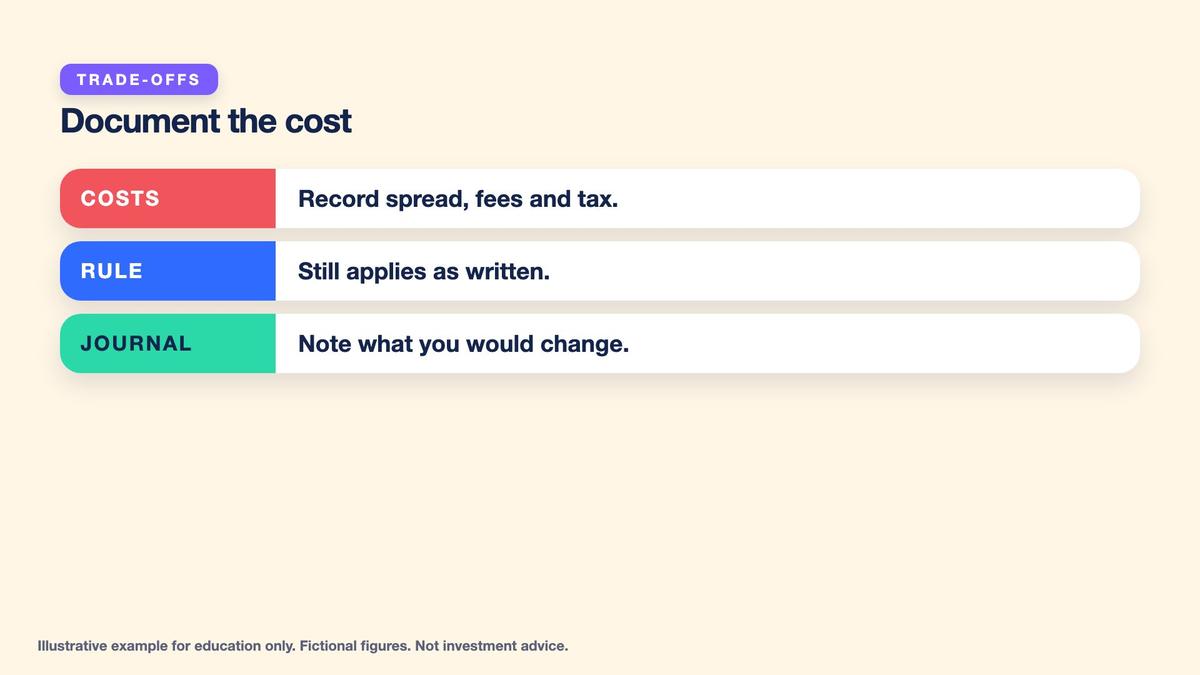
- Record costs, but do not rewrite the rule after seeing prices; write any cost exception in advance.
Cost awareness matters, but it should not become an excuse for selectively ignoring the policy. If the written rule requires rebalancing, document the expected spread, taxes, whole-share limitations, and other material costs before implementing the simulated adjustment. If a learner wishes to use a cost-based exception, that exception belongs in the policy before future market outcomes are known. Larger costs may prompt a documented policy review, but a rule should not be silently rewritten simply because the current market environment makes the required action uncomfortable.
Final Lab: Apply the Rule, Reconcile, and Journal
Your final checkpoint is to produce a complete simulated rebalancing spreadsheet for Global Stock ETF, Bond ETF, and Cash. Record the written 60%, 30%, and 10% targets and the rule to rebalance when any weight drifts more than five percentage points. Enter the current values of $8,100, $3,060, and $840, totaling $12,000. Calculate weights of 67.5%, 25.5%, and 7.0%, then drifts of positive 7.5, negative 4.5, and negative 3.0 percentage points. The stock drift activates the rebalancing rule.
Practice Lab: Apply a Five-Point Rebalancing Rule
Use one simulated portfolio containing fictional Global Stock ETF, Bond ETF, and Cash. The written policy targets 60%, 30%, and 10%, and requires rebalancing when any absolute allocation drift is greater than five percentage points; otherwise hold. Begin with current values of $8,100, $3,060, and $840. Calculate the $12,000 total, current weights, drifts, ideal target values, proposed trades, and whole-share quantities. Apply a hypothetical spread of 0.10% to the prescribed ideal trades and invented 15% tax to the stated realized gain. For the main reconciliation, use the specified $31.44 cost budget, while separately identifying the $31.42 alternative if spreading costs are recalculated on executed whole-share amounts. Preserve original values, formulas, and journal entries. No real-money transactions are involved.
- Decision 1: A hypothetical portfolio originally targeted 60% Global Stock ETF, 30% Bond ETF, and 10% Cash. Its current values are $8,100 stocks, $3,060 bonds, and $840 cash, totaling $12,000. — Calculate current weights and drifts, then determine whether the policy's greater-than-five-percentage-point threshold requires rebalancing.
- Decision 2: The current portfolio total is $12,000 with targets of 60% stocks, 30% bonds, and 10% cash, while current values are $8,100, $3,060, and $840. — Calculate target dollar values and the ideal signed changes required to restore the original target weights before costs.
- Decision 3: Ideal trades are a $900 stock sale and $540 bond purchase. The exercise uses a 0.10% trading spread and a fictional 15% tax on a stock sale with $900 proceeds and $700 cost basis. — Calculate gross traded value, spread cost, realized gain, hypothetical tax, and the prescribed total cost.
- Decision 4: Global Stock ETF trades at $45, Bond ETF at $52, and the ideal trades are a $900 sale and $540 purchase. Initial cash is $840, and the prescribed cost budget is $31.44. — Calculate whole-share trades and reconcile final stock, bond, cash, and portfolio values using the prescribed cost budget.
- Decision 5: A separate observation under the same written policy has current weights of 63% Global Stock ETF, 28% Bond ETF, and 9% Cash. The rule activates only when absolute drift is greater than five percentage points. — Calculate each signed drift, determine whether to rebalance or hold, and describe the appropriate journal entry.
Answer key
Calculate target values of $7,200 stocks, $3,600 bonds, and $1,200 cash. Record the ideal $900 stock sale and $540 bond purchase. Apply the invented 0.10% spread to the ideal $1,440 traded amount to obtain $1.44, and calculate $30 of hypothetical tax on a $200 realized gain. The prescribed total cost budget is $31.44. Convert the planned trades into whole shares: sell 20 stock shares at $45 and buy 10 bond shares at $52. The rounded bond trade costs $520 instead of the desired $540.
Key points
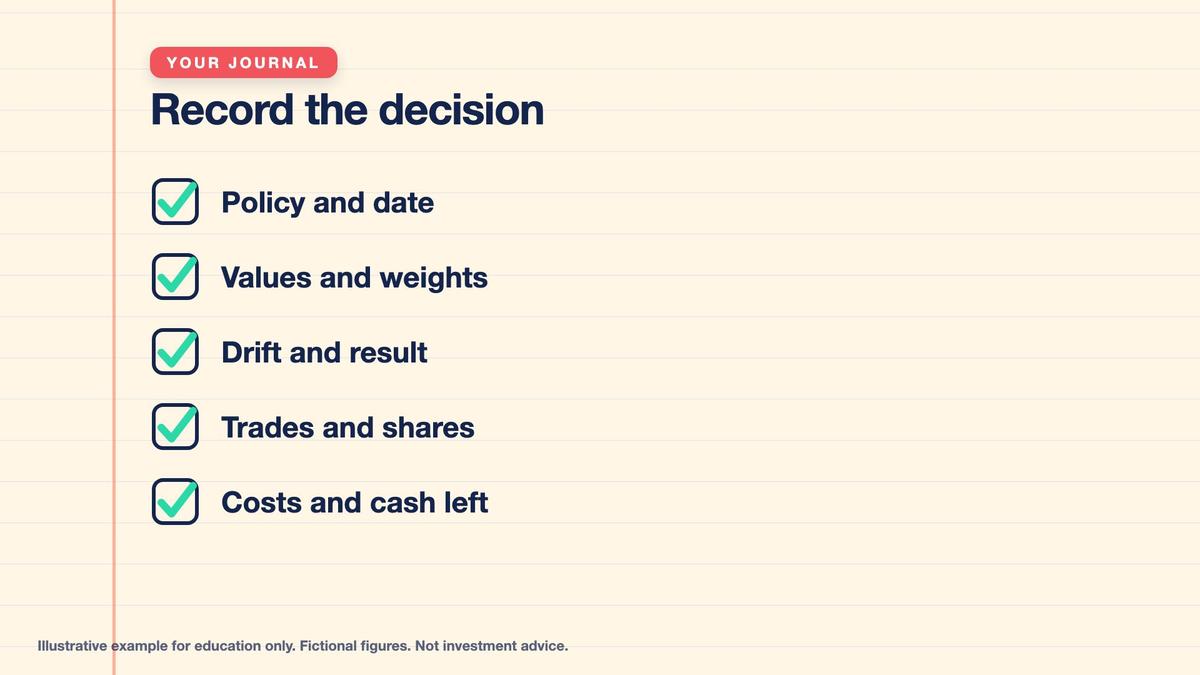
- Journal the policy, date, values, weights, drift, result, trades, shares, costs and cash left.
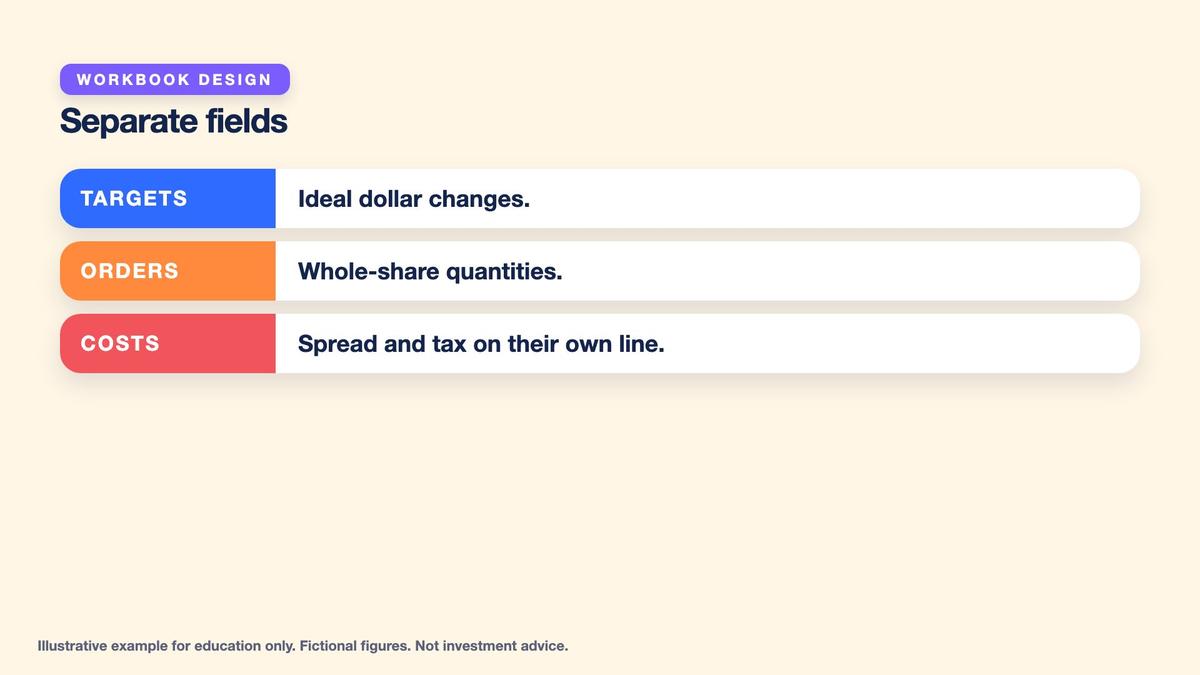
- Keep before and after snapshots, and keep targets, orders and costs in separate fields.
- Educational only, with simulated money. Not investment advice.
Using the specified illustrative cost budget, reconcile the resulting $7,200 stock position, $3,580 bond position, and $1,188.56 remaining cash, totaling $11,968.56. Also demonstrate the hold case with 63%, 28%, and 9% weights, where maximum drift is only three percentage points. Save the original inputs, record the threshold decision, list the proposed and actual simulated trades, show estimated costs, and explain any remaining allocation differences. The learning objective is to apply a stated rule consistently while accounting transparently for costs and implementation constraints.
Worked example at a glance
Key terms
- Rebalancing: adjusting holdings back toward the target weights in a written policy.
- Target weight: the share of the portfolio a holding should have under the policy.
- Drift: current weight minus target weight, in percentage points.
- Threshold rule: a rule that rebalances when any drift exceeds a set size.
- Calendar rule: a rule that rebalances on scheduled dates.
- Target value: total portfolio value times the target weight.
- Trade: target value minus current value; negative means sell, positive means buy.
- Spread: the cost of trading, paid as the gap between buy and sell prices.
- Realized gain: profit locked in by selling above the cost basis.
- Whole shares: shares bought or sold in whole units, which can leave leftover cash.
- New-money rebalancing: using new contributions to buy underweight holdings instead of selling.
Multi Asset Trading Lab provides educational information only and does not constitute personalized investment, trading, financial, accounting, legal, or tax advice. Global Stock ETF, Bond ETF, and Cash are hypothetical asset labels, and all portfolio values, weights, investment prices, transactions, fees, taxes, and outcomes are fictional. All calculations use simulated money only, and no real-money investing, brokerage activity, or actual fund purchase or sale is required or encouraged. The example target policy of 60% Global Stock ETF, 30% Bond ETF, and 10% Cash is an educational assumption, not an allocation recommendation or a universally appropriate strategy. The rule to rebalance when any asset's allocation differs from its target by strictly more than five percentage points is a hypothetical policy constraint. A five-percentage-point deviation exactly does not trigger the rule. Rebalancing seeks to maintain chosen portfolio exposure but does not guarantee profits, lower volatility, improved risk-adjusted returns, or protection against losses. Stocks, bonds, and cash each have different risks, and their market values or purchasing power can change over time. Rebalancing can involve selling assets that have performed well, purchasing assets that have performed poorly, and incurring transaction costs or taxable gains. The invented spread rate of 0.10% and the invented 15% tax on the stated $200 realized gain are arithmetic examples only; they do not describe any actual market quotation, tax treatment, investor circumstance, or jurisdiction. The prescribed $1.44 spread is calculated using the ideal $900 stock sale and $540 bond purchase, resulting in $31.44 total illustrative costs including $30 fictional tax. Actual whole-share execution in the example uses a $900 stock sale and $520 bond purchase. Applying the same 0.10% rate strictly to executed trades instead produces $1.42 spread and $31.42 combined costs, rather than the prescribed ideal-trade cost budget. The main example deliberately uses the stated $31.44 illustrative cost assumption, resulting in final cash of $1,188.56 and total value of $11,968.56; the execution-based alternative produces $1,188.58 cash and $11,968.58 total value. These two cost assumptions must not be silently mixed. Prices of $45 per Global Stock ETF share and $52 per Bond ETF share are fictional, and whole-share rounding can leave residual cash and differences from exact targets. Spreadsheet outputs depend on correct formulas, input values, rounding conventions, execution assumptions, and cost treatment. Trading fees, bid-ask spreads, commissions, slippage, account restrictions, taxes, and timing differences may materially change realized results. New-money rebalancing may reduce the need for selling existing holdings but is not guaranteed to eliminate costs or restore all target weights. Costs should be documented and evaluated according to a policy written in advance rather than used as an undocumented reason to abandon rules after market moves. The hold example at 63%, 28%, and 9% is a separate hypothetical observation and does not override the rebalance decision for the 67.5%, 25.5%, and 7.0% portfolio. Learners should preserve the original spreadsheet and journal records, verify that portfolio weights sum to 100%, confirm that frictionless target changes net to zero, reconcile actual cash flows and costs, and document every simulated decision. Historical or hypothetical asset performance does not predict future results. Nothing in this lesson constitutes a recommendation to buy, sell, or hold any real financial instrument, and qualified professionals should be consulted for real financial, legal, or tax decisions.
Lesson Checkpoint
Review what you learned and get feedback on your work.