



In this twelve-minute beginner lesson, learners distinguish fund domicile, exchange listing, trading currency, base currency, and underlying currency exposure. Using the entirely fictional Example Global ETF and Example World Index, learners calculate how exchange-rate movements affect returns in a hypothetical Home Currency, examine currency conversion costs, understand hedged share classes, and evaluate illustrative dividend withholding. They also learn to identify local access, eligibility, tax, reporting, and trading checks without making real-world jurisdictional assumptions or receiving investment advice.
Four Fund Labels That Must Not Be Confused
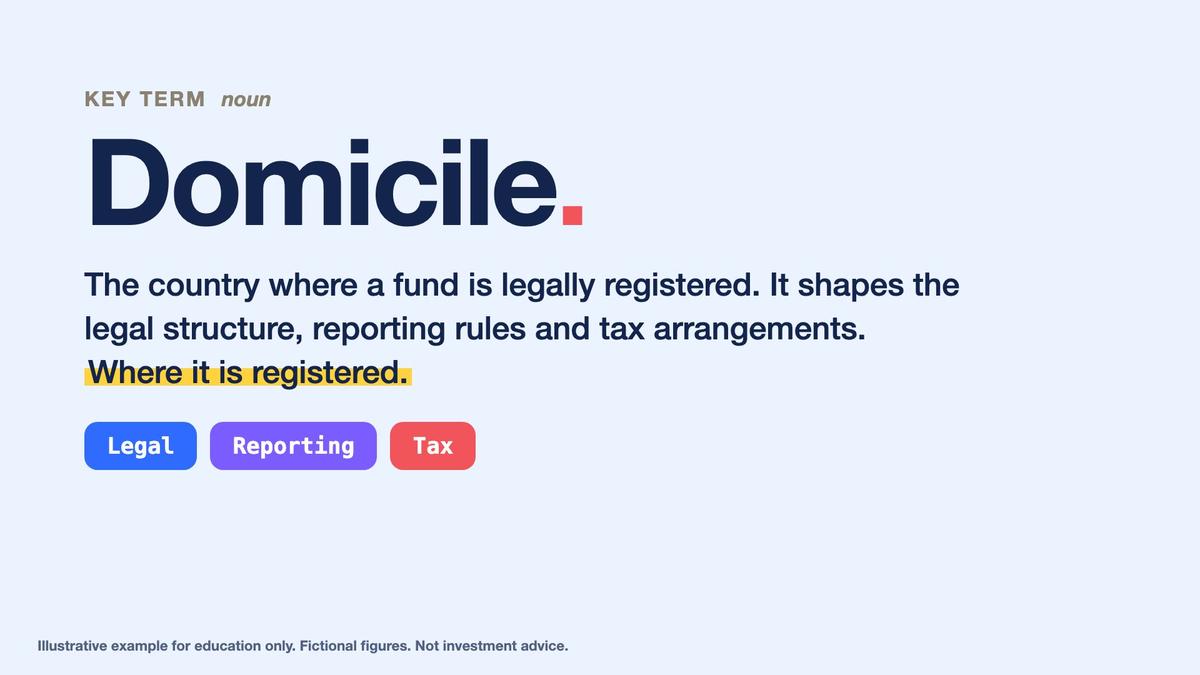
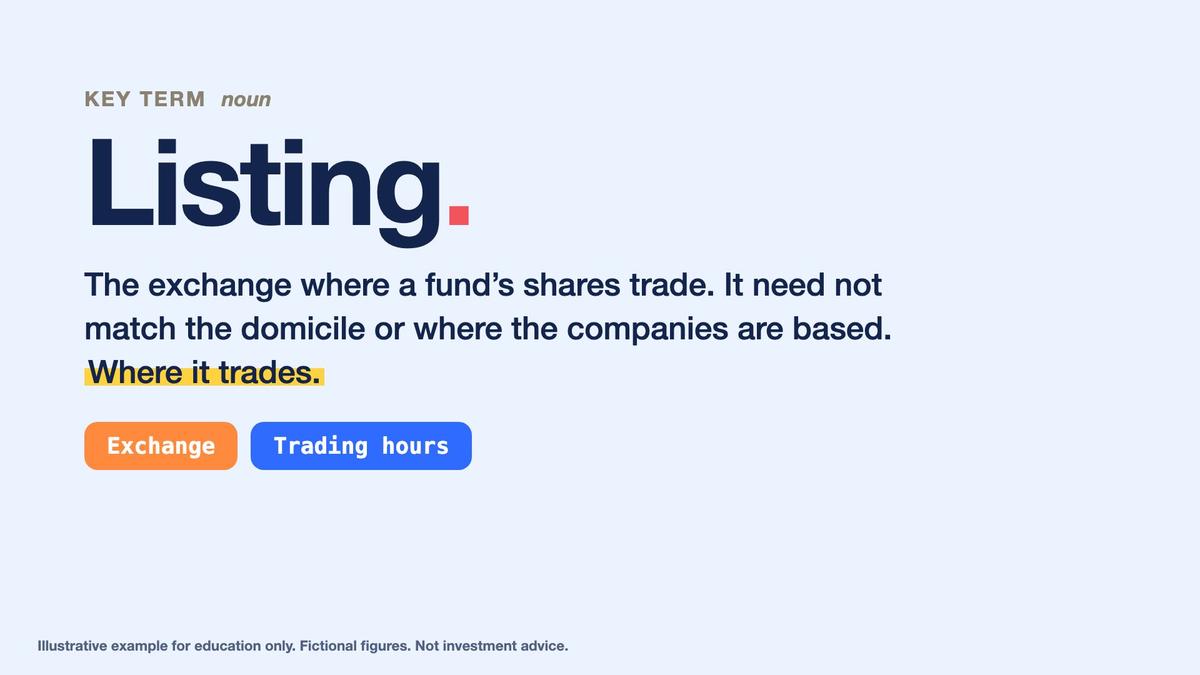
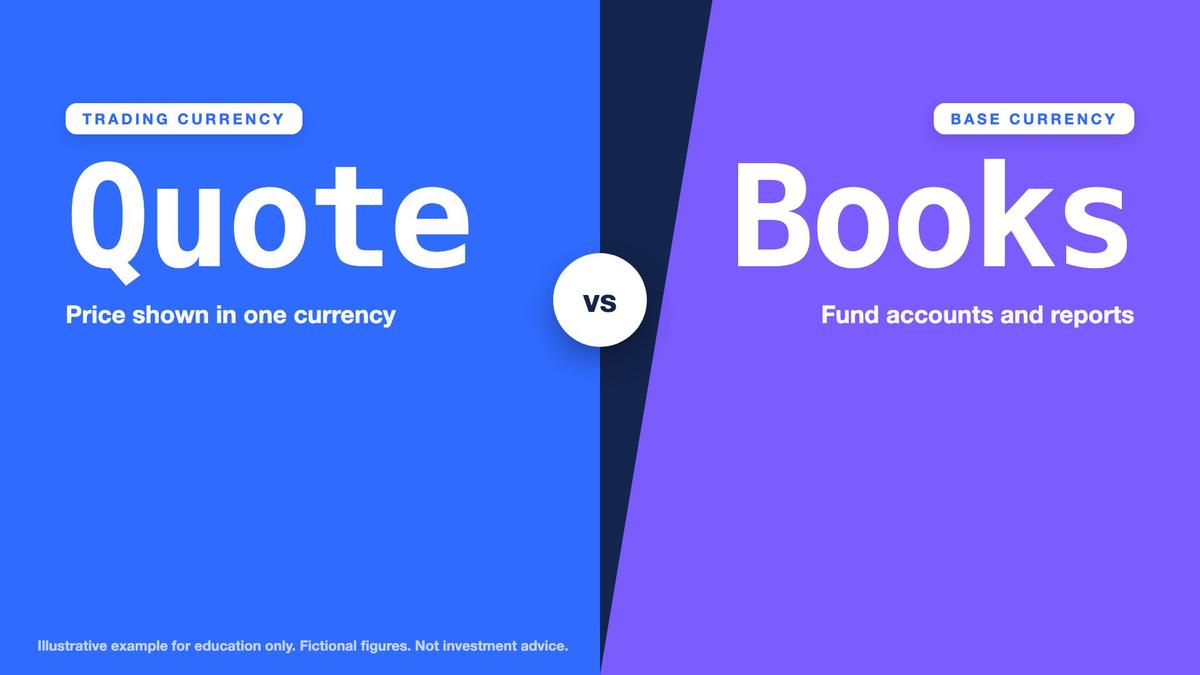
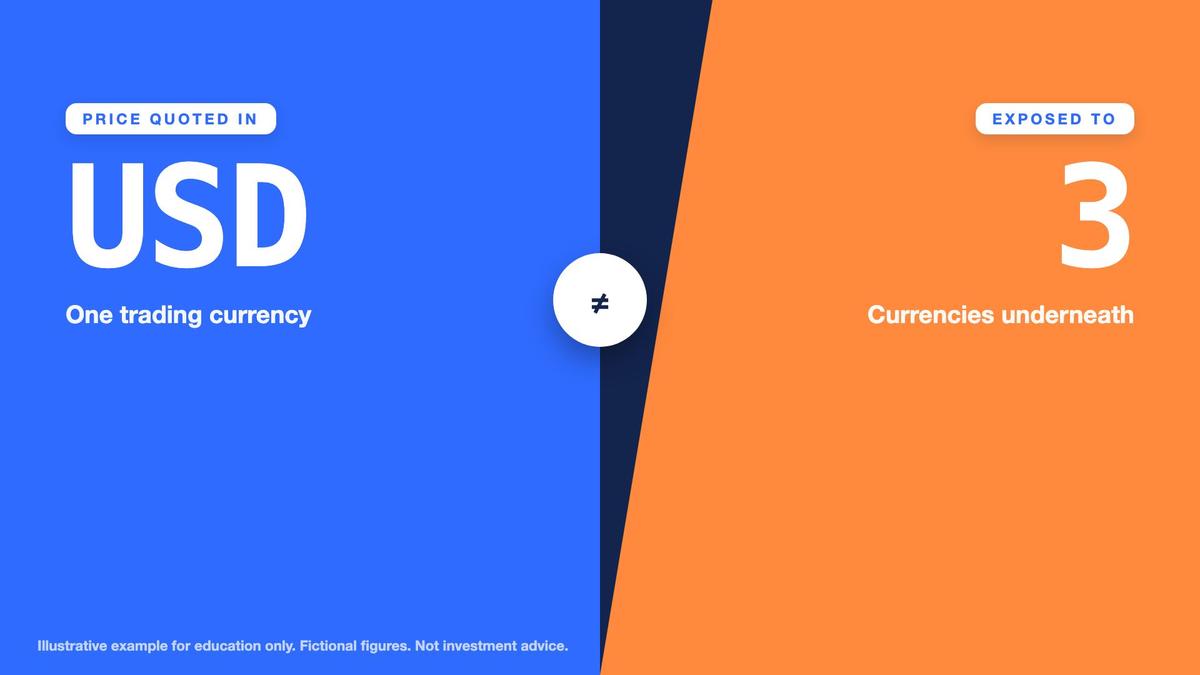
International fund research introduces several labels that can look similar but answer different questions. Domicile identifies the jurisdiction where a fund is legally registered. Listing identifies the exchange where its shares trade. Trading currency identifies the currency in which the exchange quotes the fund's share price. Base currency identifies the reporting or accounting currency used by the fund. None of these labels, by itself, establishes which currencies influence the value of the underlying investments. A beginner should record each field independently rather than assuming that a fund traded in one currency holds only assets exposed to that currency.

Our entirely fictional Example Global ETF tracks the hypothetical Example World Index. The fund is legally domiciled in imaginary Country X and listed on imaginary Example Exchange. For convenience, its trading currency is USD and its hypothetical reporting base currency is also USD. The learner measures personal wealth in an invented Home Currency, abbreviated HC. These details are educational labels only and do not imply that a real exchange, jurisdiction, or security has equivalent arrangements. Domicile, listing and currency details should normally be verified in official fund documentation.


Key points
- Four labels: domicile, listing, trading currency, base currency.
- They describe the wrapper, not the assets inside.
- Example Global ETF: Country X, Example Exchange, USD, USD.
A fund may have several share classes or exchange listings, and those arrangements can differ in pricing currency, distribution policy, or hedging strategy. This connects to Lesson Twelve, where we distinguished share classes from the underlying investments. It also extends Lesson Thirteen's factsheet checklist. Before comparing returns or access, learners should identify which exact fund structure and share class they are studying. Even two listings with similar names require verification of the underlying product and its relevant terms.
Trading Currency Is Not Underlying Currency Exposure
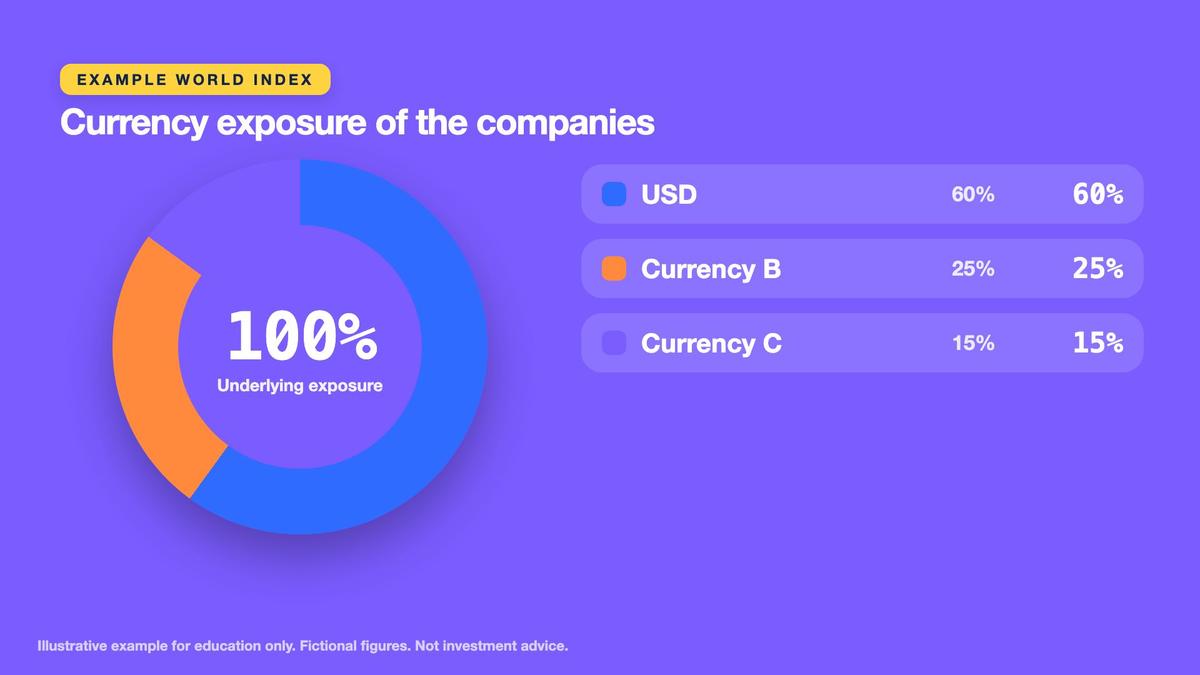
An ETF's trading currency is the currency used for quoting and settling its shares on a particular exchange listing. Its underlying investments may have exposure to entirely different currencies. Example Global ETF is quoted in USD, but its hypothetical Example World Index has underlying currency exposure of 60% USD, 25% Currency B, and 15% Currency C. These exposures sum to exactly 100%. The USD quotation therefore does not mean that all underlying economic exposure is to USD. Converting the fund's trading price into another currency also does not, by itself, change what the fund owns.
Underlying currency exposure can be more complicated than the denomination of a company's shares. Businesses may earn revenue, pay expenses, borrow money, and own assets in different currencies. Some companies may hedge part of their operational currency risks, and funds may use additional hedging instruments. The simplified 60–25–15 allocation is intended to teach the distinction between a quotation label and underlying exposure, not to provide a complete currency-risk model. Researchers should use the fund's official holdings and currency exposure disclosures when available.
Key points
- Trading currency is how the price is quoted.
- Base currency is how the fund reports.
- Quotation is not exposure: the index here is 60% USD, 25% B, 15% C.
The reporting base currency adds another label. It is the unit used to prepare the fund's accounts and certain performance presentations, but it does not automatically eliminate foreign-exchange risk. When an investor measures results in a different home currency, the relevant investment outcome generally depends on both the fund's quoted price movement and the exchange-rate movement between those currencies. The next sections demonstrate that relationship using deliberately simple hypothetical numbers and no distributions, taxes, or transaction costs.
Calculate a Foreign Holding's Return in Home Currency
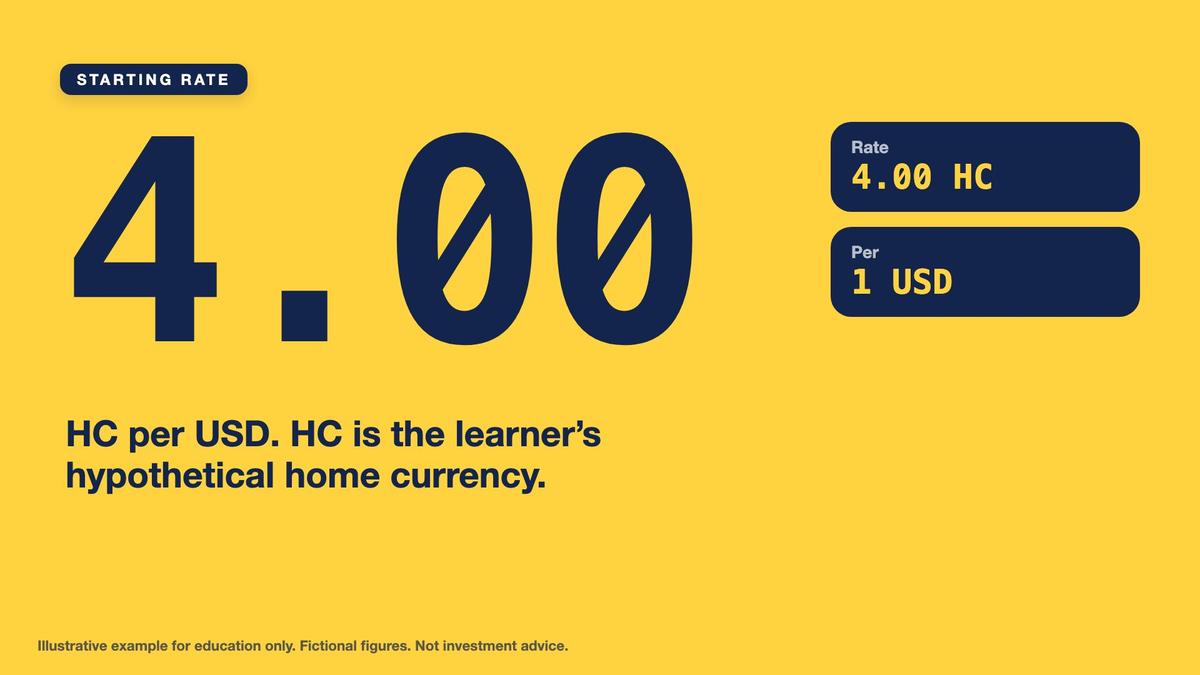
Assume the learner's Home Currency is HC and the initial exchange rate is 4.00 HC per USD. Example Global ETF trades at $50.00 per share. Purchasing 100 shares in a hypothetical calculation costs exactly $5,000, which converts to 20,000 HC at the initial exchange rate. One year later, the share price rises to $52.50. The USD price return is ($52.50 divided by $50.00) minus one, giving exactly positive 5.00%. The holding is now worth $5,250 before conversion into HC.
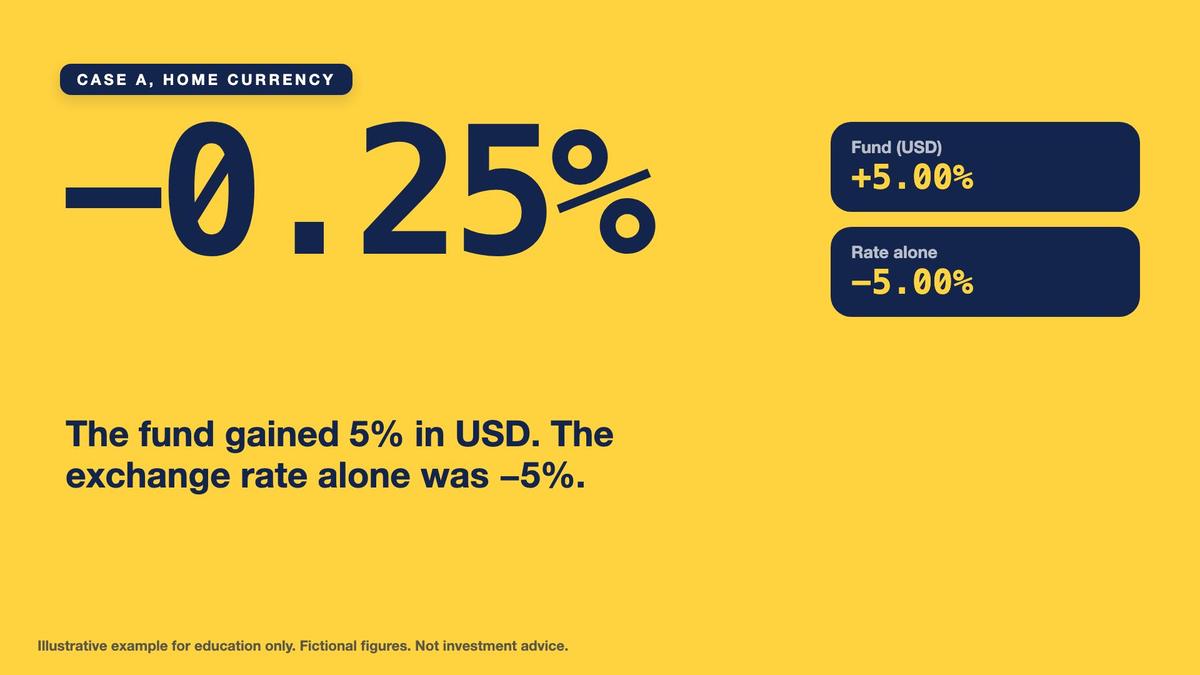
In Case A, HC strengthens against USD, so the exchange rate falls to 3.80 HC per USD. The holding's final value in HC equals 100 shares multiplied by $52.50 and then by 3.80, producing exactly 19,950 HC. Compared with the initial 20,000 HC, the home-currency return is negative 0.25%. The exchange-rate return alone is 3.80 divided by 4.00 minus one, or negative 5.00%. Thus, the positive USD share-price return does not guarantee a positive result when measured in HC.
Key points
- Start: 100 shares at 50.00 USD and 4.00 HC per USD = 20,000 HC.
- Case A (rate 3.80): 19,950 HC, a return of -0.25%.
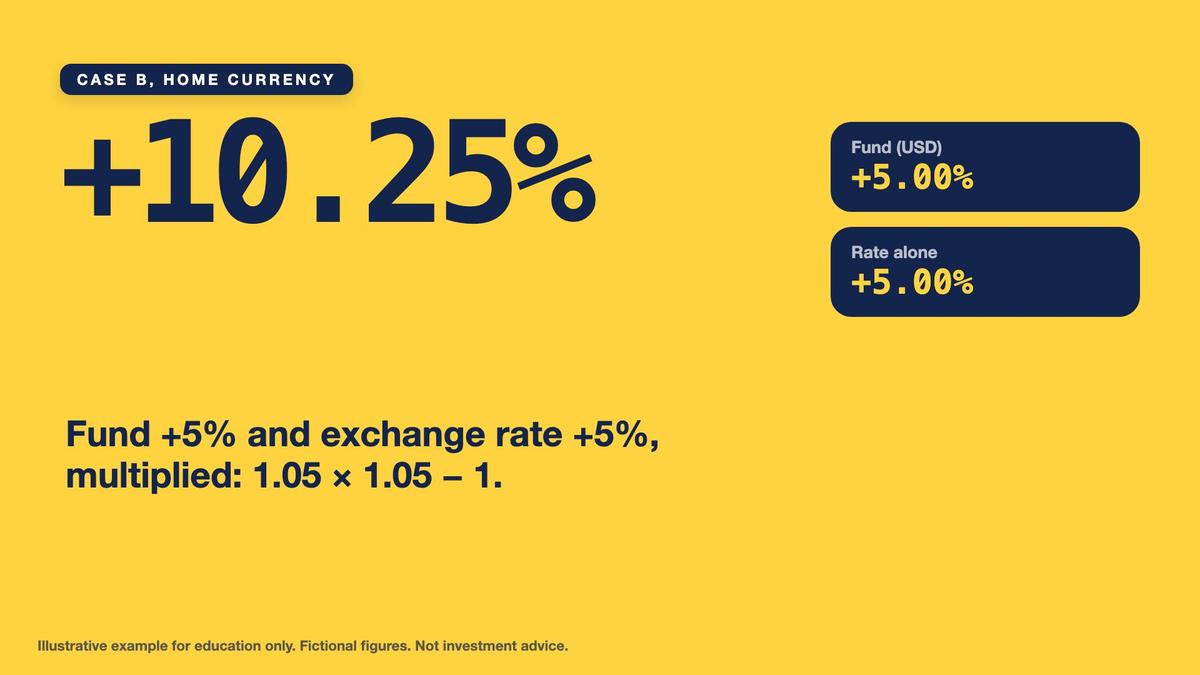
- Case B (rate 4.20): 22,050 HC, a return of +10.25%.
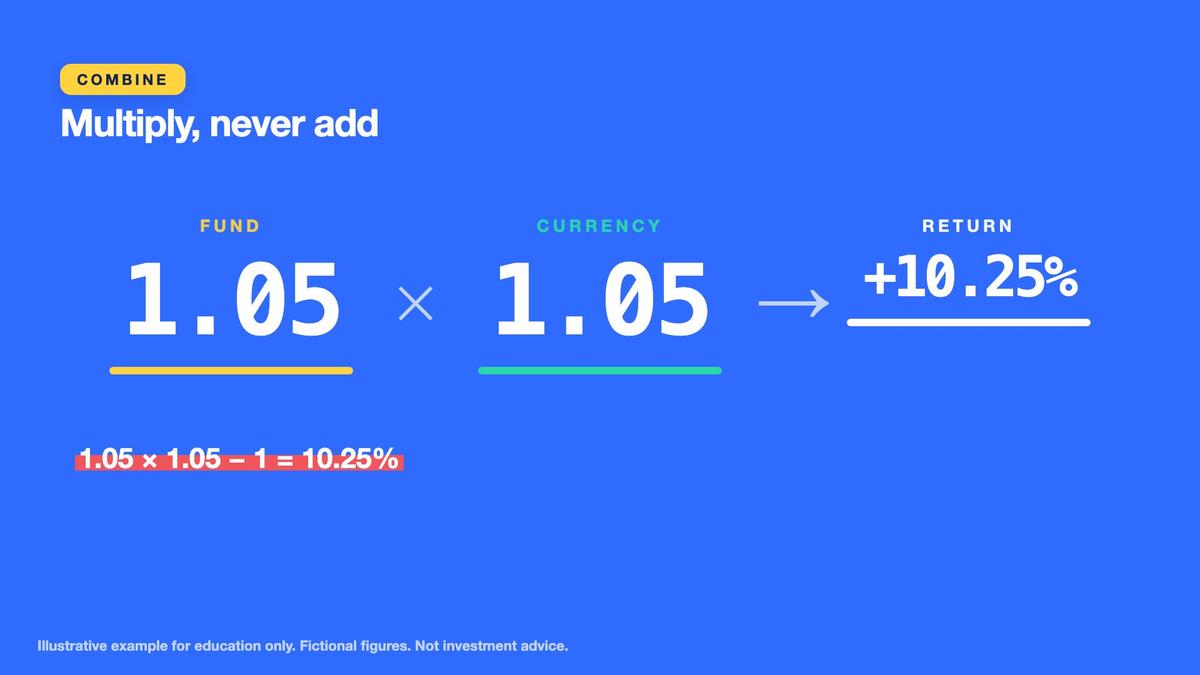
In Case B, HC weakens, and the exchange rate rises to 4.20 HC per USD. The same holding becomes worth 100 multiplied by $52.50 multiplied by 4.20, or exactly 22,050 HC. This represents a positive 10.25% home-currency return. The currency movement alone is positive 5.00%. The exact combined calculation is (1.05 multiplied by 1.05) minus one, equaling 10.25%. Returns combine multiplicatively, so simply adding two percentage changes can produce an incorrect result.
Currency Conversion Costs and Whole-Share Constraints
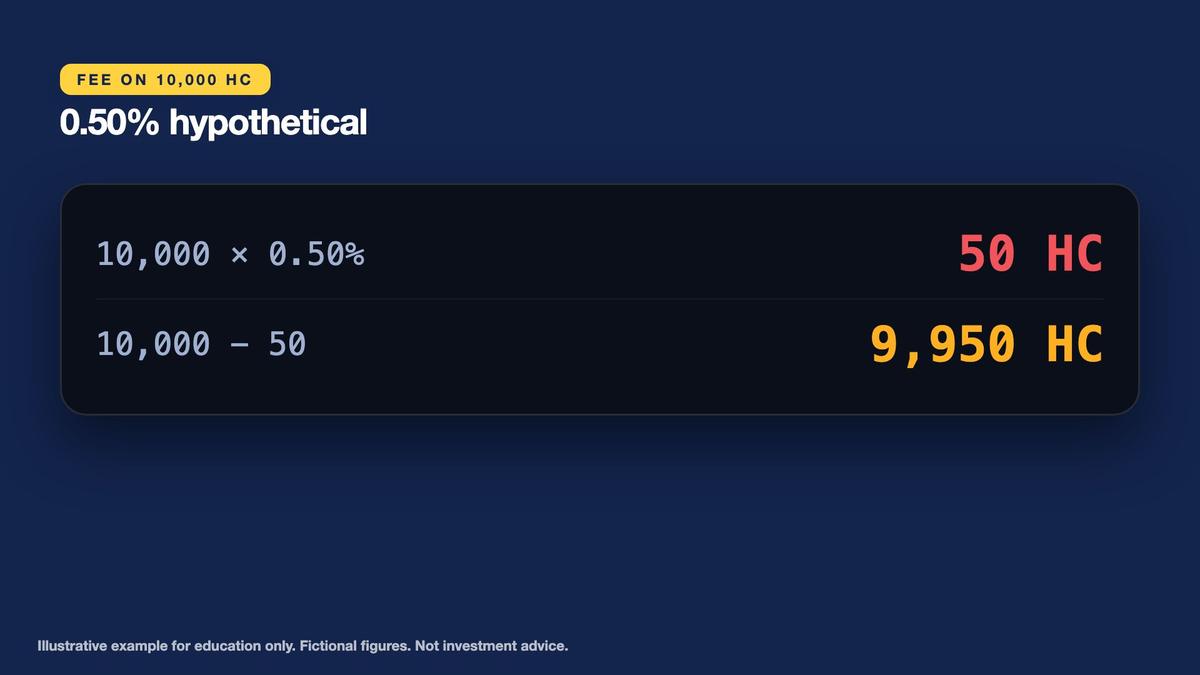
Currency conversion can introduce costs before an investor acquires an international fund. A broker or payment service may charge an explicit conversion fee, a less favorable quoted exchange rate, or a combination of the two. These costs are distinct from a fund's annual expense ratio and exchange bid-ask spread. In our separate hypothetical exercise, the learner begins with 10,000 HC and faces a conversion cost of 0.50% of the amount converted. The fee equals exactly 50 HC, leaving 9,950 HC available.
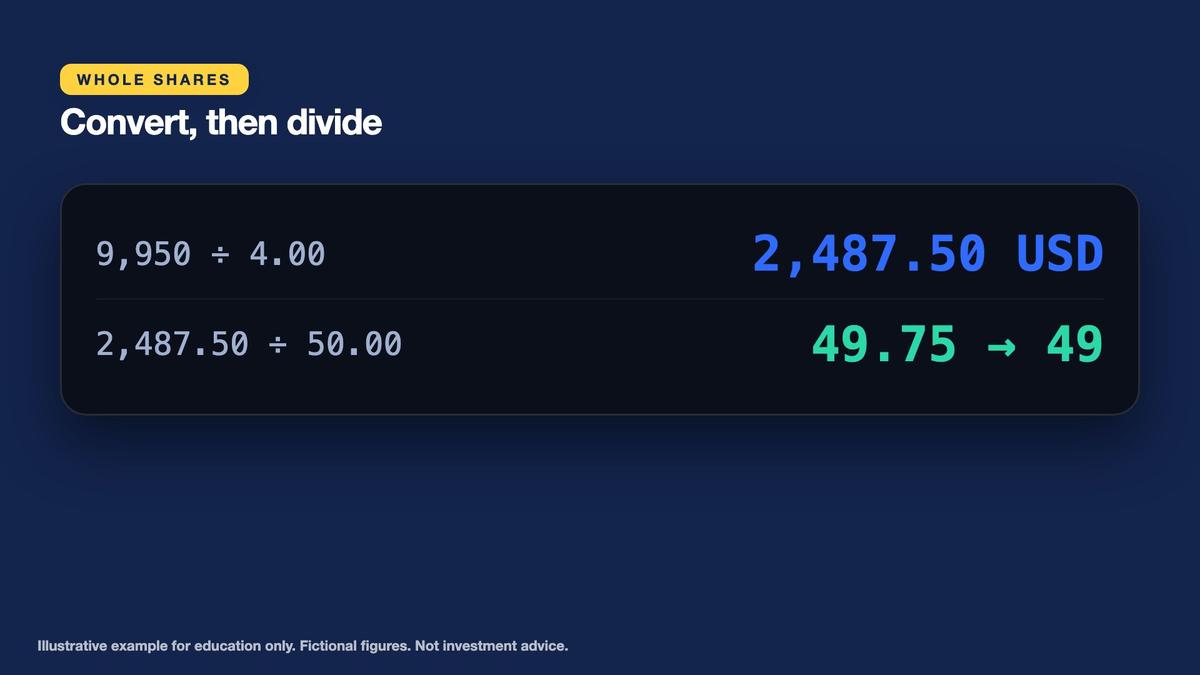
At the assumed rate of 4.00 HC per USD, the remaining 9,950 HC converts into exactly $2,487.50. Suppose Example Global ETF is priced at $50.00 per share and only whole shares are permitted. Dividing $2,487.50 by $50.00 gives 49.75 shares mathematically, so the permitted whole-share quantity is 49. Those shares cost $2,450, leaving exactly $37.50 unspent. This calculation shows why conversion fees, security prices, and fractional-share availability affect order quantities even when the underlying investment objective remains unchanged.
Key points
- Fee: 0.50% of 10,000 HC = 50 HC, leaving 9,950 HC.
- 9,950 / 4.00 = 2,487.50 USD, which buys 49 whole shares.
- 49 shares cost 2,450 USD, leaving 37.50 USD.
The conversion example is separate from the earlier 100-share holding used for exchange-rate returns. It should not be silently combined with that calculation. Real platforms may apply conversion spreads instead of explicit fees, or may use both. Some accounts permit holding multiple currency balances, while others convert automatically when buying or selling. Repeated currency conversions can create additional costs. A careful simulated journal should identify the assumed exchange rate, conversion fee, rounding method, remaining balance, and any costs excluded from the calculation.
Currency-Hedged Share Classes and Their Limitations
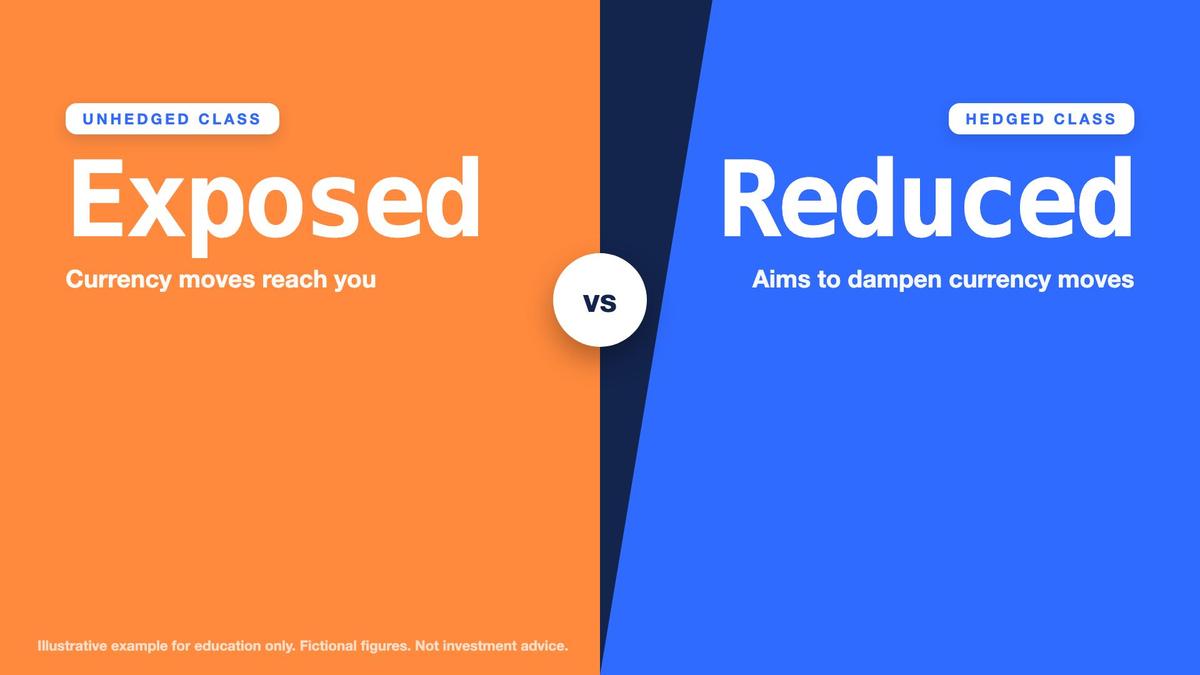
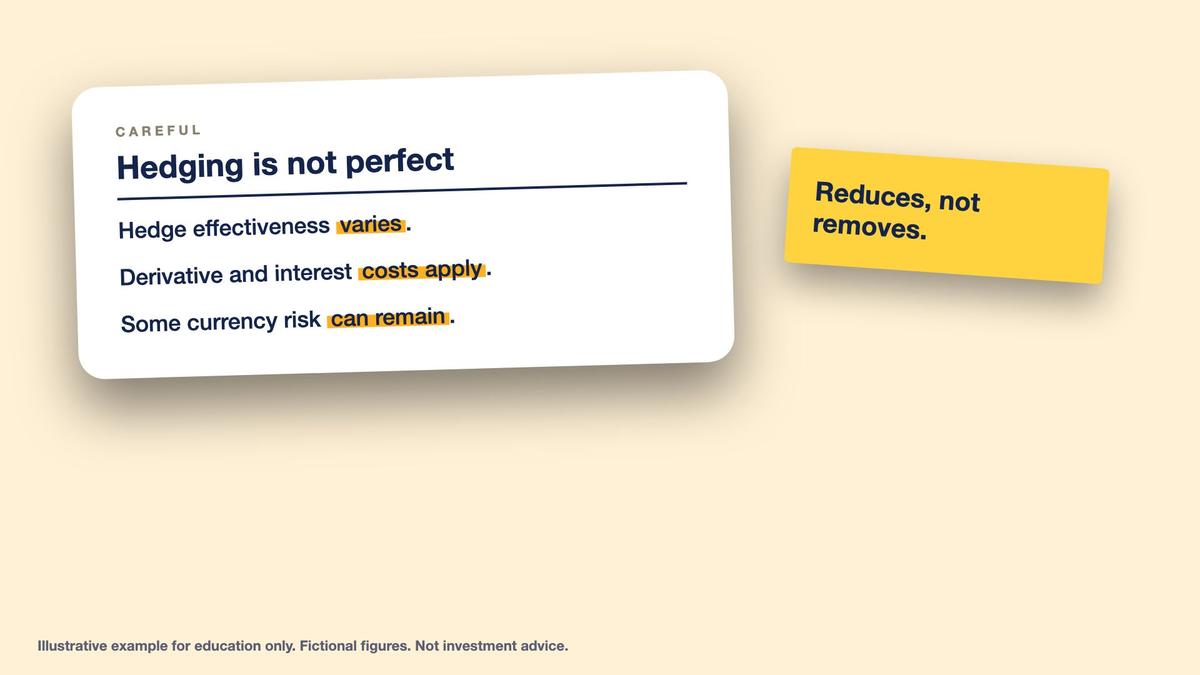
Some fund products offer currency-hedged share classes designed to reduce exposure to specified exchange-rate movements. These classes may use derivatives or other hedging arrangements to offset part of a chosen currency relationship. A hedged share class is not necessarily a different portfolio of underlying companies; it may share underlying investments with an unhedged class while applying different currency management. Nevertheless, the exact hedge target, share-class terms, reporting currency, and implementation method must be read carefully. A share class labeled hedged does not eliminate every currency-related uncertainty.
For a deliberately simplified illustration, suppose the fund would otherwise produce a 5.00% return in its stated calculation currency and hedging creates a 0.15-percentage-point annual cost. Subtracting 0.15 percentage points produces approximately 4.85% before all other effects. This is an arithmetic teaching example, not a general rule for hedged share-class returns. Actual hedging outcomes depend on hedge effectiveness, interest-rate differences, derivative pricing, implementation costs, and the currencies being hedged. The simple 4.85% figure should not be presented as a guaranteed HC return.
Key points
- A hedged class aims to reduce exchange-rate effects.
- Illustration: 5.00% - 0.15% = about 4.85% before other effects.
- Hedging costs money and does not remove all risk.
Currency hedging also does not remove ordinary market risk. The underlying companies can decline in value, and their business exposures may remain sensitive to exchange rates even when a fund hedges share-class currency movements. Hedging arrangements can add costs and operational complexity. When comparing a hedged and unhedged class, learners should confirm the exact hedge objective, relevant currency pair, recurring expenses, past tracking behavior, and disclosed residual risks. This connects directly to the share-class concept introduced in Lesson Twelve.
Dividend Withholding: An Illustration, Not Local Tax Advice
Fund domicile and underlying asset arrangements can influence how investment income is taxed or withheld. The actual outcome may also depend on the investor's tax residence, fund structure, applicable rules, documentation, and the treatment of distributions. These topics differ significantly across jurisdictions and can change over time. This lesson therefore provides no actual country-specific rates or investor tax conclusions. Instead, it uses invented percentages to demonstrate how withholding affects the cash amount received from an illustrative distribution.
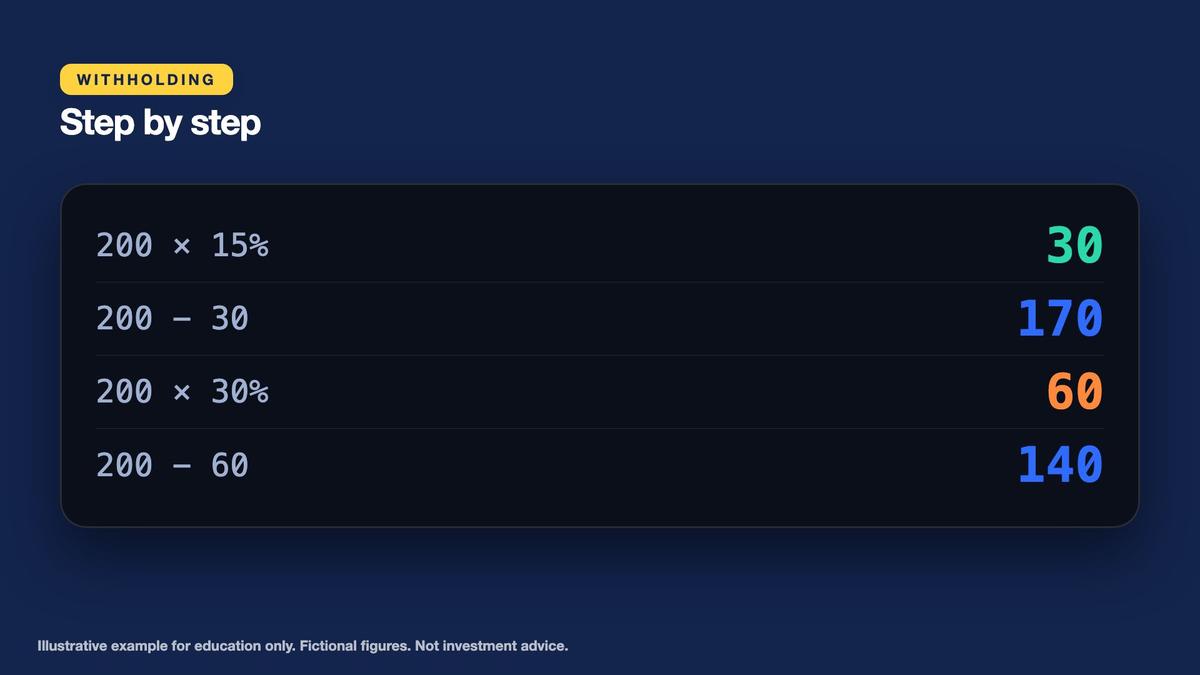
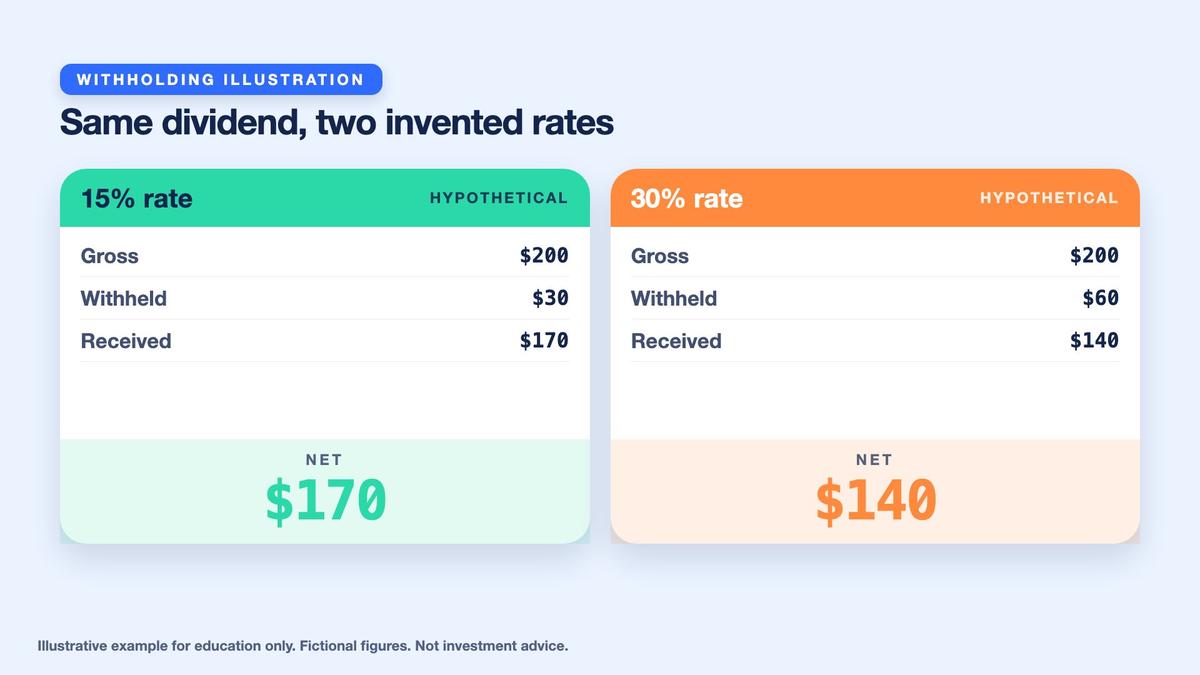
Assume a hypothetical $10,000 investment earns a gross dividend distribution equal to a 2.0% yield for the illustrated period. That produces exactly $200 before withholding. At an invented withholding rate of 15%, the withheld amount is $30 and the investor receives $170. At an alternative invented withholding rate of 30%, the withheld amount is $60 and the investor receives $140. The difference between the two net distributions is exactly $30. These computations explain arithmetic only and do not represent tax rules for Country X or any actual investor.
Key points
- Gross distribution: 2.0% of 10,000 USD = 200 USD.
- At an invented 15%: 30 withheld, 170 received.
- At an invented 30%: 60 withheld, 140 received; a 30 difference.
Withholding may occur at different stages, including within underlying investments or on fund distributions, depending on the relevant arrangements. Other tax liabilities or reporting requirements may also apply, and a quoted distribution yield may not directly reveal the final amount received. Before making any real-world decision, learners should consult official fund documents, platform information, and a qualified professional familiar with their circumstances. For this simulated lab, the appropriate conclusion is simply that domicile and investor-specific tax treatment must be checked rather than assumed.
Broker Access, Investor Eligibility, and Official Documents
An ETF can be listed on an exchange without being accessible through every broker or account. Availability may depend on the platform's supported markets, the investor's location or eligibility category, product permissions, and relevant disclosure requirements. Certain products may require a key information document or other prescribed materials for particular investor groups. These requirements should not be inferred from the fund's trading currency, domicile name, or exchange listing alone. A beginner should treat accessibility as an open question until the relevant platform and official documentation confirm it.
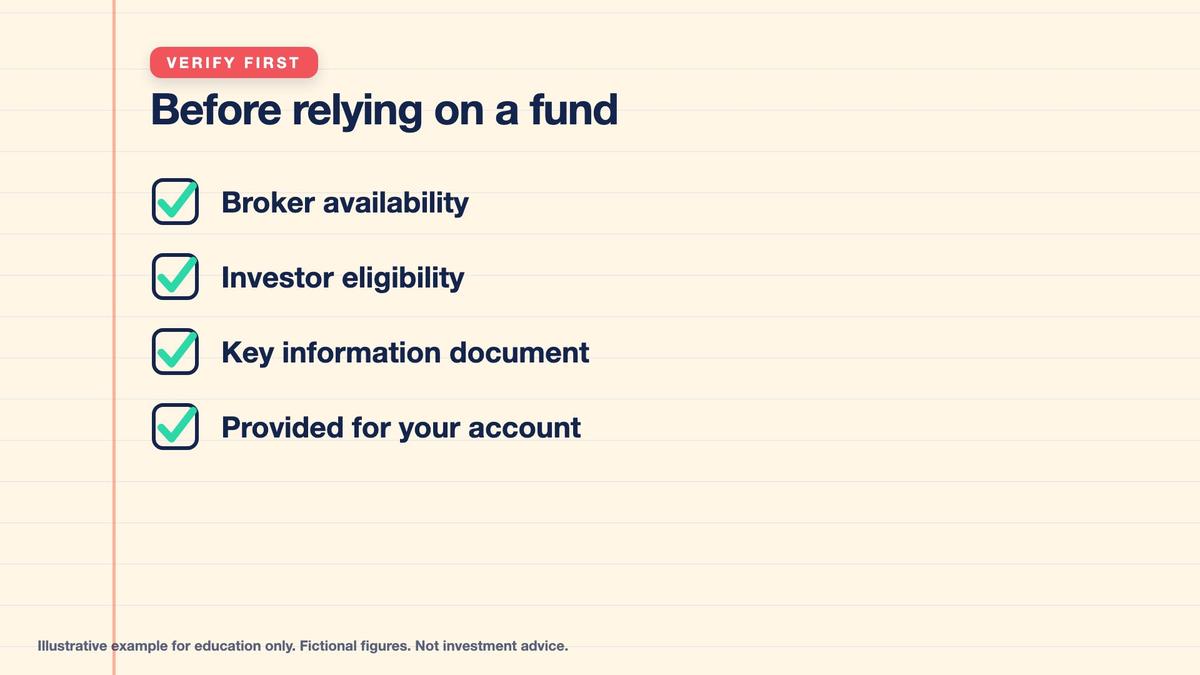
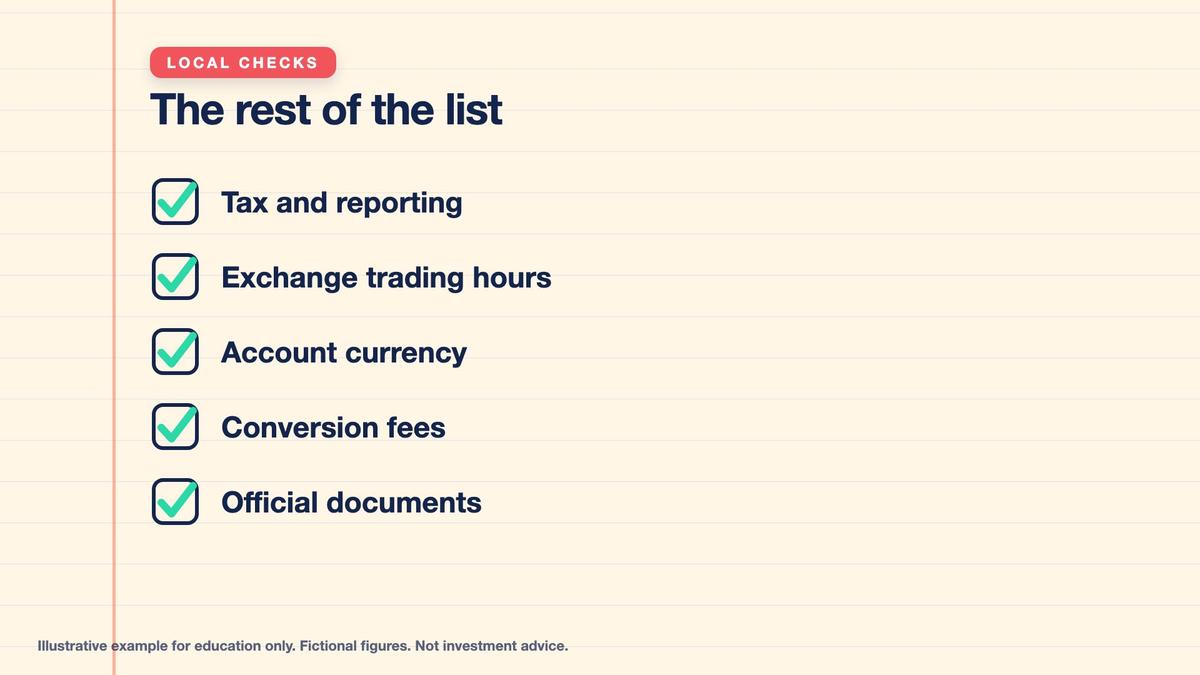
A useful local-check list covers broker availability, investor eligibility, required product disclosures, applicable tax treatment and reporting, exchange trading hours, account currency, foreign-exchange conversion fees, and the location of official fund documents. Learners should also investigate whether the account supports the relevant trading market and share class, whether conversion is automatic, and whether quotations or NAV figures use different timestamps. These practical details can materially affect costs and access even when two funds appear similar in a factsheet.
Key points
- Availability depends on broker, region and investor eligibility.
- Check tax and reporting, trading hours, account currency, fees and documents.
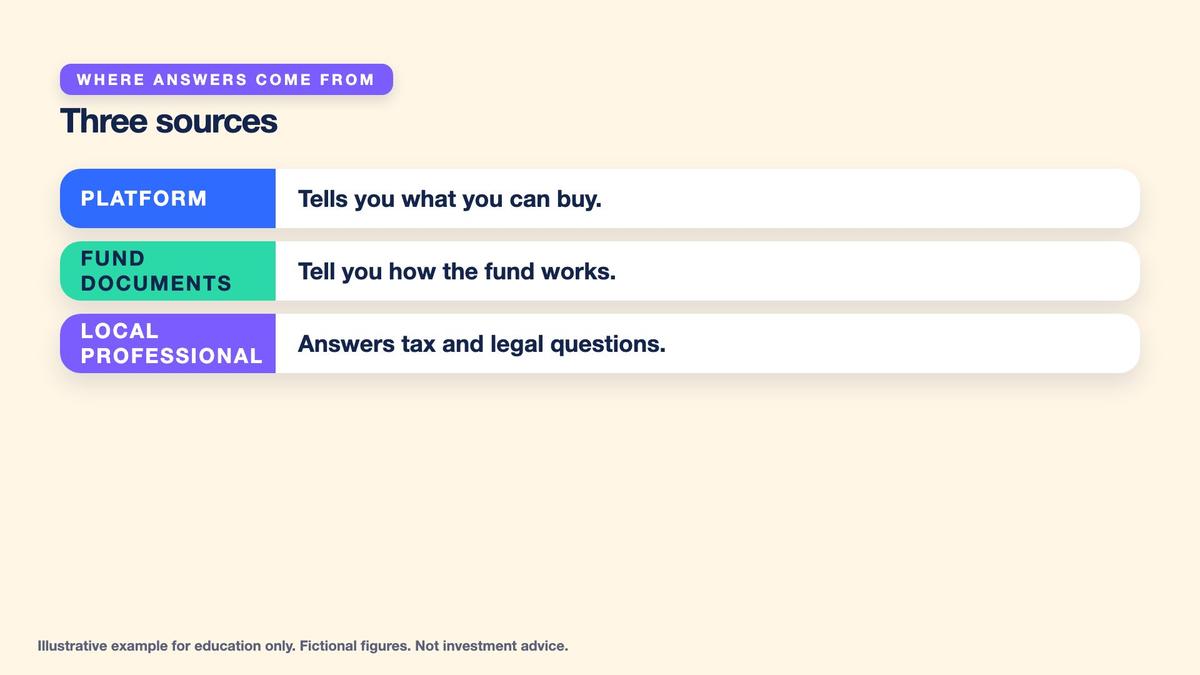
- Confirm with the platform, official documents or a qualified local professional.
For the hypothetical Example Global ETF, record Country X as the fictional domicile, Example Exchange as the fictional listing venue, USD as the trading and assumed base currencies, and HC as the learner's measurement currency. Then mark actual eligibility, taxes, document availability, and platform conditions as requiring verification rather than providing invented legal conclusions. Confirm real-world details directly with the broker, official fund provider, prospectus, applicable information document, or qualified local professional. The purpose is to develop a responsible research habit, not offer legal or investment advice.
Final Practice: Separate Labels, Calculate Returns, and Flag Checks
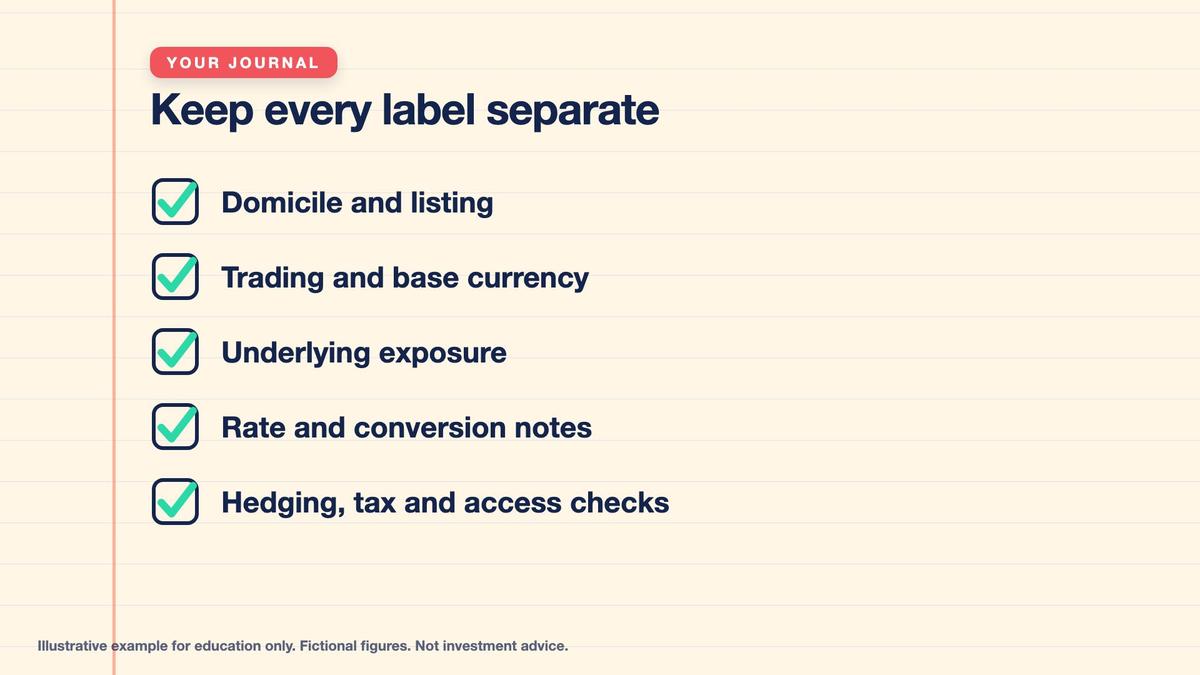
Your final checkpoint begins by identifying the different labels on Example Global ETF. Its fictional domicile is Country X, its listing is Example Exchange, and its trading and assumed base currencies are USD. The learner's home measurement currency is HC. The hypothetical Example World Index has underlying currency exposure of 60% USD, 25% Currency B, and 15% Currency C. Explain why these underlying exposures cannot be inferred from the USD quotation. Record each concept separately in your research journal and note that official factsheets should supply the relevant information.
Practice Lab: Separate Fund Labels, Currency Exposure, and Access
Use only fictional Example Global ETF, Example World Index, imaginary Country X, Example Exchange, USD, hypothetical Home Currency (HC), Currency B, and Currency C. Assume zero distributions, taxes, and trading costs for the 100-share return examples. Convert foreign investment values using HC per USD quotations and calculate combined returns multiplicatively. Treat the conversion-fee, currency-hedging, and dividend-withholding exercises as separate hypothetical cases. Identify what must be verified locally rather than assuming actual rules, eligibility, or tax treatment. All activities are educational and use simulated money only.
- Decision 1: Example Global ETF is legally registered in fictional Country X, listed on Example Exchange, quoted and reported in USD, and tracks Example World Index with currency exposures of 60% USD, 25% Currency B, and 15% Currency C. — Identify the fund's domicile, listing, trading currency, base currency, and underlying currency exposure, and explain why they are separate.
- Decision 2: The learner starts with 100 Example Global ETF shares at $50.00 each and an exchange rate of 4.00 HC per USD. One year later, the share price reaches $52.50 and HC strengthens to 3.80 HC per USD. — Calculate the initial and ending HC values, the USD price return, the currency return, and the final HC return.
- Decision 3: The same 100-share holding begins at $50.00 and 4.00 HC per USD, but one year later the price is $52.50 and HC weakens to 4.20 HC per USD. — Calculate the ending HC value and combined home-currency return, and explain why the percentage changes cannot simply be added.
- Decision 4: A fictional learner has 10,000 HC, pays a 0.50% conversion fee, converts remaining HC at 4.00 per USD, and considers whole shares of Example Global ETF at $50.00. — Calculate the conversion fee, USD amount available, maximum whole-share quantity, amount spent, and unused USD balance.
- Decision 5: A hypothetical hedged share class has an illustrative 0.15% annual hedging cost, while a separate $10,000 distribution example produces $200 gross dividends with alternative fictional withholding rates of 15% and 30%. — Calculate the simplified hedged return and both net distribution amounts, then identify which real-world details must remain unverified.
Answer key
Next, demonstrate the home-currency calculations. At 4.00 HC per USD, 100 shares priced at $50 are worth 20,000 HC. After the ETF price increases to $52.50, a rate of 3.80 produces 19,950 HC and a negative 0.25% return. A rate of 4.20 produces 22,050 HC and a positive 10.25% return. Then complete the separate conversion example: a 0.50% fee on 10,000 HC leaves 9,950 HC, equivalent to $2,487.50, allowing 49 whole shares at $50 with $37.50 remaining.
Key points
- Write each label separately in your journal.
- Calculate both home-currency returns and the conversion example.
- Flag unknowns instead of guessing. Educational only, not advice.
Finally, explain that hedged classes may reduce specified currency effects but have costs and residual risks. Verify the illustrative 4.85% fee-adjusted return and calculate the two hypothetical withholding outcomes of $170 and $140 from a $200 gross distribution. End with a list of unresolved local checks: broker availability, eligibility, official documents, tax and reporting obligations, exchange hours, account currencies, and conversion costs. The outcome is an accurate distinction between fund labels, economic exposure, exchange-rate returns, and practical access constraints.
Worked example at a glance
Key terms
- Domicile: the country where a fund is legally registered.
- Listing: the exchange where a fund's shares trade.
- Trading currency: the currency in which the fund's exchange price is quoted.
- Base currency: the currency in which the fund keeps its accounts and reports.
- Currency exposure: the currencies of the underlying assets, which can differ from the quote currency.
- Home currency: the currency in which the investor measures wealth.
- Exchange rate: the price of one currency in another, such as 4.00 HC per USD.
- Hedged share class: a version of a fund that tries to reduce exchange-rate effects.
- Withholding tax: tax taken from a distribution before it reaches the investor.
- Key information document: a short official document describing a fund's main features and risks.
Multi Asset Trading Lab provides educational information only and does not constitute personalized investment, trading, financial, legal, accounting, or tax advice. Example Global ETF, Example World Index, Example Exchange, Country X, Home Currency (HC), Currency B, and Currency C are hypothetical learning constructs, not references to actual funds, exchanges, jurisdictions, or currencies other than the explicitly used USD calculation unit. No real securities, tickers, countries, investor-specific tax rates, or product recommendations are provided. All examples involve fictional financial values and simulated research only; no real-money investment, trading, brokerage connection, or foreign-exchange transaction is required or encouraged. Fund domicile, exchange listing, trading currency, base currency, and underlying currency exposure are separate concepts and should be verified independently. A fund's quotation currency does not determine the full economic currency exposure of its underlying companies. Underlying investments may have revenues, liabilities, expenses, or hedging arrangements that create complex exposures not captured by the simplified 60%, 25%, and 15% illustration. Changes in exchange rates can increase or decrease investment returns measured in an investor's home currency. The hypothetical 100-share calculations assume specified opening and closing prices and exchange rates, without dividends, taxes, conversion costs, commissions, spreads, or other investment expenses. A 5% return quoted in USD does not guarantee a positive return in HC. Combined fund and exchange-rate returns are multiplicative, not simply additive. Foreign-exchange conversion can involve explicit fees, dealing spreads, different quoted rates, and additional transaction costs. The separate 10,000 HC conversion exercise assumes a single 0.50% fee, a constant 4.00 HC/USD exchange rate, and whole-share purchases; it is not included in the 100-share return scenarios. Currency-hedged fund share classes attempt to reduce specified exchange-rate effects but may involve derivatives, transaction costs, interest-rate effects, imperfect hedging, residual currency risk, and other implementation differences. The illustrative 4.85% hedged return is a simplified subtraction of a hypothetical 0.15-percentage-point cost from a 5.00% return before other effects, not a guaranteed hedged or home-currency result. The hypothetical 15% and 30% dividend withholding rates are arithmetic examples only and do not represent tax rules in any actual jurisdiction or for any investor. Real dividend withholding, fund-level taxation, investor taxes, reporting requirements, treaty treatment, documentation, and possible credits or refunds depend on the applicable rules and individual circumstances and can change. Fund availability and purchasing eligibility vary with brokers, account permissions, investor category, applicable region, and required information documents. A fund's listing or trading currency does not guarantee access through a given platform. Exchange hours, settlement arrangements, account currency, currency conversion fees, prospectus requirements, and product disclosure availability must also be checked independently. Learners should verify applicable rules and product information directly through the relevant platform, official fund provider, prospectus, current factsheet, required information documents, or a qualified local professional. Historical, simulated, or hypothetical returns do not predict future outcomes, and currency hedging does not eliminate investment risk. Nothing in this lesson constitutes a recommendation to buy, sell, hold, hedge, or convert any real financial instrument or currency.
Lesson Checkpoint
Review what you learned and get feedback on your work.