



In this sixteen-minute beginner lesson, learners create a one-page stock research memo for the fictional Example Corp using evidence from financial filings, income statements, balance sheets, cash flow statements, and valuation scenarios. They practice writing a concise investment thesis, constructing the strongest reasonable countercase, distinguishing facts from assumptions and opinions, and defining measurable conditions for revisiting their conclusions. The final outcome is a dated research memo with a simulated decision label, supporting evidence, valuation range, explicit uncertainties, and predefined review triggers.
What a Stock Memo Is and Why It Matters
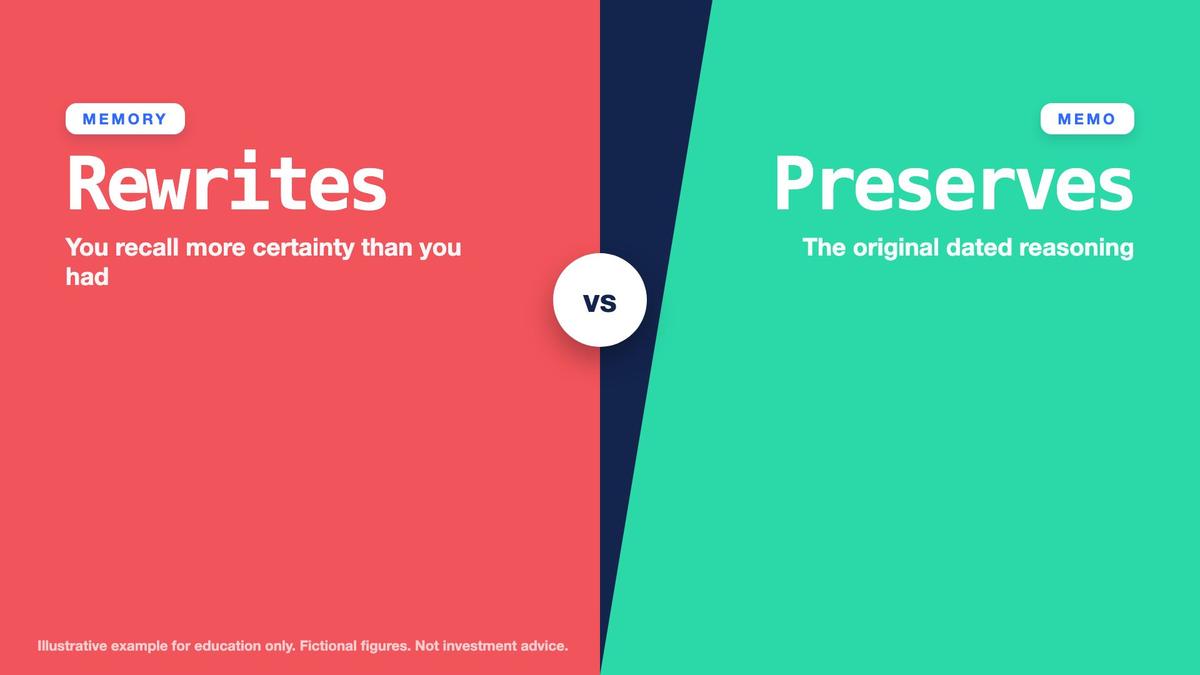
A stock research memo is a short written record of how a learner understands a company, interprets evidence, evaluates uncertainty, and decides what further research is needed. It is not a guarantee of future stock performance or a prediction of the market price. Its most important purpose is preserving reasoning at the time a decision is considered. Without a dated record, later outcomes can distort memory, making past decisions appear more obvious or better supported than they actually were.

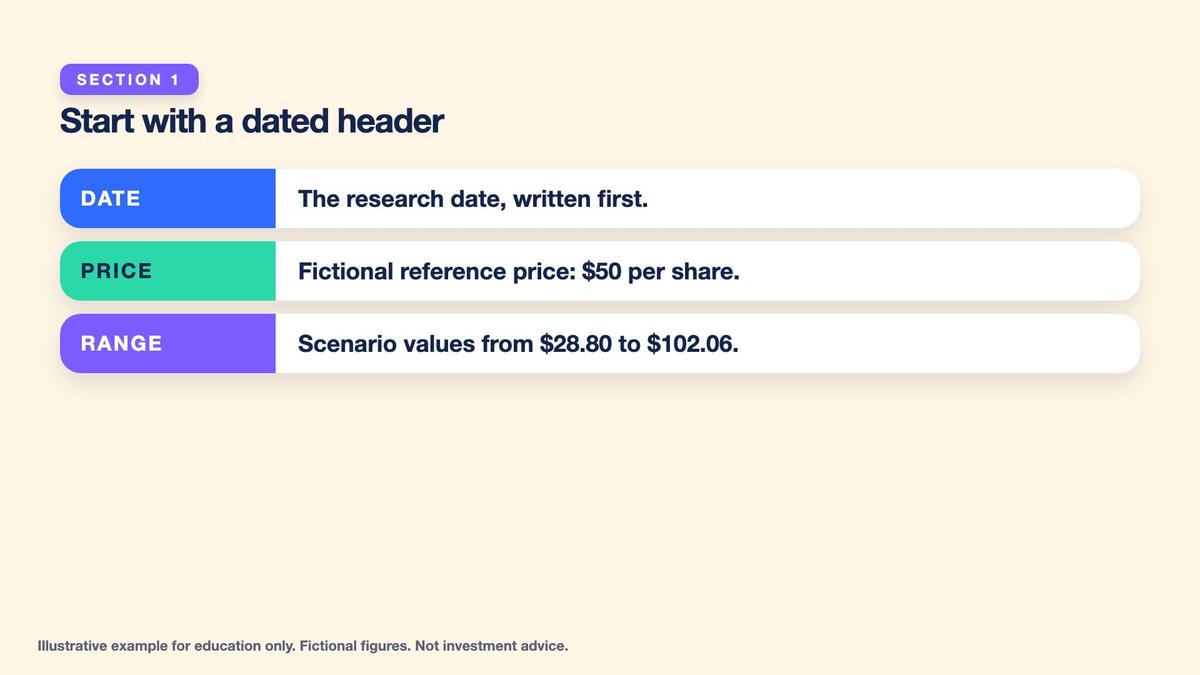
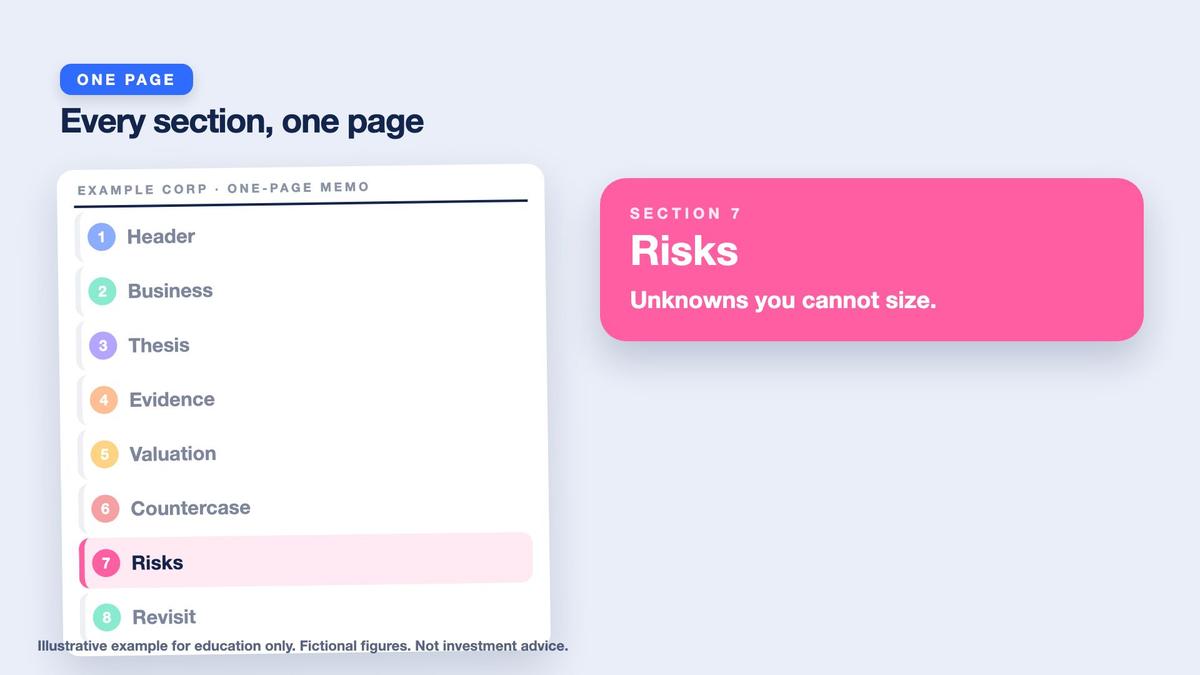
A beginner's memo should fit on one page. Start with a header containing the research date, company identifier, fictional reference price, and scenario valuation range. Follow with a one-paragraph business explanation, a thesis containing no more than three claims, a compact evidence table, and the valuation scenarios. Then write the strongest reasonable countercase, identify risks and unknowns, define measurable review conditions, and finish with a simulated research label: watch, research more, or pass.
Key points
- A memo is a short, dated record of your reasoning, not a prediction.
- It protects you from memory rewriting the past.
- Eight sections fit on one page.
For this lesson, we use only fictional Example Corp. Its hypothetical reference price is $50 per share, and the previously developed valuation scenarios range from $28.80 to $102.06. These figures provide a consistent example for memo construction, not a recommendation. We will use evidence from the previous five lessons and preserve a distinction between historical financial facts, forward-looking assumptions, and opinions about what the evidence might mean.
Write the Business Description and a Focused Thesis
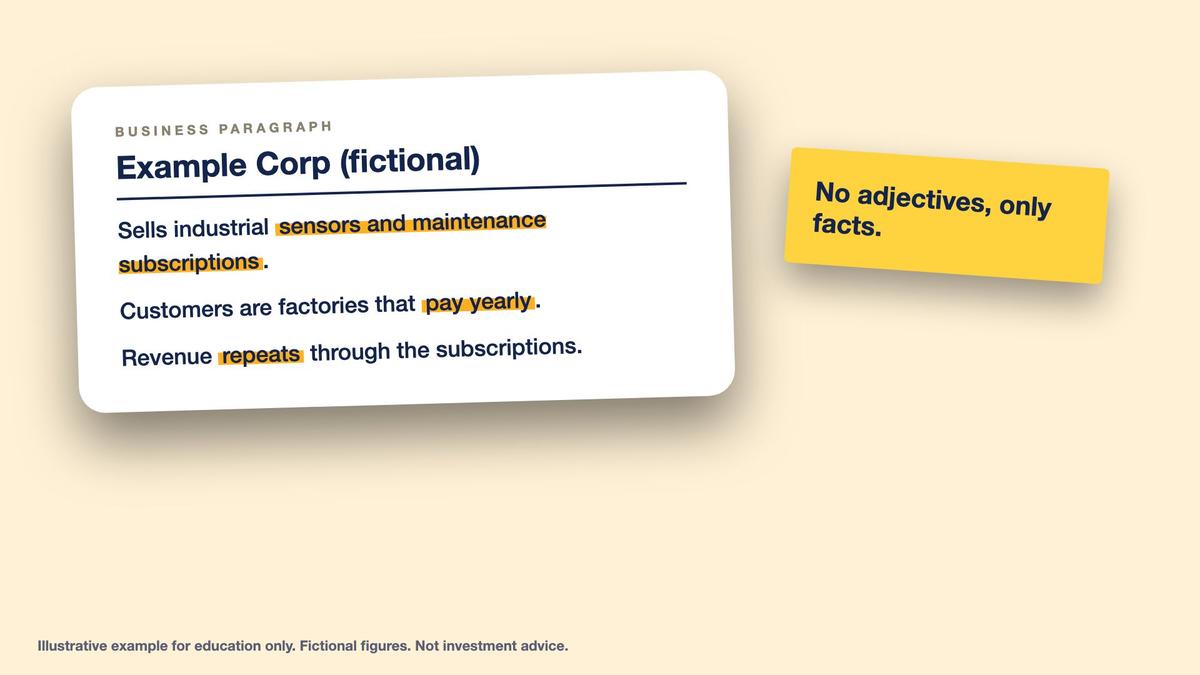
Begin with one paragraph explaining how the fictional company operates. Example Corp sells industrial sensors and maintenance subscriptions to business customers. A useful summary identifies its products, customers, revenue sources, operating segments, and competitive conditions without promotional language. Business descriptions should be grounded in the appropriate dated annual filing. If an important fact remains unknown, identify the gap rather than filling it with speculation. The goal is to explain how the business earns revenue in language another beginner can understand.
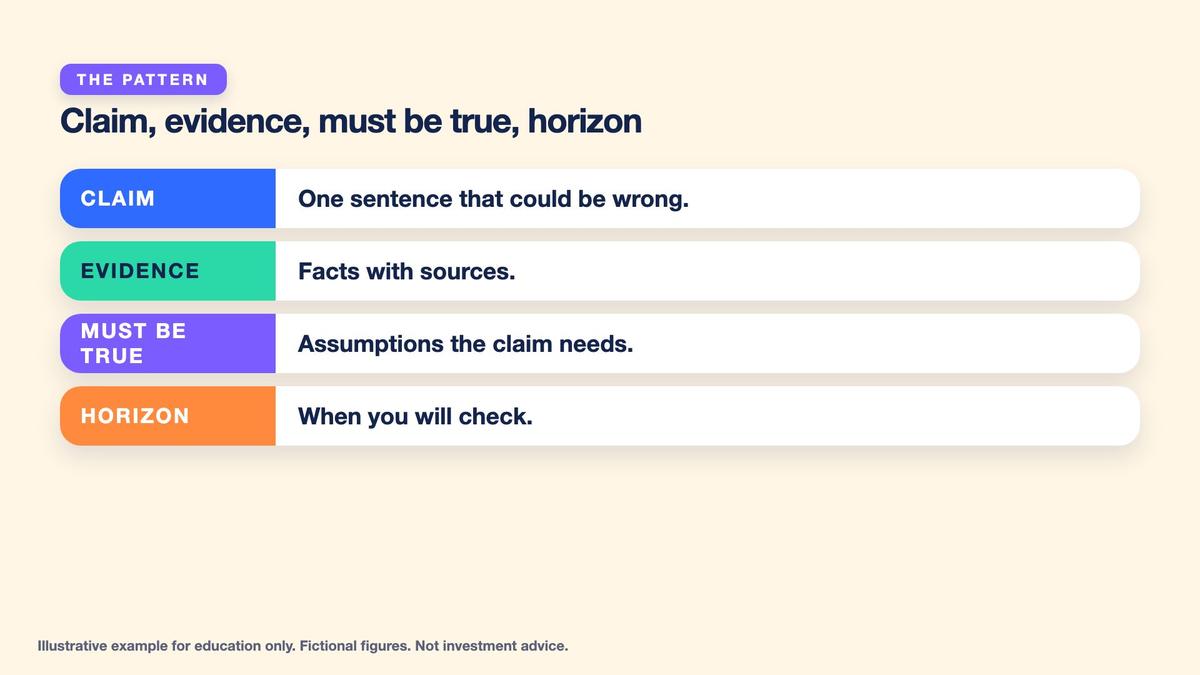
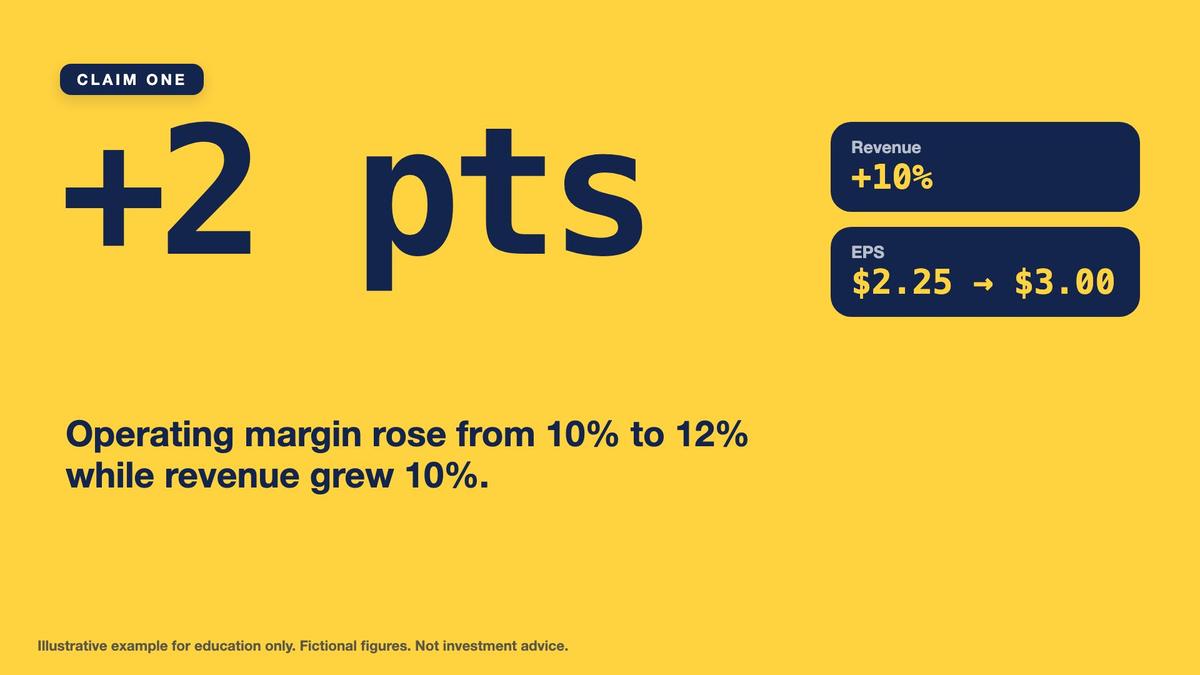
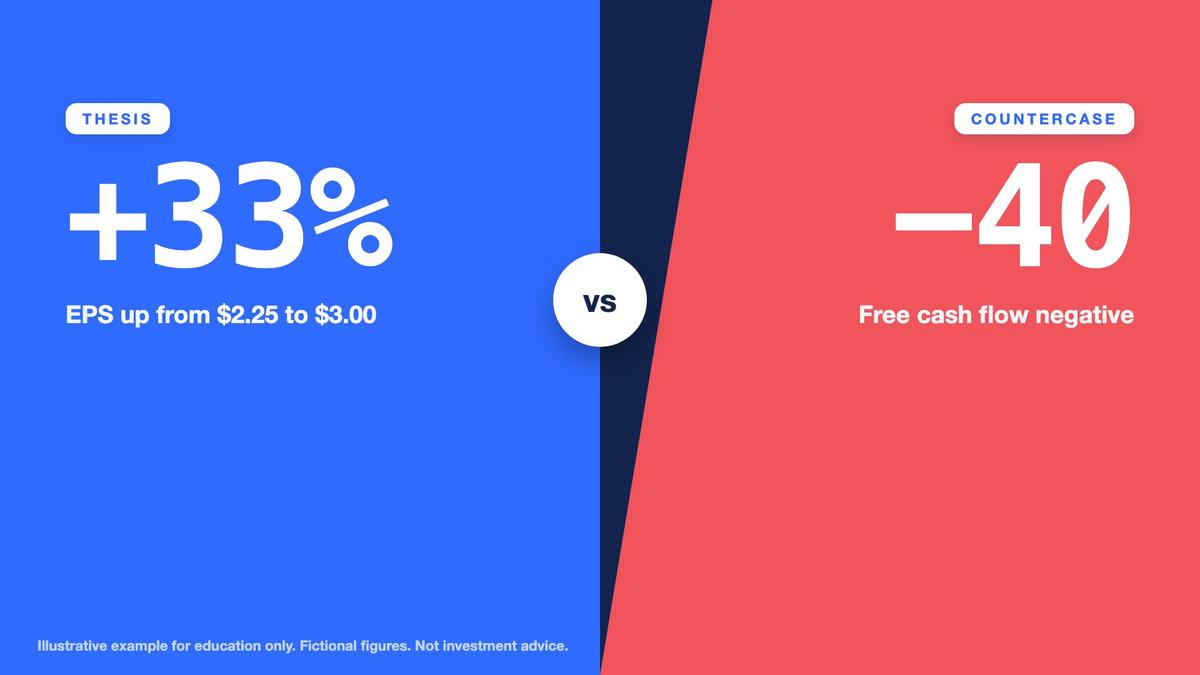
Next, write a thesis containing no more than three claims. A well-formed claim identifies the proposition, supporting evidence, conditions necessary for it to remain plausible, and its time horizon. Example Corp's first claim is that revenue growth and margin expansion improved earnings. Revenue increased from $1,000 million to $1,100 million, operating margin rose from 10% to 12%, and EPS increased from $2.25 to $3.00. These are historical observations, not guarantees of continued improvement.
Key points
- Header: date, fictional $50 reference price, range $28.80 to $102.06.
- Business: one plain paragraph, no adjectives.
- Thesis: at most three testable claims.
The second claim is conditional: if annual revenue growth remains near 8% and net margin near 9% across the three-year forecast horizon, the base model implies approximately $62.40 per share under a 15-times P/E assumption. The third claim is that Year 2 operating-income interest coverage of 11 times suggests current interest expense is manageable relative to accounting operating income. Both claims require qualifications. Forecast conditions may fail, and interest coverage does not establish sufficient cash for principal repayments or future investment needs.
Build an Evidence Table From the Previous Lessons
A good evidence table makes the thesis verifiable. Each entry should identify the financial metric, reporting period, recorded value, source location, and relevance to the claim. Lesson Six established how to navigate a dated Form 10-K. Item 1 describes the business, Item 1A contains risk factors, Item 7 provides management commentary, and Item 8 contains financial statements and accompanying notes. When working with an actual filing for research practice, record the exact filing date and relevant page numbers.
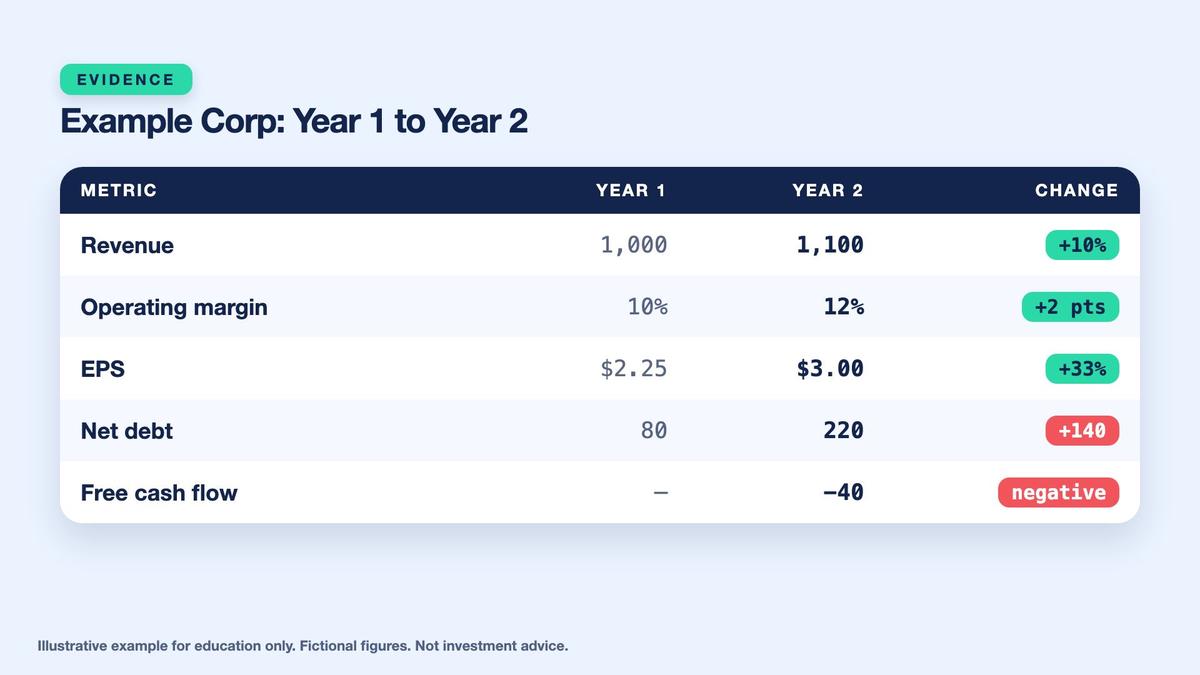
Lesson Seven provides the income-statement evidence. Example Corp's revenue increases 10%, from $1,000 million to $1,100 million. Gross margin rises from 40% to 42%, and operating margin from 10% to 12%, both improvements of two percentage points. Net income increases from $67.5 million to $90 million, exactly one-third, or approximately 33.3%. Basic EPS rises from $2.25 to $3.00, assuming 30 million weighted-average common shares in both years. These measurements support the historical earnings-improvement claim.
Key points
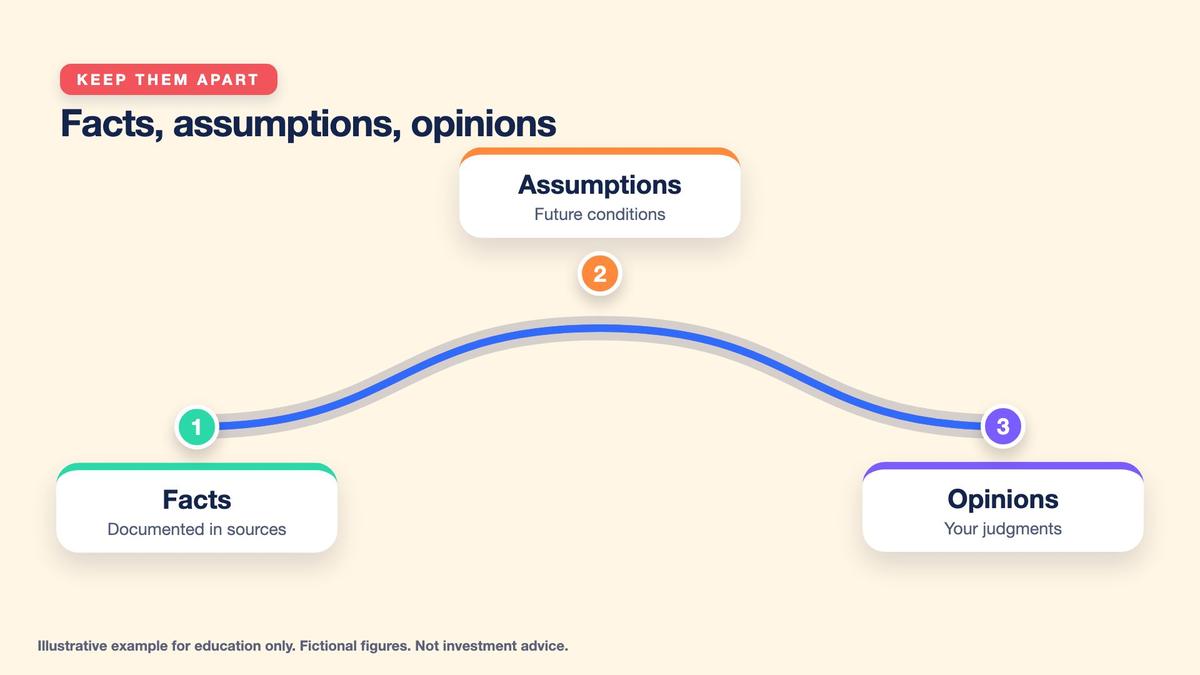
- Facts, assumptions and opinions must stay separate.
- Evidence: revenue +10%, operating margin 10% to 12%, EPS 2.25 to 3.00.
- Cautions: net debt 80 to 220, free cash flow −40.
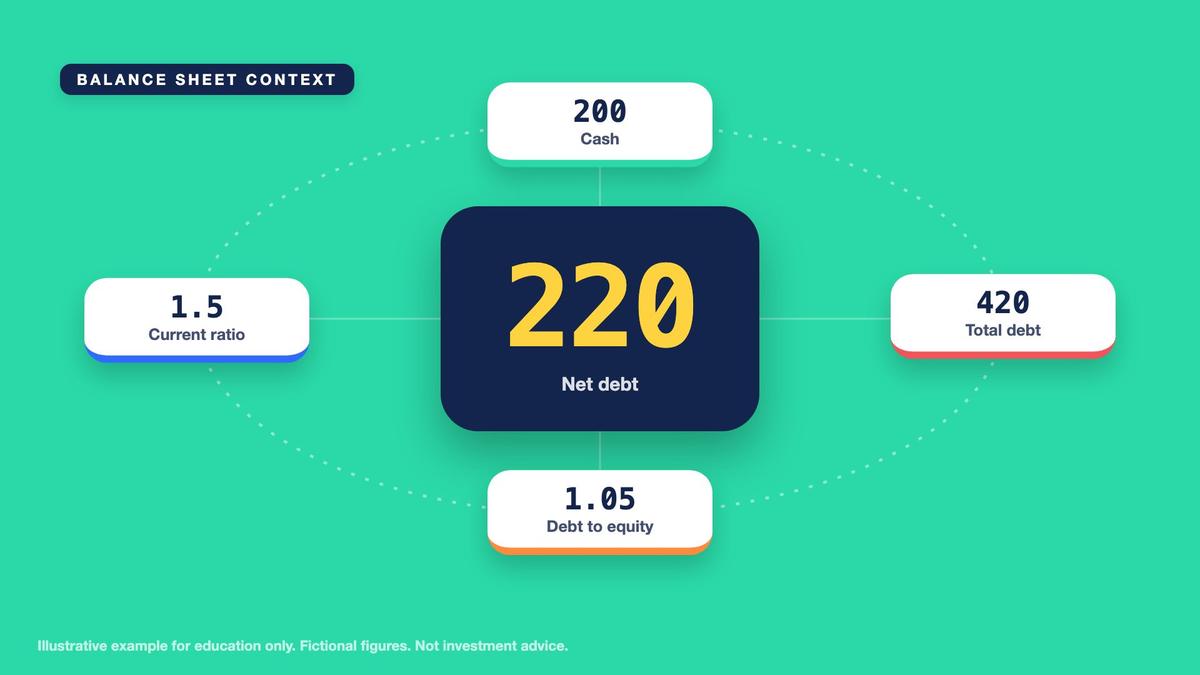
Lesson Eight adds financial position, while Lesson Nine adds cash-flow information. Example Corp reports Year 2 cash of $200 million, total debt of $420 million, net debt of $220 million, current ratio of 1.5 times, debt-to-equity of 1.05 times, and interest coverage of 11 times. Net debt increased by $140 million from Year 1. Operating cash flow was $90 million, capex was $130 million, and FCF was negative $40 million. These figures provide important counterevidence alongside improving profitability.
Present the Valuation Range Without Predicting a Price
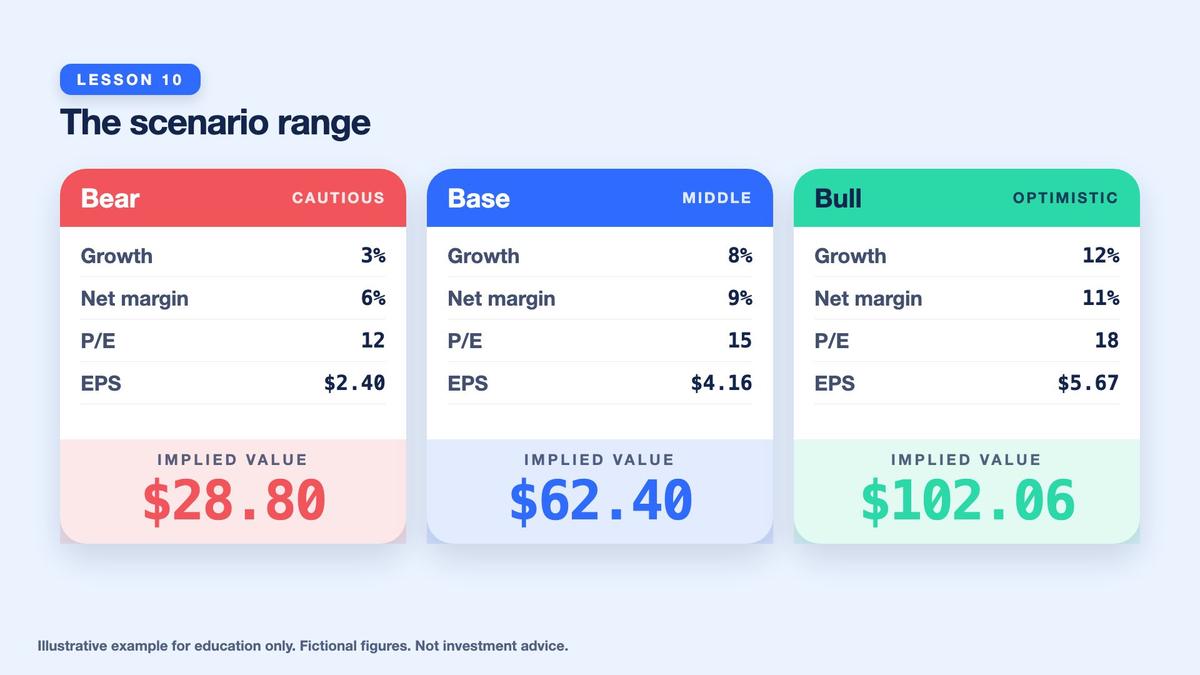
Lesson Ten introduced a three-year scenario model using revenue growth, net margin, share count, and an assumed P/E multiple. The bear scenario used 3% annual revenue growth, 6% net margin, and 12-times earnings, producing $28.80 implied value per share. The base scenario used 8% growth, 9% margin, and 15-times earnings, producing $62.40. The bull scenario used 12% growth, 11% margin, and 18-times earnings, producing $102.06. All three figures depend on hypothetical assumptions.
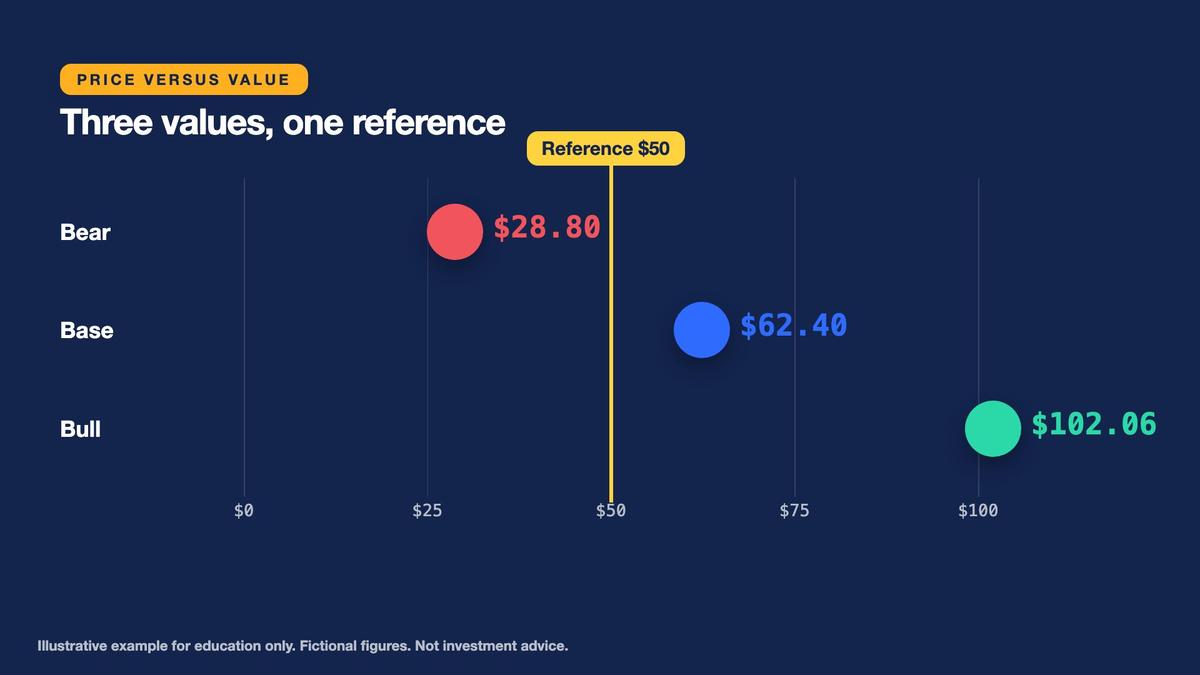
Compared with Example Corp's fictional $50 reference price, the bear scenario is 42.4% lower, the base scenario is 24.8% higher, and the bull scenario is 104.12% higher, or approximately 104.1%. With illustrative probability weights of 25% bear, 50% base, and 25% bull, the weighted calculation is exactly $63.915, approximately $63.9. This is approximately 27.8% above the reference price. The probability weights reflect educational assumptions, not objectively established likelihoods.
Key points
- Bear $28.80 (−42.4%), base $62.40 (+24.8%), bull $102.06 (+104.1%).
- Weighted value about $63.9 (+27.8%).
- Show the range, never a single price target.
A memo should present the range instead of replacing it with one apparently authoritative number. Explain which assumptions produce each scenario and which are most uncertain. A higher margin, faster revenue growth, or larger P/E multiple can raise the calculated value, but the model does not establish that those conditions will occur. The fictional price comparison is not a projected investment return. Preserve the model horizon, rounding conventions, and limitations so another learner can reproduce the arithmetic.
Construct the Strongest Honest Countercase
A countercase is the strongest reasonable interpretation that challenges the thesis. Writing a deliberately weak objection is called a strawman and does little to improve research. Instead, build a steelman: an opposing argument that uses accurate evidence and plausible assumptions. For Example Corp, the countercase should acknowledge that accounting profits improved while questioning whether the company's cash generation and financial flexibility can sustain the implied growth expectations.

Example Corp generated $90 million operating cash flow but spent $130 million on capital expenditures, leaving negative $40 million FCF. This does not automatically mean the company is financially weak; substantial investment may support future production or business expansion. However, the resulting cash deficit raises questions about how much additional spending will be needed, whether cash generation will improve, and whether the investment program can be financed without unfavorable consequences. These are material uncertainties rather than rhetorical objections.
Key points
- Steelman, do not strawman: argue against yourself fairly.
- Countercase: capex 130 exceeded operating cash 90; net debt rose 140.
- Bear case at 3% growth and 6% margin: $28.80.
The countercase also identifies net debt increasing by $140 million, from $80 million to $220 million. Higher debt exposure may create refinancing and liquidity concerns if business conditions deteriorate. If growth slows to 3% and net margin falls to 6%, the bear valuation produces $28.80 per share, 42.4% below the fictional reference price. A balanced memo should present these risks accurately even if the author initially finds the improving earnings figures encouraging.
Define Risks, Unknowns, and Measurable Review Conditions
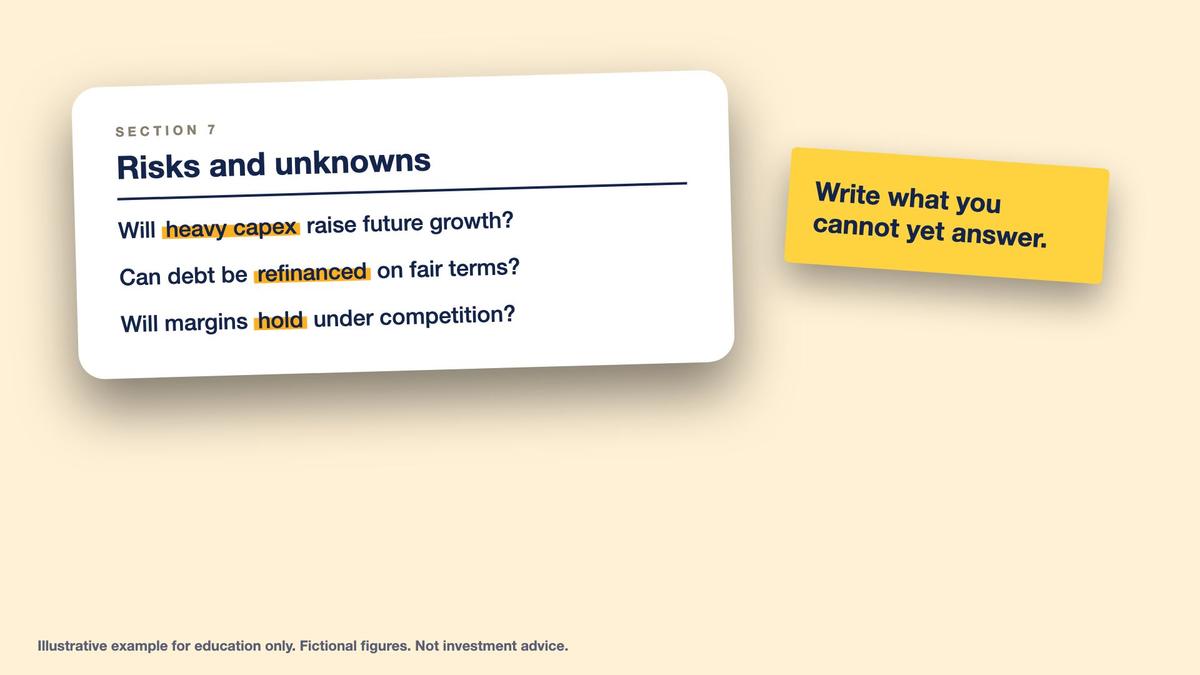
After the countercase, list the questions that existing evidence cannot resolve. For Example Corp, these include whether high capital expenditures are temporary, whether operating cash generation will improve, how debt maturities are structured, and whether current profitability can persist. The memo should not pretend to know answers that the fictional evidence does not establish. Distinguish an observed fact, such as negative FCF, from an assumption, such as future investment spending declining, and from an opinion about the likely consequences.
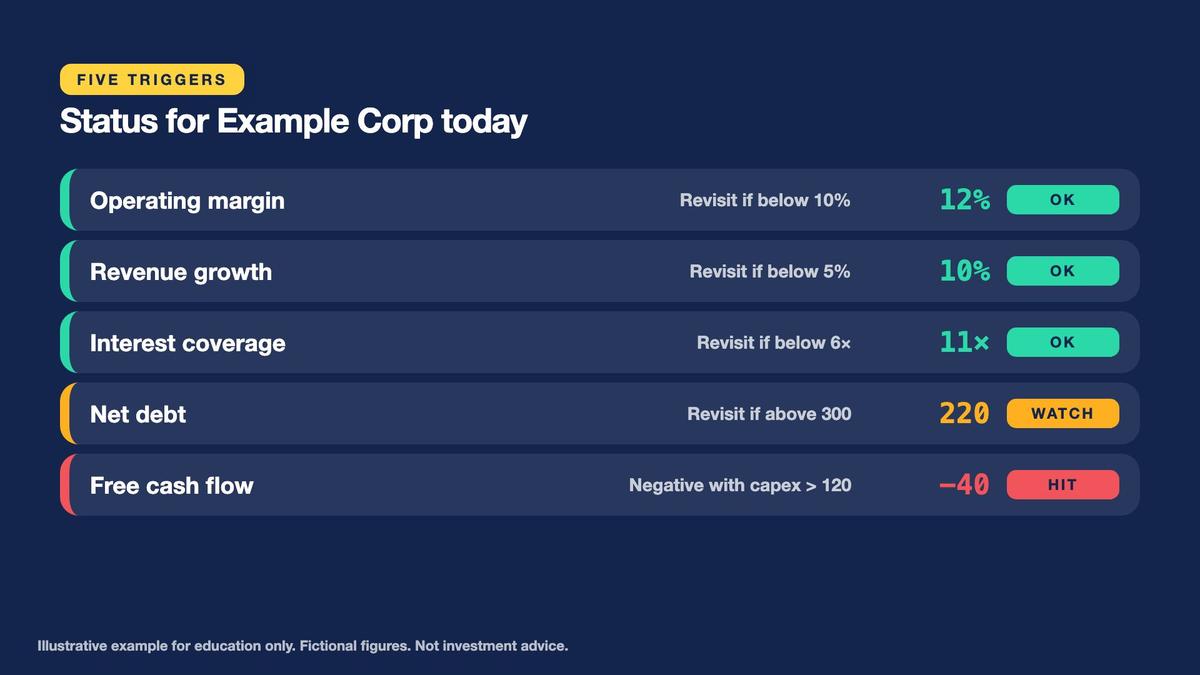
Write measurable review conditions before future results become known. For the exercise, Example Corp's memo requires review if operating margin falls below 10%, revenue growth falls below 5%, net debt exceeds $300 million, or operating-income interest coverage drops below six times. Another trigger is FCF remaining negative while annual capex stays above $120 million. The combined FCF-and-capex trigger requires both conditions to be met. These thresholds are educational monitoring rules rather than universally appropriate investment risk limits.
Key points
- List unknowns you cannot size.
- Triggers: margin below 10%, growth below 5%, coverage below 6×, net debt above 300, FCF negative with capex above 120.
- Write triggers before results are known.
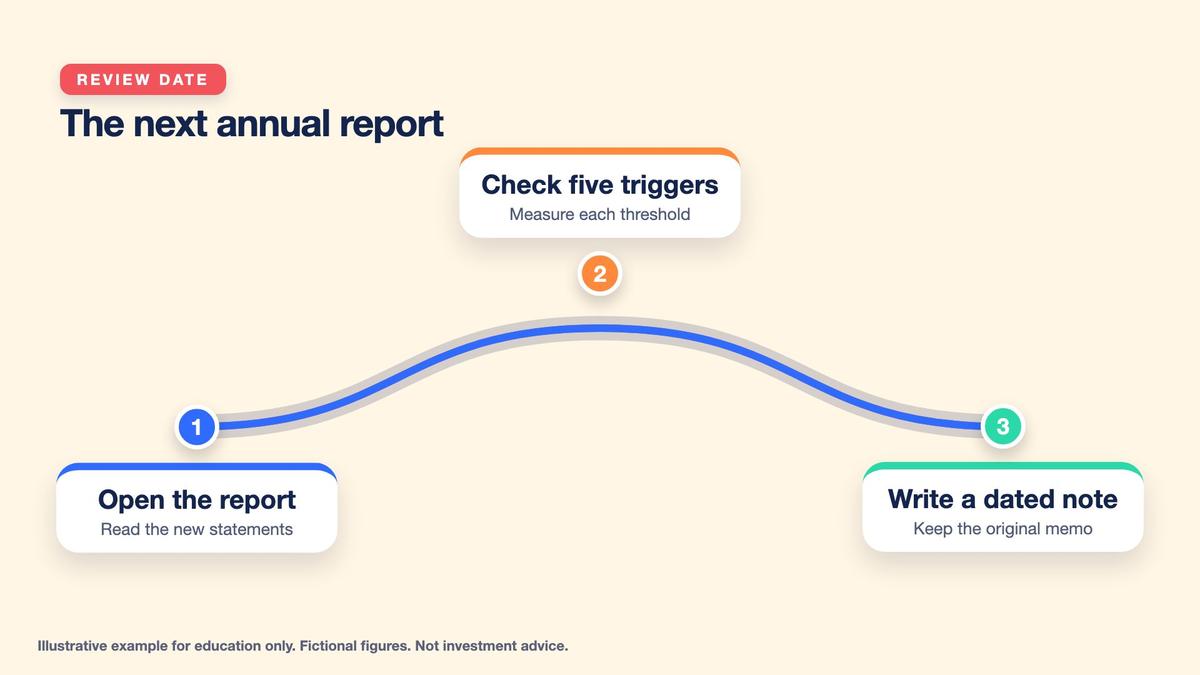
Set the scheduled review for the next annual report and record that date or event in the header. Important interim disclosures may justify an earlier review, but the reason should be documented. A trigger means the learner must reconsider assumptions, examine new evidence, and update the research conclusion. It does not automatically require buying or selling anything. In a simulated learning environment, these rules demonstrate how to make research falsifiable and avoid changing criteria after observing results.
Choose a Simulated Research Label and Preserve the Memo
The final research label should describe the next learning action rather than a real-money transaction. For this course, use watch, research more, or pass. Watch means monitoring a defined set of observations without requiring immediate additional investigation. Research more means important uncertainties remain and specific evidence should be gathered. Pass means deciding not to continue researching the fictional opportunity under the current framework. These labels are educational workflow categories, not buy, sell, or hold recommendations.
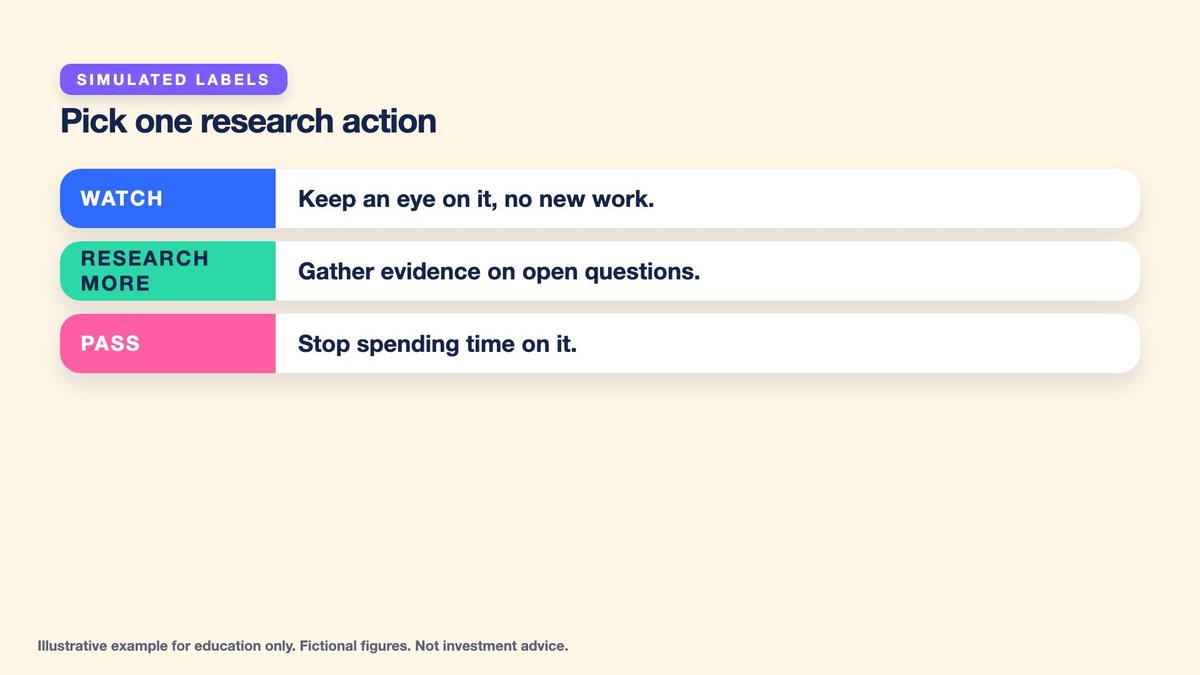
For Example Corp, the illustrative label is research more. Operating performance has improved, and the base valuation produces a higher conditional estimate than the fictional reference price. However, negative FCF, rising net debt, and unanswered questions about capital investment make further research appropriate. The learner should investigate debt maturities, operating cash conversion over time, and whether investment spending supports future revenue generation. The label reflects incomplete information rather than a prediction of poor or strong returns.
Key points
- Review at the next annual report with dated notes.
- Labels (watch, research more, pass) describe research, not trades.
- Defend against confirmation and hindsight bias.
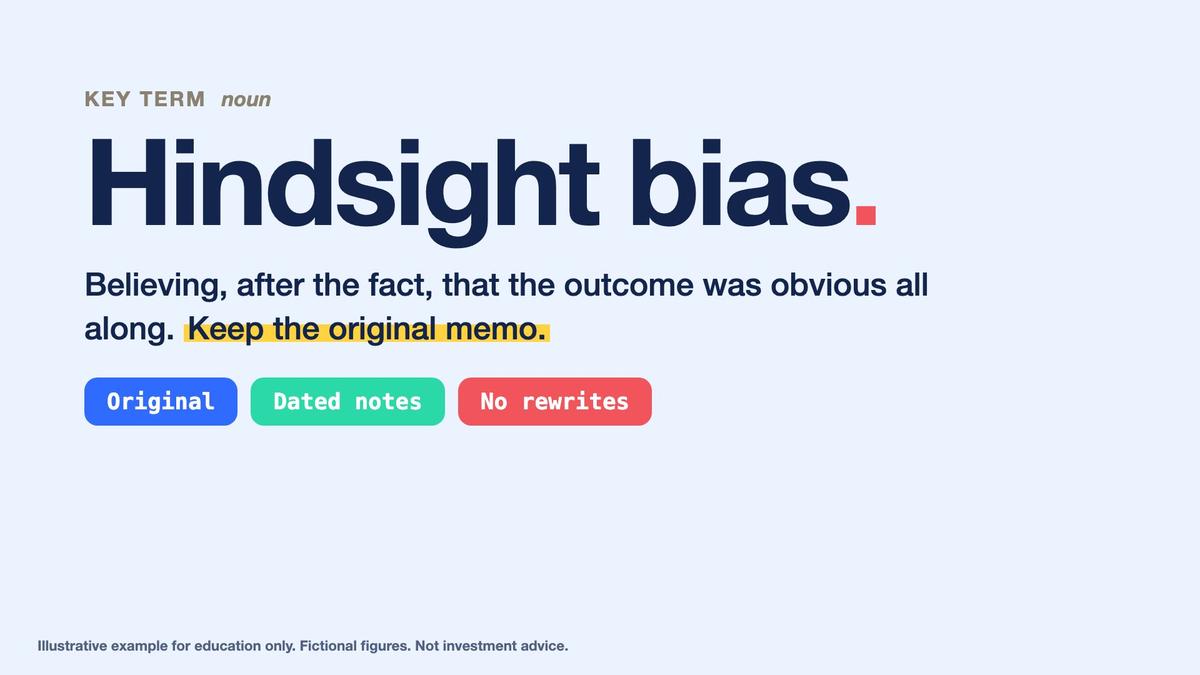
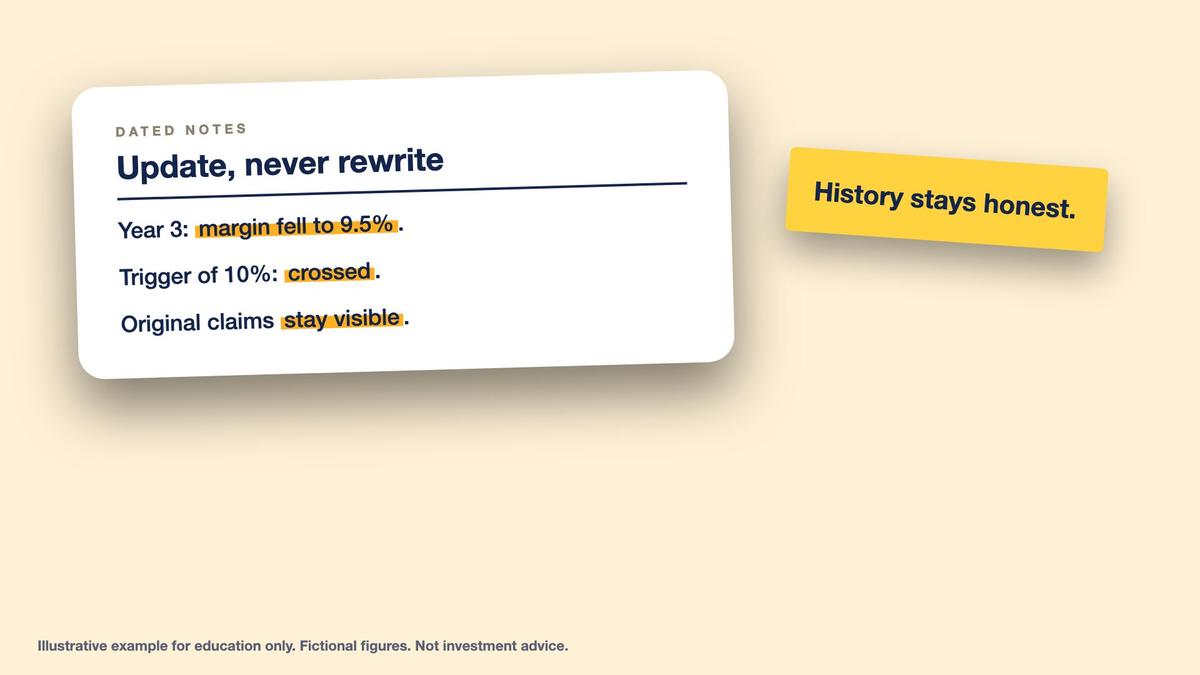
Preserve the original memo after signing and dating it. Future notes should be appended with new dates rather than silently rewriting earlier claims. This protects against hindsight bias, where past developments seem obvious after they occur. It also helps challenge confirmation bias, where researchers prefer evidence supporting their original view. When updating the memo, identify which claims survived, which were contradicted, what new evidence appeared, and whether predefined review triggers were reached.
Final Project: Complete the One-Page Stock Memo
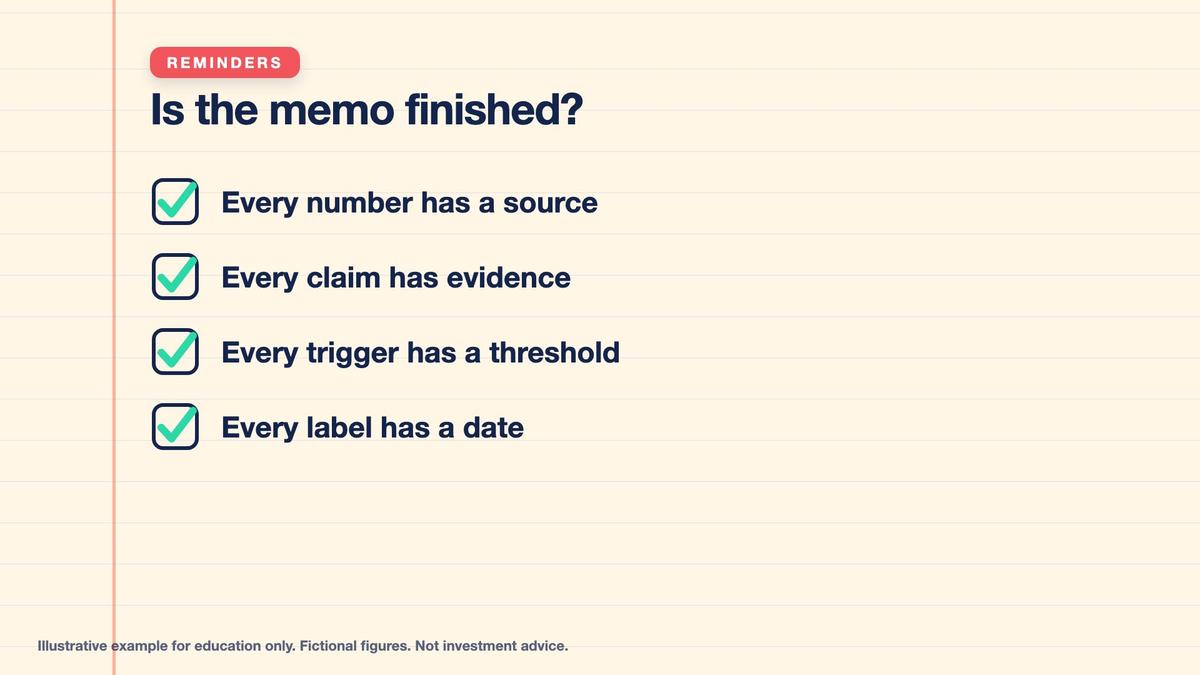
Your final project is a one-page research memo for fictional Example Corp. Begin with the research date, fictional $50 reference price, and $28.80–$102.06 scenario range. Describe the business in one paragraph. Write no more than three thesis claims covering historical earnings improvement, conditional base-case valuation, and interest coverage. Support each claim with factual figures, stated assumptions, relevant time horizons, and source references. Keep the evidence table concise and accurate.

Practice Lab: Write a Thesis, Countercase, and Review Conditions
Use only fictional Example Corp and the figures supplied in Lessons 6–10. Prepare a one-page stock research memo with a dated header, brief business explanation, no more than three thesis claims, an evidence table, bear/base/bull valuation range, strongest evidence-based countercase, key uncertainties, measurable review conditions, and a simulated research label. Separate documented facts from assumptions and opinions. All financial values are USD millions unless stated otherwise. No real-money investing or trading is required.
- Decision 1: Example Corp's revenue rises from $1,000 million to $1,100 million, operating margin increases from 10% to 12%, and basic EPS grows from $2.25 to $3.00. — Write a concise thesis claim using accurate growth calculations and explain the condition that must hold for improved profitability to remain relevant.
- Decision 2: The fictional reference price is $50.00, while Example Corp's modeled values are $28.80 bear, $62.40 base, and $102.06 bull. — Calculate the scenario comparisons with the reference price and write the valuation thesis as a conditional statement.
- Decision 3: Example Corp reports operating cash flow of $90 million, capex of $130 million, net debt of $220 million compared with $80 million previously, and positive net income of $90 million. — Write the strongest countercase without denying the historical profit improvement.
- Decision 4: The learner needs measurable conditions for revisiting Example Corp's memo and must schedule the formal review at the next annual report. — State five objective triggers that can be checked against later financial disclosures.
- Decision 5: Example Corp has improving revenue and margins, 11-times operating-income interest coverage, negative $40 million FCF, rising net debt, and a broad hypothetical valuation range. — Select a simulated research label and identify the next research questions without recommending an actual trade.
Answer key
Next, include the strongest reasonable countercase. State that Year 2 FCF was negative $40 million because $130 million capex exceeded $90 million operating cash flow. Note that net debt increased by $140 million and that the bear scenario implies $28.80 under weaker growth and margin assumptions. Separate facts from assumptions and opinions. Add the predefined operating-margin, revenue-growth, FCF, capex, net-debt, and interest-coverage review conditions without changing their definitions after results become known.
Finish with the next-annual-report review schedule and the simulated label research more. Sign and date the memo, preserve the initial version, and use later dated notes for revisions. Check that every number matches the preceding lessons and that valuation scenarios are presented as conditional estimates rather than predictions. The final outcome is a transparent, testable record of reasoning that another learner can evaluate, not an actual stock recommendation.
Worked example at a glance
Key terms
- Stock memo: a short, dated record of research reasoning.
- Thesis: up to three testable claims supported by evidence.
- Evidence table: metrics with period, figure and source.
- Countercase: the strongest honest argument against the thesis.
- Steelman: stating the opposing view in its strongest form.
- Review trigger: a measurable threshold written in advance.
- Research label: watch, research more or pass: a research action, not a trade.
- Confirmation bias: favoring evidence that supports your existing view.
- Hindsight bias: believing an outcome was obvious after it happened.
- Dated note: an update added below the original memo.
- Valuation range: the spread of values across scenarios.
Multi Asset Trading Lab provides educational information only and does not constitute personalized investment, trading, financial, accounting, legal, or tax advice. Example Corp is entirely fictional, and all business descriptions, financial statements, market prices, valuation estimates, scenario assumptions, review thresholds, and research conclusions are hypothetical. No real-money investment, trading, or brokerage activity is required or encouraged. The fictional $50.00 reference price and the modeled $28.80, $62.40, and $102.06 implied values are educational inputs and outputs, not real-company price targets, guaranteed market prices, or recommendations to buy, sell, or hold securities. A stock research memo records reasoning and uncertainty; it cannot establish future business performance or protect against financial loss. Historical revenue growth, margin expansion, net income growth, earnings per share, interest coverage, cash flow, debt balances, and other financial figures do not guarantee that similar results will continue. Positive accounting profitability can coexist with negative free cash flow, significant capital requirements, increasing debt, or future refinancing risks. The illustrated probability-weighted valuation uses subjective educational weights rather than validated probabilities. The simulated research labels watch, research more, and pass are organizational decisions for a learning exercise, not trading instructions. Review thresholds such as operating margin below 10%, revenue growth below 5%, negative FCF combined with capex above $120 million, net debt above $300 million, and interest coverage below six times are fictional educational monitoring conditions rather than universally appropriate investment risk limits. Crossing a threshold should prompt further investigation, not automatic financial transactions. Financial analysis may be affected by accounting estimates, unusual transactions, company disclosures, economic conditions, dilution, refinancing requirements, cash-flow uncertainty, and model assumptions. Confirmation bias, hindsight bias, selective evidence, and undocumented revisions can distort conclusions; learners should preserve dated research records and record updates transparently. Financial figures should be verified against appropriate dated source documents, including Form 10-K, accompanying notes, MD&A, and subsequent filings when relevant. No memo, financial ratio, valuation model, or research framework guarantees investment success. Learners should use fictional data for coursework and seek qualified professional advice before making actual financial decisions.
Lesson Checkpoint
Review what you learned and get feedback on your work.