



In this twelve-minute beginner hands-on lab, learners follow a fictional Sample Coin spot trade from the initial market quote through order execution, trading fees, gross profit, net profit, and statement reconciliation. Using simulated money only, they record a 200-coin market purchase at $10.00 and a market sale at $10.90, calculate $180.00 gross profit, subtract $8.36 in taker fees, and obtain $171.64 net profit. They compare hypothetical maker fees, identify the $8.00 midpoint-referenced spread cost already reflected in execution prices, calculate fee drag, and examine a separate withdrawal-fee adjustment. Additional exercises address exact break-even pricing, an adverse exit at $9.90, rounding, incomplete limit fills, and the distinction between trading fees and blockchain transfer costs. The lab concludes with a one-page execution journal and line-by-line reconciliation checklist. Every market, asset, price, fee and transaction is invented for education; no real exchange, coin, ticker, investment advice or price prediction is involved.
Open the Spot Execution Log and Record the Quote
Begin with a blank simulated execution ledger. Identify the fictional instrument as Sample Coin and the transaction type as spot, meaning the example purchases and later sells the underlying fictional asset rather than a derivative contract. This exercise has no borrowed funds, margin, liquidation mechanism, funding rate or leverage. Record the date, instrument, side, order type, requested quantity and displayed quotation before calculating anything. The main trade consists of purchasing 200 coins through a market order and later selling those same 200 coins through another market order. All trades occur only within the classroom worksheet.



The opening market quotation has a bid of $9.96 and an ask of $10.00. The bid represents displayed buying interest, and the ask represents displayed selling interest. The midpoint is ($9.96 + $10.00) divided by two, or $9.98. The spread is $10.00 minus $9.96, or $0.04 per coin. Dividing $0.04 by the $9.98 midpoint and multiplying by 100 gives approximately 0.4008016%, conventionally displayed as 0.40%. The quoted percentage is a relative measure of the market's bid-ask gap, not an additional exchange fee.
Key points
- Record the quote first: bid $9.96, ask $10.00, midpoint $9.98, spread $0.04 = 0.40%.
- Invented fees: taker 0.20%, maker 0.10%, flat withdrawal 0.5 coin.
- Everything is simulated: fictional Sample Coin, no real exchange or wallet.
Record the invented fee schedule before submitting the simulated ticket. The taker fee is 0.20% of executed notional, the maker fee is 0.10%, and a separate illustrative withdrawal charge is a flat 0.5 coin. Market orders generally remove displayed liquidity and commonly receive taker classification. Limit orders that rest and provide liquidity may receive maker classification when executed, but a limit order can also execute immediately as a taker. The actual maker or taker classification depends on execution mechanics, not merely the presence of a limit price. In our principal worksheet, both trades are explicitly taker executions.
Record the Market Purchase and Its Fee
Enter a market buy for 200 fictional Sample Coins. For this simplified execution, assume that all 200 coins fill at the initial displayed ask of $10.00. Multiply the quantity by the execution price: 200 multiplied by $10.00 equals $2,000.00 of executed purchase notional. The assumption of a complete fill at one price makes the arithmetic straightforward, although an actual order could fill across multiple price levels or fail to complete immediately. The earlier order-types lab showed how average execution prices can differ when order-book liquidity is limited. Here, our fill is stipulated and does not change.
Apply the invented taker fee of 0.20% to the $2,000.00 purchase notional. Expressing 0.20% as 0.002 gives $2,000.00 multiplied by 0.002, or exactly $4.00. Record this amount in a separate buy-fee field. The example assumes that the fee is paid in cash outside the purchased coin quantity, so the learner acquires exactly 200 coins. Total cash outflow is therefore $2,000.00 plus $4.00, or $2,004.00. If fees were instead deducted in the purchased asset, the acquired quantity and later calculations would need adjustment.
Key points
- Buy 200 coins by market order at the ask $10.00 = $2,000.00 notional.
- Taker fee 0.20% x $2,000 = $4.00; cash out $2,004.00.
- Record the fee as its own line in the log.
The first journal entry now contains the original bid $9.96, ask $10.00, midpoint $9.98, quoted spread $0.04, market-buy classification, taker fee rate 0.20%, 200 coins filled, $10.00 average price, $2,000.00 notional, $4.00 fee and $2,004.00 cash outflow. Verify that the quantity and cash movements reconcile. Record the purchase timestamp and keep the quoted price separate from the executed fill. Do not assume that the four-cent spread is an additional invoice: buying at the displayed ask already incorporates the difference between that execution price and the midpoint.
Record the Market Sale and Calculate Gross and Net Profit
At the fictional exit point, the market displays a bid of $10.90 and ask of $10.94. Their midpoint is $10.92, and the quoted spread remains $0.04 per coin. As a percentage of the midpoint, that spread is approximately 0.3663%, displayed as 0.37%. The learner submits a simulated market sell for all 200 coins. Assume the entire quantity fills at the displayed bid of $10.90. Gross proceeds equal 200 multiplied by $10.90, or $2,180.00. The coin balance from the main trading sequence becomes zero after the sale.
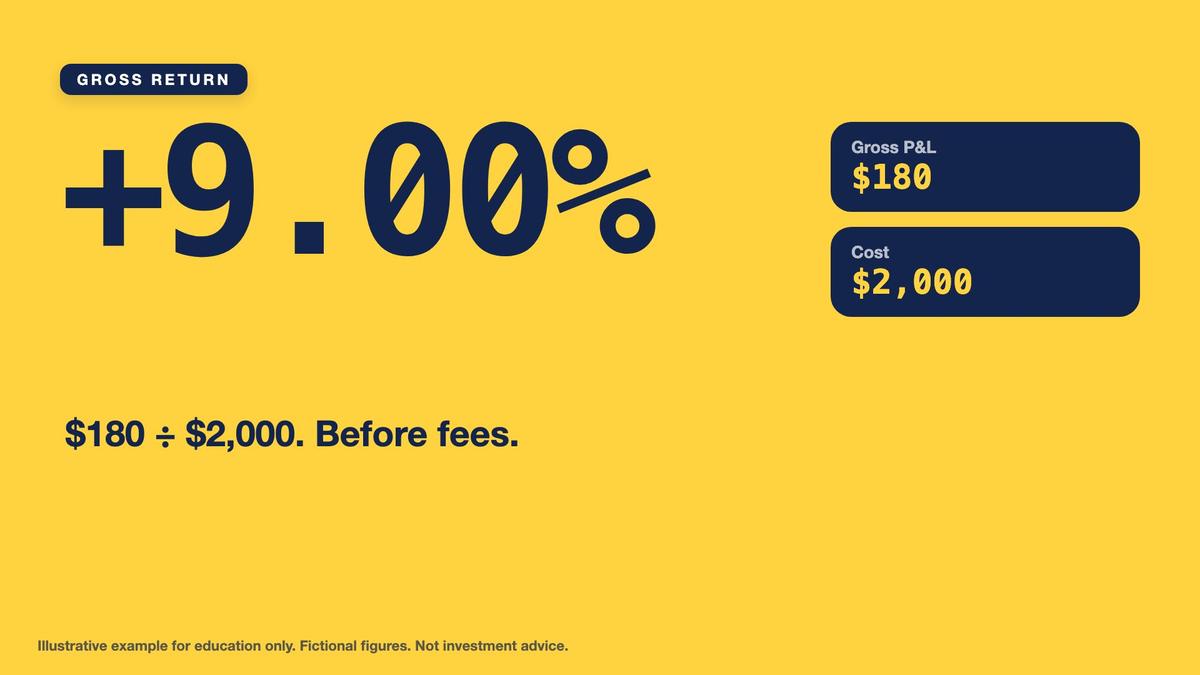
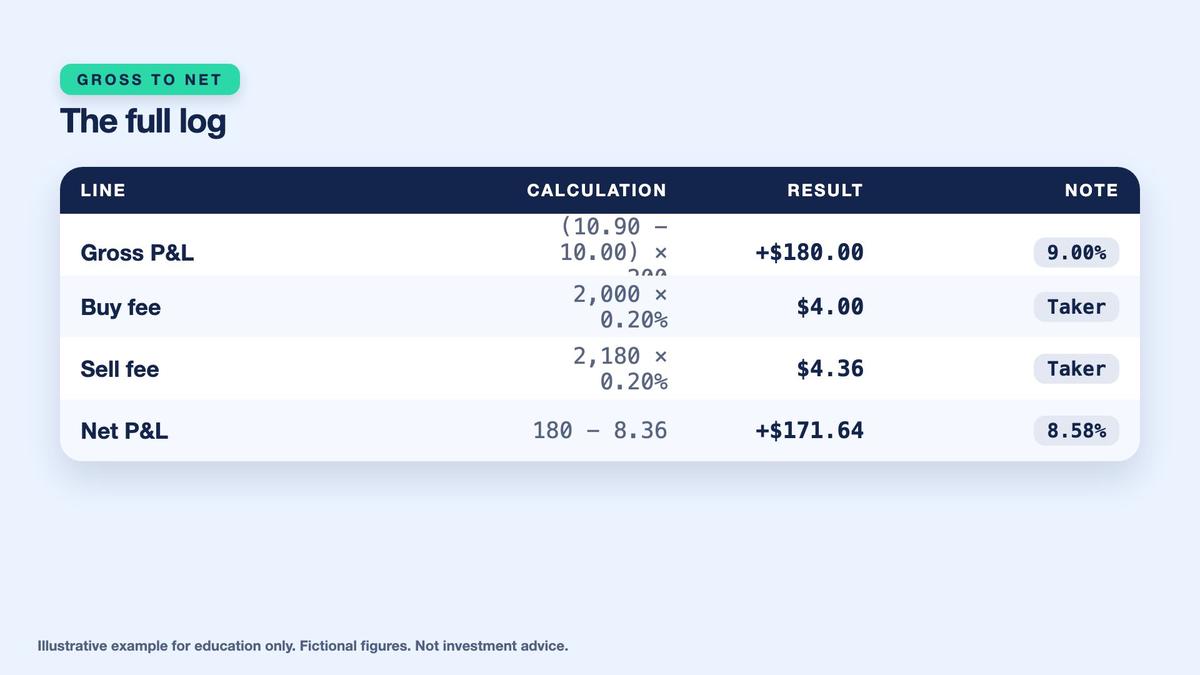
The taker sell fee equals 0.20% of $2,180.00, producing $4.36. Cash received after the sale fee is $2,180.00 minus $4.36, or $2,175.64. Calculate gross profit before trading fees from the difference in executed prices: ($10.90 minus $10.00) multiplied by 200 gives $180.00. Gross return relative to the original $2,000.00 purchase notional equals $180.00 divided by $2,000.00, or exactly 9.00%. This percentage reflects the executed entry and exit prices but excludes explicit exchange charges.
Key points
- Exit quote bid $10.90, ask $10.94; sell 200 at $10.90 = $2,180.00; fee $4.36.
- Gross P&L = (10.90 - 10.00) x 200 = $180.00 (9.00%).
- Fees $8.36; net P&L = $171.64 (8.58%); fee drag 4.64% of gross profit.
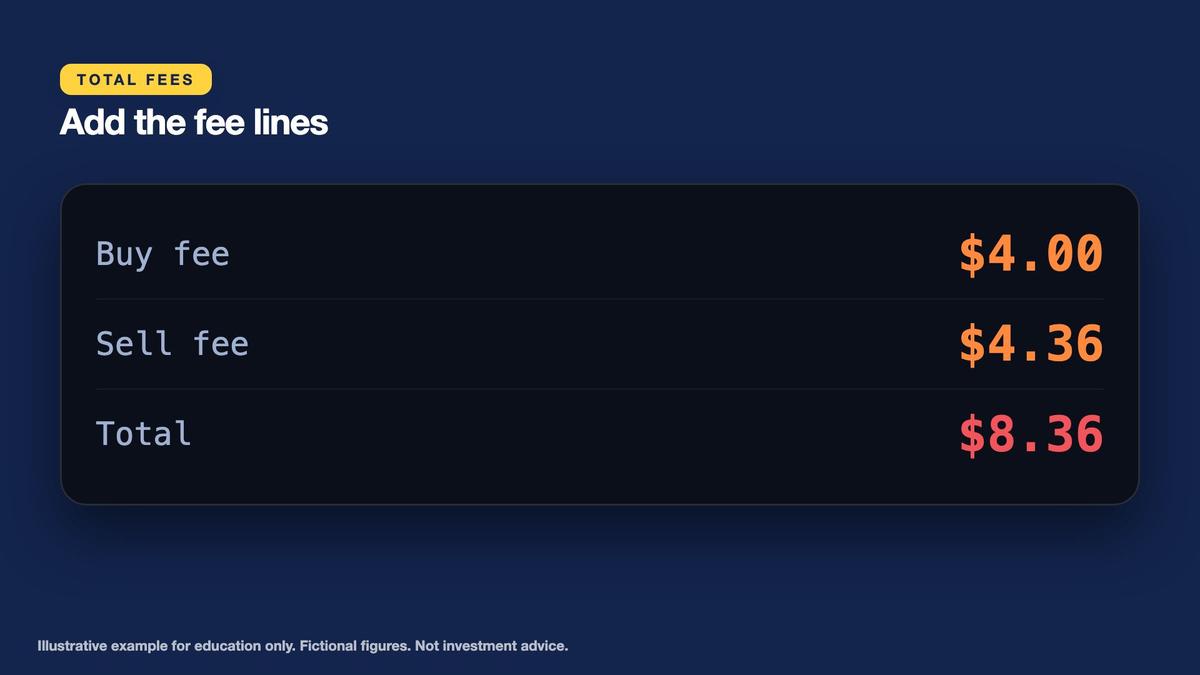
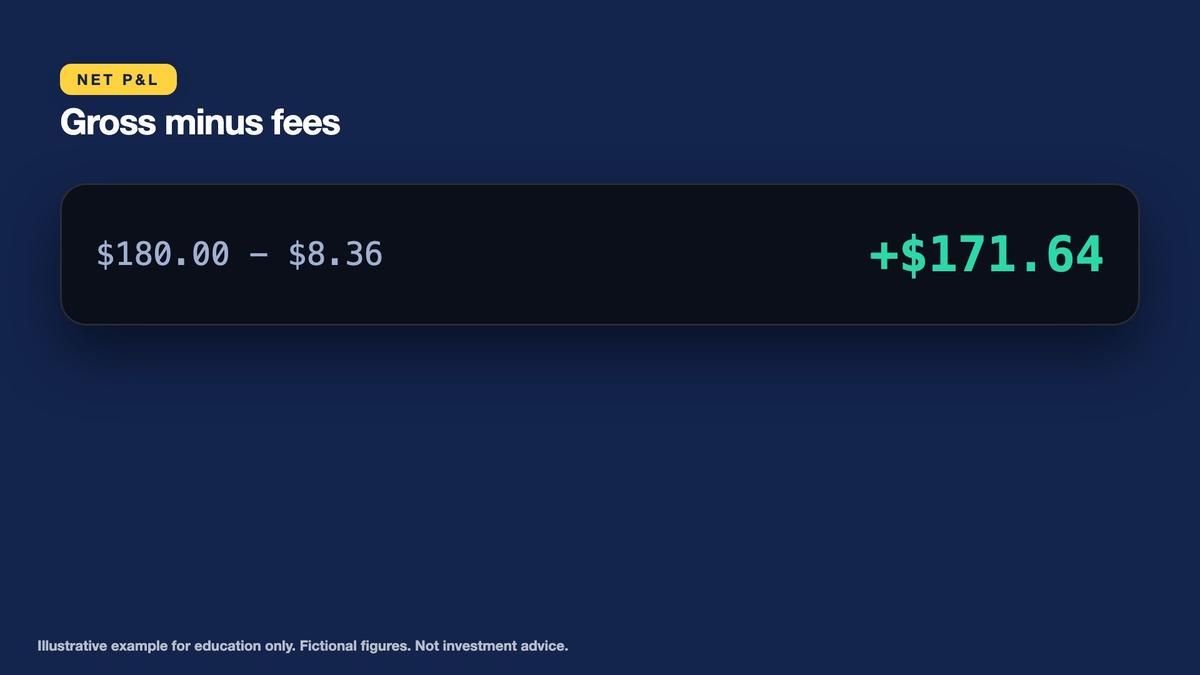
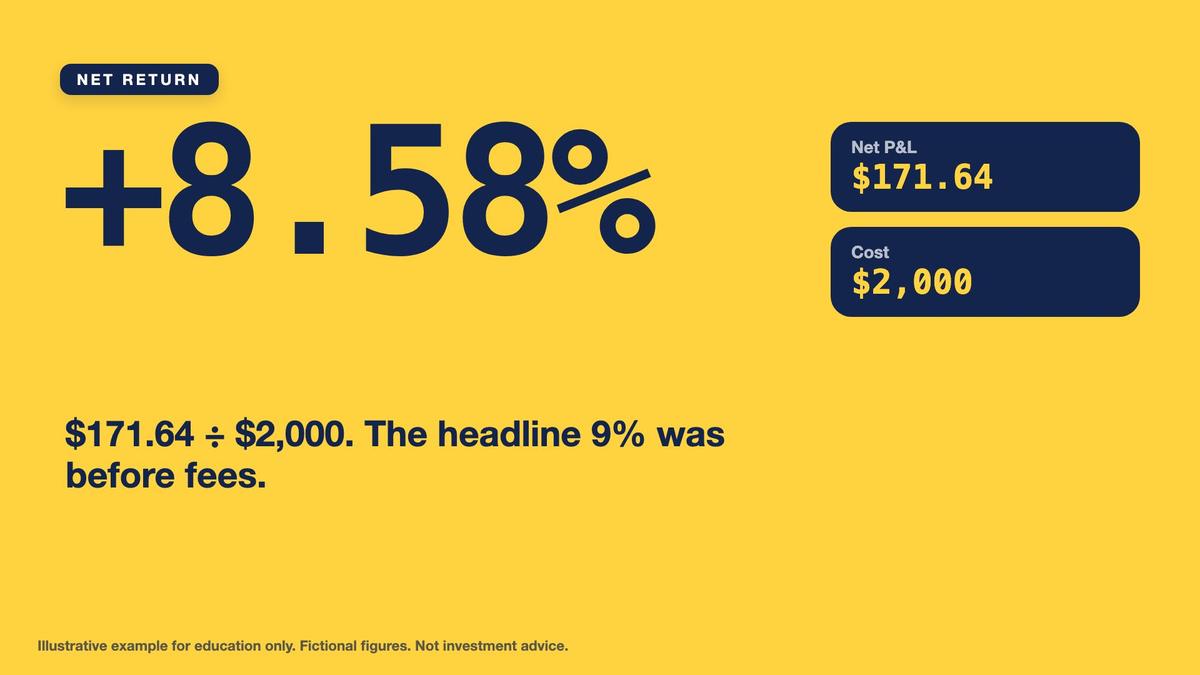
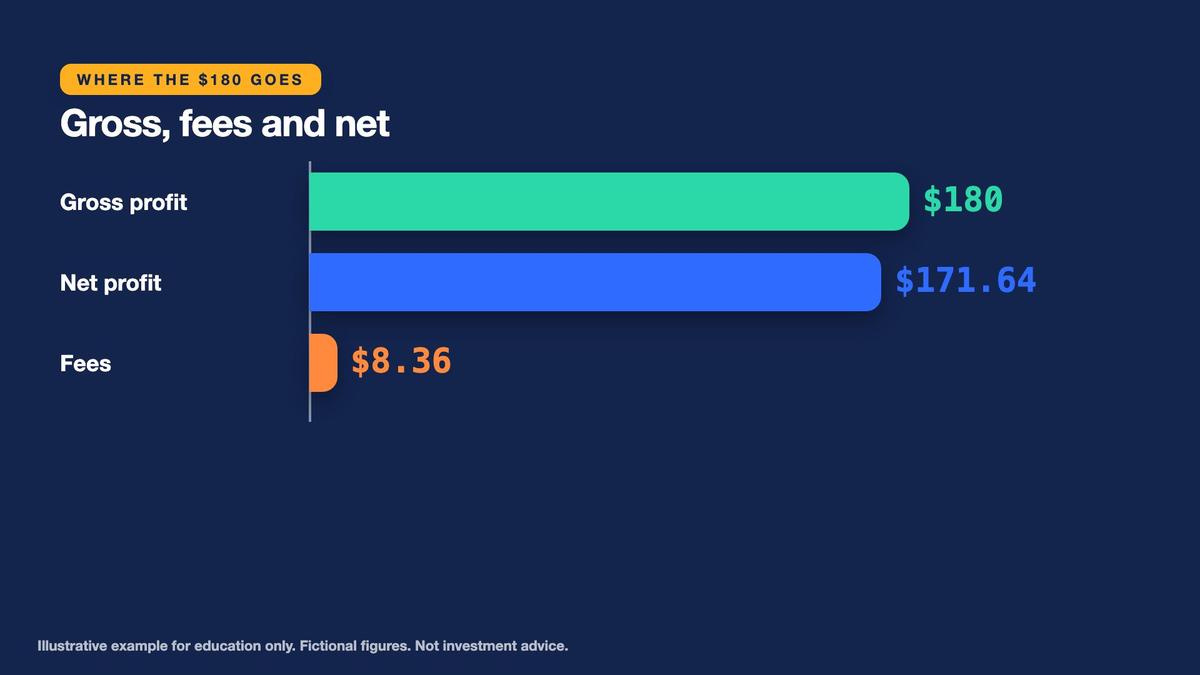
Next add the buy and sell fees: $4.00 plus $4.36 equals $8.36. Net trading profit is $180.00 minus $8.36, giving $171.64. Dividing by the $2,000.00 purchase notional gives 8.582%, displayed as 8.58%. Confirm the result independently through cash flows: $2,175.64 of cash received after selling minus the $2,004.00 initial cash outflow equals $171.64. The matching answers validate the basic journal. The lesson deliberately uses purchase notional, rather than total fee-inclusive capital outlay, as the percentage-return denominator; other reporting conventions must identify their denominator explicitly.
Compare Maker and Taker Fees Without Assuming a Fill
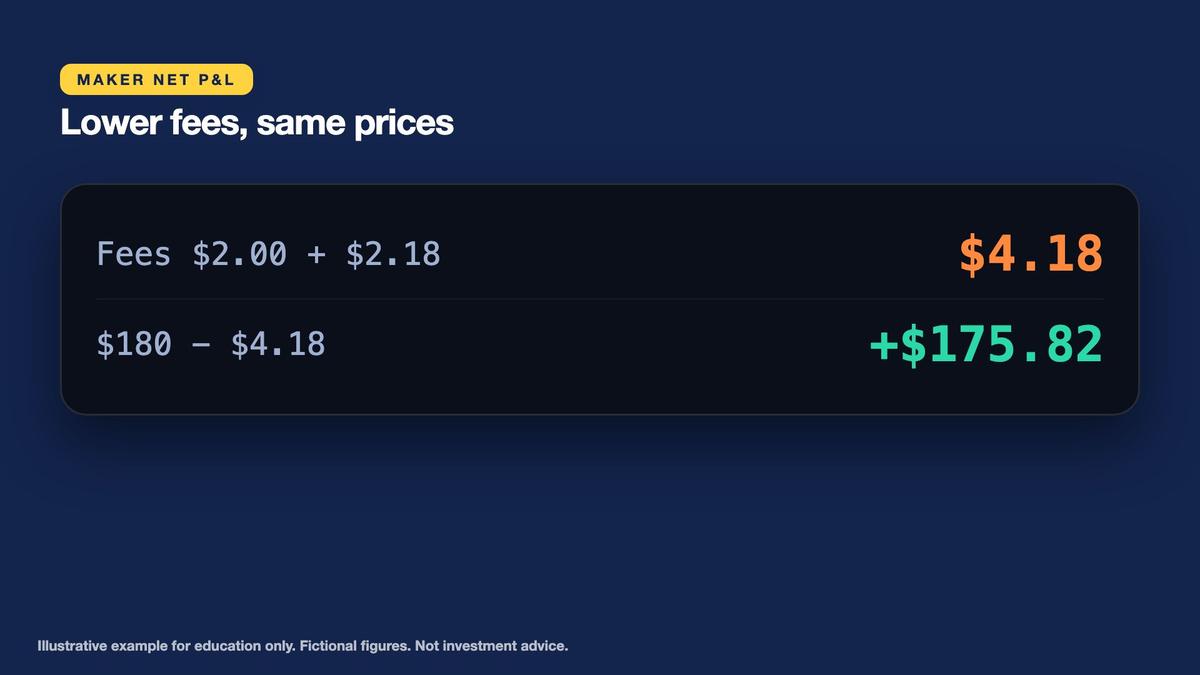
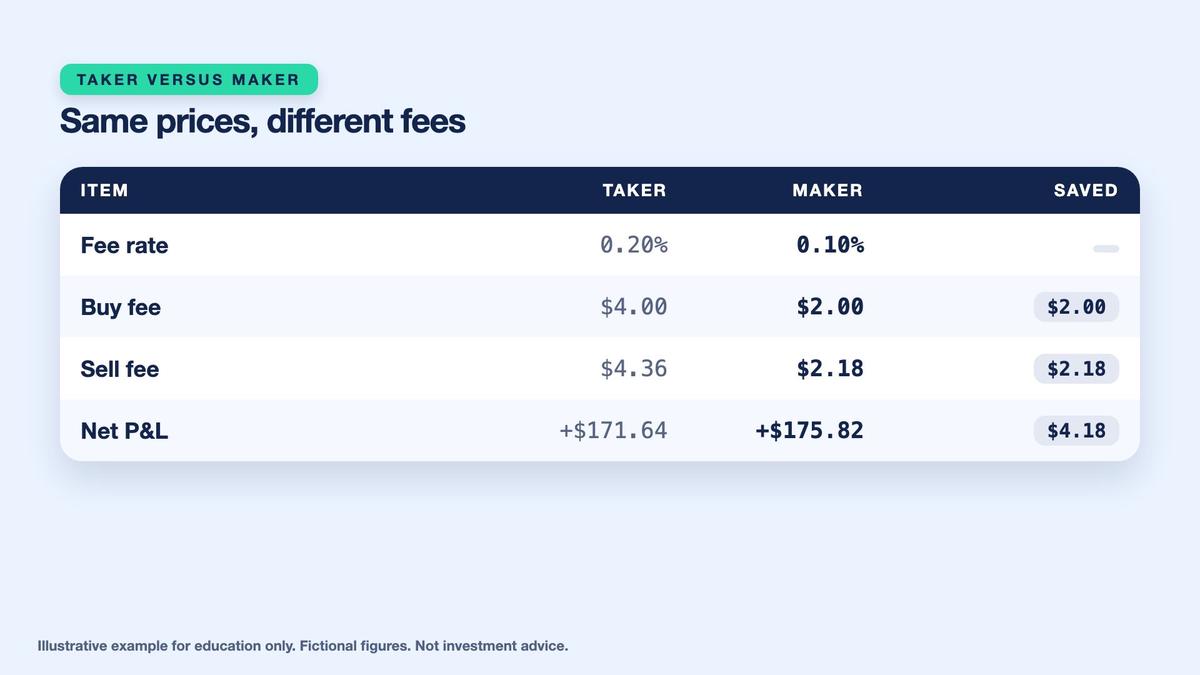
Now create a separate alternative scenario. Suppose a resting buy limit and a resting sell limit both execute completely at the exact same prices as the original market orders: $10.00 for the 200-coin purchase and $10.90 for the 200-coin sale. Assume both qualify for the invented 0.10% maker fee. The purchase fee is $2,000.00 multiplied by 0.001, or $2.00. The sell fee is $2,180.00 multiplied by 0.001, or $2.18. Combined explicit fees equal $4.18, exactly half the $8.36 taker fees.
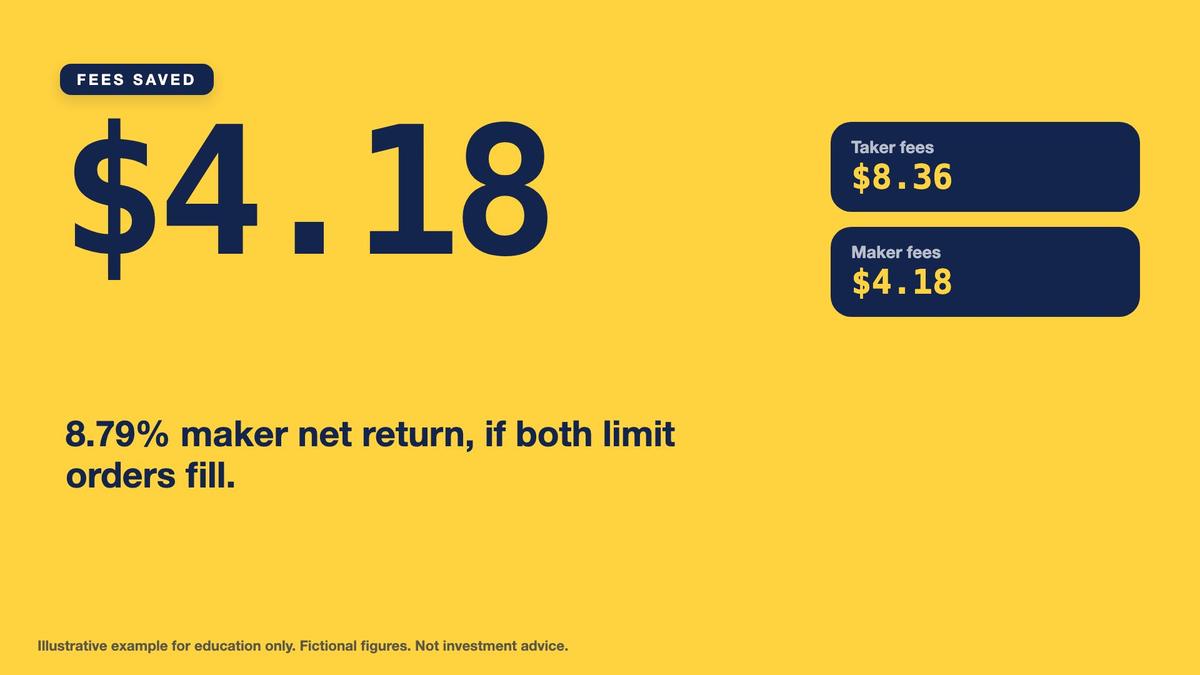
Because execution prices and quantities remain unchanged by assumption, gross profit is still $180.00. Deducting $4.18 produces $175.82 of hypothetical maker net profit. Dividing by the same $2,000.00 purchase notional gives 8.791%, displayed as 8.79%. Fee savings equal $8.36 minus $4.18, or $4.18. This is a valid conditional numerical comparison, but it does not establish that the limit-order strategy would actually execute at the desired prices. A pending order cannot be treated as a completed trade simply because its modeled fee is attractive.
Key points
- Maker fees 0.10%: $2.00 buy and $2.18 sell = $4.18; net $175.82 (8.79%).
- Fees saved: $8.36 - $4.18 = $4.18, only if both limit orders fill.
- A lower fee does not prove a better result: limit orders can go unfilled.
Limit orders may remain unfilled, partially fill, receive unfavorable queue priority, or complete after market conditions have changed. Some limit orders also remove liquidity and incur taker fees instead of maker fees. The earlier order-types lab demonstrated price control versus fill certainty, so that distinction remains important. The appropriate journal comparison records both realized simulated execution results and conditional alternatives. It should never replace the main market-order result with hypothetical maker savings unless the alternative fill assumptions are clearly documented. Lower fee rates do not automatically imply higher realized profit, lower total execution cost or lower market risk.
Separate Spread Friction, Fee Drag and Withdrawal Costs
The difference between an execution price and the quoted midpoint is one way to describe transaction friction. At entry, Sample Coin was purchased at $10.00 when the midpoint was $9.98. The midpoint-referenced purchase difference is $0.02 per coin, or $4.00 across 200 coins. At exit, the coins were sold at $10.90 when the midpoint was $10.92. The midpoint-referenced exit difference is another $0.02 per coin, or $4.00. Combined midpoint-referenced spread cost equals $8.00. This is a comparison of fill prices against quotation references, not a separately billed exchange charge.
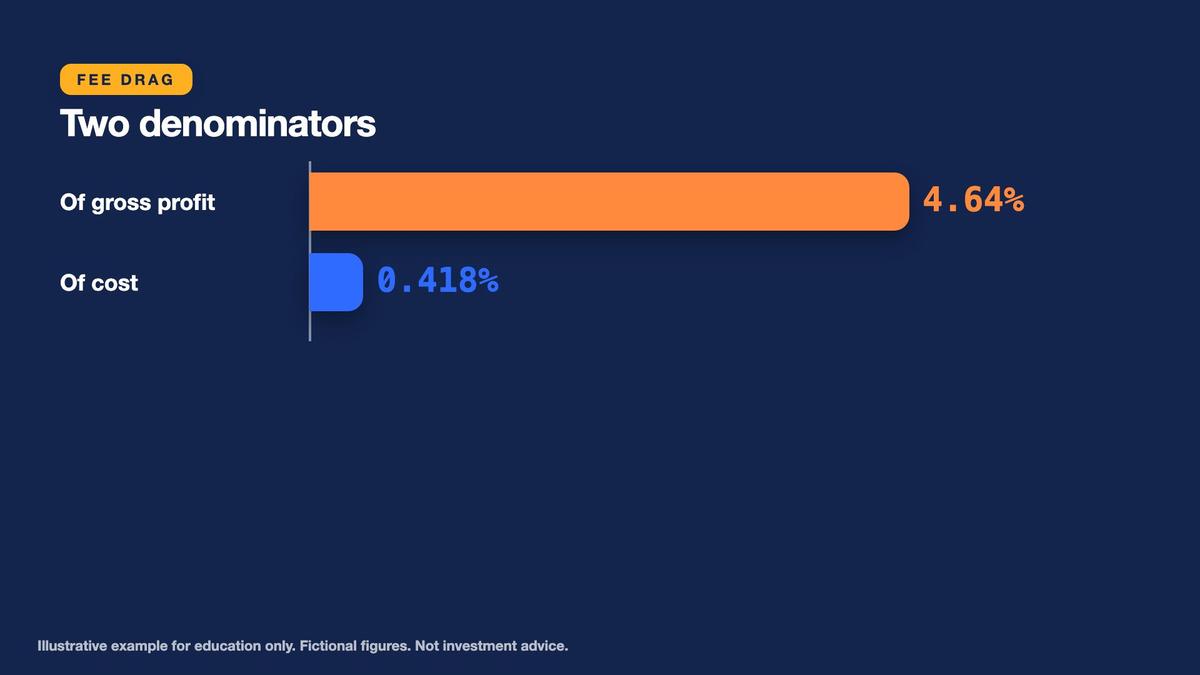
The $8.00 spread cost is already reflected in the gross profit of $180.00 because gross profit uses the actual $10.00 purchase and $10.90 sale prices. Subtracting the same $8.00 again would double-count execution friction. Explicit taker fees, by contrast, are separate line items totaling $8.36 and must be deducted when moving from gross to net profit. Those fees consume $8.36 divided by $180.00, or approximately 4.64% of gross profit. Relative to the $2,000.00 purchase notional, they equal 0.418%. Each percentage answers a different question, so the journal should state the denominator.
Key points
- Spread cost versus midpoint: $4.00 at entry and $4.00 at exit = $8.00, already inside gross P&L.
- Do not subtract the spread cost twice.
- Withdrawal fee 0.5 coin x $10.90 = $5.45; net after it = $166.19, as a separate scenario.
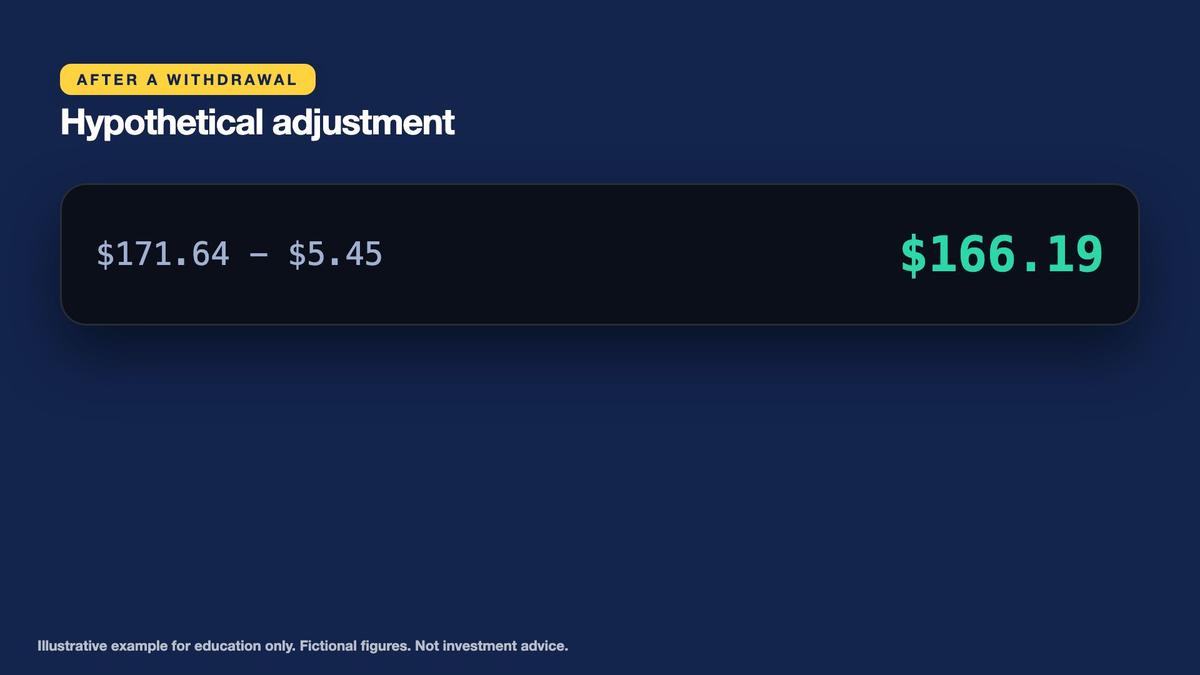
The invented withdrawal fee is a flat 0.5 Sample Coin. Valued at the fictional $10.90 exit reference, its dollar equivalent is $5.45. If this additional cost is charged in a separate hypothetical custody-transfer scenario, adjusted net profit becomes $171.64 minus $5.45, or $166.19. However, the completed main spot trade already sold all 200 coins and therefore has no remaining coins from that purchase to withdraw. The withdrawal calculation must be labeled as an independent fee-equivalent adjustment, requiring another available coin balance or a modified transaction sequence. Real platforms can distinguish withdrawal charges from network fees and can deduct either from balances according to their terms.
Calculate Break-Even and Examine a Losing Exit
Break-even means that net sale proceeds equal the total original cost after explicit trading fees. Our fictional market purchase was $10.00 per coin with a 0.20% buy fee, making the all-in purchase cost $10.00 multiplied by 1.002, or $10.02 per coin. A later market sale at bid price P receives P multiplied by 0.998 after its 0.20% sell fee. Equating the two gives P multiplied by 0.998 equals $10.02. Therefore, the exact mathematical break-even bid is $10.02 divided by 0.998, or approximately $10.0400801603.
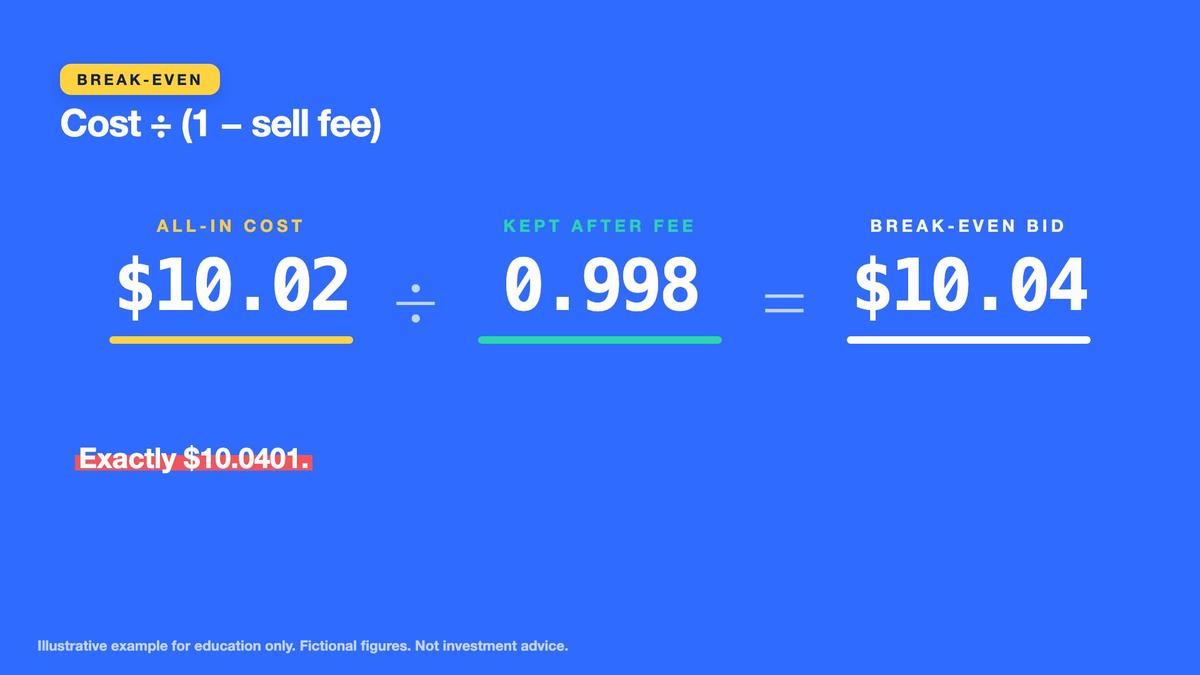
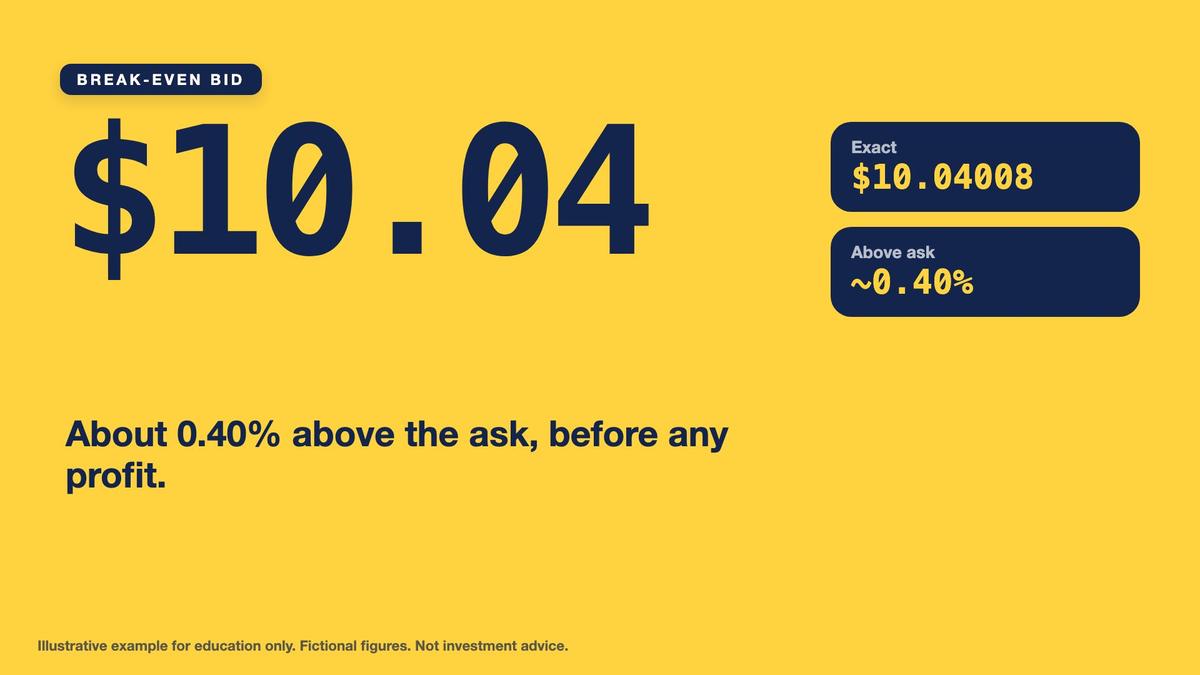
Displayed to two decimal places, that break-even price is about $10.04, approximately 0.40% above the $10.00 purchase price. However, rounding the exact result down to $10.04 does not produce mathematical break-even: the bid remains slightly below the exact required level. If quotations move in one-cent increments, $10.05 is the first permitted price above break-even. That distinction matters when checking tiny profit margins or very large quantities. Keep full precision during calculation, round monetary results only for display, and verify the exchange statement's actual fee-rounding conventions before claiming an exact zero result.
Key points
- All-in buy cost per coin = $10.00 x 1.002 = $10.02.
- Break-even bid = 10.02 / 0.998 = $10.04008, about $10.04 (+0.40% above the ask); $10.05 is the first profitable cent.
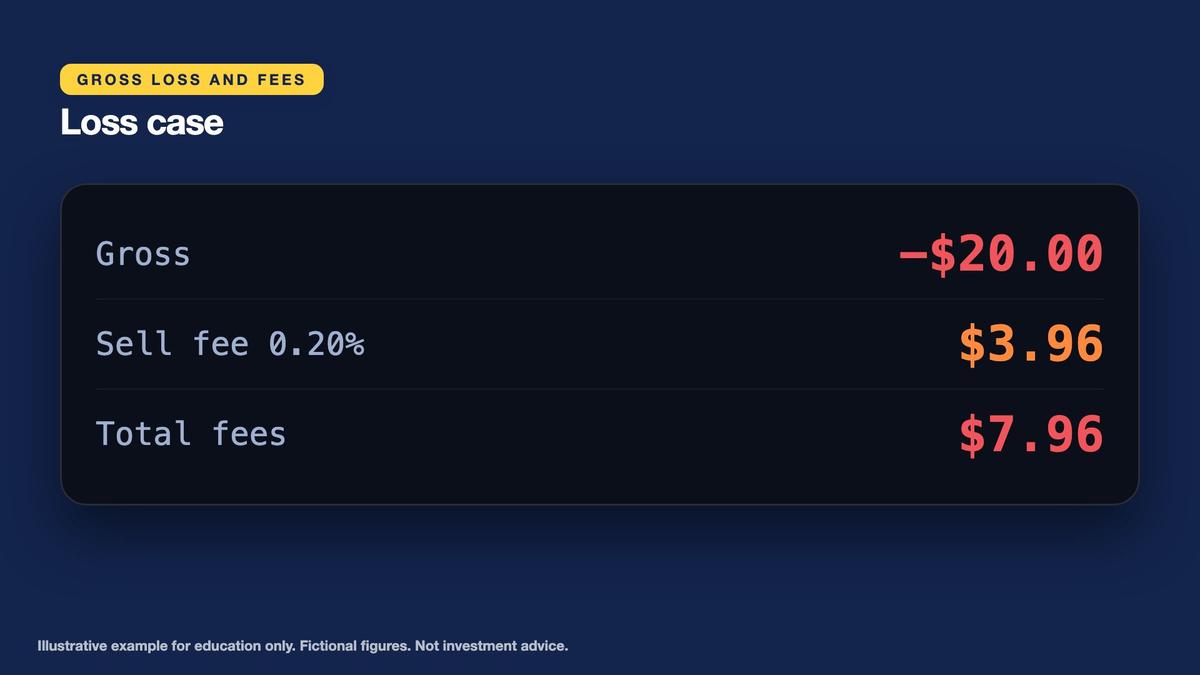
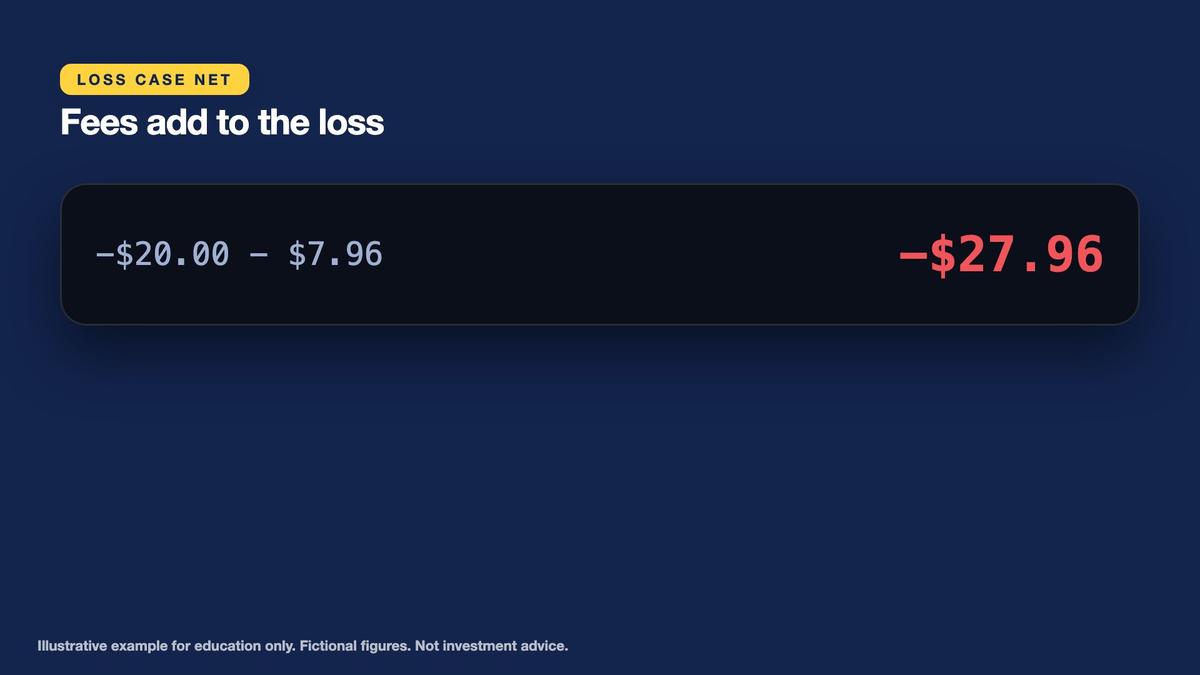
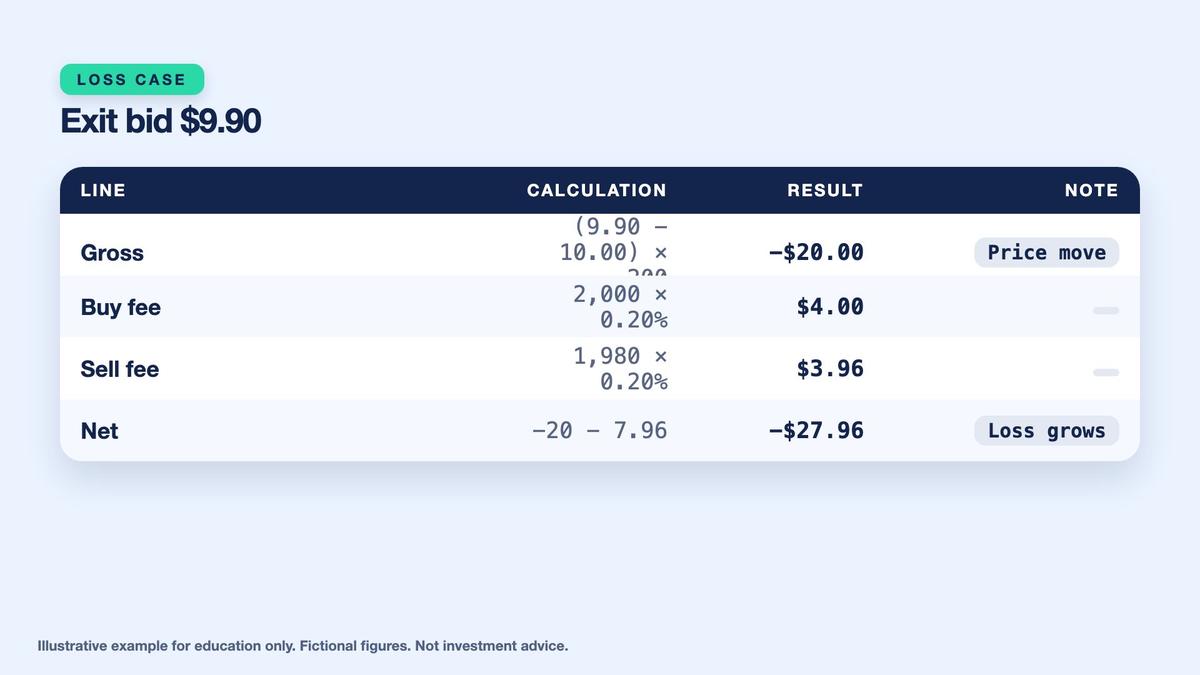
- Loss case, exit bid $9.90: gross -$20.00, fees $7.96, net -$27.96.
Now replace the successful exit with a separate adverse scenario. Assume the exit bid is $9.90, with the same 200-coin quantity and 0.20% taker fee. Sale notional becomes $1,980.00. Gross profit or loss equals ($9.90 minus $10.00) multiplied by 200, producing a $20.00 gross loss. The sell fee equals $1,980.00 multiplied by 0.002, or $3.96. Together with the original $4.00 buy fee, total fees equal $7.96. Net loss is negative $20.00 minus $7.96, or negative $27.96. The example demonstrates that fees worsen losses as well as reduce gains.
Reconcile the Fictional Exchange Statement Line by Line
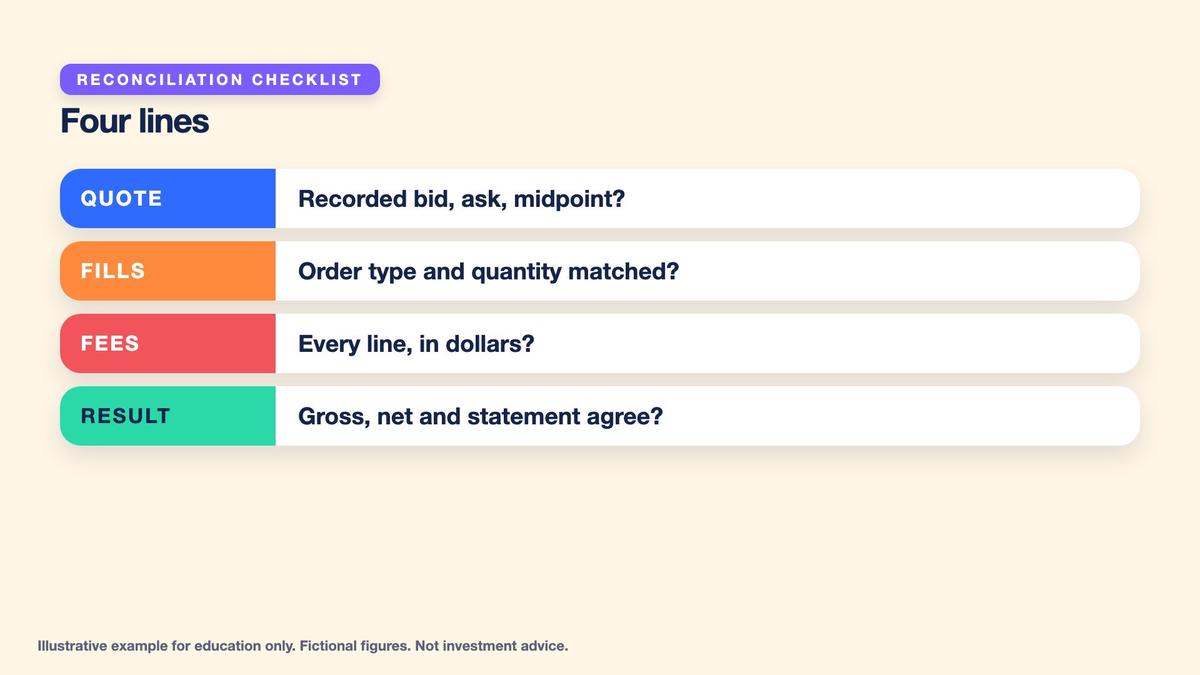
The laboratory is complete only when the simulated statement matches the journal. Start with the entry quotation and record the bid, ask, midpoint and quoted spread percentage. Then record the buy side, market order type, taker classification, requested quantity, executed quantity, average fill price and purchase notional. Enter the $4.00 buy fee as its own line and identify the fee currency. Next record the exit quotation, market sell details, $2,180.00 executed notional and $4.36 sell fee. Confirm that 200 coins entered and subsequently left the simulated position, producing a zero ending coin balance.
Calculate gross P&L as exit proceeds minus entry notional: $2,180.00 minus $2,000.00 equals $180.00. Calculate explicit fees as $4.00 plus $4.36, or $8.36. Net P&L therefore equals $171.64. Reconcile using cash flows as a second method: the initial cash outflow was $2,004.00, while final sale cash was $2,175.64. Their difference also equals $171.64. If either method produces a different result, review the fee base, quantity, execution price, currency, rounding or whether a fee was recorded twice. The agreement between methods is an important accounting sanity check.
Key points
- Reconcile line by line: quote, order type, fills, fees, exit and cash movements.
- Use separate columns for the main trade, maker alternative, withdrawal and loss case.
- Compare the journal with the (fictional) statement.
Use separate columns for the main trade, maker alternative, withdrawal adjustment and losing exit scenario. They represent different assumptions and should not be combined into a single realized account history. Record gross return as 9.00% and net return as 8.58% using the stated $2,000.00 purchase-notional denominator. Add fee drag of 4.64% of gross profit and 0.418% of purchase notional. Preserve exact underlying calculations before rounding to cents or two decimal percentage points. The earlier custody and wallet-safety lessons also remind learners that any separate transfer requires recipient, network, fee and security verification, even when the trade accounting is correct.
Final Checkpoint: Complete the Execution Journal
The final checkpoint begins with the main simulated spot trade. Confirm the entry bid $9.96, ask $10.00, midpoint $9.98 and quoted spread $0.04, approximately 0.40% of midpoint. Verify the buy of 200 Sample Coins at $10.00, purchase notional $2,000.00 and $4.00 taker fee. Record the exit bid $10.90, ask $10.94, midpoint $10.92 and 200-coin market sale producing $2,180.00 gross proceeds and $4.36 in sell fees. Gross profit is $180.00, or 9.00% of purchase notional. Net profit is $171.64, or approximately 8.58% of the same notional.

Hands-On Lab: Reconcile a Fictional Spot Trade From Quote to Net P&L
Use only fictional Sample Coin and a paper or isolated simulated trading ledger. Follow the example in sequence: record the entry quote, capture the 200-coin market buy at $10.00, calculate the 0.20% taker fee, record the exit quote, capture the 200-coin market sell at $10.90, calculate the sell fee, determine gross and net profit, and reconcile the cash movements. Then evaluate separate conditional maker, spread, withdrawal, break-even and losing-exit scenarios without merging them into the main completed trade. The invented fee schedule is 0.20% taker, 0.10% maker, and 0.5 coin flat withdrawal. Assume trading fees are charged separately in cash, all main orders fill completely at their specified prices, and no additional charges exist unless explicitly stated. Preserve full intermediate precision, round displayed monetary values to cents, and record fee currencies and calculation denominators. Do not use any real exchange or actual financial asset.
- Decision 1: Fictional Sample Coin opens with bid $9.96 and ask $10.00. The simulated learner purchases 200 coins through a market taker order filled entirely at the ask, with a 0.20% fee charged separately in cash. — Record the quote, calculate midpoint and spread, and determine purchase notional, buy fee and total cash outflow.
- Decision 2: The fictional exit quote is bid $10.90 and ask $10.94. A market taker order sells all 200 coins at $10.90 with a 0.20% fee. — Calculate exit midpoint, sale proceeds, fee, gross P&L, net P&L and net return relative to the original purchase notional.
- Decision 3: An alternative pair of resting limit orders is assumed to fill completely at the same $10.00 purchase and $10.90 sale prices, qualifying for the invented 0.10% maker fee on both sides. — Calculate maker fees and net P&L, compare with taker results, and explain why the lower maker cost is conditional.
- Decision 4: The main trade has $8.00 in combined midpoint-referenced spread cost already reflected in execution prices. A separate withdrawal-cost assumption values a flat 0.5 coin fee at $10.90 per coin. — Explain the correct treatment of spread cost, calculate the withdrawal value and withdrawal-adjusted P&L, and identify the balance inconsistency if treated as part of the completed trade.
- Decision 5: The buy price is $10.00 with 0.20% taker fee, and the alternative sell exit is $9.90 with a matching 0.20% taker fee on 200 coins. The learner must also calculate break-even. — Calculate exact break-even bid, the losing exit's gross and net P&L, and identify statement fields needed for complete reconciliation.
Answer key
Then verify the alternatives without mixing account histories. Under the conditional maker scenario, fees total $4.18 and net profit reaches $175.82, saving $4.18 in fees only if the assumed fills occur. Combined midpoint-referenced spread cost is $8.00 and already appears in executed prices. The separate 0.5-coin withdrawal fee is valued at $5.45, producing a fee-equivalent adjusted profit of $166.19 without implying that sold coins remain available. Exact break-even bid is approximately $10.0400801603, and the adverse $9.90 exit produces a $27.96 net loss after fees.
Key points
- Verify $180.00, $8.36, $171.64, 9.00%, 8.58% and 4.64%.
- Verify maker $175.82, spread $8.00, break-even $10.04 and the loss case -$27.96.
- Record timestamps, order types, fee rates and amounts, and keep both returns.
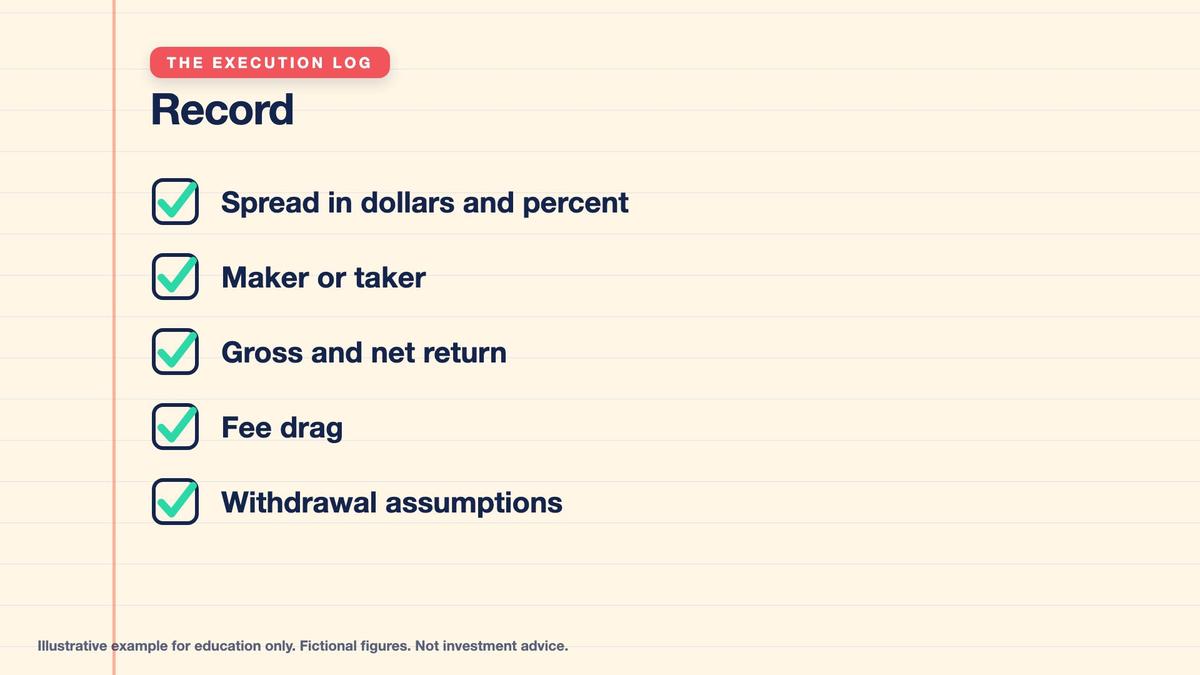
Finish by recording the quotation timestamps, order classifications, executed quantities, fee rates, fee amounts, gross and net P&L, fee drag, conditional assumptions, and final reconciliation status. The earlier order-types laboratory explains why a limit order may not fill, while the custody and wallet-safety lessons explain why withdrawal costs and destination checks require separate attention. The outcome is a consistent execution journal demonstrating the difference between gross and net performance on one fictional spot trade. No live exchange, digital asset purchase, financial recommendation or price prediction is involved.
Worked example at a glance
Key terms
- Gross P&L: profit or loss from prices alone, before fees.
- Net P&L: gross P&L after all fees.
- Notional: quantity times price of an order.
- Taker fee: the fee for removing liquidity, such as a market order.
- Maker fee: the fee for adding liquidity, such as a filled resting limit order.
- Spread cost: the gap between a fill and the midpoint; already inside the fills.
- Fee drag: fees as a share of gross profit or of cost.
- Break-even price: the exit price where net P&L is zero.
- Withdrawal fee: a flat charge for moving coins off the platform.
- Reconciliation: matching your journal to the statement line by line.
- Midpoint: the average of the bid and the ask.
- Execution log: your record of quotes, orders, fills, fees and results.
Multi Asset Trading Lab provides educational information only and does not constitute personalized investment, trading, financial, accounting, tax, legal, cybersecurity or custody advice. Sample Coin, the simulated spot market, every bid and ask quotation, every execution price, fee schedule, transaction, balance and calculated outcome in this lab are entirely fictional. No real exchange, cryptocurrency, ticker, wallet product, blockchain address, asset price or market data is used or recommended. All activities involve simulated money, classroom worksheets and hypothetical trades only; no actual financial transaction, exchange account, wallet connection or real-money order is required or encouraged. The principal fictional trade buys 200 Sample Coins through a market taker order at $10.00 per coin for $2,000.00 executed notional and later sells all 200 coins through a market taker order at $10.90 for $2,180.00 in gross proceeds. The invented taker fee is 0.20% of executed notional on each side, generating a $4.00 purchase fee and a $4.36 sale fee, totaling $8.36. Gross trading profit is exactly $180.00, equal to 9.00% of the original $2,000.00 purchase notional. Net trading profit after explicit trading fees is exactly $171.64, equal to 8.582% of the original purchase notional, displayed as 8.58%. All percentage returns in the worked example use purchase notional before fees as the denominator unless explicitly stated otherwise. Total cash paid for the purchase is $2,004.00, and total cash received after the sale fee is $2,175.64, resulting in the same $171.64 net profit. The accounting assumes trading fees are paid separately in cash rather than deducted in coins. Alternative fee currencies, rebate arrangements, rounding rules or settlement methods could change the applicable quantities or results. The entry quotation of $9.96 bid and $10.00 ask has a midpoint of $9.98 and quoted spread of $0.04, approximately 0.40% of midpoint. The exit quotation of $10.90 bid and $10.94 ask has a midpoint of $10.92 and quoted spread of $0.04, approximately 0.37% of midpoint. The midpoint-referenced execution cost is $4.00 at entry and $4.00 at exit, or $8.00 combined. These midpoint differences are already reflected in the $180.00 gross P&L, because gross P&L uses the actual ask purchase price and bid sale price. The $8.00 must not be deducted again from gross or net profit. Explicit trading fees of $8.36 are separate cash charges that must be deducted. Their value is approximately 4.64% of gross profit and exactly 0.418% of the original $2,000 purchase notional. These figures measure different denominators and should not be mixed or added as if they were independent charges. The conditional maker scenario uses an invented 0.10% fee on both buy and sell executed notionals and assumes that two resting limit orders fully execute at the same $10.00 and $10.90 prices as the principal market orders. Under those specific assumptions, maker purchase fees equal $2.00, maker sale fees equal $2.18, total fees equal $4.18, and net trading profit equals $175.82, approximately 8.79% of purchase notional. The apparent fee saving of $4.18 is conditional on the stipulated fills and qualifying maker classification. Real limit orders may remain unfilled, partially execute, receive taker rather than maker classification, suffer delays or execute under different market conditions. Lower maker fees do not guarantee better overall performance or reduced market risk. The invented flat withdrawal fee is 0.5 Sample Coin, valued at $5.45 using the fictional $10.90 exit reference. Subtracting this additional fee-equivalent amount from $171.64 gives a separate hypothetical adjusted profit of $166.19. This adjustment must not be represented as an actual withdrawal from the completed principal trade, because that trade sells all 200 purchased coins and leaves no Sample Coins from that position available for withdrawal. A genuine coin-denominated withdrawal would require other available coins or a different transaction sequence, and any accounting treatment would depend on how the balance, fee currency, asset ownership and transfer were recorded. Actual withdrawal fees, blockchain network fees, minimum withdrawals, asset representations and supported networks may vary and may not be interchangeable. Custody transfers can introduce risks that are independent of trading profit, including incorrect destinations, unsupported networks, lost access, malicious approvals, software compromise, theft and third-party failure. The earlier wallet-safety lessons therefore remain relevant, but this laboratory does not involve real wallet addresses or transactions. Break-even arithmetic assumes an all-in purchase cost of $10.02 per coin from a $10.00 price plus a 0.20% purchase fee, and fee-adjusted sale proceeds of 0.998 times the sale bid. The exact mathematical break-even bid is $10.02 divided by 0.998, approximately $10.0400801603, which displays as $10.04 when rounded to cents. At exactly $10.04, the fee-adjusted net result would still be slightly negative, so if the minimum quotation increment is $0.01, $10.05 is the first permissible bid above exact break-even under the example's assumptions. Actual execution prices, price increments, fee rounding and order quantities can change break-even outcomes. The adverse alternative assumes a $9.90 exit bid for all 200 coins, yielding $1,980.00 gross sale proceeds, a $20.00 gross loss, a $3.96 sale fee, $7.96 in combined trading fees and a $27.96 net loss. This scenario demonstrates that explicit fees worsen a loss, but it does not describe the maximum loss that could occur in a real asset. Every scenario is a separate classroom outcome and should not be combined into one realized account history. Real exchange quotations can change before or during order submission. Market orders may fill at multiple price levels, incur slippage, or experience incomplete execution, while limit orders may remain unfilled or have uncertain timing and fee classification. A displayed bid or ask does not guarantee unlimited liquidity or a particular actual fill. Financial calculations and reconciliation should preserve sufficient intermediate precision, explicitly record the fee basis and fee currency, and round only according to the stated reporting convention. Real platforms may include commissions, taxes, rebates, funding or financing charges where applicable, conversion spreads, blockchain network costs, custody costs or other charges omitted from this simplified spot example. Gross and net returns depend on the selected denominator, exact executed amounts and recognized costs. A positive result in this fictional case is not evidence of a repeatable profit opportunity, and historical, simulated or hypothetical returns do not predict future performance. The outcome of this lab is the ability to log and reconcile one fictional spot trade from displayed quotation through executed prices, explicit fees, gross P&L, net P&L and cash movements. Nothing in the lesson constitutes a recommendation to buy, sell, hold, transfer, custody or trade any actual cryptocurrency or other financial instrument. No price forecast, strategy performance promise, guaranteed execution outcome or real-money participation is intended.
Lesson Checkpoint
Review what you learned and get feedback on your work.