



Capstone Goal
A capstone creative workflow turns an open-ended idea into a reviewed deliverable that can be explained, improved, and repeated. The objective is not to produce one attractive image by chance. It is to demonstrate a reliable sequence: interpret the brief, establish a visual direction, generate or assemble options, evaluate them against criteria, revise deliberately, and prepare a final asset for its intended context.
Start by translating the brief into decisions. Define who needs to notice the work, what they should understand, what action they should take, where the asset will appear, and what limitations apply. A poster for a neighborhood film night may need to communicate the event name, date, venue, and registration action within two seconds of viewing. A social image may have more visual impact, but it still needs readable information when viewed on a small phone screen. These constraints should guide every later choice.
A strong workflow separates exploration from approval. Early outputs are evidence about possible directions, not finished answers. Record the direction you selected, the alternatives you rejected, and the reason for each decision. This record makes the creative process reviewable and prevents the final result from appearing disconnected from the original goal.
From Brief to Visual Direction
Convert the brief into a compact visual direction before requesting or producing detailed imagery. Identify the dominant subject, the intended mood, the information hierarchy, the composition, the color relationships, and the expected viewing distance. For example, a public science workshop might use a large close-up of a simple experiment, a dark neutral background, one bright accent color, and a clear vertical hierarchy from event title to practical details. The concept is stronger when every choice supports the audience and message.
Use a small set of visual principles to control the first exploration. Contrast determines what is noticed first. Scale establishes importance. Alignment creates order. Repetition creates consistency. Negative space protects readability and prevents the main subject from competing with supporting information. Color should distinguish roles, such as primary information, secondary information, background, and action, rather than adding unrelated variety.
When using generative AI, describe the outcome in terms of subject, context, composition, lighting, palette, visual references, and exclusions. The goal is not to write the longest possible instruction. The goal is to make the design intent observable. If the layout needs open space on the left for event details, that requirement must be explicit and then verified in the output. AI-generated composition often places important subjects or decorative details where they interfere with typography, so the generated image should be treated as a source element that may require cropping, masking, retouching, or replacement.

Build and Compare Concepts
Generate several distinct directions instead of making minor variations of one idea. One direction might emphasize a bold typographic composition, another might use a documentary-style image, and a third might use an abstract visual metaphor. Each direction should be recognizable as a different response to the brief. Variation is useful only when it creates a meaningful decision, such as choosing between a subject-led composition and an information-led composition.
Compare concepts using the same criteria. First check message clarity: can a viewer identify the subject, purpose, and next action without additional explanation? Next check hierarchy: is there one clear entry point, and does the eye move naturally toward essential details? Then check audience fit: does the tone, imagery, and level of complexity suit the intended viewers? Evaluate composition for balance, alignment, spacing, and visual tension. Finally, check practical performance at the real output size, including legibility, crop safety, contrast, and consistency across related formats.
A useful comparison does not ask which concept feels nicest. It asks which concept solves the communication problem most effectively, and what evidence supports that judgment. A visually dramatic image may fail because the event information disappears into the background. A quieter layout may perform better because its title, date, and action are immediately understood. Save both the selected direction and the strongest rejected direction so the rationale remains visible during review.
Revision Loops and Before After Analysis
The first revision loop should address structural problems. Inspect the design at its intended viewing size and identify the three most damaging issues. These might include an unclear focal point, insufficient space for text, weak contrast, or a title that competes with decorative imagery. Change the composition, hierarchy, or spacing before polishing minor details. A revision is meaningful when the viewer can perceive an improvement without being told what changed.
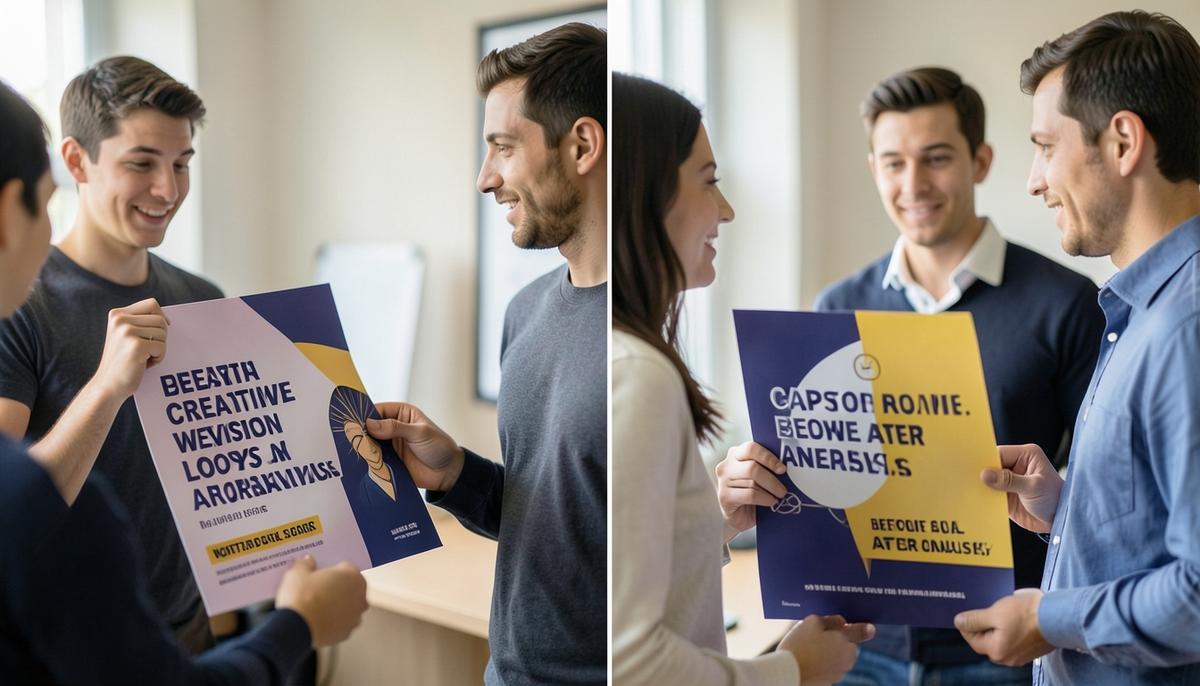
The second revision loop should address communication and production quality. Test whether the wording is concise, whether the image supports the claim, whether the palette remains readable, and whether the asset behaves correctly in its delivery format. Compare the before and after versions side by side. Describe the problem in observable terms, such as the date being lower contrast than the background or the main subject occupying too little of the frame. Then describe the design response, such as increasing tonal separation, reducing competing details, or reserving a larger text zone.
Feedback should be specific, prioritized, and connected to the brief. The comment “make it stronger” is not actionable until it becomes a defined issue involving emphasis, clarity, mood, or audience response. Separate preference from performance. A reviewer may personally prefer one color, but the more important question is whether the color creates the intended hierarchy and remains accessible. Keep a revision log that records the issue, the change, the reason, and the result.
Responsible AI Review
Responsible practice is part of visual quality, not an administrative step added at the end. Check whether generated imagery resembles a living artist, a protected character, a recognizable brand, or a specific source image in a way that could create legal or ethical concerns. Avoid presenting generated people, products, locations, or events as documentary evidence when they are fictional or materially altered. Keep a record of the tools and source materials used according to the project requirements and the tool terms that apply.
Review representation as carefully as composition. Look for stereotypes, inaccurate cultural details, tokenistic inclusion, unrealistic bodies, or roles assigned to people in predictable ways. If the brief represents a real community, consult relevant references and, where appropriate, seek feedback from people connected to that community. Do not use private personal information, confidential images, or identifiable material without permission. AI output can also contain invented text, distorted objects, or confident visual errors, so inspect every prominent detail rather than assuming plausibility means accuracy.
Human judgment remains responsible for the final claim and the final selection. AI can accelerate exploration, but it cannot decide whether an image is respectful, truthful, suitable for the audience, or consistent with the brief. Reject an output when its convenience creates a larger risk than the time saved. A responsible workflow may use AI for ideation, background exploration, or controlled variations while relying on human review for meaning, representation, factual content, and approval.
Final Delivery and Repeatable Workflow
Prepare the final deliverable for its actual use rather than for a presentation screen alone. Confirm the dimensions, orientation, resolution, safe areas, color mode, file format, and naming convention required by the destination. Inspect the smallest important text, the edges of the crop, and the result on a realistic device or printed proof when relevant. Export only the approved version and retain an editable working file plus a concise review record.
The final review should answer six questions. Is the primary message understood quickly? Is the hierarchy intentional? Does the composition guide attention without obstruction? Do color and typography support readability and accessibility? Does the asset represent the subject accurately and responsibly? Can another designer reproduce the main decisions from the brief, visual direction, evaluation criteria, and revision log?
A repeatable workflow ends with reflection. Record which prompt or production decision produced useful evidence, which assumptions failed, and which checks caught problems early. The purpose is not to standardize every creative decision. It is to standardize the moments that protect quality: defining the problem, comparing alternatives, testing the real output, incorporating feedback, and reviewing responsible use. A successful capstone is therefore both a finished visual asset and a defensible method for making the next one.
Summary
The capstone process begins with a brief that defines audience, message, context, and constraints. It then develops multiple visual directions, evaluates them with observable criteria, and uses revision loops to improve structure, clarity, and production readiness. Visual decisions should be explained through hierarchy, composition, color, contrast, typography, spacing, and audience behavior rather than personal preference alone.
Responsible AI practice requires inspection of generated content, careful handling of likenesses and source materials, attention to representation, protection of private information, and human responsibility for the final message. The final deliverable should be accompanied by enough documentation to show what changed, why it changed, and how the workflow can be repeated. The standard is not simply a polished image; it is a clear, tested, ethical, and reviewable creative outcome.
Lesson Checkpoint
Review what you learned and get feedback on your work.