



Why You Need a Trading Plan Before You Click Buy
Most beginners enter crypto trades based on a tip from a friend, a coin that pumped overnight, or pure gut feeling. This is gambling, not trading. A trading plan is a written set of rules you follow BEFORE you enter any position. It removes emotion from the decision, which is the single biggest reason retail traders lose money.
Your plan does not need to be complex. It needs to be specific enough that on a stressful day, when a coin is pumping and everyone is shouting BUY, you can look at your plan and immediately know whether this trade fits your rules or not. If it does not fit, you sit out. No trade is almost always better than a bad trade.

The Four Sections Every Trading Plan Must Have
A simple but effective trading plan for spot or futures trading has four mandatory sections.
Section 1 is your entry criteria. This is the exact condition that must be true before you open a trade. Examples include: price breaks above a resistance level with strong volume, or RSI drops below 30 and starts curling up. You must be able to write this in one or two sentences without using words like "maybe" or "probably."
Section 2 is your exit criteria. Every trade needs two exits: a take-profit target and a stop-loss level. Decide these BEFORE you enter. A common rule is risking no more than 1 to 2 percent of your total trading capital on a single trade.
Section 3 is your position size. Based on your stop-loss distance and your risk percentage, calculate how much you buy or how many contracts you open.
Calculating Position Size With a Simple Formula
Here is the formula most beginners use and it works well enough to start:
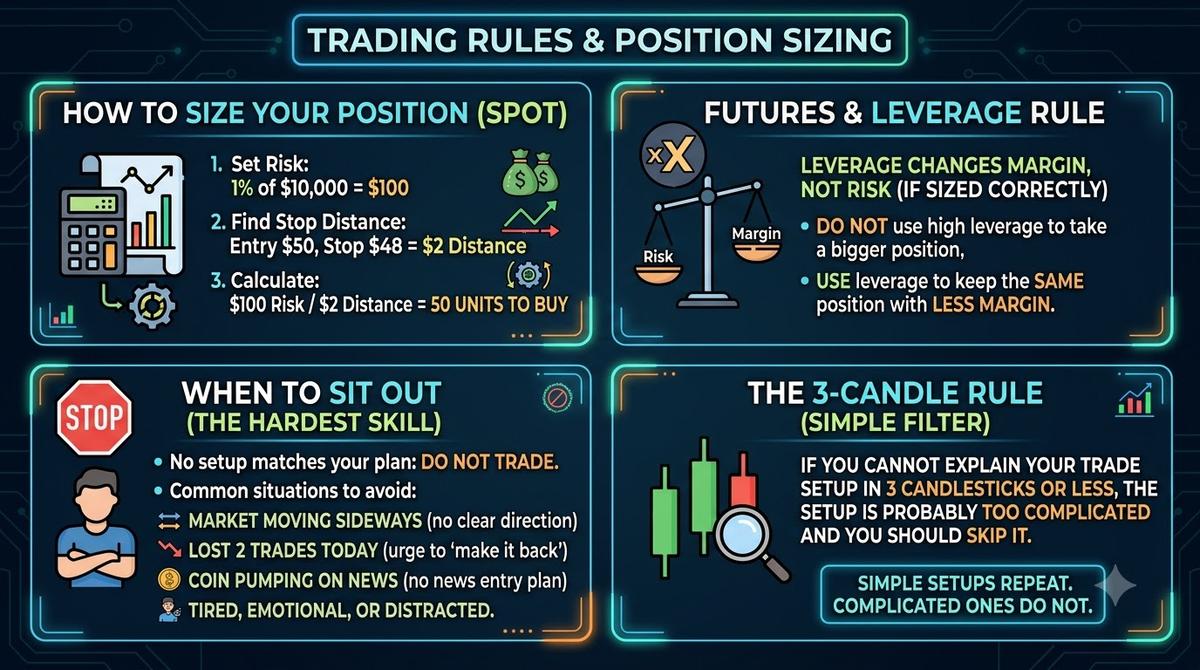
If your account is 10,000 USDT and you risk 1 percent, you can lose 100 USDT on this trade. If your entry is at 50 and stop-loss is at 48, stop distance is 2. Position size becomes 100 divided by 2 equals 50 units of the asset. This number is what you actually buy.
For futures, the same idea applies but you also need to check leverage. Leverage does not change your risk if you size correctly, it only changes the margin required. Do not use high leverage to take a bigger position, use it to keep the same position with less margin.
Knowing When NOT to Trade
This is the hardest skill and the most valuable one. Some days there are simply no setups that match your plan. On those days, you do not trade. Period.
Common situations where you should sit out: the market is moving sideways with no clear direction, you already lost two trades today and feel the urge to "make it back," a coin is pumping because of news but you do not have an entry plan for news events, or you are tired, emotional, or distracted.
A useful filter is the 3-candle rule. If you cannot explain your trade setup in three candlesticks or less, the setup is probably too complicated and you should skip it. Simple setups repeat. Complicated ones do not.
Tổng kết
A trading plan is not about predicting the market. It is about defining your behavior so that randomness in price does not destroy your capital. Write down your entry rules, exit rules, position size formula, and a short list of conditions that mean "do not trade today." Follow it for at least 30 trades before you judge whether it works. During those 30 trades, your only job is discipline, not profit. Survival first, returns later.
Lesson Checkpoint
Review what you learned and get feedback on your work.