



Introduction
Local on-page SEO connects a business website to the places, services, and customer problems it serves. Google Business Profile optimization can improve visibility in Maps, but the website helps Google and potential customers understand the business in greater depth. A well-optimized site should make three facts clear: what the business offers, where it operates, and why a local customer should trust it.
This lesson focuses on improving core website pages and creating useful location-specific content. The objective is not to repeat a city name throughout every paragraph. The objective is to build a clear, useful information structure supported by accurate local signals, relevant internal links, and evidence that the business genuinely serves the area.
Consider a plumbing company serving Austin and nearby suburbs. A weak approach creates ten nearly identical pages that replace only the city name. A stronger approach improves the main service pages, creates genuinely useful pages for priority locations, and explains the differences in customer needs, service availability, travel areas, or local regulations where those differences are real.
Local On-Page Signals
Start with the core pages that influence both discovery and conversion. The homepage should state the main service category, primary service area, business name, and a clear next step. Service pages should describe one meaningful service in detail, explain who needs it, show the service area when relevant, and provide a direct way to request a quote, book an appointment, or call the business. Contact and location information should be easy to find without forcing users to search through the site.
Use local signals where they help users make decisions. These may include a complete business address when the business has a public location, a service area explanation for businesses that travel to customers, local phone details, opening hours, local testimonials, nearby landmarks, project examples, and service limitations. Do not claim a physical presence in a city simply because the business accepts customers there. Accuracy is more valuable than broad but misleading geographic coverage.
Page titles and main headings should describe the actual page rather than repeat a keyword formula. For example, a page titled Emergency Plumber in Austin should explain emergency plumbing services in Austin, while a page titled Commercial Drain Cleaning should focus on that service and mention the relevant service area naturally. Supporting text should answer practical questions such as response time, property types served, pricing factors, appointment process, and whether the company handles the customer’s specific situation.
Location Page Framework
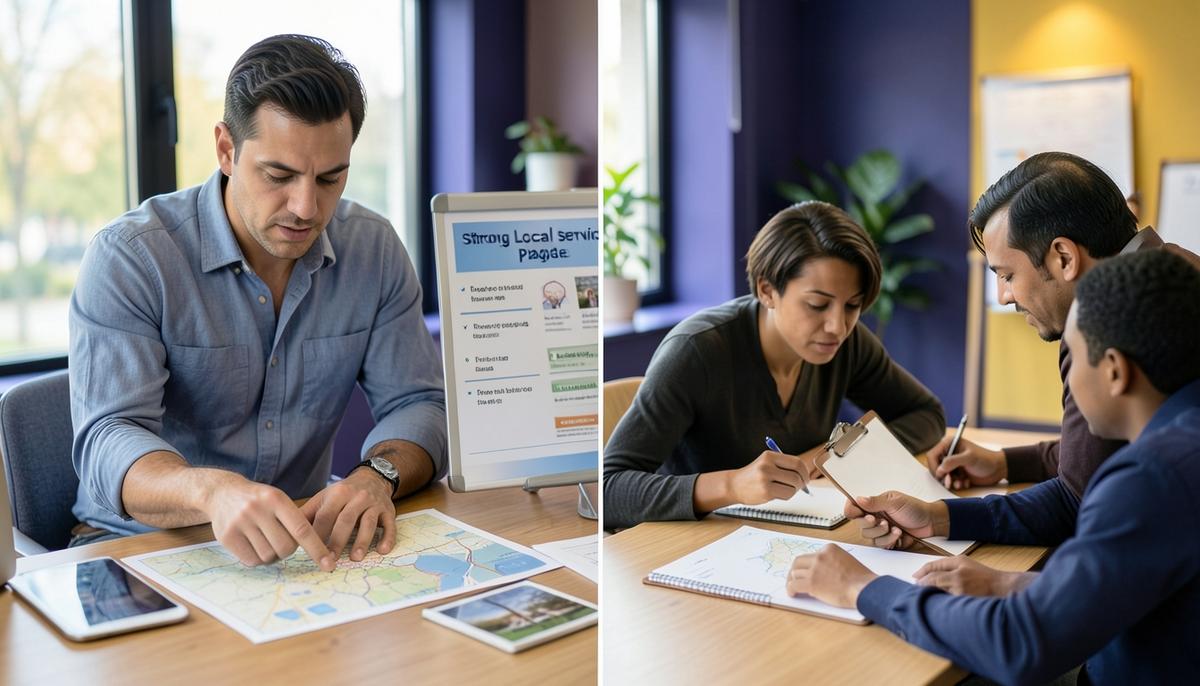
Create a location page only when the business can provide useful information for that location. A strong page identifies the services available there, explains how the business serves customers in that area, and includes evidence such as local projects, customer experiences, staff familiarity, or practical travel and scheduling information. The page should stand on its own as a helpful resource, not exist only as a doorway to the contact page.
A useful structure begins with a clear heading naming the service and location, followed by a short explanation of the customer problem the business solves. The next section can describe relevant services, common local use cases, and the service process. Add trustworthy proof, such as a real project description or a review that clearly relates to the area. Finish with service boundaries, contact options, and links to related services. The exact order can change, but each section should support a real customer decision.
For example, a roofing company might create a page for Roof Repair in Round Rock if it regularly serves Round Rock and can discuss storm damage inspections, common roof materials, scheduling expectations, and examples from the area. It should not create separate pages for every nearby town unless each page contains distinct, useful information. Near-duplicate pages can confuse users, weaken the site’s information quality, and consume time without adding meaningful visibility.
Before publishing, ask whether a customer could learn something specific about serving that location. If the answer is no, improve the page with original evidence or combine it with a broader service-area page. A smaller number of useful pages is usually easier to maintain and easier for visitors to trust than a large collection of thin pages.
Internal Linking and Content Planning
Internal links should reflect how customers move through the website. A location page can link to the relevant service page, pricing or process information, case studies, FAQs, and the contact page. A service page can link to the most important locations it serves. The homepage should provide access to priority services and primary locations without linking to every page indiscriminately.
Use descriptive link wording that tells the visitor what they will find next. A link labeled Austin emergency plumbing service is more informative than a vague label such as learn more. The wording should remain natural and should not force the same keyword phrase into every link. Links should also be visible, functional, and placed where they support the surrounding explanation.
Build the content plan around customer demand and business priorities. Begin by listing the services that produce valuable leads, the locations the business can serve reliably, and the questions customers ask before contacting the company. Then map each important service and location to one primary page. This prevents multiple pages from competing for the same purpose and makes gaps easier to identify.
A practical quarterly plan might include improving two high-value service pages, creating one well-supported location page, publishing one locally relevant case study, and reviewing internal links across the site. Local content does not need to be news about the city. It can explain a local customer problem, document a real project, answer a regional compliance question, or clarify how weather, property types, travel distance, or neighborhood conditions affect the service.
Measurement and Quality Control
Measure local on-page work using business outcomes as well as search visibility. Track organic calls, form submissions, booked appointments, qualified leads, and conversion rate by landing page where possible. Search impressions and clicks can show whether visibility is expanding, but they do not prove that the content attracts the right customers. A page that receives traffic but produces no qualified enquiries may need a clearer offer, stronger proof, better service alignment, or a more accurate location target.
Review important pages at least monthly during the first few months after publication. Check whether the page is indexed, whether the title and heading describe the correct intent, whether internal links work, and whether contact details match the Google Business Profile and other trusted business references. Also verify that the page does not promise services, hours, locations, or response times the business cannot consistently deliver.
Use a simple quality score for each location page. Confirm that the page has a distinct purpose, original local information, an accurate service-area claim, relevant proof, a clear conversion path, and links to related pages. If several pages share the same wording and offer no distinct customer value, consolidate or rewrite them. Updating outdated content is often more valuable than publishing another similar page.
Do not treat rankings for one location keyword as the only success criterion. Local results vary by searcher location, competition, device, and query wording. Combine ranking observations with Search Console data, analytics, call tracking, lead quality, and direct customer feedback. The business decision is whether the content helps the right local customers find, understand, and choose the company.
Summary
Effective local on-page SEO begins with clear core pages that explain the business, its services, and its real service area. Location-specific content should add useful local context and evidence rather than repeat a template with a different city name. Accuracy, customer usefulness, and business capability must guide geographic expansion.
Internal linking should connect services, locations, proof, and contact paths in a way that matches customer intent. A focused content plan should prioritize profitable services, dependable locations, and recurring customer questions. Finally, evaluate the work through qualified leads and conversions alongside visibility metrics, then improve or consolidate pages that fail to provide distinct value.
Lesson Checkpoint
Review what you learned and get feedback on your work.