



Introduction
Off-page SEO is the work a business does beyond its own website to strengthen search visibility, credibility, and discoverability. It includes backlinks, brand mentions, digital public relations, partnerships, reviews, and other external signals that help search engines and users understand whether an organization is trusted and relevant. The practical goal is not to collect the largest possible number of links. The goal is to earn meaningful recognition from sources that matter to the business and its audience.
Off-page SEO supports, but does not replace, strong on-page and technical foundations. A page with clear information, useful structure, and reliable performance gives external sources something valuable to reference. Conversely, a technically sound website with weak reputation or no external validation may struggle to compete in crowded search results. A sensible strategy therefore treats off-page work as part of a complete visibility system rather than as an isolated link acquisition activity.
For example, a regional accounting firm may publish a well-researched guide about tax planning for small businesses. If a respected local chamber of commerce, business publication, or professional association references that guide, the firm gains more than a hyperlink. It gains exposure to a relevant audience, a potential referral relationship, and an external signal that its expertise is worth citing.
The Main Off-Page Signals
Backlinks are hyperlinks from one website to another. They can support search visibility when they come from credible sources, fit the topic of the destination page, and provide genuine value to readers. A link from a respected industry publication to a detailed service comparison is usually more meaningful than dozens of links from unrelated, low-quality websites. The surrounding context, the source’s editorial standards, and the usefulness of the destination all affect the business value of the link.
Brand mentions are references to a company, product, expert, or organization outside its own website. A mention may include a hyperlink, but it does not have to. For instance, a podcast may discuss a software company without linking to it, while a trade publication may mention the company and link to a research report. Mentions can increase awareness, generate visits, support reputation, and create opportunities for future relationships even when they do not produce a conventional backlink.
Authority and trust describe the perceived strength and reliability of an external source or entity. Authority is influenced by factors such as a publication’s reputation, expertise, audience, and history of producing useful information. Trust is connected to accuracy, transparency, responsible practices, and the absence of manipulative behavior. These concepts overlap, but they are not identical: a large website may have substantial reach while still being a poor fit for a specific topic, and a smaller specialist publication may be highly credible within a niche.
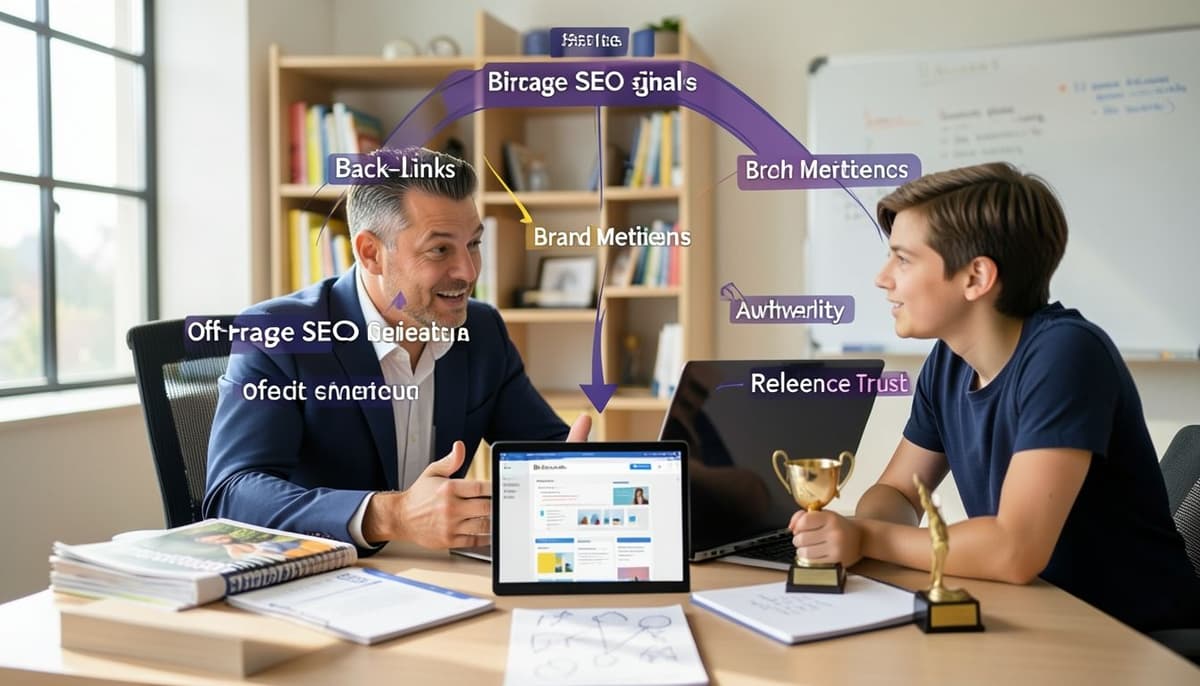
Off-Page, On-Page, and Technical SEO
On-page SEO concerns the content and elements that exist on a page, such as its subject coverage, title, headings, internal links, and usefulness to the visitor. Technical SEO concerns how effectively search engines can crawl, render, index, and understand the website. These areas are primarily controlled by the business and its implementation team. Off-page SEO concerns how external websites, organizations, experts, and audiences recognize and reference that business.
The three areas influence one another. A technically accessible website makes it easier for search engines to process the value earned through external recognition. Strong on-page content gives journalists, partners, and publishers a credible resource to cite. Off-page visibility can then bring qualified visitors and strengthen the perceived importance of the site. If one area is weak, investment in another may produce limited results. Building links to a page that is confusing, outdated, or difficult to use creates a poor experience for both the referring audience and the business.
Consider an online furniture retailer that earns coverage from a home design magazine. If the linked product category loads slowly, contains little useful information, or does not match the article’s subject, the retailer may receive less commercial value from the coverage. The right response is not simply to request more links. The business should improve the destination experience, clarify the offer, and ensure that future outreach points to pages that genuinely satisfy the audience’s intent.
Evaluating Opportunities and Making Decisions
A practical evaluation starts with relevance. Ask whether the referring website serves an audience that could reasonably care about the business, product, or topic. A cybersecurity company should generally prioritize technology publications, professional associations, business security resources, and credible educational sources over unrelated websites with impressive-looking metrics. Relevance protects the strategy from becoming a volume exercise detached from customer needs.
Next, assess editorial credibility and audience value. Review whether the site publishes original material, identifies authors, maintains clear standards, attracts a real audience, and covers the subject consistently. Third-party authority metrics can help prioritize research, but they are not final decision rules. A high score does not guarantee topical fit, editorial quality, or referral potential. A smaller but respected niche source may be more valuable than a broad site with little connection to the customer.
Finally, consider the likely business outcome and the risk. A strong opportunity may support referral traffic, expert positioning, partnerships, media visibility, or future sales conversations. A risky opportunity may involve obvious link selling, automated content, excessive unrelated outbound links, or a pattern designed mainly to manipulate rankings. The preferred decision is usually to pursue fewer opportunities with stronger audience and editorial logic, while documenting why each opportunity was accepted, rejected, or postponed.
Building a Sustainable Off-Page Program
A sustainable program begins with assets and stories that deserve external attention. These might include original research, benchmark data, expert commentary, useful tools, transparent case studies, industry explanations, or practical resources that solve a recognized problem. The asset should be created for a real audience first. Outreach becomes more credible when it offers a relevant resource instead of asking strangers to place an artificial link.
The next step is relationship development. Identify journalists, publishers, community leaders, complementary businesses, professional associations, and subject-matter experts who already communicate with the desired audience. A business can contribute expert insight, collaborate on research, answer relevant questions, or provide a useful reference. The strongest relationships are mutually beneficial and can produce mentions, referrals, partnerships, and links over time rather than one isolated placement.
Measurement should connect activity to business decisions. Track qualified referral visits, assisted conversions, branded search demand, relevant referring domains, earned mentions, visibility for priority topics, and the quality of relationships created. Do not treat every new link as a success or expect rankings to change immediately after one placement. Compare performance with the original objective, review the quality of the audience reached, and adjust the program when activity produces volume without relevance or commercial value.
The most common failure is confusing quantity with progress. Buying large batches of links, using the same outreach message everywhere, or pursuing unrelated websites can create short-term activity while weakening trust and wasting budget. Another failure is ignoring the destination page, measurement plan, or customer experience. A disciplined program combines useful content, selective outreach, credible relationships, and regular review of outcomes.
Summary
Off-page SEO strengthens search visibility by helping a business earn recognition beyond its own website. Backlinks, brand mentions, authority, relevance, and trust are related but distinct concepts. A backlink can support visibility, but its value depends on the source, context, audience, and usefulness of the destination. A brand mention can still matter when no hyperlink is present because it can build awareness, reputation, and future discovery.
Effective decision-making compares off-page opportunities with on-page quality and technical readiness. Businesses should prioritize relevant and credible sources, use third-party metrics as supporting evidence rather than absolute truth, and avoid tactics that create artificial volume. The best programs earn attention through useful assets and genuine relationships, then measure results through qualified traffic, visibility, conversions, and long-term trust rather than link counts alone.
Lesson Checkpoint