



In this eight-minute beginner lesson, learners discover how investing and trading differ in time horizon, objective, decision-making, costs, and risk. Through everyday examples, visual comparisons, and five classification exercises, learners practice choosing an approach based on their goals, available time, and risk limits using simulated money only.
Introduction: One Asset, Two Different Decisions
Imagine two people purchasing shares of the same company. One intends to keep the shares for ten years because they believe in the company's long-term prospects. The other plans to sell the shares later today after a particular price movement. Both are participating in the same market, and both could gain or lose money. Yet their decisions represent different approaches because their objectives, time horizons, and methods of evaluating success are different.

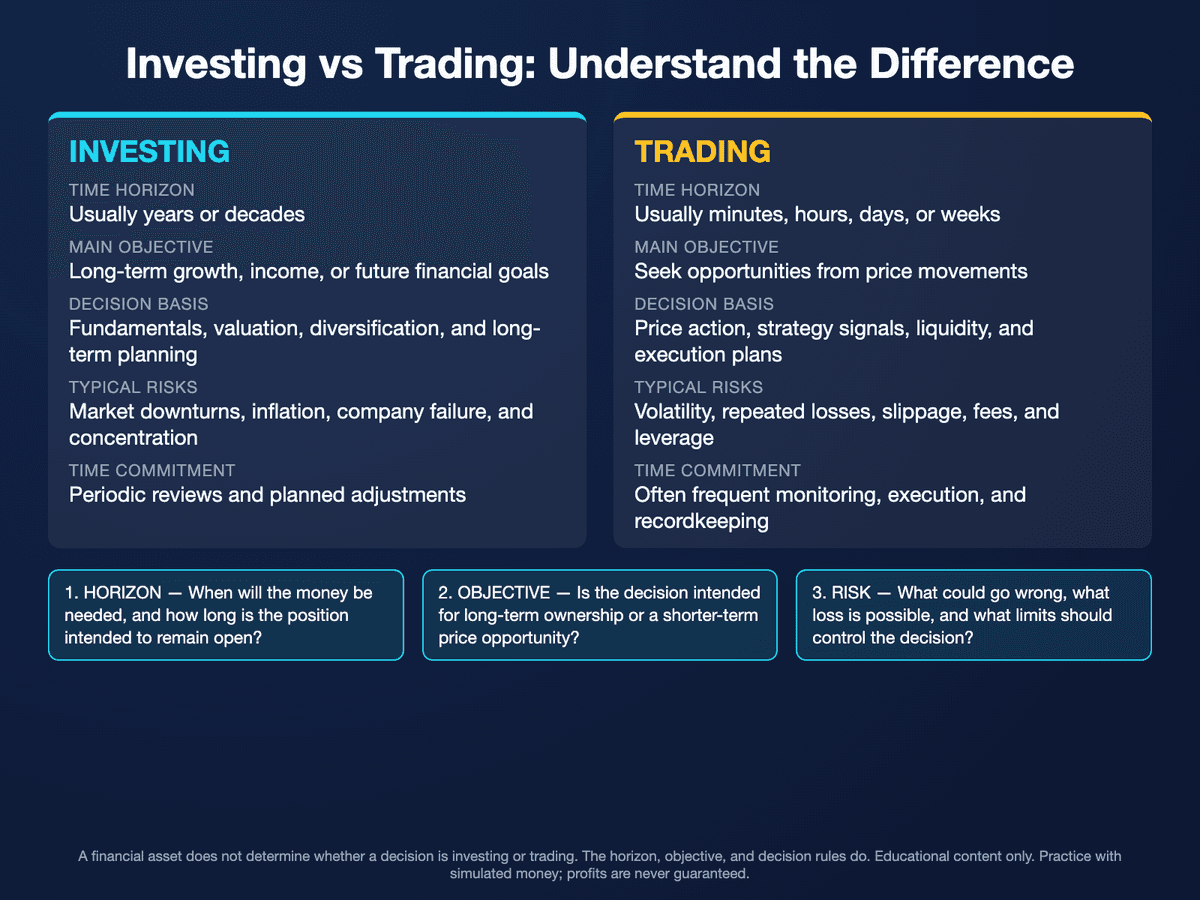
Investing generally focuses on owning financial assets to pursue longer-term goals. Trading focuses on seeking opportunities from changes in market prices, often over shorter periods. Neither method guarantees profits, and neither is automatically appropriate for every person. Throughout Multi Asset Trading Lab, you will learn how to describe these decisions clearly, evaluate their risks, and practice responsible financial reasoning using simulated money instead of real capital.

Key points
- Investing: owning assets to pursue goals that are years away.
- Trading: opening and closing positions to seek short-term price opportunities.
- Both involve risk, and neither guarantees a profit.
- Three questions guide every decision: horizon, objective and risk.
This lesson introduces three questions that will appear repeatedly throughout the course: How long is the intended time horizon? What objective is the decision trying to achieve? What risks could prevent that objective from being reached? By the end, you should be able to classify five realistic decisions as investing or trading and explain your answers in ordinary language. The goal is understanding, not predicting the next market move.

What Investing Means: Long-Term Financial Goals
Investing is the process of allocating money to assets with the expectation that they may help achieve future financial objectives. These objectives can include retirement, education expenses, long-term growth, or income. An investor usually evaluates whether the chosen assets suit the goal and how long the money can remain invested. For example, someone saving for a child's university education in ten years might develop a diversified investment plan rather than react to every daily market movement.


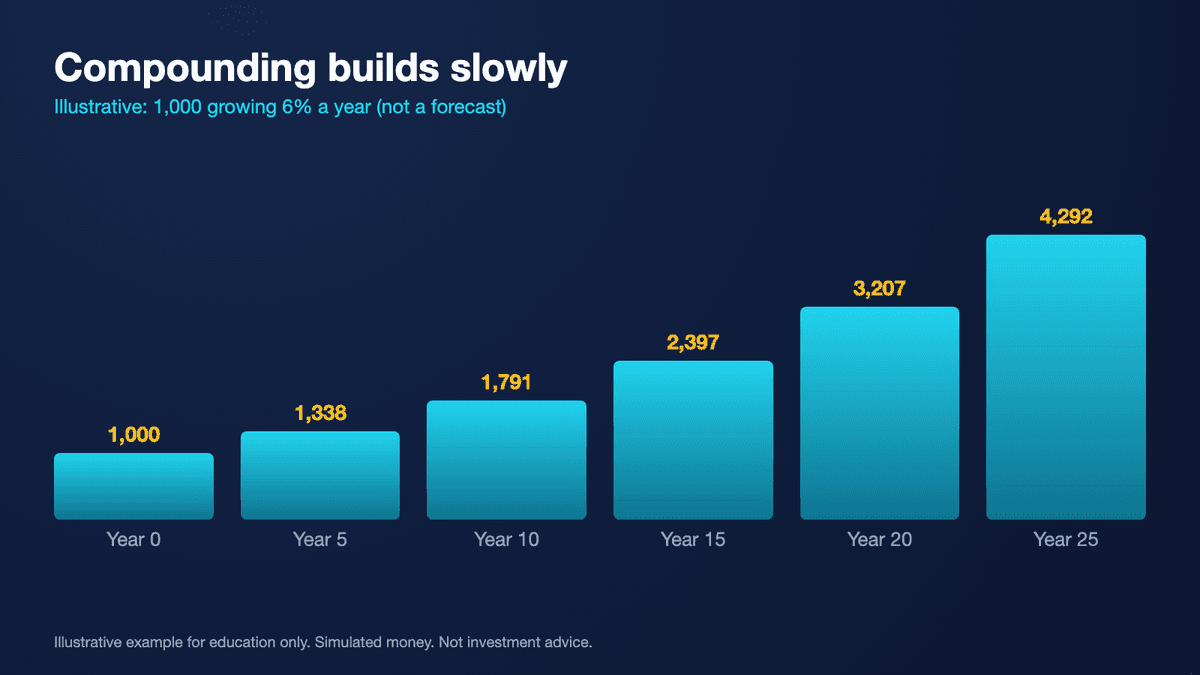
Compounding is an important concept in long-term investing. When returns remain invested, subsequent returns may be earned on a larger balance. However, compounding is not a promise of steady growth. Negative market returns, fees, taxes, and withdrawals can reduce or interrupt the process. Investors may use diversified funds to spread exposure across holdings, but diversification does not eliminate the possibility of losses or ensure that financial goals will be achieved.
Key points
- Typical investing goals: retirement, education, a home, long-term income.
- A diversified fund spreads money across many holdings.
- Compounding rewards time, but losses and fees can interrupt it.
- The shorter the deadline, the less room you have to wait out a price fall.
A retirement investor with a twenty-year horizon may tolerate some temporary price fluctuations if the overall plan remains appropriate. Someone who needs money for tuition next month faces a different situation. Their short deadline may make substantial market exposure unsuitable. Investing therefore requires more than selecting assets with attractive historical returns. It requires matching time horizon, liquidity needs, financial objectives, diversification, and the ability to withstand uncertainty.


What Trading Means: Price Movements and Execution
Trading involves opening and closing positions to seek opportunities from price movements. A trader might hold a position for minutes, hours, days, or several weeks, depending on the strategy. Unlike a long-term investor, the trader may place greater emphasis on market timing, liquidity, technical patterns, and execution. For example, a learner could use a demo account to test a strategy involving a stock's intraday price changes without exposing actual money.

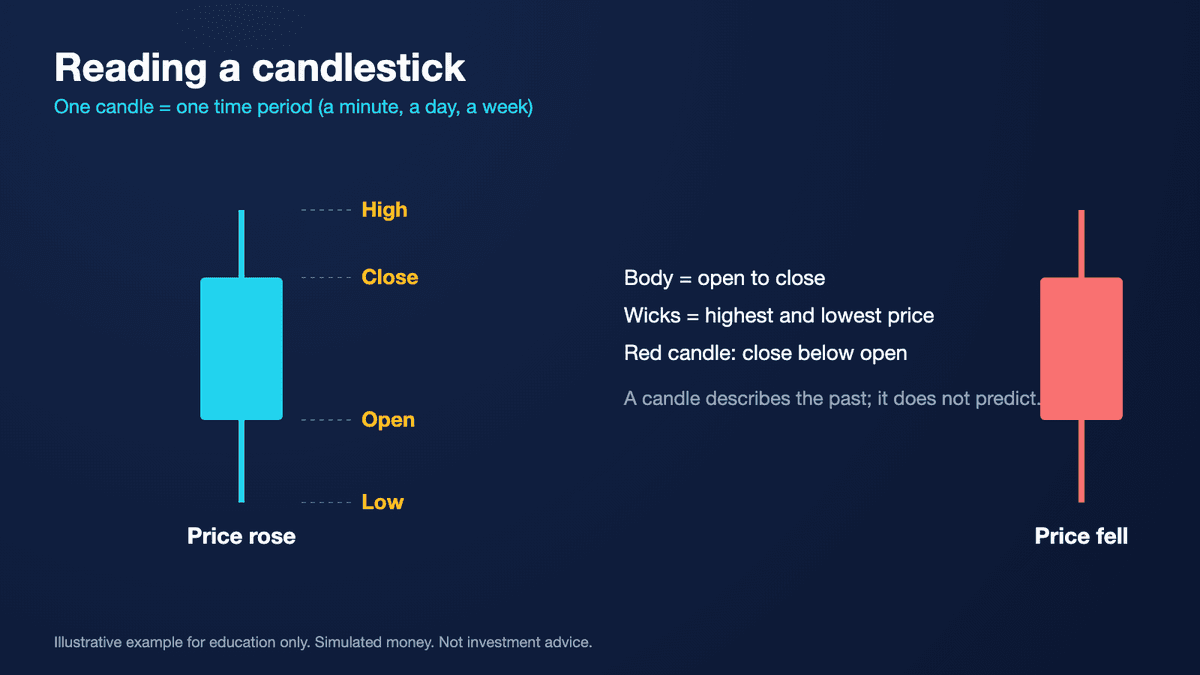
Candlestick charts are commonly used to visualize market prices. Each candle represents price behavior over a selected period, including the opening, closing, highest, and lowest prices. Candles can help traders describe market movements, but they cannot reliably predict the future on their own. A sensible trading exercise begins with a clearly defined hypothesis. The learner records why a position would be opened, what would invalidate the idea, and when the position should be closed.
Key points
- A trade can last minutes, days or weeks.
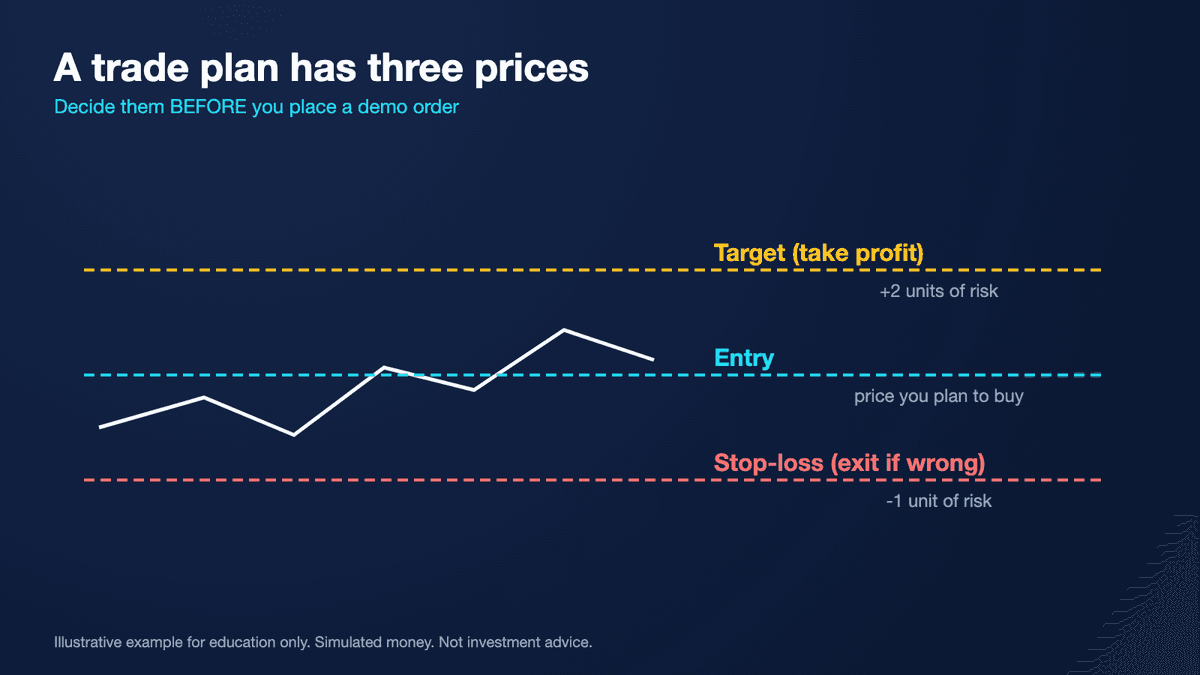
- A trade plan = entry condition + exit condition + risk limit.
- A stop-loss helps limit a loss, but a fill at the intended price is not guaranteed.
- A candlestick summarises the open, high, low and close of one period.
A basic trading plan identifies an entry condition, an exit condition, and a risk limit. A stop-loss order can be one component, although execution at the intended price is not guaranteed. The trader should also consider transaction costs, position size, and market conditions. This course approaches trading as a process of structured experimentation, measurement, and review. Demo results are learning observations, not evidence that a strategy will succeed in live markets.
Understanding Risk, Volatility, and Transaction Costs
Both investing and trading involve the possibility of financial loss. Investors face company failures, changing economic conditions, inflation, prolonged market declines, and concentration risk. Traders also face rapid price movements, repeated unsuccessful decisions, limited liquidity, and execution uncertainty. Volatility describes the degree of price fluctuation, not simply whether a market is rising or falling. Higher volatility may create larger opportunities, but it can also produce sudden losses and make planned decisions harder to execute.

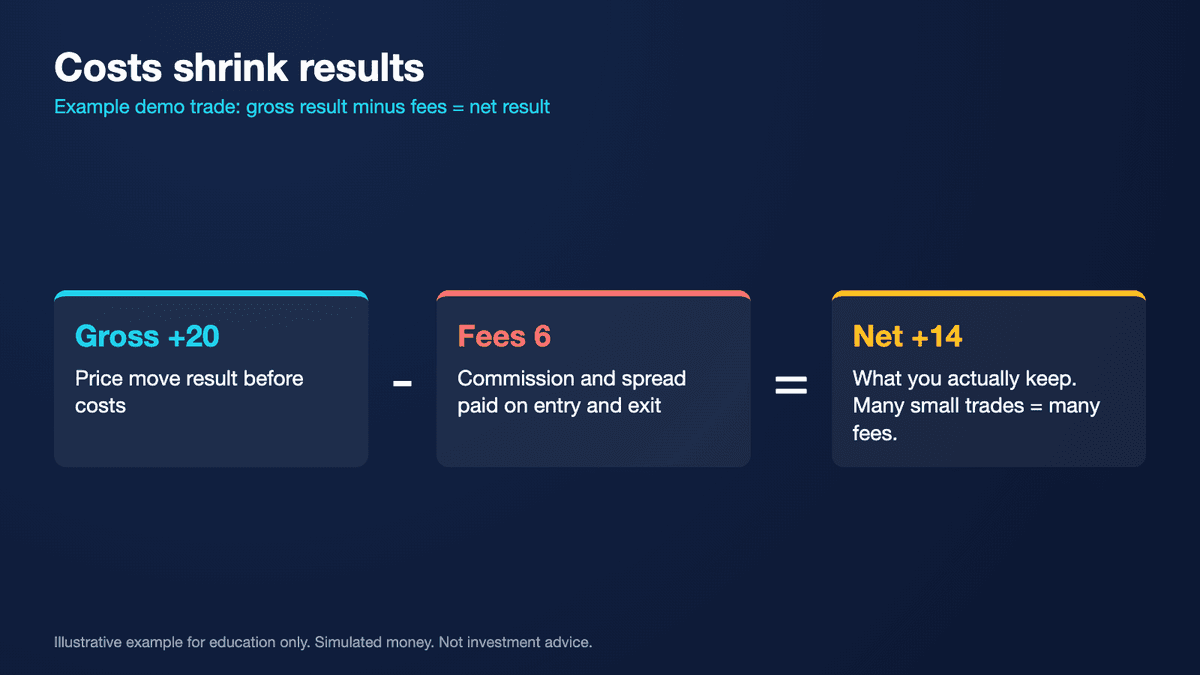
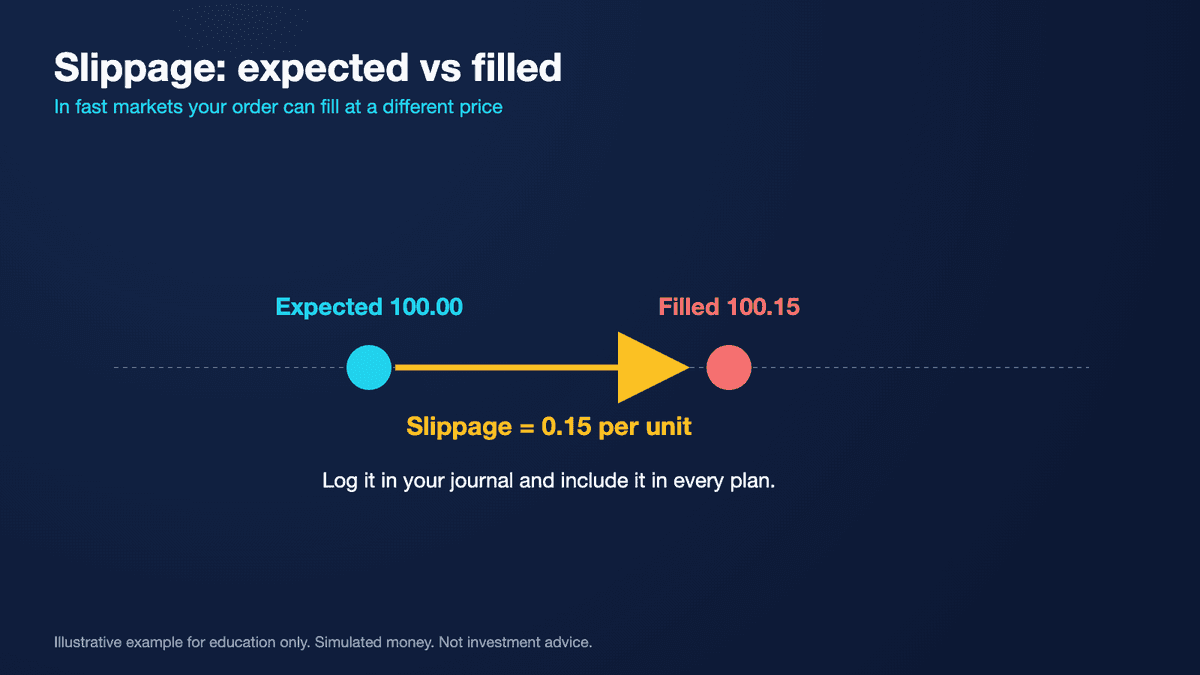
Transaction costs deserve careful attention. Brokerage commissions, trading fees, bid-ask spreads, and certain funding charges can reduce the results of a strategy. Slippage occurs when an executed price differs from the expected price. For example, a simulated order might be planned at one price but execute at a less favorable price during a fast market. Repeated transactions may magnify the effect of seemingly small costs, especially when the expected gain per trade is modest.
Key points
- Costs: commissions, bid-ask spreads and funding charges all reduce results.
- Slippage: the executed price can differ from the expected price.
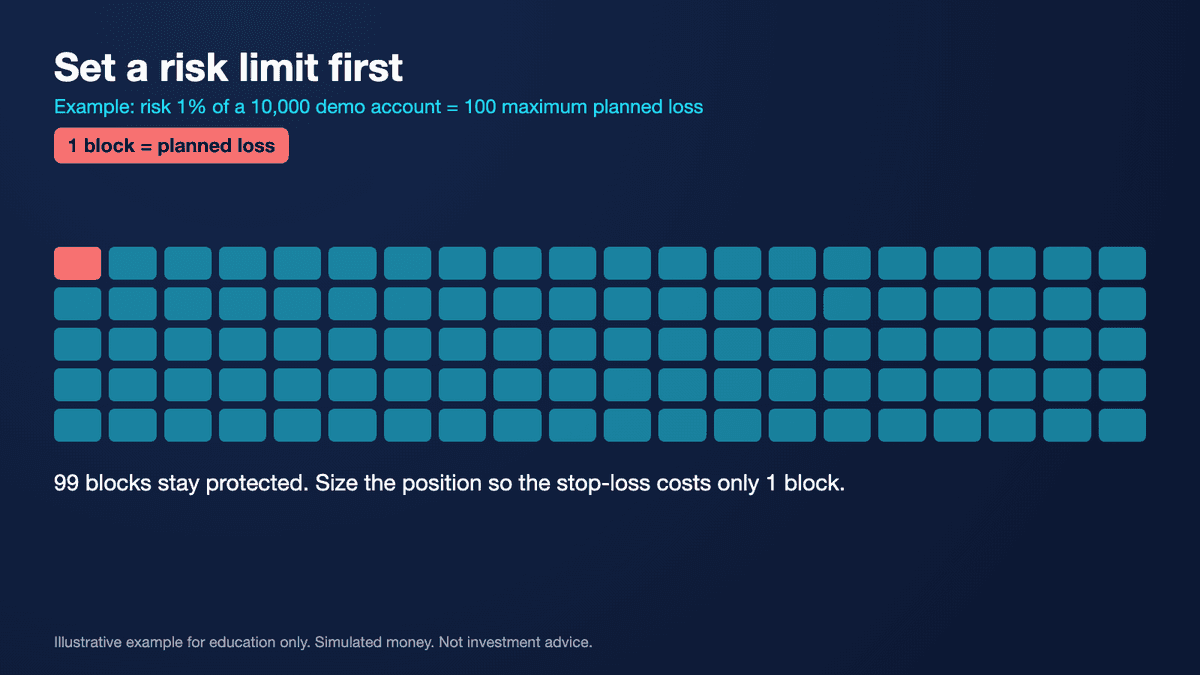
- Define the maximum planned loss before you enter any position.
- Volatility affects investors and traders alike.
Beginners should learn to define risk before evaluating potential rewards. A useful exercise asks how much simulated capital might be lost under an unfavorable scenario and whether that loss is consistent with the strategy's limits. Risk controls help organize decisions, but they do not guarantee protection from every market event. Understanding these limitations is more valuable than assuming that a sophisticated chart or attractive historical result makes a financial decision safe.
Leverage, Emotions, and Trading Discipline
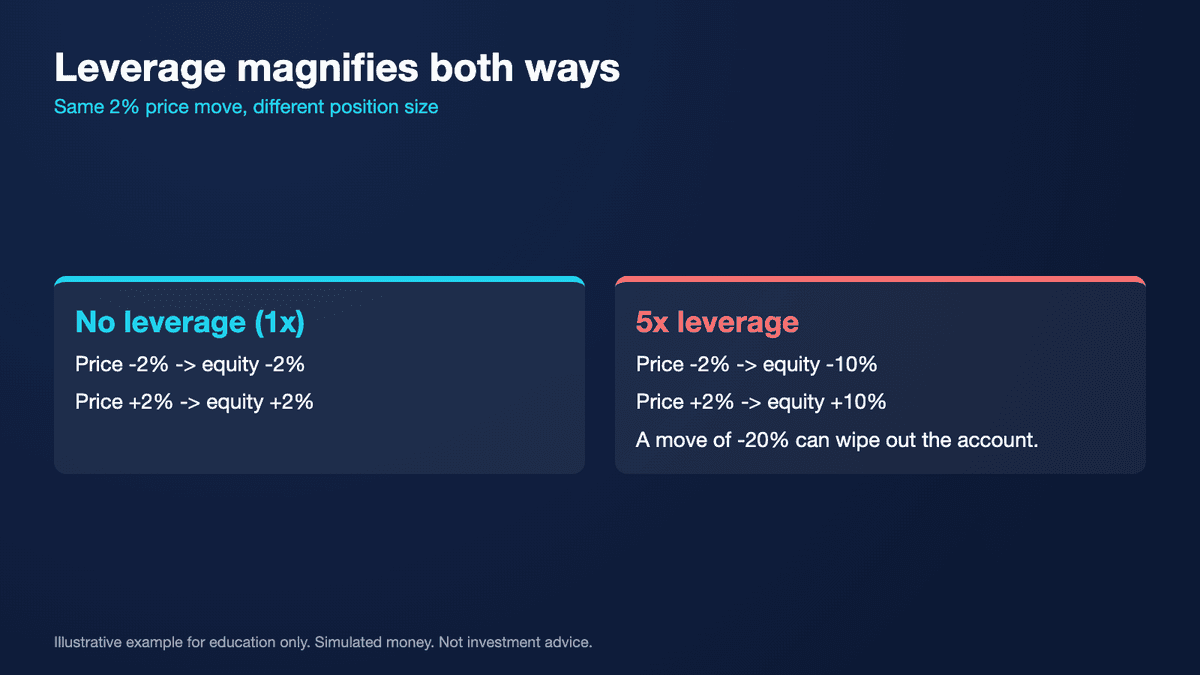
Leverage allows a market position to have greater exposure than the capital directly committed to it. This can magnify gains, but it also magnifies losses. An unfavorable price movement may rapidly consume the available margin and trigger liquidation. Depending on the financial product and account structure, losses can sometimes exceed an initial deposit. In this beginner course, leverage is studied conceptually through simulations rather than encouraged as a method for increasing returns.
Financial decisions are influenced by emotions. Fear may cause a person to abandon a reasonable plan, while excitement may encourage excessive position sizes or impulsive entries. After several losses, a trader might attempt to recover money quickly through increasingly risky positions. This behavior is often called revenge trading. A written process can reduce the influence of these reactions by defining the conditions for taking action before emotional pressure becomes intense.

Key points
- Leverage means more exposure than the capital you commit, so losses grow as well as gains.
- Fear can make you abandon a sound plan; excitement can make you oversize.
- Revenge trading, trying to win back losses quickly, is a classic mistake.
- Discipline: follow the plan, respect limits, review mistakes calmly.
Discipline means following an appropriate plan, respecting risk limits, and reviewing mistakes constructively. It does not mean that every trade will succeed or that feelings can be completely eliminated. A trading journal supports disciplined learning by recording the reason for a decision, its intended risk, the outcome, and any deviation from the original plan. A responsible beginner values consistency and honest evaluation more than impressive short-term simulated profits.

The Same Asset Can Be Invested In or Traded
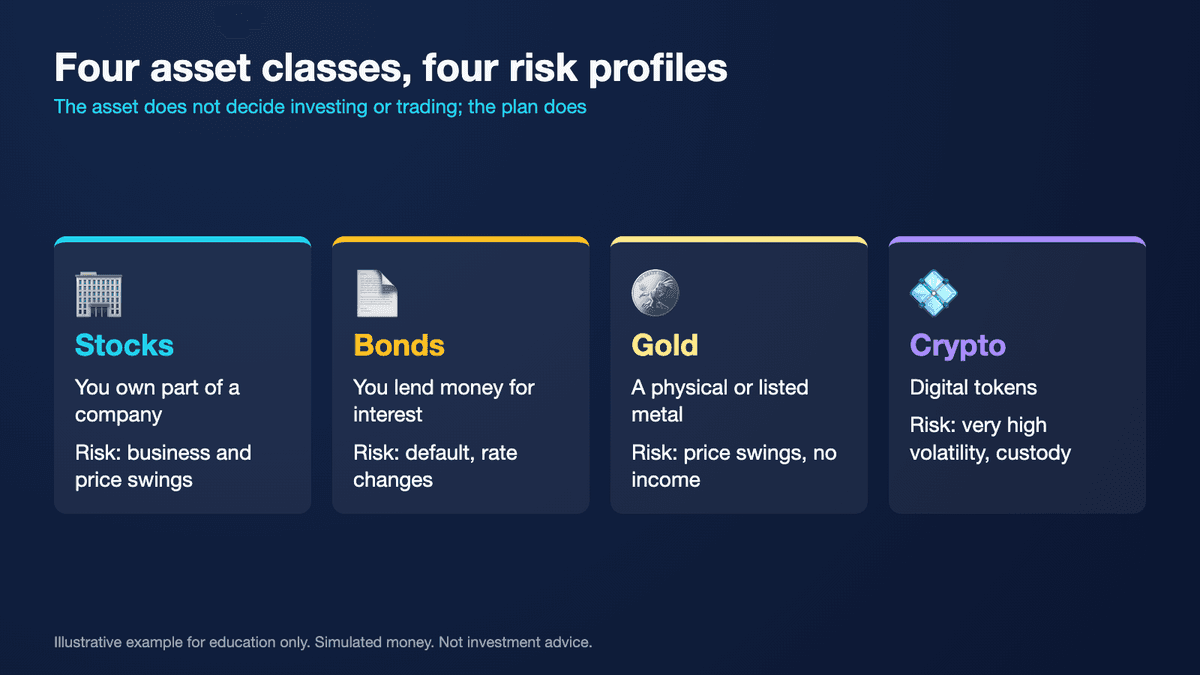
Stocks, bonds, gold, and cryptocurrency are examples of financial asset classes or instruments that learners may encounter. Their structures and risks differ, and not every instrument is appropriate for every objective. However, the asset's name alone does not determine whether a decision is investing or trading. What matters is why the position exists, how long it is intended to remain open, which evidence supports it, and what rules govern its management.
Consider gold. One person might maintain a modest long-term gold allocation as part of a broader portfolio. Another might practice a two-day gold price strategy in a demo account. Both observe the same underlying market, but their objectives and decision rules differ. Similarly, a company's shares might be purchased for long-term ownership or used to test an intraday trading pattern. The classification follows the purpose and structure of the decision.
Key points
- The asset does not decide whether you invest or trade; your plan does.
- The same gold can be a small long-term allocation or a two-day demo strategy.
- The time and attention you have available are part of the decision.
The amount of time available also matters. Investing can still require careful research and periodic review, while active trading may demand frequent monitoring, rapid execution, and detailed recordkeeping. A person with limited daily availability might struggle to maintain a strategy requiring constant attention. Before choosing any approach for a simulated exercise, consider the necessary knowledge, available time, expected costs, emotional demands, and the consequences of unfavorable outcomes.

The Decision Framework: Horizon, Objective, Risk, and Journaling
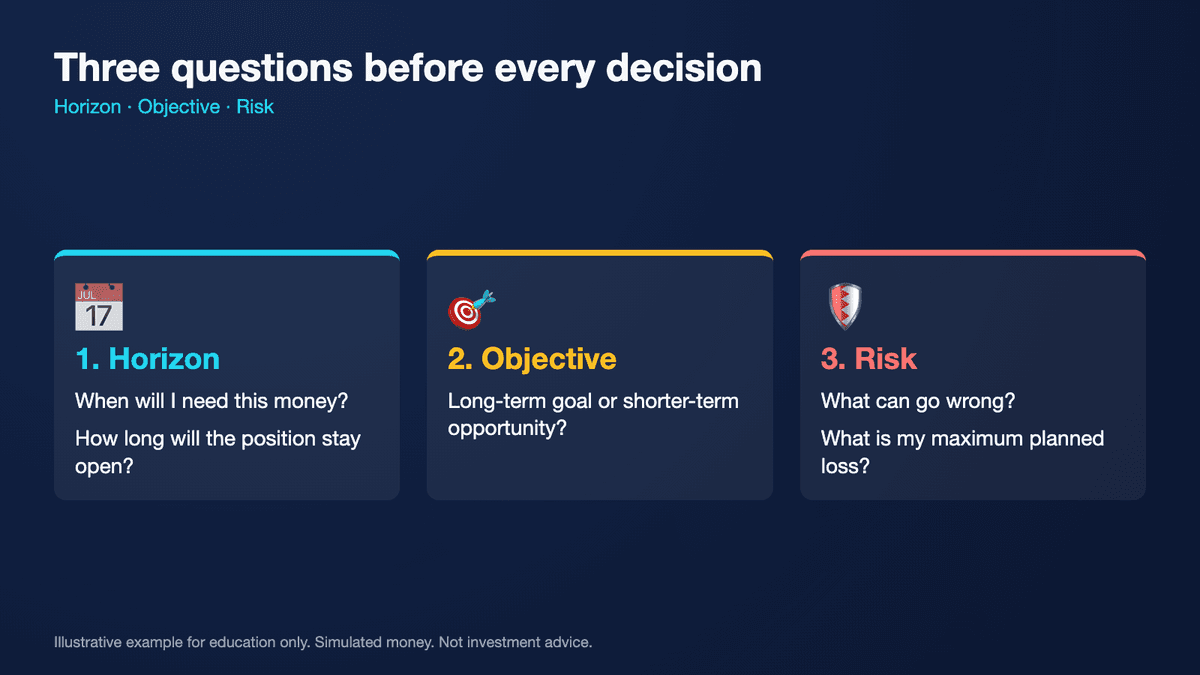
Use the Horizon-Objective-Risk framework whenever you examine a financial decision. First, identify the horizon: is the position intended to last hours, days, months, or years? Second, identify the objective: long-term ownership, future income, savings for a planned expense, or a shorter-term price opportunity? Third, evaluate the risk: what can go wrong, how substantial might the loss be, and what rules would limit exposure? These questions form a practical foundation for clear classification.
A journal turns these questions into a repeatable habit. Before a simulated decision, record the asset, intended horizon, objective, reason, risk limit, and planned review point. Afterward, document what happened and whether the original rules were followed. Separate the quality of the decision from the financial outcome. A profitable simulated trade may still involve poor reasoning, while a losing trade may have followed a coherent and appropriately controlled plan.

Key points
- Step 1, Horizon: will the position last hours, days, months or years?
- Step 2, Objective: long-term ownership or a shorter-term price opportunity?
- Step 3, Risk: what could go wrong, and what loss is acceptable?
- Journal: record asset, horizon, objective, reason, risk limit and review date.
Demo accounts provide a useful environment for learning the mechanics of orders, markets, and strategy testing. Whenever possible, include simulated commissions, spreads, and slippage so results reflect practical limitations. Remember that simulated execution, emotional pressure, and liquidity conditions may differ from live trading. Keep a decision checklist nearby, and review your journal regularly. The objective is to understand behavior and improve the process, not to manufacture attractive performance statistics.

Practice: Classify Five Decisions and Review Your Learning
Read each scenario. Before revealing the answer, choose Investing or Trading, identify the expected holding period, and explain the main objective. All decisions are hypothetical and use simulated assets.

- Decision 1: Emma creates a simulated portfolio of diversified index funds that she intends to hold for 20 years while studying long-term retirement planning. — Is Emma investing or trading?
- Decision 2: Noah opens a demo Bitcoin position after a technical breakout and plans to close it within four hours using predefined exit rules. — Is Noah investing or trading?
- Decision 3: Sofia buys simulated shares of a profitable company and plans to review the business annually while holding the shares for at least seven years. — Is Sofia investing or trading?
- Decision 4: Liam opens a simulated crude oil position before a scheduled market report and plans to exit the same day according to his trading rules. — Is Liam investing or trading?
- Decision 5: Ava allocates simulated savings to a diversified bond fund and plans to hold it for five years while studying capital preservation and income. — Is Ava investing or trading?
Answer key
For your checkpoint, write one imaginary financial decision and explain its horizon, objective, and main risk in three short sentences. Then classify it as investing or trading. Your answer should show that you understand the difference between long-term ownership and short-term price opportunities. It should also acknowledge that either approach can produce losses. Practice with simulated money only; this lesson is educational and does not provide personal investment recommendations.

Investing vs trading at a glance
Key terms
- Horizon: how long you intend to hold a position or keep the money invested.
- Objective: what the decision is meant to achieve: a long-term goal or a shorter-term opportunity.
- Diversification: spreading money across different holdings to reduce concentration risk.
- Compounding: earning returns on earlier returns when gains stay invested; never guaranteed.
- Candlestick: a chart symbol showing open, high, low and close for one period.
- Stop-loss: a planned exit level meant to limit a loss; fills are not guaranteed.
- Volatility: how strongly and unpredictably prices move up and down.
- Slippage: the difference between the expected price and the executed price.
- Leverage: exposure larger than the capital committed; it magnifies gains and losses.
- Demo account: a practice account using simulated money, ideal for learning mechanics.
Educational content only, not financial or investment advice. All examples, portfolios, and trades are hypothetical and must be practiced using demo or simulated funds only. Investing and trading can both result in losses. Past performance does not guarantee future results.
Lesson Checkpoint
Review what you learned and get feedback on your work.