



Contract Structure and Standardization
A futures contract is a standardized agreement to buy or sell an underlying asset at a specified price, with settlement tied to a defined future date. The exchange determines the contract specifications, while traders choose the price and whether to take a long or short position. Standardization makes contracts interchangeable and allows positions to be closed before expiration.
The key specifications are the underlying asset, contract size or multiplier, price quotation, minimum tick, tick value, expiration month, trading hours, and settlement method. For example, an E-mini S&P 500 futures contract has a $50 index multiplier and a minimum price movement of 0.25 index points. Its tick value is therefore 0.25 points × $50 per point = $12.50. If the quoted futures price is 5,000, one contract represents a notional value of 5,000 × $50 = $250,000.
Notional value is the market exposure controlled by the contract; it is not normally the cash paid to open the position. Instead, the trader posts margin as performance collateral. If initial margin were assumed to be $12,500, controlling $250,000 of notional exposure would imply notional leverage of $250,000 ÷ $12,500 = 20 times. Actual margin requirements vary by contract, broker, volatility, and account type.
Long and Short Positions
A trader who goes long benefits when the futures price rises. A trader who goes short benefits when the futures price falls. Unlike buying an asset in the cash market, opening a short futures position does not require first borrowing the underlying asset. The futures contract directly creates opposite obligations for the long and short sides.
For a long position, profit or loss equals exit price minus entry price, multiplied by the contract multiplier and number of contracts. For a short position, the sign reverses: profit or loss equals entry price minus exit price, multiplied by the multiplier and number of contracts. These calculations exclude commissions, exchange fees, slippage, and financing effects.
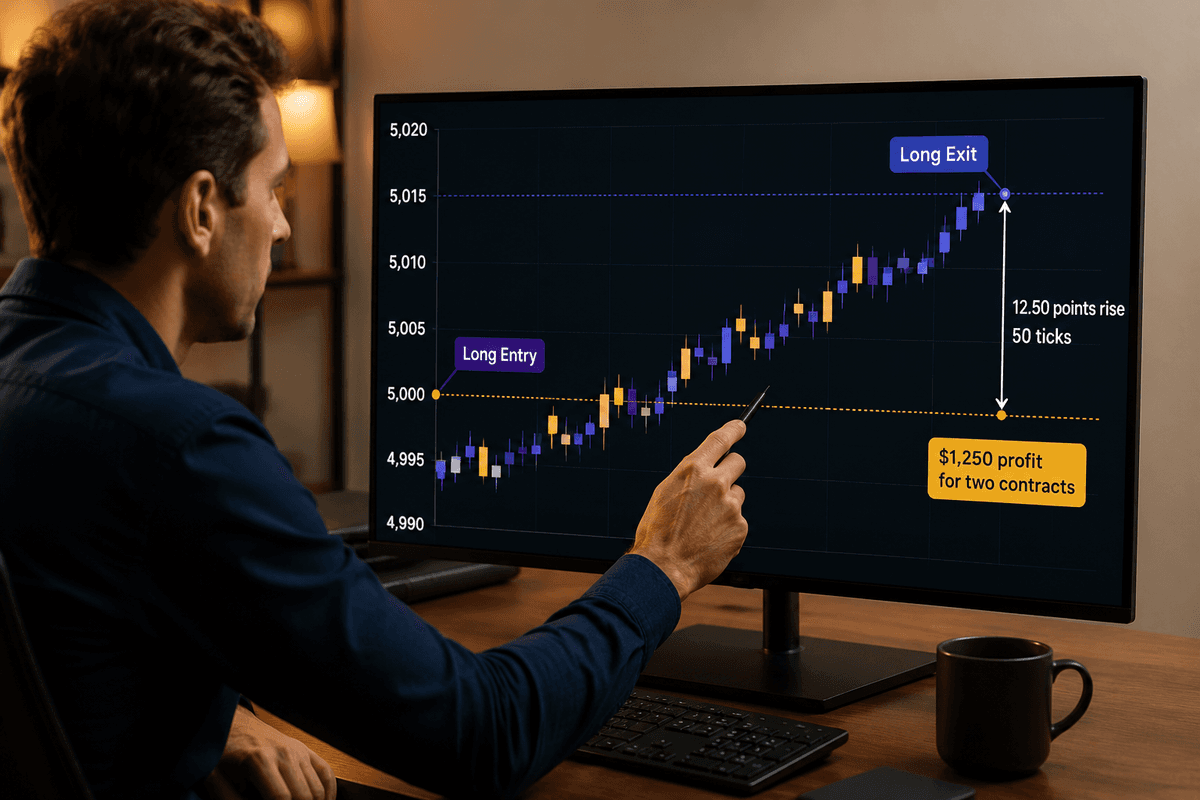
Assume a trader buys two E-mini S&P 500 contracts at 5,000 and closes them at 5,012.50. The market moved 12.50 index points. Profit equals 12.50 points × $50 per point × 2 contracts = $1,250. The same move contains 12.50 ÷ 0.25 = 50 ticks, so profit can also be calculated as 50 ticks × $12.50 per tick × 2 = $1,250.
If the trader had instead sold two contracts at 5,000 and bought them back at 5,012.50, the loss would be $1,250. Direction changes the sign of profit and loss, but the dollar sensitivity per point remains $50 per contract.
Mark-to-Market, Settlement, and Expiration
Futures accounts are generally marked to market daily. The clearing system credits gains and debits losses using the exchange’s daily settlement price. Suppose one long contract is entered at 5,000. If the first settlement price is 5,006, the daily gain is 6 points × $50 = $300. If the next settlement price is 4,998, that day’s change is negative 8 points, producing a debit of 8 × $50 = $400. The cumulative result is $300 minus $400 = negative $100, matching the total move from 5,000 to 4,998.
Margin is not a maximum-loss amount. If account equity falls below the maintenance margin requirement, the trader may need to deposit funds or reduce the position. Because losses are settled as prices move, a leveraged position can create cash demands before the contract expires.
Each contract has an expiration schedule. Traders who do not want settlement normally offset the position or roll it into a later expiration month. Offsetting means taking the opposite position in the same contract month. Rolling means closing the nearby contract and opening a later-dated contract; the price difference between those contracts can create an additional gain or loss.
At expiration, some futures use physical delivery, while others use cash settlement. Physical delivery follows exchange procedures for transferring a deliverable asset or warehouse documentation. Cash-settled contracts use a final reference value to calculate the remaining monetary difference. Traders must verify the specific contract’s last trading day, notice dates, delivery rules, and final settlement procedure rather than assuming all futures behave identically.
Practical Position Check
Before entering a futures trade, translate the quote into dollar exposure. Confirm the multiplier, tick size, tick value, number of contracts, notional value, and loss at the intended stop. For three contracts with a $50 multiplier and a 7-point adverse move, planned price risk is 7 × $50 × 3 = $1,050 before costs and slippage. The same position controls three × 5,000 × $50 = $750,000 of notional exposure when the index is at 5,000.
A complete position check also identifies the exact expiration month and settlement type. Contract specifications should always be verified with the relevant exchange and broker because similarly named products may have different multipliers, ticks, margin requirements, and expiration procedures. Futures mechanics become manageable when every price movement is converted into ticks, dollars, margin impact, and a defined exit obligation.
Lesson Checkpoint